
Understanding how to adjust your driving behavior in poor weather is a core competency for the French Code de la route. This guide covers the specific legal obligations for light usage and distance management, helping you recognize correct behaviors to select during your ETG theory test.
Article content overview
Navigating the roads of France requires a solid grasp of how environmental factors influence vehicle handling and legal responsibilities. For those preparing for the Code de la route (French driving theory exam), understanding the specific rules for driving in rain and fog is not just a safety requirement—it is a mandatory component of your ETG (Épreuve Théorique Générale) success. The French regulations emphasize proactive behavior and anticipation, particularly when adhesion is reduced due to water or poor visibility limits your reaction time.
One of the most common topics tested in the French theory exam involves the correct usage of vehicle lighting when conditions deteriorate. In France, the law is strict about when and how you must use your lights to ensure you remain visible to others and can see the road ahead. Simply turning on your headlights is often not enough; you must distinguish between light rain, heavy rain, and fog.
The primary lights used to illuminate the road ahead without dazzling other drivers. In France, these are mandatory at night, in tunnels, and during periods of poor visibility such as heavy rain or fog.
When rain is falling, dipped headlights are mandatory to ensure your vehicle is seen by oncoming traffic. If visibility drops significantly due to thick fog or heavy rain, you may be required to use front fog lights to improve your view of the road markings. However, rear fog lights are strictly reserved for fog or falling snow; using them during heavy rain is prohibited because the intense red glare can dazzle the driver behind you, potentially causing an accident.
On a dry road, the minimum safety distance is equivalent to the distance covered by the vehicle in two seconds. When it rains, the water film between your tires and the road surface—often referred to as aquaplanage or hydroplaning—drastically increases your braking distance. The French Code de la route dictates that you must increase your following distance to compensate for this loss of adhesion.
In your ETG exam, if you are presented with a scenario featuring a wet road, the only correct answer regarding following distance is to increase it. Never choose to "keep the same distance as when the road is dry," as this is a fundamental safety error that the examiners actively flag.
To help you remember these behaviors, consider the following key terms which frequently appear in official French examination banks:
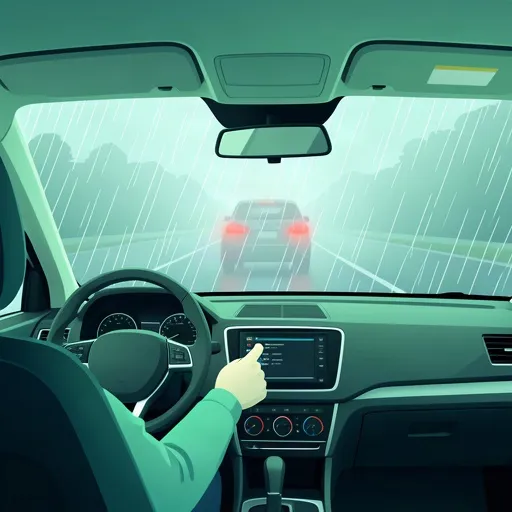
When you are taking your theory test, you will likely encounter scenarios depicting various weather conditions. You must assess the scene quickly: look for water spray, reflections on the asphalt, and the behavior of other drivers. If the scene shows heavy rain, check the lighting status of the vehicles in the picture. If the rear fog lights are on during heavy rain, that vehicle is in violation of the law.
| Weather Condition | Front Lights | Rear Lights | Speed Adjustment |
|---|---|---|---|
| Normal daylight | Day running lights | Normal | Normal limit |
| Heavy rain | Dipped headlights | Fog lights prohibited | Reduced |
| Fog / Snow | Dipped headlights | Rear fog lights | Strongly reduced |
Always remember that as a driver in France, your responsibility is to adapt your driving style to the environment. The Code de la route places a high value on "defensive driving" (conduite défensive). In every question about weather, your priority is to select the option that maximizes distance, reduces speed, and ensures proper light configuration.
This article covers the essential French Code de la route rules for driving in adverse weather, focusing on proper light usage and safety distances. Key legal distinctions are explained: dipped headlights are mandatory in rain and fog, front fog lights improve road visibility in thick conditions, but rear fog lights are restricted to fog or snow only. The braking distance increases significantly on wet roads due to reduced adhesion, requiring drivers to extend their following distance beyond the standard two-second rule. For ETG exam preparation, learners should memorize that weather scenarios always require selecting answers that maximize distance, reduce speed, and configure lights appropriately for the specific condition shown.
A short set of high-value points that capture the most important ideas from this article.
Rear fog lights (feux de brouillard) are strictly prohibited during heavy rain; they may only be used in fog or falling snow to avoid dazzling following drivers
When adhesion is reduced by rain, you must increase your following distance beyond the standard two-second rule to compensate for longer braking distances
Dipped headlights (feux de croisement) are mandatory during heavy rain or fog regardless of time of day to ensure visibility to other road users
Front fog lights may be used in thick fog or heavy rain to improve your view of road markings, but rear fog lights require a different legal threshold
In every ETG weather scenario, correct answers prioritize increasing distance, reducing speed, and proper light configuration over maintaining normal driving behavior
Adhérence decreases when roads are wet, which directly increases your stopping distance and requires proactive speed reduction
Aquaplanage (aquaplanage) occurs when a water film separates your tires from the road, causing total loss of steering and braking control
The two-second safety distance on dry roads must be extended in wet conditions; the ETG exam treats 'keeping the same distance' as a fundamental error
Light configuration rules vary by condition: day running lights for normal daylight, dipped headlights for heavy rain, and rear fog lights only for fog or snow
Defensive driving (conduite défensive) in France means anticipating hazards before they become critical, especially in poor visibility
Selecting the same following distance in wet conditions as on dry roads, which ignores the reduced adhesion and longer braking distance
Choosing to use rear fog lights during heavy rain, not realizing this is prohibited because the intense red glare can dazzle drivers behind you
Failing to turn on dipped headlights during heavy rain because it is daytime, not understanding that light usage is tied to visibility conditions not time of day
Assuming front and rear fog lights can be used interchangeably; rear fog lights have a specific legal threshold (fog or snow only) that differs from front fog lights
Not adjusting speed when visibility is reduced, forgetting that speed reduction is a legal and safety requirement under the Code de la route in poor weather
Article content overview
A short set of high-value points that capture the most important ideas from this article.
Rear fog lights (feux de brouillard) are strictly prohibited during heavy rain; they may only be used in fog or falling snow to avoid dazzling following drivers
When adhesion is reduced by rain, you must increase your following distance beyond the standard two-second rule to compensate for longer braking distances
Dipped headlights (feux de croisement) are mandatory during heavy rain or fog regardless of time of day to ensure visibility to other road users
Front fog lights may be used in thick fog or heavy rain to improve your view of road markings, but rear fog lights require a different legal threshold
In every ETG weather scenario, correct answers prioritize increasing distance, reducing speed, and proper light configuration over maintaining normal driving behavior
Adhérence decreases when roads are wet, which directly increases your stopping distance and requires proactive speed reduction
Aquaplanage (aquaplanage) occurs when a water film separates your tires from the road, causing total loss of steering and braking control
The two-second safety distance on dry roads must be extended in wet conditions; the ETG exam treats 'keeping the same distance' as a fundamental error
Light configuration rules vary by condition: day running lights for normal daylight, dipped headlights for heavy rain, and rear fog lights only for fog or snow
Defensive driving (conduite défensive) in France means anticipating hazards before they become critical, especially in poor visibility
Selecting the same following distance in wet conditions as on dry roads, which ignores the reduced adhesion and longer braking distance
Choosing to use rear fog lights during heavy rain, not realizing this is prohibited because the intense red glare can dazzle drivers behind you
Failing to turn on dipped headlights during heavy rain because it is daytime, not understanding that light usage is tied to visibility conditions not time of day
Assuming front and rear fog lights can be used interchangeably; rear fog lights have a specific legal threshold (fog or snow only) that differs from front fog lights
Not adjusting speed when visibility is reduced, forgetting that speed reduction is a legal and safety requirement under the Code de la route in poor weather
Explore related topics, search based questions, and concepts that learners often look up when studying Driving in Rain and Fog. These themes reflect real search intent and help you understand how this topic connects to wider driving theory knowledge in France.
Find clear and practical answers to common questions learners often have about Driving in Rain and Fog. This section helps explain difficult points, remove confusion, and reinforce the key driving theory concepts that matter for learners in France.
Front fog lights may be used in addition to or instead of dipped headlights during heavy rain, fog, or snowfall. Rear fog lights are mandatory only in thick fog or falling snow, and you must switch them off if visibility improves to avoid dazzling other drivers.
Water on the road reduces tyre adhesion and significantly increases your braking distance. Increasing the safety gap is a mandatory defensive driving practice to ensure you have enough space to stop safely if the vehicle in front brakes suddenly.
Yes, dipped headlights are mandatory in heavy rain to ensure you are visible to others, but they may be supplemented by front fog lights to improve your own visibility of the road ahead.
Continue your preparation for the French permis de conduire exam. Dive deeper into specific Code de la route sections, practice scenarios, or review official procedures. Use our comprehensive article collection to master every aspect of driving theory.