Navigating intersections in France requires a precise understanding of the hierarchy of priority rules and road signage. This guide clarifies the differences between right-hand priority and mandated yield signs like Cédez le Passage, ensuring you are fully prepared for critical ETG exam questions.
Article content overview
Navigating the roads of France requires a comprehensive understanding of the Code de la route. For learners preparing for the Épreuve Théorique Générale (ETG), mastering the hierarchy of intersections is perhaps the most critical step to avoiding failures. While many new drivers focus on speed limits or parking, the reality is that misinterpreting priority rules—such as the classic priorité à droite or the nuances of a Cédez le passage—remains one of the most common reasons for errors during the theory exam.
In the French theory exam, you must realize that road signs do not always dictate every action. When no specific sign is present, the default rule in France is to yield to the right, known as priorité à droite. This rule applies at all intersections unless indicated otherwise by signs, road markings, or traffic lights.
When you approach an intersection, your first scan should be for regulatory signs. If you see a warning sign or a regulatory sign, the priorité à droite is effectively cancelled or replaced. It is important to remember that in France, the absence of signage does not mean the road is automatically yours. Always scan for potential hazards entering from side streets to your right, even if they appear to be moving slower than you.
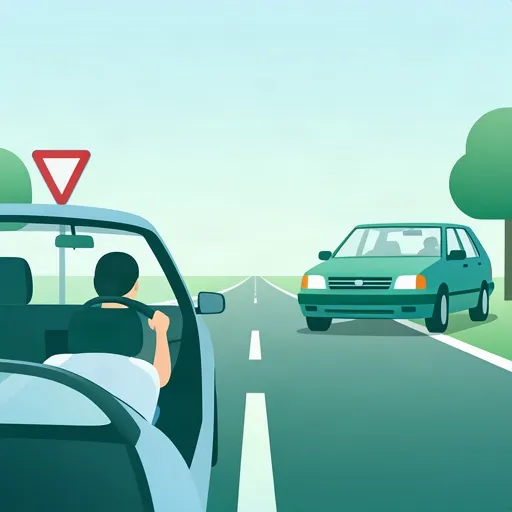
The French system uses distinct signs to manage traffic flow, and understanding their legal implications is vital for the ETG. While both the Stop and the Cédez le passage require you to yield, they demand different physical behaviors from the driver.
A major point of confusion for learners in France involves the difference between a giratoire (roundabout) and a traditional carrefour à sens giratoire. In a modern giratoire, drivers already inside the circle have priority, and you must yield to those coming from your left. This is marked by the Cédez le passage sign and shark-teeth markings on the ground.
Never assume you have the right of way in a roundabout. If you see the yield sign (triangle with a red border) and the white triangular markings on the road, you are legally obligated to wait for traffic already in the circle, even if the intersection seems large.
| Sign/Situation | Action Required | Priority Status |
|---|---|---|
| Unmarked intersection | Yield to the right | Priority to the right |
| Cédez le passage | Slow/Stop if needed | Yield to cross traffic |
| Stop | Mandatory full stop | Yield to cross traffic |
| Priority Road sign | Maintain caution | You have priority |
The Code de la route exams are designed to test your attention to detail. A common trap in the ETG involves "Priority Roads" that change direction. Always look for the small supplementary sign under the main priority sign, which shows, via a thick black line, which direction the priority road takes at an intersection. If you follow the main road but the "Priority" line turns to a side street, you lose your right of way if you continue straight.
French priority rules center on the default priorité à droite at unmarked intersections, where you must yield to vehicles from your right. Regulatory signs like Cédez le passage and Stop override this default and require different actions - slowing and preparing to stop versus mandatory full stops respectively. Roundabouts (giratoires) operate on a left-yield principle where circulating traffic has priority. Always scan for supplementary signs on priority roads, as the thick black directional line shows exactly where priority extends, and losing that line means losing your right of way if you continue straight.
A short set of high-value points that capture the most important ideas from this article.
Priorité à droite is the default rule at unmarked French intersections - always yield to vehicles approaching from your right
Cédez le passage requires you to slow down and be prepared to stop, but you may proceed without a full halt if the way is clear
Stop signs legally mandate a complete halt behind the stop line before you can proceed
Inside a giratoire (roundabout), drivers already in the circle have priority and you must yield to traffic approaching from your left
Road signs and markings override the default priorité à droite rule entirely
Without signs, markings, or traffic lights, priorité à droite always applies at intersections
Cédez le passage is a downward-pointing red-bordered triangle requiring readiness to stop
Stop is an octagonal red sign requiring a mandatory complete stop behind the line
A priority road sign with a directional arrow shows which direction the priority extends
Shark-teeth road markings at a giratoire confirm you must yield to traffic already inside
Assuming priority à droite applies when yield signs are present - signs cancel the default rule
Confusing a giratoire with a traditional intersection, leading to incorrect yielding direction
Continuing straight on a priority road without noticing the priority line turns onto a side street
Rolling through a Stop sign instead of completing a full halt behind the line
Failing to check for vehicles emerging from the right at seemingly quiet unmarked intersections
Article content overview
A short set of high-value points that capture the most important ideas from this article.
Priorité à droite is the default rule at unmarked French intersections - always yield to vehicles approaching from your right
Cédez le passage requires you to slow down and be prepared to stop, but you may proceed without a full halt if the way is clear
Stop signs legally mandate a complete halt behind the stop line before you can proceed
Inside a giratoire (roundabout), drivers already in the circle have priority and you must yield to traffic approaching from your left
Road signs and markings override the default priorité à droite rule entirely
Without signs, markings, or traffic lights, priorité à droite always applies at intersections
Cédez le passage is a downward-pointing red-bordered triangle requiring readiness to stop
Stop is an octagonal red sign requiring a mandatory complete stop behind the line
A priority road sign with a directional arrow shows which direction the priority extends
Shark-teeth road markings at a giratoire confirm you must yield to traffic already inside
Assuming priority à droite applies when yield signs are present - signs cancel the default rule
Confusing a giratoire with a traditional intersection, leading to incorrect yielding direction
Continuing straight on a priority road without noticing the priority line turns onto a side street
Rolling through a Stop sign instead of completing a full halt behind the line
Failing to check for vehicles emerging from the right at seemingly quiet unmarked intersections
Explore related topics, search based questions, and concepts that learners often look up when studying French Priority Rules Explained. These themes reflect real search intent and help you understand how this topic connects to wider driving theory knowledge in France.
Find clear and practical answers to common questions learners often have about French Priority Rules Explained. This section helps explain difficult points, remove confusion, and reinforce the key driving theory concepts that matter for learners in France.
When you approach an intersection without specific signs or markings, priority to the right (priorité à droite) applies, meaning you must yield to vehicles coming from your right.
A 'Cédez le passage' sign means 'yield the right of way'. You must slow down and, if necessary, stop to let traffic on the priority road pass before you proceed.
A stop sign mandates a complete halt of the vehicle at the stop line or intersection, whereas 'Cédez le passage' requires yielding, but a full stop is only necessary if there is traffic to yield to.
While the core rule of priority to the right is the same, many urban intersections use signage to override it; always prioritize looking for signs or road markings over assuming general priority rules.
Continue your preparation for the French permis de conduire exam. Dive deeper into specific Code de la route sections, practice scenarios, or review official procedures. Use our comprehensive article collection to master every aspect of driving theory.