Compliance with vehicle lighting standards is a fundamental requirement of the French Code de la route and a frequent topic in the theory exam. This guide clarifies the specific usage of position, low-beam, high-beam, and fog lights, while explaining your duty as a driver to maintain all exterior lighting in perfect working order. You will learn the legal risks of faulty equipment and the best practices for handling visibility challenges in diverse driving environments.
Article content overview
Understanding vehicle lighting is not just a fundamental requirement for the French Code de la route; it is a critical skill for passing your theory exam (ETG) and ensuring your safety on the road. In France, the law strictly regulates how and when you must use your vehicle’s lighting systems. These rules are designed to ensure you remain visible to others and that you can clearly see the road ahead, regardless of weather conditions or the time of day. Failure to comply with these regulations can lead to significant fines and, in cases of severe neglect, the immobilization of your vehicle by the authorities.
Every vehicle must be equipped with a specific set of lights, all of which must be in perfect working order. This includes front and rear position lights, low-beam headlights (feux de croisement), high-beam headlights (feux de route), directional indicators (clignotants), brake lights (feux stop), and a rear registration plate light. If your vehicle was first put into circulation after October 1st, 1990, it must also be equipped with at least one rear fog light.
Driving with a single faulty bulb is a common reason for failure during practical exams and a primary cause for roadside fines. Under the Code de la route, it is highly recommended to keep a set of spare bulbs in your vehicle at all times, as you are legally required to ensure all lights are functional before you start your journey.
Understanding the difference between your lights is vital for answering exam questions correctly. Low-beam headlights are your primary tool for driving at night or in conditions of poor visibility, such as heavy rain or fog, to ensure you can see without dazzling other road users. High-beam headlights provide maximum illumination but must be switched off immediately when crossing or following other vehicles to prevent blinding them.
| Light Type | Primary Use Case | When to Use |
|---|---|---|
| Position Lights | Parking or low visibility | At night in well-lit areas |
| Low-beam | Night driving, rain, tunnels | Mandatory for general visibility |
| High-beam | Night driving on dark roads | Only when no other vehicle is near |
| Fog Lights | Severe weather (fog, snow) | Only when visibility is significantly reduced |
This is a legal measure where police authorities prevent a vehicle from continuing its journey due to a serious safety defect, such as a complete failure of lighting systems during nighttime driving. The vehicle may be kept in place until the defect is resolved.
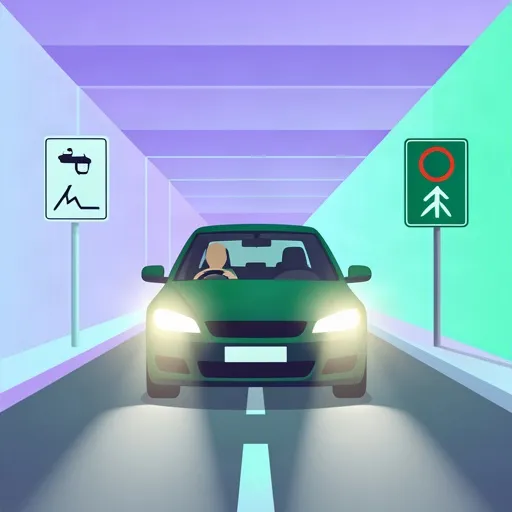
The Code de la route places heavy emphasis on how you adjust your visibility equipment based on environmental factors. Tunnels are a prime example: even if the tunnel is lit, you must turn on your low-beam headlights to ensure you are easily identified by both incoming and following traffic. When driving in heavy rain or fog, your rear fog lights are essential for the safety of those behind you, but you must remember to switch them off immediately once the visibility improves to avoid distracting or blinding drivers behind you.
The French authorities take vehicle equipment seriously. Driving at night, or when visibility is insufficient, without functional lights—such as broken stop lights or faulty headlights—can result in an immediate fine, typically around 68 €, but potentially rising up to 450 € depending on the severity of the offense. Beyond the financial burden, the risk of being ordered to stop your journey immediately due to immobilisation is a major inconvenience that every candidate must be prepared to avoid through diligent vehicle maintenance.
The French Code de la route requires all vehicles to have functioning position lights, low-beam headlights, high-beam headlights, turn signals, brake lights, and registration plate lights, with rear fog lights mandatory on vehicles registered after October 1990. Low-beam headlights are the default for any reduced visibility situation including tunnels, rain, and night driving, while high-beam is reserved exclusively for unlit roads with no nearby traffic. Drivers must perform a systematic pre-drive check of all lighting systems and keep spare bulbs available, as penalties for non-compliance range from 68 € to 450 € and can include vehicle immobilisation for serious safety defects.
A short set of high-value points that capture the most important ideas from this article.
All exterior lights must be in perfect working order before driving; a single faulty bulb can result in fines and exam failure
Low-beam headlights (feux de croisement) are mandatory for night driving, rain, fog, and tunnels even when artificial lighting exists
High-beam headlights (feux de route) must be switched off immediately when meeting or following other vehicles
Rear fog lights are mandatory on vehicles first registered after October 1, 1990, and must be switched off when visibility improves
Vehicle immobilisation is a legal consequence for serious lighting defects, particularly when driving at night
Position lights (feux de position) are for parking or low visibility in well-lit areas only, not for driving
Rear fog lights help following traffic see you in severe weather but dazzle drivers when visibility returns to normal
The pre-drive visibility check should verify all turn signals, brake lights, and dashboard indicator icons
Fines for lighting violations range from approximately 68 € to 450 € depending on severity
Keep spare bulbs in the vehicle as the Code de la route requires all lights to be functional at the start of any journey
Leaving rear fog lights on when visibility improves, which blinds drivers behind you
Using high-beam headlights when other vehicles are present, causing dangerous glare
Believing tunnel lighting eliminates the need for headlights; low-beam is always mandatory in tunnels
Assuming daytime running lights alone satisfy night driving requirements
Neglecting brake light checks, which are a common cause of roadside stops and fines
Article content overview
A short set of high-value points that capture the most important ideas from this article.
All exterior lights must be in perfect working order before driving; a single faulty bulb can result in fines and exam failure
Low-beam headlights (feux de croisement) are mandatory for night driving, rain, fog, and tunnels even when artificial lighting exists
High-beam headlights (feux de route) must be switched off immediately when meeting or following other vehicles
Rear fog lights are mandatory on vehicles first registered after October 1, 1990, and must be switched off when visibility improves
Vehicle immobilisation is a legal consequence for serious lighting defects, particularly when driving at night
Position lights (feux de position) are for parking or low visibility in well-lit areas only, not for driving
Rear fog lights help following traffic see you in severe weather but dazzle drivers when visibility returns to normal
The pre-drive visibility check should verify all turn signals, brake lights, and dashboard indicator icons
Fines for lighting violations range from approximately 68 € to 450 € depending on severity
Keep spare bulbs in the vehicle as the Code de la route requires all lights to be functional at the start of any journey
Leaving rear fog lights on when visibility improves, which blinds drivers behind you
Using high-beam headlights when other vehicles are present, causing dangerous glare
Believing tunnel lighting eliminates the need for headlights; low-beam is always mandatory in tunnels
Assuming daytime running lights alone satisfy night driving requirements
Neglecting brake light checks, which are a common cause of roadside stops and fines
Explore related topics, search based questions, and concepts that learners often look up when studying Mandatory French Vehicle Lighting. These themes reflect real search intent and help you understand how this topic connects to wider driving theory knowledge in France.
Find clear and practical answers to common questions learners often have about Mandatory French Vehicle Lighting. This section helps explain difficult points, remove confusion, and reinforce the key driving theory concepts that matter for learners in France.
A vehicle must be equipped with low beams, high beams, position lights, direction indicators, stop lights, a rear fog light (for vehicles registered after October 1990), and rear license plate illumination.
Driving with non-compliant or broken lighting can lead to an on-the-spot fine, typically around 68 euros, and may result in the immobilization of the vehicle by authorities.
While it is not strictly stated as a legal requirement to carry them, it is highly recommended to have spare bulbs to perform immediate repairs, as you must maintain all lighting in good working order to avoid fines.
Rear fog lights must be used in conditions of heavy fog or heavy snow to improve visibility, but they should be switched off in rain as they can dazzle other drivers.
Continue your preparation for the French permis de conduire exam. Dive deeper into specific Code de la route sections, practice scenarios, or review official procedures. Use our comprehensive article collection to master every aspect of driving theory.