Navigating pedestrian crossings safely is a fundamental skill for any driver in France and a high-frequency topic in the ETG exam. This guide explains your legal duty to yield, how to interpret pedestrian behavior as 'intent to cross,' and the consequences of failing to stop. By mastering these rules, you will improve your hazard awareness and ensure you respond correctly to vulnerable road user scenarios in your theory test.
Article content overview
In the French Code de la route, the protection of vulnerable road users is not merely a recommendation; it is a strict legal obligation. For candidates preparing for the Épreuve Théorique Générale (ETG), understanding the precise conditions under which you must yield to pedestrians is critical. Many learners lose points by failing to recognize the subtle nuances between a pedestrian who has already begun to cross and one who is simply displaying an "intention" to do so. Mastering these rules will not only help you pass your exam but is a vital skill for safe driving in French urban environments.
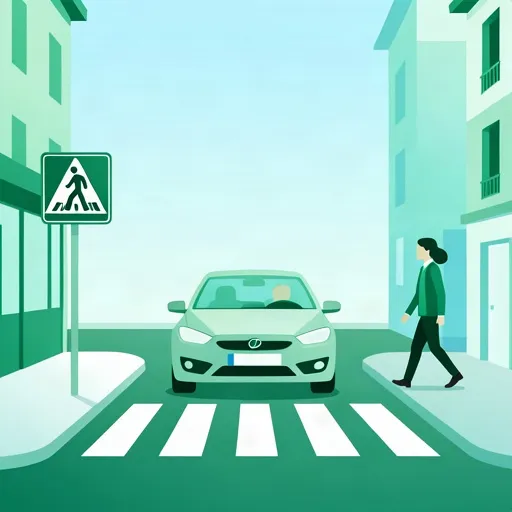
Under French law, any driver approaching a pedestrian crossing—commonly referred to as a passage piéton—must be prepared to stop if a pedestrian is engaged on the crossing or shows a clear intent to cross. This rule applies to all motorized vehicles, including mopeds and cars. Failing to yield to a pedestrian in these circumstances is considered a serious traffic offense. It can result in a significant fine, the loss of points on your license, and, in severe cases, a suspension of your driving privileges.
In the ETG exam, you are often presented with a scenario where a pedestrian is standing near the curb. If they have one foot on the road or are looking toward traffic while waiting to cross, this is legally considered an "intention to cross." You must be prepared to stop.
One of the most common pitfalls for students is failing to interpret body language correctly during the hazard perception part of the exam. The Code de la route emphasizes that a pedestrian does not need to be physically standing in the middle of the road for the priority rule to trigger. You must actively scan the sidewalks for people, particularly near schools, public transport stops, and zones of high commercial activity.
Knowing the signs that accompany these zones is essential. While the zebra crossing markings are the primary indicator, you will often see supplementary signs in high-risk areas. Pay close attention to school zones or areas where pedestrians are frequently present, as the expected safety margin is higher.
| Scenario | Driver Action |
|---|---|
| Pedestrian on the crossing | Must stop and yield |
| Pedestrian showing intent | Must slow down and be prepared to stop |
| Pedestrian on sidewalk (not crossing) | Proceed with caution and maintain alertness |
| Crossing with traffic lights | Obey the light; yield to pedestrians if the signal allows them to move |
The ETG exam often tests your ability to stay vigilant. A frequent question involves a situation where a vehicle in the lane next to you stops for a pedestrian. Even if you do not see the pedestrian yourself, you must be prepared to stop. Overtaking or passing a vehicle that has stopped at a pedestrian crossing is a dangerous maneuver and is strictly prohibited by the Code de la route. Always maintain a speed that allows for a smooth, controlled stop without startling the pedestrian or the drivers behind you.
Pedestrian priority at crossings is a legal obligation under the French Code de la route, requiring drivers to yield to anyone on the passage piéton or showing clear intent to cross—such as placing a foot on the curb or facing traffic. The ETG exam frequently tests your ability to recognize intent from body language and to stop appropriately without overtaking vehicles that have already stopped. Key exam traps include failing to interpret pedestrian positioning and illegally passing stopped vehicles, both of which can result in points loss and dangerous situations.
A short set of high-value points that capture the most important ideas from this article.
Under the Code de la route, drivers must yield to pedestrians who are already on the crossing or showing clear intent to cross, including foot placement on the curb or facing the road
A pedestrian's 'intention to cross' is legally recognized when they position themselves to enter the road, not only when they are actively walking across
All motorized vehicles including mopeds and cars are subject to pedestrian priority rules at passages piéton
Drivers must maintain a speed allowing controlled stops and remain vigilant for pedestrians near schools, public transport stops, and high-traffic areas
Overtaking or passing a vehicle stopped for a pedestrian at a crossing is strictly prohibited by French traffic law
Pedestrian intent is established when one foot is on the road or the pedestrian is looking toward traffic while waiting to cross
The zebra crossing markings (passage piéton) are the primary indicator, but supplementary signs in school zones indicate heightened safety requirements
Even if you cannot see the pedestrian yourself, you must be prepared to stop when an adjacent vehicle has stopped for one
Always check mirrors before restarting after stopping for a pedestrian to ensure trailing vehicles have also stopped
Obey traffic lights at crossings and yield to pedestrians when the signal permits their movement
Assuming a pedestrian must be in the middle of the road before the priority rule applies, when legally the rule triggers on intent alone
Overtaking a vehicle that has stopped for a pedestrian, which is a dangerous and prohibited maneuver
Failing to scan sidewalks for pedestrians before focusing only on the crossing itself
Not adjusting speed early enough to demonstrate intent to yield to other drivers and pedestrians
Misinterpreting a pedestrian simply standing on the sidewalk as having no intention to cross when body language indicates otherwise
Article content overview
A short set of high-value points that capture the most important ideas from this article.
Under the Code de la route, drivers must yield to pedestrians who are already on the crossing or showing clear intent to cross, including foot placement on the curb or facing the road
A pedestrian's 'intention to cross' is legally recognized when they position themselves to enter the road, not only when they are actively walking across
All motorized vehicles including mopeds and cars are subject to pedestrian priority rules at passages piéton
Drivers must maintain a speed allowing controlled stops and remain vigilant for pedestrians near schools, public transport stops, and high-traffic areas
Overtaking or passing a vehicle stopped for a pedestrian at a crossing is strictly prohibited by French traffic law
Pedestrian intent is established when one foot is on the road or the pedestrian is looking toward traffic while waiting to cross
The zebra crossing markings (passage piéton) are the primary indicator, but supplementary signs in school zones indicate heightened safety requirements
Even if you cannot see the pedestrian yourself, you must be prepared to stop when an adjacent vehicle has stopped for one
Always check mirrors before restarting after stopping for a pedestrian to ensure trailing vehicles have also stopped
Obey traffic lights at crossings and yield to pedestrians when the signal permits their movement
Assuming a pedestrian must be in the middle of the road before the priority rule applies, when legally the rule triggers on intent alone
Overtaking a vehicle that has stopped for a pedestrian, which is a dangerous and prohibited maneuver
Failing to scan sidewalks for pedestrians before focusing only on the crossing itself
Not adjusting speed early enough to demonstrate intent to yield to other drivers and pedestrians
Misinterpreting a pedestrian simply standing on the sidewalk as having no intention to cross when body language indicates otherwise
Explore related topics, search based questions, and concepts that learners often look up when studying Pedestrian Priority Rules. These themes reflect real search intent and help you understand how this topic connects to wider driving theory knowledge in France.
Find clear and practical answers to common questions learners often have about Pedestrian Priority Rules. This section helps explain difficult points, remove confusion, and reinforce the key driving theory concepts that matter for learners in France.
In France, you must stop if the pedestrian is already on the crossing or clearly demonstrates the intention to cross, such as looking at traffic or stepping toward the road.
Failure to yield to a pedestrian is considered a serious traffic offense in France, which can result in a significant fine, points deducted from your license, and a possible license suspension.
Yes, the obligation to yield to pedestrians crossing or intending to cross at marked pedestrian crossings applies on all public roads where such crossings are present.
Continue your preparation for the French permis de conduire exam. Dive deeper into specific Code de la route sections, practice scenarios, or review official procedures. Use our comprehensive article collection to master every aspect of driving theory.