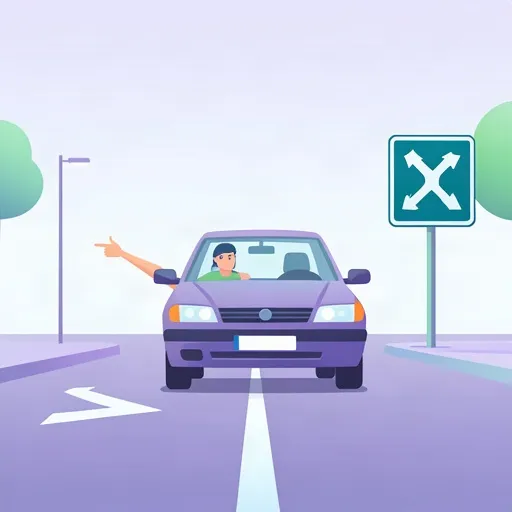
Turning left is one of the most complex maneuvers a driver must perform, often requiring you to cross the path of oncoming traffic while remaining vigilant for pedestrians and cyclists. This guide explains the systematic approach mandated by French traffic law to ensure you clear intersections safely and avoid common exam traps. By understanding these protocols, you will be well-prepared to navigate both urban and rural junctions with confidence and precision.
Article content overview
Turning left at an intersection is one of the most critical and complex maneuvers a driver performs under the French Code de la route. Because a left turn requires you to cross the path of oncoming traffic, it inherently increases the risk of collisions. Success in your Code de la route theory exam requires a deep understanding of positioning, priority rules, and the constant, vigilant observation of vulnerable road users, such as cyclists and motorcyclists.
Before initiating a left turn, you must communicate your intentions clearly and position your vehicle safely. Failure to position your vehicle correctly is a common error in the permis de conduire assessment. You must begin your preparation well in advance of the junction, checking your mirrors and your blind spot (angle mort) before signaling your intention to turn.
In France, the priority rules at intersections are strictly enforced. Unless you are on a priority road or have a green light, you must be prepared to yield to vehicles approaching from the right. When turning left, the legal responsibility is yours to ensure the path is clear. You must never enter an intersection if you cannot clear it without blocking the flow of traffic or endangering others.
The ETG exam frequently features scenarios involving vulnerable road users. When turning left, the most significant risk is the "hidden" road user. Cyclists often travel in bike lanes or along the side of the road, and they may be positioned in your left angle mort. If you fail to check this area, you risk a catastrophic collision, which is a common cause of instant failure in practical evaluations and a core focus of theoretical questions.
| Situation | Priority Rule | Action Required |
|---|---|---|
| Unmarked Intersection | Priority to the right | Yield to vehicles from the right |
| Green Light | Signal controlled | Proceed, but watch for turning traffic |
| 'Cédez-le-passage' sign | Yield to traffic | Stop only if necessary to let others pass |
| Pedestrian Crossing | Pedestrians have priority | Must stop if a pedestrian is crossing or waiting |
Under French law, you must ensure that your maneuver does not impede the safety of other road users. This includes oncoming traffic that is also turning or continuing straight. When you cross the lane of oncoming traffic, they technically have the right of way unless a specific sign or signal indicates otherwise. Staying aware of signal-controlled intersections, such as those with a dedicated green arrow, is essential for passing your theory test.
This article covers the systematic approach to turning left required by the French Code de la route, combining legal priority rules with practical safety procedures. The six-step procedure emphasizes early preparation through mirror and blind spot checks before signaling, followed by correct lane positioning and speed adaptation. Critical legal requirements include yielding to vehicles from the right at unmarked intersections and never entering an intersection without clearance. The content highlights particular exam relevance around detecting vulnerable road users in blind spots and understanding specific road signs like AB3a and AB4. Mastery of these procedures is essential for both the ETG theory exam and safe practical driving in France.
A short set of high-value points that capture the most important ideas from this article.
Left turns are inherently high-risk because you must cross the path of oncoming traffic, requiring extra vigilance
Preparation for a left turn begins long before the junction with mirror checks, blind spot checks, and early signaling
At unmarked intersections in France, you must yield to vehicles approaching from your right (Priorité à droite)
Cyclists and motorcyclists can occupy your blind spot (angle mort) during a left turn and must be checked with a shoulder check
You must never enter an intersection if you cannot clear it without obstructing other traffic
Priorité à droite means vehicles from your right have priority at unmarked intersections unless on a priority road
Always perform a physical shoulder check in addition to mirror checks—mirrors alone are insufficient
The AB3a sign warns you must yield to traffic from the right at the next junction
Vulnerable road users (usagers vulnérables) include cyclists, motorcyclists, and pedestrians who have specific protections
If a pedestrian is crossing or waiting at a crossing, you must stop regardless of other signals
Relying solely on mirrors and skipping the shoulder check for angle mort, especially missing two-wheeled vehicles
Assuming an intersection is clear without checking for cyclists hidden alongside or behind the vehicle
Failing to yield to oncoming traffic when turning left, thinking the green light gives unconditional priority
Entering an intersection when traffic ahead is congested, risking blocking the junction
Not signaling early enough, leaving other road users insufficient time to react
Article content overview
A short set of high-value points that capture the most important ideas from this article.
Left turns are inherently high-risk because you must cross the path of oncoming traffic, requiring extra vigilance
Preparation for a left turn begins long before the junction with mirror checks, blind spot checks, and early signaling
At unmarked intersections in France, you must yield to vehicles approaching from your right (Priorité à droite)
Cyclists and motorcyclists can occupy your blind spot (angle mort) during a left turn and must be checked with a shoulder check
You must never enter an intersection if you cannot clear it without obstructing other traffic
Priorité à droite means vehicles from your right have priority at unmarked intersections unless on a priority road
Always perform a physical shoulder check in addition to mirror checks—mirrors alone are insufficient
The AB3a sign warns you must yield to traffic from the right at the next junction
Vulnerable road users (usagers vulnérables) include cyclists, motorcyclists, and pedestrians who have specific protections
If a pedestrian is crossing or waiting at a crossing, you must stop regardless of other signals
Relying solely on mirrors and skipping the shoulder check for angle mort, especially missing two-wheeled vehicles
Assuming an intersection is clear without checking for cyclists hidden alongside or behind the vehicle
Failing to yield to oncoming traffic when turning left, thinking the green light gives unconditional priority
Entering an intersection when traffic ahead is congested, risking blocking the junction
Not signaling early enough, leaving other road users insufficient time to react
Explore related topics, search based questions, and concepts that learners often look up when studying Turning Left Rules in France. These themes reflect real search intent and help you understand how this topic connects to wider driving theory knowledge in France.
Find clear and practical answers to common questions learners often have about Turning Left Rules in France. This section helps explain difficult points, remove confusion, and reinforce the key driving theory concepts that matter for learners in France.
You must always check your interior and exterior mirrors, followed by a critical check of your 'angle mort' (blind spot) to ensure no cyclists or motorcycles are alongside your vehicle before turning.
In the absence of specific signs or signals, the rule of 'priorité à droite' applies. You must yield to traffic coming from the right, and if you are turning left across oncoming traffic, you must wait for a safe gap in the stream of vehicles.
Turning left involves crossing the trajectory of oncoming vehicles, including motorcycles, which are often harder to spot. Failing to correctly judge their distance or speed is a common cause of accidents and a frequent trap in the ETG exam.
Yes, you must signal your intention well in advance, move to the correct lane or position on the road, and slow down sufficiently while continuously monitoring your surroundings before completing the turn.
Continue your preparation for the French permis de conduire exam. Dive deeper into specific Code de la route sections, practice scenarios, or review official procedures. Use our comprehensive article collection to master every aspect of driving theory.