
Understanding the specific rules for long motorway tunnels is a mandatory requirement for the German driving theory exam. This guide covers the legal obligations for drivers in tunnels, including correct lighting, prohibited maneuvers, and the life-saving steps you must take if you encounter smoke, fire, or vehicle failure.
Article content overview
Driving in a tunnel on a German motorway is a high-stakes environment that requires strict adherence to traffic regulations. Whether you are navigating the expansive Elbtunnel in Hamburg or the long tunnels found in mountain regions, the German traffic code (StVO) imposes specific, non-negotiable rules to ensure driver safety. Because tunnel accidents and fires can quickly become life-threatening due to limited exits and restricted airflow, your theoretical knowledge of these procedures is a mandatory component of the German driving licence test.
When you enter a tunnel, the environment changes significantly compared to open-road driving. The first rule is that you must activate your dipped headlights (Abblendlicht) immediately upon entering, even if the tunnel is well-lit or it is daytime. This improves your visibility to other drivers and ensures your vehicle is clearly seen against the contrast of the tunnel walls. Furthermore, U-turns and reversing are strictly prohibited under any circumstances; doing so in a tunnel creates an immediate risk of a fatal pile-up.
In longer tunnels, you will often encounter specific speed limits and spacing requirements designed to prevent rear-end collisions. While the standard motorway rules might allow for higher speeds, long tunnels are frequently restricted to 80 km/h. Additionally, you are often required to maintain a minimum following distance of 50 meters, which is strictly enforced and indicated by road signs.
If your vehicle develops a fault, the protocol differs from a standard highway breakdown. You must avoid stopping on the main carriageway if it is at all possible to continue to an emergency bay or the end of the tunnel. If your car is immobilized, you must pull into a designated emergency and breakdown bay (Nothalte- und Pannenbucht).
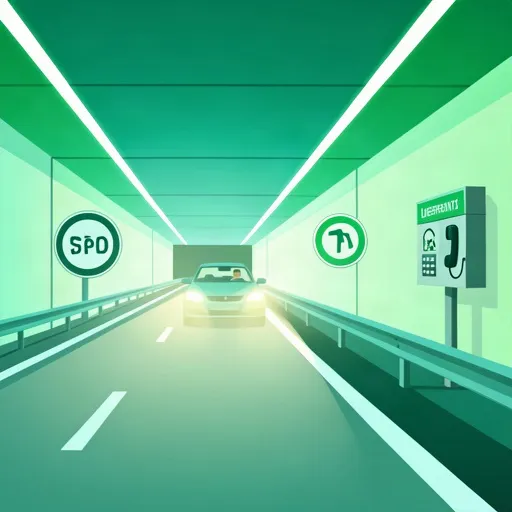
Once you have stopped in a bay, your actions must be swift and calculated. Switch off your engine, turn on your hazard lights, and use the provided emergency telephone to call for help—these are located at regular intervals, typically every 150 meters. Do not remain in your vehicle while waiting for assistance; if the tunnel is crowded or you feel unsafe, leave the vehicle and proceed to the nearest emergency exit, which is indicated by illuminated green signs.
Long tunnels utilize specific regulatory signs that carry legal weight. Changing lanes is often forbidden in tunnel sections to maintain traffic flow and safety; if a solid white line or a specific "no overtaking" sign is present, you must remain in your lane. Ignoring these lane discipline rules not only poses a significant risk to other road users but also leads to heavy fines and potential points in the German penalty system.
The examiners focus on tunnel scenarios because they represent a high-hazard environment where minor errors can have catastrophic consequences. Expect questions that test your ability to distinguish between standard roadside stops and the strict requirement to reach an emergency bay. You should also be prepared to answer questions about why headlight usage and maintaining distance are more critical in a tunnel than on the open road.
German Autobahn tunnels operate under strict StVO regulations requiring immediate dipped headlight activation, adherence to posted speed limits (often 80 km/h), and maintenance of at least 50 meters following distance. During breakdowns, drivers must reach an emergency bay rather than stopping on the carriageway, then use emergency telephones located every 150 meters and exit the vehicle if unsafe. Tunnel fires demand immediate evacuation on foot following green illuminated exit signs, as smoke toxicity makes remaining inside the vehicle or attempting vehicle turnaround lethal. These procedures are testable components of the German driving theory exam due to the high-hazard nature of tunnel environments.
A short set of high-value points that capture the most important ideas from this article.
Dipped headlights (Abblendlicht) must be switched on immediately upon entering any tunnel, regardless of lighting conditions or time of day.
U-turns and reversing are strictly prohibited in tunnels at all times due to the extreme danger of collision.
In longer tunnels, speed is often restricted to 80 km/h with a mandatory minimum following distance of 50 meters.
Emergency bays (Nothaltebucht) must be used for any breakdown; stopping on the main carriageway is prohibited and extremely dangerous.
During a tunnel fire, evacuation on foot via green illuminated exit signs is the only safe option; smoke can reach lethal toxicity within minutes.
Emergency telephones are located approximately every 150 meters inside tunnels and must be used to report breakdowns or emergencies.
When evacuating during an emergency, leave the vehicle immediately and abandon all luggage; do not delay gathering personal items.
Keep keys accessible after turning off the engine to allow emergency services to move your vehicle if necessary.
Lane changing is forbidden in tunnel sections marked with solid white lines or no-overtaking signs.
Green illuminated signs always indicate the nearest emergency exit route for evacuation on foot.
Assuming tunnel lighting eliminates the need for dipped headlights; they remain mandatory for your own visibility to others.
Attempting to turn around or reverse when trapped in a tunnel during a fire or heavy congestion, which is both illegal and extremely dangerous.
Staying inside the vehicle while waiting for help in an emergency bay when conditions become unsafe due to smoke or fire.
Confusing standard roadside breakdown procedures with tunnel protocols; tunnels require reaching an emergency bay or tunnel exit.
Ignoring lane discipline rules in tunnels, believing occasional lane changes are tolerated for safety reasons.
Article content overview
A short set of high-value points that capture the most important ideas from this article.
Dipped headlights (Abblendlicht) must be switched on immediately upon entering any tunnel, regardless of lighting conditions or time of day.
U-turns and reversing are strictly prohibited in tunnels at all times due to the extreme danger of collision.
In longer tunnels, speed is often restricted to 80 km/h with a mandatory minimum following distance of 50 meters.
Emergency bays (Nothaltebucht) must be used for any breakdown; stopping on the main carriageway is prohibited and extremely dangerous.
During a tunnel fire, evacuation on foot via green illuminated exit signs is the only safe option; smoke can reach lethal toxicity within minutes.
Emergency telephones are located approximately every 150 meters inside tunnels and must be used to report breakdowns or emergencies.
When evacuating during an emergency, leave the vehicle immediately and abandon all luggage; do not delay gathering personal items.
Keep keys accessible after turning off the engine to allow emergency services to move your vehicle if necessary.
Lane changing is forbidden in tunnel sections marked with solid white lines or no-overtaking signs.
Green illuminated signs always indicate the nearest emergency exit route for evacuation on foot.
Assuming tunnel lighting eliminates the need for dipped headlights; they remain mandatory for your own visibility to others.
Attempting to turn around or reverse when trapped in a tunnel during a fire or heavy congestion, which is both illegal and extremely dangerous.
Staying inside the vehicle while waiting for help in an emergency bay when conditions become unsafe due to smoke or fire.
Confusing standard roadside breakdown procedures with tunnel protocols; tunnels require reaching an emergency bay or tunnel exit.
Ignoring lane discipline rules in tunnels, believing occasional lane changes are tolerated for safety reasons.
Explore related topics, search based questions, and concepts that learners often look up when studying Autobahn Tunnel Safety Rules. These themes reflect real search intent and help you understand how this topic connects to wider driving theory knowledge in Germany.
Find clear and practical answers to common questions learners often have about Autobahn Tunnel Safety Rules. This section helps explain difficult points, remove confusion, and reinforce the key driving theory concepts that matter for learners in Germany.
Yes, according to the StVO, you must switch on your dipped headlights (Abblendlicht) when entering a tunnel, even if it is well-lit or during daylight hours.
If your vehicle is still mobile, you must reach an emergency bay (Nothalte- und Pannenbucht). If the car is immobilized, activate hazard lights, stop as far right as possible, turn off the engine, and immediately use the emergency phone to notify authorities before exiting the vehicle.
No, turning around or reversing inside a tunnel is strictly prohibited and extremely dangerous. You must continue driving until you reach a safe location outside the tunnel.
Tunnel fires produce toxic, lethal smoke very quickly. If you are near an emergency exit, it is safer to abandon your vehicle and evacuate on foot following the green emergency signage rather than waiting inside the car.
Didn't find what you were looking for? Continue your German driving theory preparation by exploring related articles, specific road sign categories, or in-depth guides on complex traffic situations. Deepen your understanding before the official test.