
Understanding the specific regulations for tunnel transit is a critical part of your preparation for the German driving theory test. You will learn why dipped headlights are mandatory regardless of artificial lighting and why maneuvers like U-turns are strictly prohibited for your safety. Mastering these concepts helps you avoid common exam pitfalls and prepares you for responsible, law-abiding behavior in real-world traffic.
Article content overview
Navigating tunnels is an essential skill for any driver in Germany, whether you are traversing short urban underpasses or longer infrastructure projects. While many drivers perceive tunnels simply as stretches of road where they must turn on their headlights, the Straßenverkehrs-Ordnung (StVO) imposes a strict set of regulations designed to ensure safety in these confined, visibility-restricted environments. Understanding these rules is not only vital for passing your German driving theory test but is also a cornerstone of defensive driving.
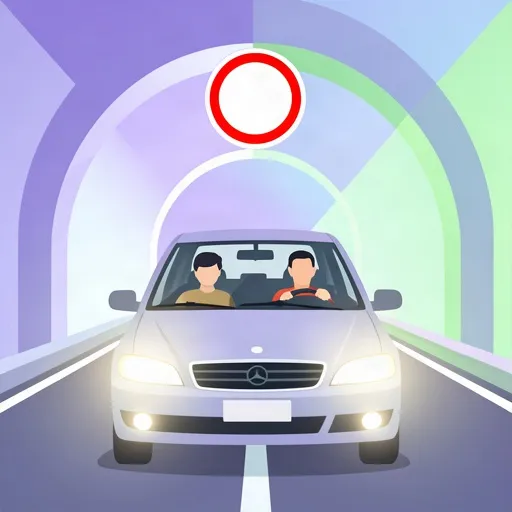
Common theory exam trap: Many learners mistakenly believe that if a tunnel is well-lit, they do not need to switch on their headlights. This is incorrect. Under §17 StVO, you are legally required to use dipped headlights (Abblendlicht) as soon as you enter any tunnel, regardless of ambient artificial lighting.
When you drive through a tunnel, the transition from daylight to artificial light—and back again—can temporarily impact your depth perception and reaction time. To mitigate these risks, the law requires that your vehicle remains clearly visible to others at all times. Activating your dipped headlights is mandatory upon entry, and failure to do so is a frequent point of failure in theory exam questions.
Furthermore, the confined nature of a tunnel makes certain maneuvers extremely hazardous. It is strictly prohibited to turn your vehicle around, reverse, or stop, except in designated emergency bays. These regulations exist to prevent traffic chaos and secondary accidents, which could be catastrophic in a space where emergency vehicles may struggle to reach you.
One of the most critical aspects of German road law is knowing how to act if your vehicle breaks down inside a tunnel. If you experience a technical failure, you should attempt to drive out of the tunnel if it is safe to do so. If your vehicle is disabled, you must pull into an Nothalte- und Pannenbucht (emergency bay) if one is available.
If you are forced to stop within the tunnel due to an accident or a fire, the priority shifts immediately to safety and communication. You should switch on your hazard lights, turn off the engine, and exit the vehicle. Use the emergency telephones located in designated niches, which connect directly to emergency services, and follow any signs leading to emergency exits.
A common misconception among new drivers is that tunnels operate under a different set of traffic laws than open roads. In reality, all general road traffic rules—including speed limits, lane discipline, and the requirement to keep to the right—remain fully in force. The only difference is the increased enforcement of specific prohibitions, such as the ban on overtaking or the strict speed limits often enforced by cameras to prevent accidents in tight lanes.
Drivers must remain hyper-aware of their surroundings. Cyclists, pedestrians, or maintenance vehicles may occasionally be present in specialized tunnels or restricted service lanes, and the reduced light levels mean your reaction time must be even sharper than on an open highway.
The theory exam often presents you with scenarios involving tunnel entry or breakdown situations to test your grasp of the StVO. Look for questions that ask about headlight usage or the correct actions during a traffic jam inside a tunnel. Always remember that the law prioritizes the prevention of disorientation and the maintenance of traffic flow.
If you encounter a sign indicating a tunnel, prepare your vehicle early by checking your mirrors and adjusting your lighting. Mastering these fundamental habits now will ensure you are a safe and confident driver once you take your practical test.
This article covers the essential StVO regulations for driving through tunnels in Germany, emphasizing that dipped headlights are mandatory upon entry under §17 StVO regardless of tunnel illumination. The content explains strict prohibitions on reversing, turning around, or stopping except in designated emergency bays, and outlines correct emergency procedures including evacuation protocols and use of emergency telephones. It clarifies that all standard traffic rules remain in effect within tunnels, with heightened enforcement of speed limits and lane discipline. The material directly addresses a common theory exam misconception about well-lit tunnels and headlights, making it particularly valuable for exam preparation.
A short set of high-value points that capture the most important ideas from this article.
Dipped headlights (Abblendlicht) are legally required in every tunnel under §17 StVO, regardless of artificial lighting inside the tunnel
Reversing, turning around, or making U-turns inside tunnels is strictly prohibited by StVO to prevent traffic chaos and secondary accidents
Emergency bays (Nothalte- und Pannenbucht) are the only lawful stopping locations within tunnels for breakdowns or emergencies
All standard road traffic rules—including speed limits, lane discipline, and keeping to the right—remain fully in force inside tunnels
In case of breakdown, attempt to exit the tunnel if safe; if forced to stop, use hazard lights, exit the vehicle, and use emergency telephones in tunnel niches
Well-lit tunnels do not exempt you from headlight requirements—dipped headlights activate upon tunnel entry under any conditions
Only stop in official emergency bays; stopping in the tunnel lane creates severe hazards and obstructs emergency vehicles
Emergency exit signs and telephones are located in designated niches—familiarize yourself with their placement
If a fire occurs inside the tunnel, turn off the engine and evacuate via the nearest emergency exit immediately
Tunnel speed limits are often enforced by cameras due to confined space and limited escape routes
Assuming that artificial tunnel lighting means dipped headlights are optional—this is a frequent theory exam trap and a real-world safety error
Attempting to reverse or turn around if you miss your exit, which is both illegal and extremely dangerous in confined tunnel space
Stopping in the tunnel lane instead of searching for the nearest emergency bay during a breakdown
Believing tunnels operate under different traffic rules than open roads—speed limits and lane discipline still apply
Not preparing your vehicle's lighting in advance when approaching tunnel signs, causing delayed activation
Article content overview
A short set of high-value points that capture the most important ideas from this article.
Dipped headlights (Abblendlicht) are legally required in every tunnel under §17 StVO, regardless of artificial lighting inside the tunnel
Reversing, turning around, or making U-turns inside tunnels is strictly prohibited by StVO to prevent traffic chaos and secondary accidents
Emergency bays (Nothalte- und Pannenbucht) are the only lawful stopping locations within tunnels for breakdowns or emergencies
All standard road traffic rules—including speed limits, lane discipline, and keeping to the right—remain fully in force inside tunnels
In case of breakdown, attempt to exit the tunnel if safe; if forced to stop, use hazard lights, exit the vehicle, and use emergency telephones in tunnel niches
Well-lit tunnels do not exempt you from headlight requirements—dipped headlights activate upon tunnel entry under any conditions
Only stop in official emergency bays; stopping in the tunnel lane creates severe hazards and obstructs emergency vehicles
Emergency exit signs and telephones are located in designated niches—familiarize yourself with their placement
If a fire occurs inside the tunnel, turn off the engine and evacuate via the nearest emergency exit immediately
Tunnel speed limits are often enforced by cameras due to confined space and limited escape routes
Assuming that artificial tunnel lighting means dipped headlights are optional—this is a frequent theory exam trap and a real-world safety error
Attempting to reverse or turn around if you miss your exit, which is both illegal and extremely dangerous in confined tunnel space
Stopping in the tunnel lane instead of searching for the nearest emergency bay during a breakdown
Believing tunnels operate under different traffic rules than open roads—speed limits and lane discipline still apply
Not preparing your vehicle's lighting in advance when approaching tunnel signs, causing delayed activation
Explore related topics, search based questions, and concepts that learners often look up when studying Tunnel Safety and Rules. These themes reflect real search intent and help you understand how this topic connects to wider driving theory knowledge in Germany.
Find clear and practical answers to common questions learners often have about Tunnel Safety and Rules. This section helps explain difficult points, remove confusion, and reinforce the key driving theory concepts that matter for learners in Germany.
Yes. Under German law (§17 StVO), you must use your dipped headlights when driving through any tunnel, regardless of how well-lit it may be or what time of day it is.
No. Turning around (U-turns) or reversing inside a tunnel is strictly prohibited and is a severe traffic offense that carries significant penalties.
You should attempt to reach an emergency bay (Nothalte- und Pannenbucht) if possible. If you must stop, turn on your hazard lights, switch off the engine, and follow official emergency procedures.
Didn't find what you were looking for? Continue your German driving theory preparation by exploring related articles, specific road sign categories, or in-depth guides on complex traffic situations. Deepen your understanding before the official test.