
Understanding how extreme heat impacts your vehicle is a vital component of driver safety and successful theory exam preparation. This article explains the technical relationship between ambient temperature and tire pressure, the risks of road surface deterioration like Spurrillen, and how to plan your journeys to minimize exposure to peak holiday traffic. Learn the necessary technical and behavioral standards to maintain control and safety when driving across Germany during the summer months.
Article content overview
Driving in Germany during the summer months presents a unique set of challenges that every learner must understand for both the theoretical driving test and real-world safety. High ambient temperatures, long-distance holiday travel, and changing road surface conditions require a proactive approach to vehicle maintenance and trip planning. By mastering the fundamentals of vehicle safety and traffic flow, you can avoid common pitfalls that lead to accidents or administrative penalties on the Autobahn.
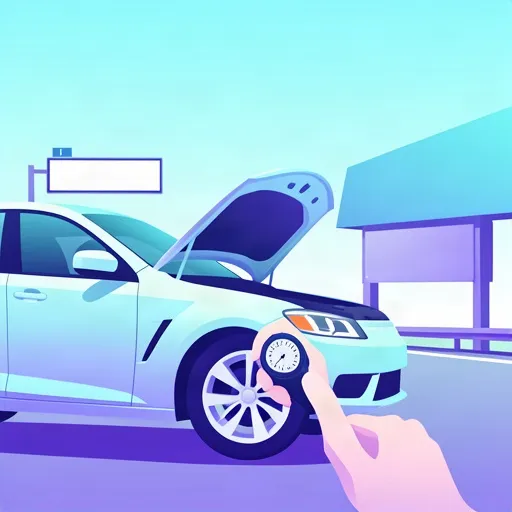
Many learners mistakenly believe that they should release air from their tires during intense heat waves to compensate for increased pressure. This is a dangerous misconception. As temperatures rise, the air inside your tires expands, typically increasing pressure by approximately 0.1 to 0.15 bar for every 10°C rise in ambient temperature. Vehicle manufacturers account for this thermal expansion when specifying the correct tire pressure for your vehicle.
Never bleed air from your tires to "correct" heat-induced pressure increases. Always check and adjust tire pressure when the tires are cold—before you begin your journey—to ensure they meet the manufacturer's recommended specifications.
Maintaining the correct pressure is vital, as both under-inflation and over-inflation can cause excessive tire wear or sudden failure. In extreme heat, an under-inflated tire experiences increased "walkarbeit" (internal deformation/flexing), causing the rubber to overheat rapidly. In the worst-case scenario, this heat buildup can lead to a tire blowout, which is particularly dangerous when driving at high speeds on the Autobahn.
Summer heat does not just affect your car; it significantly impacts the road infrastructure. On older sections of the German highway network, sustained high temperatures combined with heavy traffic can cause the asphalt to soften. This leads to the formation of Spurrillen—deep longitudinal ruts caused by the constant channeling of vehicle tires.
These ruts are a serious safety concern for drivers. They can negatively influence vehicle tracking, making your car feel unstable or causing it to "pull" unexpectedly. Furthermore, Spurrillen act as channels for water during sudden summer thunderstorms, significantly increasing the risk of hydroplaning even if the rest of the road surface appears dry. When you encounter signs of damaged or rutted road surfaces, you must reduce your speed and increase your following distance to ensure you maintain control at all times.
The Ferienreisewelle (holiday travel wave) represents one of the most predictable yet stressful phenomena on German roads. During the summer, traffic volume surges as families head toward the mountains or the coast. The most severe congestion typically occurs on the A8 (Munich to Stuttgart) and the A9 (Munich to Nuremberg), particularly when school holiday periods in Bavaria and Baden-Württemberg overlap.
To avoid being caught in a prolonged Stau (traffic jam), effective trip planning is essential. If possible, avoid starting your journey on peak days such as Friday afternoons or Saturday mornings. Monday and Tuesday are generally considered better days for long-distance travel, as commercial traffic is more predictable and the sheer volume of vacationers is lower. Always check live traffic reports via the radio or digital navigation tools before departure, and remain prepared for unexpected delays.
The legal requirement in Germany to use winter tires only when weather conditions—such as black ice, snow, or slush—actually require them. There is no hard "summer tire law," but using appropriate tires for the season remains a critical safety duty.
Older vehicles with marginal cooling systems are particularly susceptible to overheating when stuck in stop-and-go traffic under the summer sun. Without the steady flow of air generated by high-speed movement, engines can quickly reach critical temperatures. If your temperature gauge begins to climb toward the red zone, turn off the air conditioning and activate the vehicle's heating system to full power; this helps dissipate engine heat. If the warning light persists, pull over safely at the next available service area or Nothaltebucht (emergency lay-by) and allow the engine to cool down properly.
This article addresses critical summer driving safety concepts for Germany, covering the physics of how heat affects tire pressure (correcting the dangerous misconception about bleeding air), the formation and hazards of Spurrillen rutting on older Autobahn sections, and practical strategies for avoiding holiday traffic congestion during the Ferienreisewelle. Learners should understand that maintaining correct cold-tire pressure is essential because heat-induced pressure increases are already factored into manufacturer specifications. Additionally, the content explains how to handle vehicle overheating in stop-and-go traffic by using the heating system to dissipate engine heat, and emphasizes the importance of planning travel times to avoid peak congestion days on major routes like the A8 and A9.
A short set of high-value points that capture the most important ideas from this article.
Tire pressure increases by approximately 0.1 to 0.15 bar for every 10°C rise in ambient temperature—never bleed air from tires during hot weather to compensate
Always check and adjust tire pressure when tires are cold, before your journey begins, to meet manufacturer specifications
Spurrillen (rutting) form on older asphalt during sustained heat and heavy traffic, creating channels for water that increase hydroplaning risk
Plan long-distance Autobahn trips to avoid Friday afternoons and Saturday mornings during holiday periods when Ferienreisewelle peaks
If your temperature gauge approaches the red zone in stop-and-go traffic, turn off air conditioning and max out heating to help cool the engine
Under-inflated tires experience increased Walkarbeit (internal deformation) which causes rapid overheating and can lead to blowouts at high Autobahn speeds
Spurrillen negatively affect vehicle tracking and make cars feel unstable or cause unexpected pulling
The A8 (Munich-Stuttgart) and A9 (Munich-Nuremberg) are particularly prone to severe Stau during overlapping Bavaria and Baden-Württemberg school holidays
If engine overheating warning persists after using heating, pull over at the next Nothaltebucht (emergency lay-by) to cool down safely
The situational Winterreifenpflicht means winter equipment is required only when actual winter weather conditions demand it, not by calendar date
Bleeding air from tires during hot weather to 'correct' natural thermal expansion, which is both dangerous and unnecessary
Checking tire pressure after driving when tires are warm, giving falsely low readings that lead to over-inflation
Ignoring early signs of Spurrillen and failing to reduce speed and increase following distance appropriately
Starting holiday journeys on Friday afternoons or Saturday mornings during peak vacation travel periods
Continuing to drive when temperature gauge reaches red instead of pulling over to prevent engine damage
Article content overview
A short set of high-value points that capture the most important ideas from this article.
Tire pressure increases by approximately 0.1 to 0.15 bar for every 10°C rise in ambient temperature—never bleed air from tires during hot weather to compensate
Always check and adjust tire pressure when tires are cold, before your journey begins, to meet manufacturer specifications
Spurrillen (rutting) form on older asphalt during sustained heat and heavy traffic, creating channels for water that increase hydroplaning risk
Plan long-distance Autobahn trips to avoid Friday afternoons and Saturday mornings during holiday periods when Ferienreisewelle peaks
If your temperature gauge approaches the red zone in stop-and-go traffic, turn off air conditioning and max out heating to help cool the engine
Under-inflated tires experience increased Walkarbeit (internal deformation) which causes rapid overheating and can lead to blowouts at high Autobahn speeds
Spurrillen negatively affect vehicle tracking and make cars feel unstable or cause unexpected pulling
The A8 (Munich-Stuttgart) and A9 (Munich-Nuremberg) are particularly prone to severe Stau during overlapping Bavaria and Baden-Württemberg school holidays
If engine overheating warning persists after using heating, pull over at the next Nothaltebucht (emergency lay-by) to cool down safely
The situational Winterreifenpflicht means winter equipment is required only when actual winter weather conditions demand it, not by calendar date
Bleeding air from tires during hot weather to 'correct' natural thermal expansion, which is both dangerous and unnecessary
Checking tire pressure after driving when tires are warm, giving falsely low readings that lead to over-inflation
Ignoring early signs of Spurrillen and failing to reduce speed and increase following distance appropriately
Starting holiday journeys on Friday afternoons or Saturday mornings during peak vacation travel periods
Continuing to drive when temperature gauge reaches red instead of pulling over to prevent engine damage
Explore related topics, search based questions, and concepts that learners often look up when studying Summer Driving and Vehicle Safety. These themes reflect real search intent and help you understand how this topic connects to wider driving theory knowledge in Germany.
Find clear and practical answers to common questions learners often have about Summer Driving and Vehicle Safety. This section helps explain difficult points, remove confusion, and reinforce the key driving theory concepts that matter for learners in Germany.
No, you should never artificially reduce tire pressure due to heat. Tire manufacturers calculate for thermal expansion, so you should always set your tire pressure to the manufacturer's recommended cold-inflation value before starting your trip.
No, there is no specific legal requirement for summer tires. However, Germany has a 'situative' winter tire requirement, meaning if winter conditions like ice or snow are present, your vehicle must be equipped with suitable winter-rated tires.
Spurrillen are longitudinal ruts formed in asphalt due to heat and heavy traffic loads. They are dangerous because they can affect vehicle tracking and increase the risk of hydroplaning when it rains after a dry period.
To avoid peak congestion, it is generally recommended to travel on Mondays or Tuesdays, as Wednesdays, Thursdays, and especially Fridays and Saturdays during the vacation season see the highest volume of holiday traffic.
Didn't find what you were looking for? Continue your German driving theory preparation by exploring related articles, specific road sign categories, or in-depth guides on complex traffic situations. Deepen your understanding before the official test.