
Understanding precisely where the 50 km/h speed limit begins and ends is a fundamental requirement for the German theoretical driving test. This guide clarifies the legal significance of the Ortstafel (Zeichen 310) and the end-of-built-up-area sign (Zeichen 311), helping you navigate the StVO rules with confidence. You will learn why physical surroundings like buildings or lights do not trigger the speed change and how to correctly identify these zones to prevent costly mistakes in your exam.
Article content overview
For any learner preparing for the German theoretical driving test, mastering speed limit regulations is non-negotiable. Among these, the 50 km/h rule within built-up areas is a foundational concept that frequently appears in exam questions. Misunderstanding the triggers for this speed limit is a common cause of lost points in the Theorieprüfung. By understanding the specific legal function of the Ortstafel, you can navigate urban and rural transitions with confidence and legal precision.
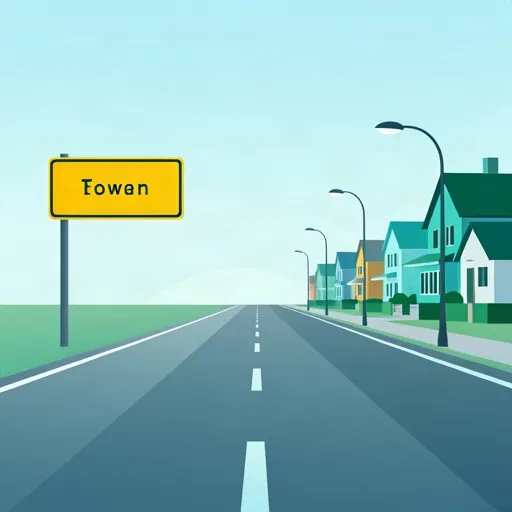
A common misconception among new drivers is that the presence of buildings, houses, or street lighting automatically signals the start of a built-up area and, consequently, a 50 km/h speed limit. In reality, the legal obligation to reduce your speed to 50 km/h is triggered exclusively by the official town entrance sign, known as the Ortstafel (Zeichen 310). Regardless of how "urban" a stretch of road may look, if you have not passed this specific sign, you are legally still outside a built-up area.
The reverse is also true: if you pass the Ortstafel, you must immediately comply with the 50 km/h limit. This applies from the exact plane of the sign. You do not need to wait until you reach the first house, nor are you permitted to maintain a higher speed up to the point where streetlights begin. The sign represents the legal border of the town; once your vehicle passes it, the speed limit is in effect.
The 50 km/h speed limit remains in effect continuously until you encounter the end-of-built-up-area sign, officially designated as Zeichen 311. This sign is easily identified as it features the same name as the town entrance sign but is crossed out with a diagonal red bar. Just as with the entrance sign, the speed limit restriction ends exactly at the plane of this sign. Accelerating before you have completely passed the Zeichen 311 can result in speeding violations, which are strictly monitored and tested in the theory exam.
One of the most challenging scenarios in the theoretical exam involves driving through areas where two towns are separated by a very short distance. It is common to see an exit sign (Zeichen 311) for one village followed by an entrance sign (Zeichen 310) for the next within a few hundred meters. Even if this "open" section between the two towns is very short, the 50 km/h rule remains the baseline for the entire duration of these interconnected areas unless specifically marked otherwise.
Do not be misled by short gaps between town signs. Even if there are no houses for 200 meters between two connected town areas, you must adhere to the speed limits provided by the signs. Always look for the Ortstafel to determine your current legal status on the road.
It is important to note that the rules governing built-up areas do not always apply to high-speed roads. For instance, when an Autobahn passes near or through a city, the urban speed limit of 50 km/h does not apply unless you exit the Autobahn and cross an Ortstafel. Similarly, if a road bypasses a town entirely without the presence of an Ortstafel, you remain in an "outside built-up area" (außerhalb geschlossener Ortschaften) status, even if you can see houses in the distance.
In some cases, specific road conditions may lead to an official increase to 70 km/h within a town, but this will always be indicated by a supplementary speed limit sign (Zeichen 274). Never assume you can drive faster than 50 km/h inside a town simply because the road is wide or clear of traffic; only the presence of an explicit traffic sign can override the general 50 km/h mandate.
The 50 km/h speed limit within built-up areas in Germany is triggered exclusively by the Ortstafel (Zeichen 310), an official traffic sign that marks the legal boundary of a town. Physical features like buildings or streetlights have no legal significance for determining speed limits; only the presence or absence of the official signs matters. The speed limit applies from the exact plane of Zeichen 310 and continues until you fully pass Zeichen 311. Special attention is needed for twin-town scenarios where two signs appear close together, as the legal speed limit applies continuously across the gap. High-speed roads like the Autobahn maintain their own rules unless you exit and cross an Ortstafel.
A short set of high-value points that capture the most important ideas from this article.
The Ortstafel (Zeichen 310) is the only legal trigger for the 50 km/h built-up area speed limit, not buildings, streetlights, or other visual cues
The 50 km/h limit takes effect immediately at the plane of the Ortstafel sign, not when you reach the first house
The end-of-built-up-area sign (Zeichen 311) must be completely passed before you may legally accelerate beyond 50 km/h
Short gaps between towns do not create exceptions: consecutive Ortstafel and Ortsausfahrtschild signs must both be obeyed
Autobahn sections retain high-speed rules even when passing near cities unless you exit and cross an Ortstafel
Zeichen 310 (Ortstafel) = beginning of built-up area, 50 km/h applies from the sign's plane
Zeichen 311 = end of built-up area, 50 km/h ends at the sign's plane
Visual surroundings (houses, streetlights) have no legal significance for speed limit determination
Twin-town situations with signs close together require obeying both without a free zone in between
Zeichen 274 (supplementary speed limit sign) is the only way the standard 50 km/h limit can be officially raised to 70 km/h
Assuming streetlights or houses indicate the start of a 50 km/h zone instead of looking for the Ortstafel
Accelerating immediately after passing Zeichen 311 instead of waiting until fully past the sign
Believing a short gap between two towns creates a zone where no speed limit applies
Assuming wide or empty roads inside a town permit speeds above 50 km/h without a Zeichen 274 sign
Confusing the visual appearance of an area with its legal status under StVO
Article content overview
A short set of high-value points that capture the most important ideas from this article.
The Ortstafel (Zeichen 310) is the only legal trigger for the 50 km/h built-up area speed limit, not buildings, streetlights, or other visual cues
The 50 km/h limit takes effect immediately at the plane of the Ortstafel sign, not when you reach the first house
The end-of-built-up-area sign (Zeichen 311) must be completely passed before you may legally accelerate beyond 50 km/h
Short gaps between towns do not create exceptions: consecutive Ortstafel and Ortsausfahrtschild signs must both be obeyed
Autobahn sections retain high-speed rules even when passing near cities unless you exit and cross an Ortstafel
Zeichen 310 (Ortstafel) = beginning of built-up area, 50 km/h applies from the sign's plane
Zeichen 311 = end of built-up area, 50 km/h ends at the sign's plane
Visual surroundings (houses, streetlights) have no legal significance for speed limit determination
Twin-town situations with signs close together require obeying both without a free zone in between
Zeichen 274 (supplementary speed limit sign) is the only way the standard 50 km/h limit can be officially raised to 70 km/h
Assuming streetlights or houses indicate the start of a 50 km/h zone instead of looking for the Ortstafel
Accelerating immediately after passing Zeichen 311 instead of waiting until fully past the sign
Believing a short gap between two towns creates a zone where no speed limit applies
Assuming wide or empty roads inside a town permit speeds above 50 km/h without a Zeichen 274 sign
Confusing the visual appearance of an area with its legal status under StVO
Explore related topics, search based questions, and concepts that learners often look up when studying German Ortstafel Speed Rules. These themes reflect real search intent and help you understand how this topic connects to wider driving theory knowledge in Germany.
Find clear and practical answers to common questions learners often have about German Ortstafel Speed Rules. This section helps explain difficult points, remove confusion, and reinforce the key driving theory concepts that matter for learners in Germany.
No, the 50 km/h speed limit within built-up areas is legally triggered only by the official Ortstafel (Zeichen 310). Houses or streetlights alone do not impose this speed restriction.
The speed limit of 50 km/h begins at the exact point where you pass the front of your vehicle by the Ortstafel (Zeichen 310).
No, Autobahns are exempt from built-up area speed rules. Unless specifically signed otherwise, standard Autobahn regulations apply.
You must maintain 50 km/h from the first Ortstafel of the first town until you have passed the final end-of-built-up-area sign (Zeichen 311) of the second town, even if there is a short open road section between them.
Didn't find what you were looking for? Continue your German driving theory preparation by exploring related articles, specific road sign categories, or in-depth guides on complex traffic situations. Deepen your understanding before the official test.