
In the German theory exam, failing to notice the details on a supplementary sign can easily lead to a wrong answer. This guide breaks down how vehicle-specific icons, time-of-day restrictions, and weather-conditional warnings change the rules of the road. Understanding these nuances is crucial for both your theoretical preparation and safe, legal driving on German streets.
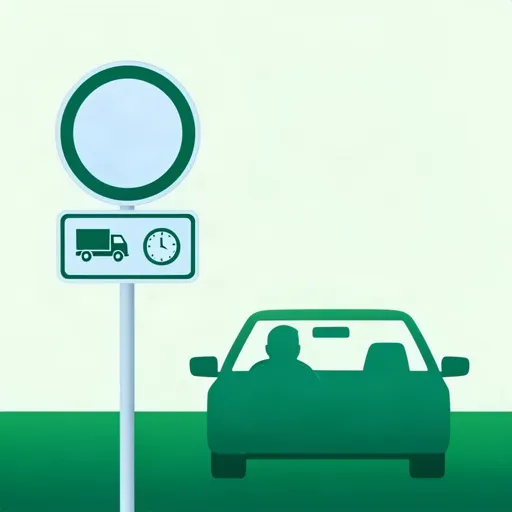
Article content overview
Understanding the nuances of the Straßenverkehrs-Ordnung (StVO) is the cornerstone of passing your German theory exam. While a standard speed limit sign is straightforward, many roads in Germany feature "Zusatzschilder"—supplementary panels that fundamentally change the rules based on vehicle type, time of day, or current weather conditions. Misinterpreting these is one of the most common reasons for errors in the theoretical test, as students often incorrectly assume that a speed limit applies universally to all vehicles at all times.
A speed limit sign, formally known as Zeichen 274, is often accompanied by an icon below it. These icons dictate which vehicles are legally bound by the speed restriction. If you see a speed limit sign paired with a truck silhouette, that regulation applies only to vehicles exceeding 3.5 tonnes. A passenger car driver passing such a sign is not bound by the limit unless otherwise posted, and should instead follow the general speed limit for that road type—such as 100 km/h on rural roads or the recommended speed on the Autobahn.
Common traps in the theory exam involve showing a speed limit with a "car towing a trailer" icon. Drivers often assume this applies to all cars. In reality, a car without a trailer is not affected by this specific restriction. Always check the exact silhouette on the Zusatzschild to determine if your vehicle category is being addressed.
One of the most critical safety regulations you must master is the "bei Nässe" (in wet conditions) supplementary sign. When you see a speed limit sign combined with this panel, the limit is legally binding the moment the road surface is covered by a film of water. This is not restricted to heavy downpours; if the road is sufficiently wet to cause spray from the tires of leading vehicles, the limit applies.
The "bei Nässe" sign is legally binding based on the state of the road, not the weather forecast. If the road surface is covered in a continuous layer of water, you must adhere to the posted limit, even if it has stopped raining. Failure to do so can result in significant fines and points in the Fahreignungsregister.
Drivers often mistakenly believe they can ignore this sign if it is only drizzling. However, the legal definition of a "wet" road in Germany is quite precise: there must be a visible, consistent water film on the surface. If you see spray behind the vehicle in front of you, you are legally required to treat the road as wet and obey the restricted speed limit.
Near schools, construction zones, or residential areas, you will frequently encounter speed limits that only apply during specific hours. These are usually indicated by a time range, such as "7–17 Uhr" or "Montag bis Freitag." These signs serve to protect vulnerable road users during peak traffic or school commute times.
If you pass a 30 km/h sign with a time-based restriction outside of the posted hours, the default speed limit for that zone—typically 50 km/h within built-up areas (innerhalb geschlossener Ortschaften)—applies once more. Being aware of the time and the current road conditions is just as important as reading the signs themselves.
| Supplementary Sign | Target Audience / Condition |
|---|---|
| Truck Icon | Trucks over 3.5t |
| Trailer Icon | Towing vehicles with trailers |
| "Bei Nässe" | All vehicles, if the road surface is wet |
| Time (e.g., 7-17h) | All vehicles during specified hours |
This article teaches how to interpret Zeichen 274 speed limit signs when accompanied by supplementary panels that add conditions based on vehicle type, weather, or time. The most critical distinction is that vehicle-specific icons (truck, trailer) restrict limits to only those vehicle categories, while weather-conditional signs like bei Nässe apply to all vehicles once the road surface is visibly wet. Time-based restrictions follow posted hours only, reverting to standard limits outside those periods. Understanding these conditional layers is essential for avoiding common theory exam errors and for legal, safe driving on German roads.
A short set of high-value points that capture the most important ideas from this article.
Supplementary signs (Zusatzschilder) can fundamentally change a speed limit by restricting it to specific vehicle types, weather conditions, or time periods
A speed limit sign with a truck icon applies only to vehicles over 3.5 tonnes; passenger cars must follow the general road speed limit instead
The bei Nässe (wet conditions) limit is triggered by a visible water film on the road surface, not by rainfall or weather forecasts
Time-based speed restrictions near schools and residential areas are only active during the posted hours; outside those hours, standard limits apply
Always identify Zeichen 274 first, then check for any attached supplementary panels before determining your applicable speed limit
A car towing a trailer icon restricts only vehicles actually towing a trailer; a car without a trailer is not bound by this limit
In Germany, a road is legally 'wet' (nässe) when a continuous water film is visible, or when spray from the vehicle ahead is visible
Trucks over 3.5t are the only vehicles affected when a speed limit sign includes a truck silhouette icon
Inside built-up areas (innerhalb geschlossener Ortschaften), the default speed limit is 50 km/h unless otherwise posted
The Fahreignungsregister (Flensburg register) records penalties for failing to obey conditional speed limits when conditions are met
Assuming a speed limit with a truck icon applies to all vehicles, including passenger cars
Ignoring a bei Nässe restriction during light drizzle when the road surface is still dry
Forgetting to check time-based restrictions and continuing to obey a reduced limit outside posted hours
Assuming a car with a trailer icon applies to cars without trailers
Believing the bei Nässe sign is advisory rather than legally binding when wet conditions are present
Article content overview
A short set of high-value points that capture the most important ideas from this article.
Supplementary signs (Zusatzschilder) can fundamentally change a speed limit by restricting it to specific vehicle types, weather conditions, or time periods
A speed limit sign with a truck icon applies only to vehicles over 3.5 tonnes; passenger cars must follow the general road speed limit instead
The bei Nässe (wet conditions) limit is triggered by a visible water film on the road surface, not by rainfall or weather forecasts
Time-based speed restrictions near schools and residential areas are only active during the posted hours; outside those hours, standard limits apply
Always identify Zeichen 274 first, then check for any attached supplementary panels before determining your applicable speed limit
A car towing a trailer icon restricts only vehicles actually towing a trailer; a car without a trailer is not bound by this limit
In Germany, a road is legally 'wet' (nässe) when a continuous water film is visible, or when spray from the vehicle ahead is visible
Trucks over 3.5t are the only vehicles affected when a speed limit sign includes a truck silhouette icon
Inside built-up areas (innerhalb geschlossener Ortschaften), the default speed limit is 50 km/h unless otherwise posted
The Fahreignungsregister (Flensburg register) records penalties for failing to obey conditional speed limits when conditions are met
Assuming a speed limit with a truck icon applies to all vehicles, including passenger cars
Ignoring a bei Nässe restriction during light drizzle when the road surface is still dry
Forgetting to check time-based restrictions and continuing to obey a reduced limit outside posted hours
Assuming a car with a trailer icon applies to cars without trailers
Believing the bei Nässe sign is advisory rather than legally binding when wet conditions are present
Explore related topics, search based questions, and concepts that learners often look up when studying Understanding German Speed Limits and Supplementary Signs. These themes reflect real search intent and help you understand how this topic connects to wider driving theory knowledge in Germany.
Find clear and practical answers to common questions learners often have about Understanding German Speed Limits and Supplementary Signs. This section helps explain difficult points, remove confusion, and reinforce the key driving theory concepts that matter for learners in Germany.
A speed limit sign accompanied by a truck icon applies only to trucks over 3.5 tons. Other vehicle categories, such as passenger cars, are not bound by this specific limit.
The term 'bei Nässe' means that a visible water film must be present on the road surface. Individual puddles or simple dampness do not count as 'wet' for the purposes of these speed limits.
No, time-conditional limits, such as those often found near schools, only apply during the hours and days specified on the supplementary sign. Outside these times, the standard speed limit for that road type applies.
If a supplementary sign shows a vehicle silhouette, the limit applies only to that vehicle category. If no vehicle icon is present, or if a generic car icon is shown, the speed limit applies to all vehicles.
Didn't find what you were looking for? Continue your German driving theory preparation by exploring related articles, specific road sign categories, or in-depth guides on complex traffic situations. Deepen your understanding before the official test.