
Adapting to current conditions is a fundamental requirement under §1 StVO, and official digital alerts provide the critical information needed to fulfill this duty. This guide clarifies how to integrate warnings from the Deutscher Wetterdienst and NINA into your driving preparation without falling into the trap of distracted driving. Learn how to balance modern navigation aids with the strict requirement for constant attentiveness to the road environment.
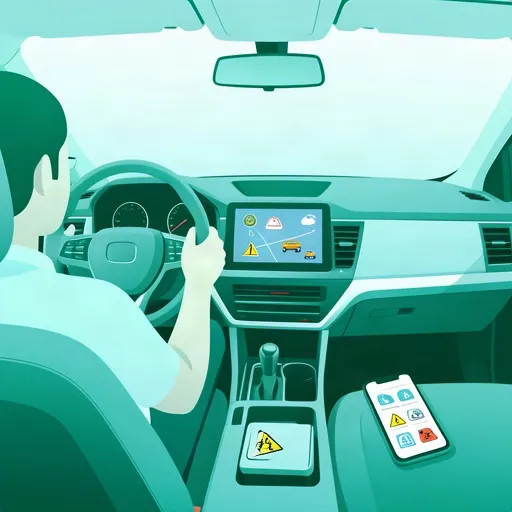
Article content overview
In the context of the German driving theory exam, the concept of "driving responsibly" goes far beyond simply knowing the traffic rules. Under §1 of the Straßenverkehrs-Ordnung (StVO), every road user is required to act with constant caution and mutual respect. A fundamental component of this legal duty is the requirement to adapt your driving style to foreseeable conditions, including weather and traffic patterns. Using modern digital tools effectively can help you fulfill this duty, but failing to heed official warnings can significantly impact your liability if an accident occurs.
The German theory test frequently emphasizes that a driver’s responsibility begins before they even start the engine. If official sources, such as the Deutscher Wetterdienst (DWD), issue warnings for your area, you are legally expected to factor this information into your journey planning. Ignorance of an available, widely publicized weather warning is rarely accepted as an excuse in an insurance claim or a legal proceeding.
Ignoring official "Unwetterwarnungen" (severe weather warnings) before embarking on a trip can be interpreted as negligence. If you are involved in an accident during extreme weather, failing to demonstrate that you adjusted your speed and driving behavior to the reported conditions can lead to a significant increase in your share of the liability.
To drive defensively, you must understand which information sources are reliable and how to prioritize them. Not all digital inputs carry the same weight when it comes to traffic safety.
The Deutscher Wetterdienst (DWD) is the primary source for meteorological data in Germany. Their app provides real-time alerts on a four-level severity scale. When combined with the NINA (Notfall-Informations- und Nachrichten-App) system, these warnings are pushed directly to your smartphone. These tools are designed to inform you of hazards like ice, heavy rain, or storm gusts before you encounter them on the road.
Regional radio stations continue to be the backbone of German traffic reporting. Broadcasts, often featuring ADAC data, provide up-to-the-minute information on motorway congestions and incidents. These reports are particularly vital because they are often more immediate than general navigation software when it comes to sudden accidents or road blocks.
Services like autobahn.de and integrated map data are excellent for route planning and identifying construction zones (Baustellen). However, drivers must never prioritize a navigation screen over their actual visual environment.
A common trap in the theory exam involves scenarios where a driver uses a digital device while behind the wheel. While apps provide useful data, the law is strict: you may not interact with mobile devices in a way that distracts you from the primary task of driving. Using a navigation app is permitted, but only if it is mounted securely and does not require manual input while the vehicle is in motion.
In your theory exam, always choose the answer that prioritizes "looking at the road" and "observing traffic flow" over checking navigation aids or digital weather updates. Your eyes must remain on the road environment at all times.
When the Deutscher Wetterdienst reports high winds or heavy rain, the "safe speed" is almost always significantly lower than the legal maximum or the Richtgeschwindigkeit of 130 km/h. On the Autobahn, you must ensure your following distance is sufficient to allow for emergency braking. As a general rule, your distance in meters should be at least half of your current speed in km/h. In adverse weather, this distance must be increased further.
This article explains how German drivers must use official digital tools to fulfill their legal duty of care under §1 StVO, which requires adapting driving behavior to weather and traffic conditions. The content outlines a clear hierarchy of information sources, with DWD and NINA providing the most authoritative warnings, followed by regional radio traffic reports and navigation services. A key practical rule is the half-speed following distance formula, which must be extended during adverse weather. The article also emphasizes that ignoring official Unwetterwarnungen can be interpreted as negligence in accident liability cases, and that navigation devices must never be manually operated while driving.
A short set of high-value points that capture the most important ideas from this article.
Under §1 StVO, drivers must adapt to foreseeable weather and traffic conditions, and ignorance of official warnings is not accepted as an excuse in liability cases
The official warning hierarchy places DWD and NINA alerts at the top, followed by regional radio traffic reports (Verkehrsfunk), then navigation services
Digital navigation aids are permitted only when mounted securely and must never be manually operated while driving
Safe speed during adverse weather is typically well below the legal maximum or the 130 km/h Richtgeschwindigkeit
The following distance rule of at least half your speed in meters must be increased further in poor conditions
DWD issues Unwetterwarnungen on a four-level severity scale for conditions like ice, heavy rain, and storm gusts
NINA (Notfall-Informations- und Nachrichten-App) pushes emergency alerts directly to your smartphone
Regional radio with ADAC data provides the most immediate updates on motorway incidents and congestion
You may not interact with mobile devices manually while the vehicle is in motion
The half-speed rule (speed in km/h ÷ 2 = minimum following distance in meters) applies on the Autobahn
Assuming that simply having a navigation app running satisfies the duty to monitor conditions
Using mobile devices for manual input while driving, even to check weather updates
Failing to increase following distance when adverse weather warnings have been issued
Relying solely on navigation apps instead of prioritizing radio traffic reports for real-time incidents
Assuming the 130 km/h Richtgeschwindigkeit is safe during severe weather conditions
Article content overview
A short set of high-value points that capture the most important ideas from this article.
Under §1 StVO, drivers must adapt to foreseeable weather and traffic conditions, and ignorance of official warnings is not accepted as an excuse in liability cases
The official warning hierarchy places DWD and NINA alerts at the top, followed by regional radio traffic reports (Verkehrsfunk), then navigation services
Digital navigation aids are permitted only when mounted securely and must never be manually operated while driving
Safe speed during adverse weather is typically well below the legal maximum or the 130 km/h Richtgeschwindigkeit
The following distance rule of at least half your speed in meters must be increased further in poor conditions
DWD issues Unwetterwarnungen on a four-level severity scale for conditions like ice, heavy rain, and storm gusts
NINA (Notfall-Informations- und Nachrichten-App) pushes emergency alerts directly to your smartphone
Regional radio with ADAC data provides the most immediate updates on motorway incidents and congestion
You may not interact with mobile devices manually while the vehicle is in motion
The half-speed rule (speed in km/h ÷ 2 = minimum following distance in meters) applies on the Autobahn
Assuming that simply having a navigation app running satisfies the duty to monitor conditions
Using mobile devices for manual input while driving, even to check weather updates
Failing to increase following distance when adverse weather warnings have been issued
Relying solely on navigation apps instead of prioritizing radio traffic reports for real-time incidents
Assuming the 130 km/h Richtgeschwindigkeit is safe during severe weather conditions
Explore related topics, search based questions, and concepts that learners often look up when studying Using Weather and Traffic Data in Germany. These themes reflect real search intent and help you understand how this topic connects to wider driving theory knowledge in Germany.
Find clear and practical answers to common questions learners often have about Using Weather and Traffic Data in Germany. This section helps explain difficult points, remove confusion, and reinforce the key driving theory concepts that matter for learners in Germany.
Yes, under §1 StVO, you are expected to adapt your driving to prevailing conditions. If an official, publicly accessible warning (like those from the DWD or NINA) exists, failing to adjust your behavior or cancel a trip in extreme conditions can negatively impact your insurance coverage and legal liability.
You must never interact with digital map displays, smartphone apps, or navigation systems while the vehicle is in motion. Any information, such as route updates or traffic warnings, should be checked before starting your journey or by a passenger, as distracted driving is a severe safety violation and a common exam trap.
NINA (Notfall-Informations- und Nachrichten-App) is the official federal warning app that provides real-time push notifications about emergency situations, including severe weather, flooding, and major road closures, helping you stay informed about hazards on your route.
Didn't find what you were looking for? Continue your German driving theory preparation by exploring related articles, specific road sign categories, or in-depth guides on complex traffic situations. Deepen your understanding before the official test.