Many learners struggle with the ambiguity of a yellow light, often mistaking it for an invitation to accelerate before the signal turns red. This guide breaks down the official regulations under the Polish 'Prawo o ruchu drogowym', helping you distinguish between a legal obligation to stop and the rare scenarios where sudden braking poses a greater safety risk. Mastering this decision-making process is essential for both your practical driving safety and your success on the official theory exam.
Article content overview
Understanding how to react to a yellow traffic signal is one of the most critical skills for any driver in Poland. While it might seem straightforward, the legal interpretation of a yellow light often catches learners off guard during their theory examinations. Under the Polish Prawo o ruchu drogowym (Road Traffic Act), the traffic light system acts as the primary authority at an intersection, overriding most static road signs. Misinterpreting these signals is not only a common cause of driving test failures but can also lead to significant fines and penalty points on the road.
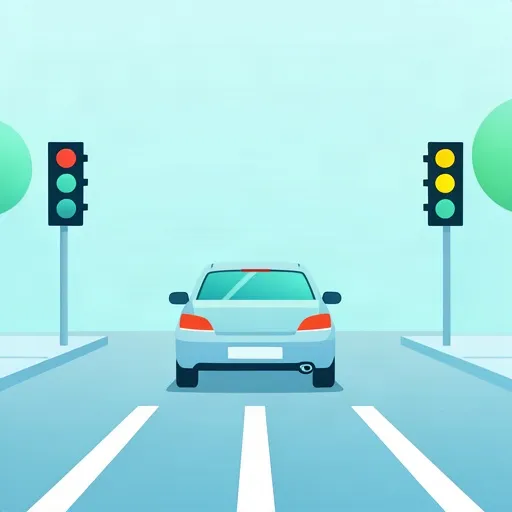
In Poland, a yellow signal is not an invitation to accelerate and clear the intersection before the light turns red; rather, it is a signal of prohibition. According to official regulations, a yellow light indicates that a driver is forbidden from entering the intersection or passing beyond the stop line. The only legal exception to this rule is a situation where stopping the vehicle would require sudden, violent braking that could create a hazardous condition for other road users, particularly those following closely behind you.
Many learners mistakenly believe that a yellow light gives them a "grace period" to drive through. In the eyes of Polish law, if you had sufficient distance to stop safely but chose to speed up to "beat the light," you are committing a traffic violation.
The decision-making process at a yellow light should be based on defensive driving principles rather than haste. You must continuously scan the road ahead as you approach a junction. If you see that the signal has been green for a significant amount of time, it is highly likely to change; in such cases, you should proactively adjust your speed to allow for a smooth stop.
Polish traffic regulation differentiates between standard circular signals (S-1) and directional signals (S-3). When you see a standard S-1 signal, you are generally permitted to turn, provided you yield to traffic that has priority. However, S-3 directional signals provide a "protected" phase. If you are at an intersection with an S-3 signal, you can only proceed—or turn—when the specific arrow for your direction is illuminated. Failing to follow these signals, or attempting to perform maneuvers that the signal does not permit (like turning on a straight-only arrow), is a frequent cause of failed theory exam questions.
In Poland, while automated traffic cameras are primarily calibrated to detect red-light violations, police patrols frequently monitor intersections for improper yellow-light maneuvers. A violation of these rules can result in a fine and, notably, the accumulation of penalty points. Given that new drivers in Poland face stricter limits on allowed penalty points before they risk losing their license, mastering the discipline required at traffic lights is essential for long-term driving safety and compliance.
Article content overview
Explore related topics, search based questions, and concepts that learners often look up when studying Yellow Light Rules in Poland. These themes reflect real search intent and help you understand how this topic connects to wider driving theory knowledge in Poland.
Find clear and practical answers to common questions learners often have about Yellow Light Rules in Poland. This section helps explain difficult points, remove confusion, and reinforce the key driving theory concepts that matter for learners in Poland.
No. Under Polish law, the yellow signal indicates a prohibition to enter the intersection. Passing on yellow is only permitted if stopping your vehicle would require sudden, emergency braking that could endanger other road users.
While traffic cameras primarily target red-light violations, police officers on patrol can still issue a fine and penalty points for failing to stop at a yellow light if the situation did not justify proceeding.
The exam tests your ability to recognize that yellow is a signal to stop, not an acceleration warning. You will likely face scenarios requiring you to identify the correct behavior based on the distance to the intersection.
After finding your specific article, continue your targeted learning by exploring related topics or diving deeper into practice questions. Our extensive library ensures you have all the resources needed to confidently prepare for your Polish driving license theory exam. Discover more guides and solidify your understanding of Polish road rules.