
Understanding how to effectively use an acceleration lane is critical for passing your driving theory exam and ensuring safety on Polish roads. This article breaks down the legal obligations of the driver, the importance of speed matching, and why stopping on an acceleration lane is a prohibited and dangerous maneuver. You will learn the exact distinction between standard merging and the 'zipper merge' to avoid common pitfalls during your examination.
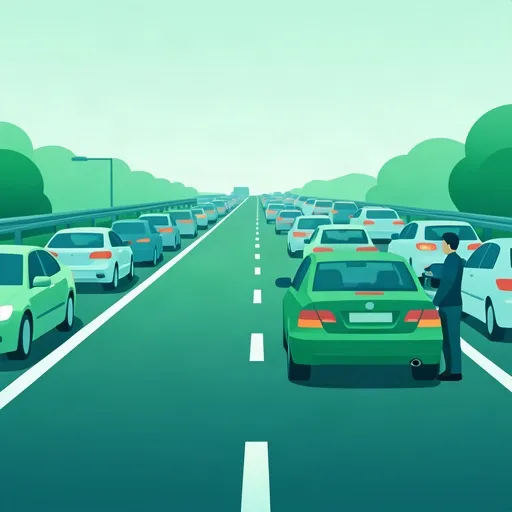
Article content overview
Entering a motorway or an expressway in Poland is a high-stakes maneuver that demands precision, confidence, and a thorough understanding of the Road Traffic Act. For many learner drivers, the acceleration lane (pas rozbiegowy) is a source of anxiety, often leading to common mistakes that can result in failing the driving theory exam or, more importantly, creating hazardous situations on the road. Understanding that this lane is designed exclusively for speed matching—not for merging via a 'zipper' or stopping—is the key to mastering motorway entry.
In Poland, an acceleration lane exists to provide a space where a vehicle can safely increase its speed to match the flow of traffic on the main motorway lanes. The objective is simple: you must reach a speed that allows you to blend into the main traffic stream without forcing other drivers to brake or change lanes abruptly. Many learners mistakenly believe they should treat the end of the slip road as a point where they have the right of way. In reality, the legal responsibility for a safe entry rests entirely on the driver entering the motorway.
Stopping on an acceleration lane is not only a dangerous error that disrupts traffic flow but is also a violation of Polish law. Under Art. 90 of the Code of Petty Offences, stopping or obstructing traffic in such a manner can lead to significant fines. Always use the full length of the lane to reach the appropriate speed before attempting to merge.
One of the most frequent points of confusion in Polish driving theory is the application of the "zipper merge" (jazda na suwak). It is critical to understand that the statutory zipper merge only applies when a lane is ending due to an obstacle or a reduction in the number of lanes, and traffic is moving at a very slow pace.
The zipper merge rule does not apply to acceleration lanes. When you are entering a motorway, you are effectively performing a lane change. According to Art. 23 of the Road Traffic Act, a driver changing lanes is required to yield to any vehicle already traveling in the lane they intend to enter. You do not have priority, and you cannot demand that other drivers let you in.
In the Polish theory exam, questions regarding motorway entry often focus on the hierarchy of priority and the technical definition of the maneuver. You must remember that traffic on the main carriageway has the absolute right of way. If you cannot merge safely because of heavy traffic, you must wait until a sufficient gap appears, but you should never stop at the beginning of the slip road if there is still room to accelerate.
The examiners look for your ability to judge traffic speed and distance. A common mistake is failing to accelerate sufficiently, resulting in an entry speed of 60-70 km/h when main-road traffic is moving at 120-140 km/h. This mismatch creates a "bottleneck" effect, forcing other drivers to react, which is a major safety violation and a reason for exam failure.
A section of the road designed to allow vehicles entering a motorway or expressway to increase their speed to match that of the main traffic flow before merging.
To ensure you navigate these areas correctly, keep the following table in mind as a summary of your obligations when entering a high-speed road:
| Scenario | Rule | Priority |
|---|---|---|
| Merging from Slip Road | You are performing a lane change | Yield to main lane traffic |
| Traffic Jam (Lane Closure) | Zipper Merge (Jazda na suwak) | Alternating entry applies |
| Empty Motorway | Match speed to traffic | You control the entry |
Article content overview
Explore related topics, search based questions, and concepts that learners often look up when studying Using Polish Acceleration Lanes. These themes reflect real search intent and help you understand how this topic connects to wider driving theory knowledge in Poland.
Find clear and practical answers to common questions learners often have about Using Polish Acceleration Lanes. This section helps explain difficult points, remove confusion, and reinforce the key driving theory concepts that matter for learners in Poland.
No. According to Polish traffic law, vehicles on the acceleration lane do not have an inherent right of way. You must yield to vehicles already on the main lane you are attempting to join.
No. The zipper merge rule only applies when a lane ends and there is significant traffic congestion. It does not apply to entering a motorway via an acceleration lane or slip road.
No. Stopping on an acceleration lane is forbidden as it impedes traffic flow and creates a significant hazard. You should use the entire length of the lane to reach a speed matching the traffic on the motorway.
Yes, but only if you are using the acceleration lane for its intended purpose of joining the main carriageway at an appropriate speed and doing so safely.
After finding your specific article, continue your targeted learning by exploring related topics or diving deeper into practice questions. Our extensive library ensures you have all the resources needed to confidently prepare for your Polish driving license theory exam. Discover more guides and solidify your understanding of Polish road rules.