
Understanding the precise difference between a parking ban and a stopping ban is a fundamental requirement for every driver in Poland. This guide clarifies the legal definitions of stopping and parking, explains how to identify the effective range of these signs, and highlights how supplementary plates can change the rules of the road. By learning these regulations, you will improve your situational awareness and be better prepared for the theoretical driving exam.
Article content overview
Understanding the distinction between stopping and parking is a cornerstone of the Polish driving theory exam. Many learners struggle with the nuances of traffic signs that dictate how and where a vehicle may be left. Misinterpreting these regulations is not only a common cause of exam failure but also leads to frequent fines and, in some cases, the towing of your vehicle from restricted zones. By mastering the legal definitions of the B-35 and B-36 signs, you will be better equipped to navigate urban traffic and avoid costly administrative penalties.
In the context of the Polish Road Traffic Act, the duration of your vehicle's immobility determines whether you have "stopped" or "parked." This distinction is the primary reason why drivers often inadvertently trigger fines. A "stop" (zatrzymanie) is defined as any voluntary cessation of vehicle movement lasting no longer than one minute, or any involuntary cessation of movement resulting from traffic conditions or regulations. "Parking" (postój), on the other hand, refers to any voluntary cessation of vehicle movement that lasts longer than one minute.
The intentional cessation of vehicle movement, lasting no longer than one minute, or any cessation of movement resulting from traffic conditions (e.g., waiting at a red light or in a traffic jam).
The intentional cessation of vehicle movement, lasting longer than one minute, which is not caused by traffic conditions or regulations.
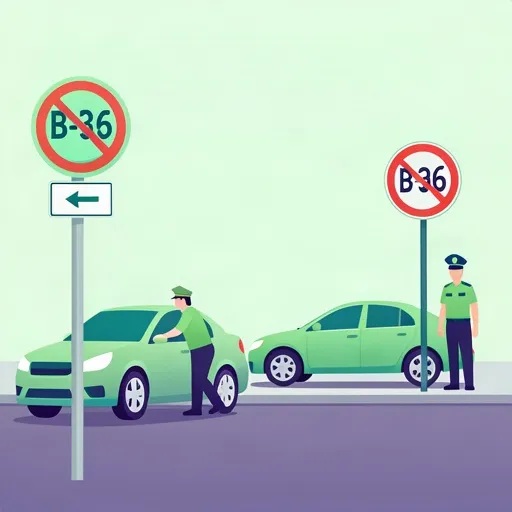
The B-35 and B-36 signs are among the most important prohibitions you will encounter on Polish roads. While they may appear visually similar, their legal impact is significantly different.
Drivers often assume that the B-35 sign allows them to park "just for a minute." This is a critical error. The B-35 prohibits parking (longer than one minute), while the B-36 prohibits stopping entirely. If you stop under a B-36 sign to pick up a passenger, you are committing a traffic violation.
A common exam trap involves ignoring the supplementary plates (tabliczki) placed beneath the main sign. These plates often dictate the specific duration, the start or end of the restriction, or the physical range of the ban. The ban expressed by the B-35 or B-36 sign generally applies to the side of the road on which the sign is placed and remains in effect until the nearest intersection. However, if a supplementary plate with an arrow (like the T-25c series) is present, it will explicitly mark the beginning, continuation, or end of the restriction.
| Feature | B-35 (No Parking) | B-36 (No Stopping) |
|---|---|---|
| Duration allowed | Up to 1 minute | 0 minutes |
| Allowed maneuver | Dropping off passengers | Only traffic-enforced stops |
| Common exception | Does not apply if road signs/markings say otherwise | Only for emergency or traffic necessity |
| End of restriction | Next intersection or end sign | Next intersection or end sign |
When preparing for your theory exam, pay close attention to questions that place these signs near pedestrian crossings, intersections, or public transport stops. Remember that the law also imposes general prohibitions on stopping and parking in specific locations (e.g., within 10 meters of a pedestrian crossing or intersection) that exist independently of road signs. Even if you do not see a B-36 sign, you may still be breaking the law by stopping in these prohibited areas. Always verify if the spot is an official parking zone indicated by a D-18 sign with a T-30 supplementary plate, which specifies the required parking orientation.
The B-35 and B-36 signs in Poland govern different restrictions: B-35 prohibits parking (voluntary immobility over 1 minute) while B-36 prohibits all stopping (immobility under any duration). Understanding the 1-minute threshold is essential for both avoiding fines and passing exam questions. Both signs apply to the road side where they are placed and remain in force until the next intersection or an end sign, though supplementary plates can modify this scope. Beyond these signs, general traffic law independently prohibits stopping within 10 meters of crossings and intersections, making visual awareness critical regardless of signage.
A short set of high-value points that capture the most important ideas from this article.
The 1-minute rule is the key differentiator: stopping (zatrzymanie) lasts up to 1 minute, parking (postój) lasts longer than 1 minute.
B-35 (No Parking) prohibits leaving your vehicle for more than 1 minute but allows brief stops such as dropping off passengers.
B-36 (No Stopping) prohibits any stopping whatsoever unless required by traffic conditions, regulations, or vehicle breakdown.
The restriction imposed by both signs generally applies only to the roadside where the sign is placed.
Supplementary plates like T-25c can modify the scope, direction, or duration of the ban indicated by B-35 or B-36.
B-35 permits stops up to 1 minute; B-36 permits zero stopping—both have different legal consequences.
The ban ends at the next intersection or when an end-of-restriction sign is posted.
General traffic law prohibits stopping within 10 meters of pedestrian crossings and intersections independently of any signs.
A D-18 sign combined with a T-30 plate marks an official parking zone with specific orientation requirements.
Traffic-related stops (red lights, congestion) are excluded from both definitions of stopping and parking.
Assuming B-35 allows parking for 'just a minute'—B-35 prohibits parking over 1 minute, not stopping under 1 minute.
Ignoring supplementary plates that can narrow or extend the effective range of the restriction.
Forgetting that stopping near pedestrian crossings and intersections is prohibited by general law even without a B-36 sign.
Confusing the directional application of signs and assuming the restriction applies to both sides of the road.
Believing emergency stops are prohibited under B-36—vehicle breakdowns or traffic necessity are valid exceptions.
Article content overview
A short set of high-value points that capture the most important ideas from this article.
The 1-minute rule is the key differentiator: stopping (zatrzymanie) lasts up to 1 minute, parking (postój) lasts longer than 1 minute.
B-35 (No Parking) prohibits leaving your vehicle for more than 1 minute but allows brief stops such as dropping off passengers.
B-36 (No Stopping) prohibits any stopping whatsoever unless required by traffic conditions, regulations, or vehicle breakdown.
The restriction imposed by both signs generally applies only to the roadside where the sign is placed.
Supplementary plates like T-25c can modify the scope, direction, or duration of the ban indicated by B-35 or B-36.
B-35 permits stops up to 1 minute; B-36 permits zero stopping—both have different legal consequences.
The ban ends at the next intersection or when an end-of-restriction sign is posted.
General traffic law prohibits stopping within 10 meters of pedestrian crossings and intersections independently of any signs.
A D-18 sign combined with a T-30 plate marks an official parking zone with specific orientation requirements.
Traffic-related stops (red lights, congestion) are excluded from both definitions of stopping and parking.
Assuming B-35 allows parking for 'just a minute'—B-35 prohibits parking over 1 minute, not stopping under 1 minute.
Ignoring supplementary plates that can narrow or extend the effective range of the restriction.
Forgetting that stopping near pedestrian crossings and intersections is prohibited by general law even without a B-36 sign.
Confusing the directional application of signs and assuming the restriction applies to both sides of the road.
Believing emergency stops are prohibited under B-36—vehicle breakdowns or traffic necessity are valid exceptions.
Explore related topics, search based questions, and concepts that learners often look up when studying B-35 and B-36 Parking Signs. These themes reflect real search intent and help you understand how this topic connects to wider driving theory knowledge in Poland.
Find clear and practical answers to common questions learners often have about B-35 and B-36 Parking Signs. This section helps explain difficult points, remove confusion, and reinforce the key driving theory concepts that matter for learners in Poland.
The B-35 sign prohibits parking (postój), allowing for a stop of up to one minute, for example, to drop off a passenger. The B-36 sign prohibits stopping (zatrzymywanie) entirely, meaning you cannot stop for any duration unless required by traffic conditions or regulations.
Unless indicated otherwise by supplementary plates, the prohibition imposed by B-35 and B-36 signs is effective until the nearest intersection.
Yes, absolutely. Supplementary plates (tabliczki) often define the specific hours of operation, the length of the prohibited zone, or clarify if the ban starts or ends at that point. Ignoring these plates is a common cause of fines.
You may only stop in a B-36 zone if the stop is forced by traffic conditions (e.g., waiting in a traffic jam), local regulations, or an emergency/vehicle failure.
After finding your specific article, continue your targeted learning by exploring related topics or diving deeper into practice questions. Our extensive library ensures you have all the resources needed to confidently prepare for your Polish driving license theory exam. Discover more guides and solidify your understanding of Polish road rules.