Understanding how road markings and parking signs interact is a fundamental skill for any driver in Poland. This guide breaks down the legal requirements for parking, the interpretation of prohibition signs, and the specific rules surrounding modern urban zones, ensuring you are fully prepared to navigate these scenarios both on the road and during your official theory examination.
Article content overview
Navigating Polish roads requires more than just knowing how to operate a vehicle; it demands a precise understanding of the signage and road markings that dictate traffic flow and parking regulations. Many candidates preparing for the Polish driving theory exam often underestimate the complexity of parking rules, leading to common mistakes that are both costly and dangerous. Mastering these regulations is essential for passing your exam and ensuring you remain a compliant, safe driver on the road.
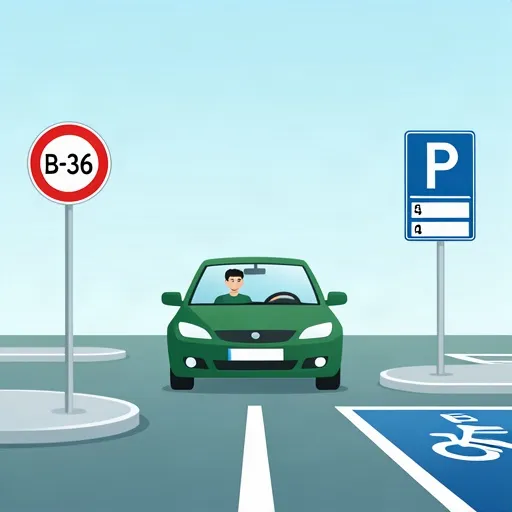
One of the most frequent sources of confusion for new drivers in Poland involves the difference between the B-35 (no parking) and B-36 (no stopping) signs. Misinterpreting these can lead to immediate fines, as the authorities strictly enforce these prohibitions.
It is crucial to remember that the B-36 sign is absolute. If you stop to "just run into a shop for a second," you are in violation of the rules. Conversely, the B-35 sign allows for a short, one-minute window for loading or unloading, but this time limit is strictly observed by municipal authorities. If a sign includes a supplementary plate, such as "T-25c," always check the arrows to see if the prohibition is starting, ending, or continuing along that section of the road.
Road markings in Poland are legally binding instructions, not just suggestions. A common error is parking on or partially overlapping with "pola wyłączone z ruchu" (areas excluded from traffic). These are typically marked by white slanted lines within a boundary.
These areas are designed to protect road users, and encroachment on them can lead to significant penalties, including vehicle towing. Always ensure your vehicle is parked entirely within designated lines when required, and never treat unmarked spaces as "temporary parking" if they fall within restricted zones.
As urban mobility changes, Poland has introduced specific signs for eco-friendly and transit-oriented parking. Understanding these is essential for modern driving scenarios.
The green parking spots designated for electric vehicles (EV) are governed by the law on electromobility. These are not merely suggestions; parking a combustion engine vehicle in a spot designated for electric vehicle charging is a specific violation. Similarly, signs like P+R (Park and Ride) are designed to reduce urban traffic by encouraging drivers to leave their vehicles and use public transport. Recognizing these signs early helps you make better decisions and avoids unnecessary fines while supporting urban mobility.
The Polish theory exam frequently presents situational questions that combine multiple signs or ask about the reach of a prohibition. For instance, a common trap is assuming a parking ban is lifted without a clear end signal. In the absence of an "end of zone" sign, a parking prohibition typically extends until the next intersection.
This article clarifies the critical distinction between B-35 (no parking) and B-36 (no stopping) signs, emphasizing that B-36 is an absolute prohibition while B-35 permits stops under one minute. It explains the legal weight of horizontal road markings and forbidden areas, highlighting that even partial overlap constitutes a violation. The content also covers modern parking solutions including electric vehicle zones and P+R facilities, which carry specific legal consequences for unauthorized use. A practical step-by-step method is provided for evaluating parking legality, and key Polish terminology is defined in the glossary for exam preparation.
A short set of high-value points that capture the most important ideas from this article.
The B-35 sign prohibits parking (postój) for longer than one minute, allowing only brief stops for passenger drop-off or unloading.
The B-36 sign prohibits any stopping (zatrzymanie) of the vehicle, regardless of duration, making it an absolute prohibition.
Parking partially on forbidden areas marked by white slanted lines is still a violation, even if most of the vehicle is outside the markings.
Electric vehicle charging spots and P+R (Park and Ride) zones have specific legal status and violations for non-authorized vehicles.
In the absence of an end-of-zone sign, parking prohibitions typically extend until the next intersection.
Postój (parking) = vehicle stationary for more than one minute; Zatrzymanie (stopping) = less than one minute or required by traffic conditions.
B-36 is absolute — no stopping allowed under any circumstance unless mandated by traffic regulations.
Forbidden areas (pola wyłączone z ruchu) are protected to ensure visibility at intersections and space for turning vehicles.
Check supplementary plates like T-25c for arrows indicating where prohibition starts, ends, or continues.
A D-18 sign confirms a designated legal parking area when parking restrictions are unclear.
Assuming a brief stop to 'run into a shop' is allowed under B-36 — this is a violation of the absolute no-stopping rule.
Believing that partially overlapping forbidden area lines is acceptable — any encroachment counts as a violation.
Failing to look for an end-of-zone sign and assuming a parking ban lifts immediately after passing a sign.
Parking a combustion engine vehicle in an electric vehicle charging spot, not realizing it is a specific legal violation.
Misreading supplementary plate arrows, causing the driver to misunderstand the spatial reach of a prohibition.
Article content overview
A short set of high-value points that capture the most important ideas from this article.
The B-35 sign prohibits parking (postój) for longer than one minute, allowing only brief stops for passenger drop-off or unloading.
The B-36 sign prohibits any stopping (zatrzymanie) of the vehicle, regardless of duration, making it an absolute prohibition.
Parking partially on forbidden areas marked by white slanted lines is still a violation, even if most of the vehicle is outside the markings.
Electric vehicle charging spots and P+R (Park and Ride) zones have specific legal status and violations for non-authorized vehicles.
In the absence of an end-of-zone sign, parking prohibitions typically extend until the next intersection.
Postój (parking) = vehicle stationary for more than one minute; Zatrzymanie (stopping) = less than one minute or required by traffic conditions.
B-36 is absolute — no stopping allowed under any circumstance unless mandated by traffic regulations.
Forbidden areas (pola wyłączone z ruchu) are protected to ensure visibility at intersections and space for turning vehicles.
Check supplementary plates like T-25c for arrows indicating where prohibition starts, ends, or continues.
A D-18 sign confirms a designated legal parking area when parking restrictions are unclear.
Assuming a brief stop to 'run into a shop' is allowed under B-36 — this is a violation of the absolute no-stopping rule.
Believing that partially overlapping forbidden area lines is acceptable — any encroachment counts as a violation.
Failing to look for an end-of-zone sign and assuming a parking ban lifts immediately after passing a sign.
Parking a combustion engine vehicle in an electric vehicle charging spot, not realizing it is a specific legal violation.
Misreading supplementary plate arrows, causing the driver to misunderstand the spatial reach of a prohibition.
Explore related topics, search based questions, and concepts that learners often look up when studying Polish Parking Signs and Zones. These themes reflect real search intent and help you understand how this topic connects to wider driving theory knowledge in Poland.
Find clear and practical answers to common questions learners often have about Polish Parking Signs and Zones. This section helps explain difficult points, remove confusion, and reinforce the key driving theory concepts that matter for learners in Poland.
Sign B-35 prohibits parking (postój), allowing for a stop shorter than one minute, whereas B-36 prohibits stopping (zatrzymywanie się) entirely, unless forced by traffic conditions or a breakdown.
No, you cannot park on a forbidden area at all. Even if only a small portion of your vehicle overlaps with the marked lines, it is considered a violation of traffic law.
These green spots are specifically reserved for electric vehicles to access charging infrastructure; parking a non-electric vehicle there is a clear traffic violation subject to fines.
P+R (Park and Ride) zones are designed to encourage public transport use. In many Polish cities, parking is free if you possess a valid public transport ticket, but always check the specific local regulations at the site.
After finding your specific article, continue your targeted learning by exploring related topics or diving deeper into practice questions. Our extensive library ensures you have all the resources needed to confidently prepare for your Polish driving license theory exam. Discover more guides and solidify your understanding of Polish road rules.