
Understanding how to safely interact with pedestrians is a cornerstone of the Polish driving theory exam and safe daily driving. This guide breaks down the legal obligations under Article 13 of the Road Traffic Act, focusing on when you must yield and the importance of exercising particular caution. You will learn to navigate urban traffic scenarios and avoid common mistakes that lead to failure in theory tests.
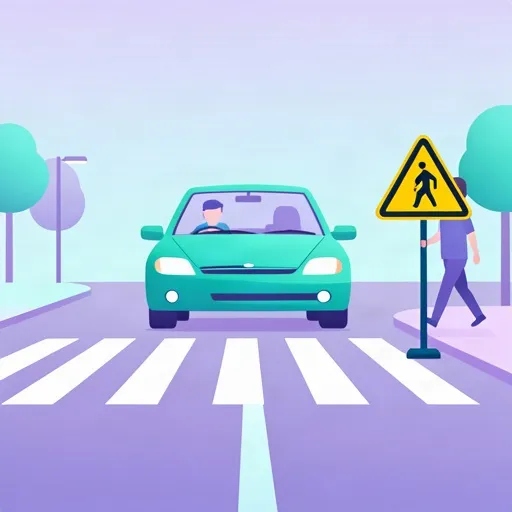
Article content overview
Mastering the rules surrounding pedestrian crossings is perhaps the most critical skill for any learner preparing for the Polish driving theory exam. Recent legislative changes have significantly reinforced the protection of vulnerable road users, making it essential to distinguish clearly between a pedestrian who is already on a crossing and one who is merely approaching or entering it. Failing to grasp these nuances is a common cause of failure in theoretical tests and, more importantly, a major risk factor in real-world urban traffic.
The core of Polish law regarding this subject is found in the Law on Road Traffic. It explicitly mandates that a driver approaching a pedestrian crossing must exercise particular caution and reduce their speed to ensure they do not endanger any pedestrian who is either on the crossing or in the process of entering it. The obligation to yield—ustąpić pierwszeństwa—is absolute, meaning the driver must allow the pedestrian to cross safely without forcing them to speed up, stop, or change their path to avoid a collision.
The obligation to yield means taking actions—such as reducing speed or stopping—that allow a pedestrian to continue their movement across the road without having to wait, accelerate, or halt due to the presence of your vehicle.
A frequent point of confusion for learners is the status of the pedestrian. According to current Polish regulations, you are required to yield not only to those already walking on the zebra crossing but also to those clearly entering it. This expanded priority rule means that if a pedestrian is standing at the edge of the crossing and demonstrating an intention to cross, you must be prepared to stop.
Do not confuse "yielding" with the requirement to wait until the pedestrian has completely vacated the entire width of the road. You may proceed once the pedestrian has passed the path of your vehicle and it is clear that they are no longer in danger, provided they are not forced to alter their behavior.
The theory exam often presents scenarios involving people with limited mobility or those using mobility devices. The law is very specific: when a person with an obvious physical disability, or someone using a dedicated mobility device, is crossing or entering the road, you are strictly required to stop your vehicle to facilitate their safe crossing. This applies even if they are crossing outside of a designated pedestrian crossing, provided their movement is visible and predictable.
Many exam questions focus on dangerous behaviors that lead to immediate disqualification. For example, overtaking a vehicle that has slowed down or stopped to yield to a pedestrian is a severe traffic offense, often resulting in heavy fines and points. Additionally, remember that while pedestrians have priority, they are also subject to rules: they must not enter the road directly in front of an oncoming vehicle or use mobile phones while crossing.
| Situation | Driver's Requirement |
|---|---|
| Pedestrian on crossing | Yield |
| Pedestrian entering crossing | Yield |
| Pedestrian waiting at curb (no intent) | Caution, but no forced stop |
| Person with disability (anywhere) | Stop and facilitate |
| Overtaking at crossing | Strictly prohibited |
Polish pedestrian priority rules under Article 13 require drivers to yield to anyone on or entering a marked crossing and to exercise particular caution by reducing speed. A key exam distinction is between pedestrians already on the crossing versus those merely approaching or demonstrating intent to enter. Special obligations apply to people with disabilities or mobility devices - you must stop for them anywhere they cross. Overtaking at crossings and failing to yield are serious violations that frequently appear in theory exam questions.
A short set of high-value points that capture the most important ideas from this article.
Under Article 13 of the Polish Road Traffic Act, you must yield to pedestrians both already on the crossing AND those clearly entering it
The duty of 'particular caution' (szczególna ostrożność) requires you to reduce speed approaching any pedestrian crossing
Pedestrians using mobility devices or with visible disabilities have absolute priority - you must stop for them even outside marked crossings
You may proceed once a pedestrian has cleared your vehicle's path, not the entire road width
Overtaking another vehicle at or immediately before a pedestrian crossing is a severe traffic offense
Ustąpić pierwszeństwa means allowing the pedestrian to continue without forcing them to speed up, stop, or change direction
A pedestrian 'on the crossing' includes anyone who has stepped onto the white markings, not just those mid-crossing
You must stop for disabled pedestrians crossing anywhere, not only at designated crossings
Proceed only after the pedestrian has cleared your lane path, not the full road width
A pedestrian merely standing at the curb with no visible intent to cross does not require you to stop
Assuming you only need to yield when a pedestrian is fully on the crossing, not when they are stepping onto it
Attempting to overtake a vehicle that has slowed or stopped for a pedestrian at a crossing
Waiting until the pedestrian has completely crossed all lanes before proceeding, when only your lane path needs to be clear
Failing to reduce speed proactively at crossings where no pedestrian is currently visible
Overlooking that disabled pedestrians have priority even when crossing outside marked zebra crossings
Article content overview
A short set of high-value points that capture the most important ideas from this article.
Under Article 13 of the Polish Road Traffic Act, you must yield to pedestrians both already on the crossing AND those clearly entering it
The duty of 'particular caution' (szczególna ostrożność) requires you to reduce speed approaching any pedestrian crossing
Pedestrians using mobility devices or with visible disabilities have absolute priority - you must stop for them even outside marked crossings
You may proceed once a pedestrian has cleared your vehicle's path, not the entire road width
Overtaking another vehicle at or immediately before a pedestrian crossing is a severe traffic offense
Ustąpić pierwszeństwa means allowing the pedestrian to continue without forcing them to speed up, stop, or change direction
A pedestrian 'on the crossing' includes anyone who has stepped onto the white markings, not just those mid-crossing
You must stop for disabled pedestrians crossing anywhere, not only at designated crossings
Proceed only after the pedestrian has cleared your lane path, not the full road width
A pedestrian merely standing at the curb with no visible intent to cross does not require you to stop
Assuming you only need to yield when a pedestrian is fully on the crossing, not when they are stepping onto it
Attempting to overtake a vehicle that has slowed or stopped for a pedestrian at a crossing
Waiting until the pedestrian has completely crossed all lanes before proceeding, when only your lane path needs to be clear
Failing to reduce speed proactively at crossings where no pedestrian is currently visible
Overlooking that disabled pedestrians have priority even when crossing outside marked zebra crossings
Explore related topics, search based questions, and concepts that learners often look up when studying Pedestrian Priority Rules in Poland. These themes reflect real search intent and help you understand how this topic connects to wider driving theory knowledge in Poland.
Find clear and practical answers to common questions learners often have about Pedestrian Priority Rules in Poland. This section helps explain difficult points, remove confusion, and reinforce the key driving theory concepts that matter for learners in Poland.
No, you do not have to wait for the pedestrian to clear the entire crossing. You may move forward as long as your action does not force the pedestrian to change their speed or stop.
According to Article 13 of the Road Traffic Act, a driver must give way not only to pedestrians already on the crossing but also to those who are visibly in the process of entering it.
Yes, drivers must exercise particular caution and are strictly obligated to give way to pedestrians using mobility devices (such as wheelchairs) when they are entering or crossing the road, even outside of formal crossings.
No, overtaking a vehicle on or immediately before a pedestrian crossing is strictly prohibited unless the traffic on the crossing is controlled by signals or a police officer.
No, the priority of a pedestrian entering a crossing does not apply to trams, although drivers must still exercise extreme caution to prevent accidents.
After finding your specific article, continue your targeted learning by exploring related topics or diving deeper into practice questions. Our extensive library ensures you have all the resources needed to confidently prepare for your Polish driving license theory exam. Discover more guides and solidify your understanding of Polish road rules.