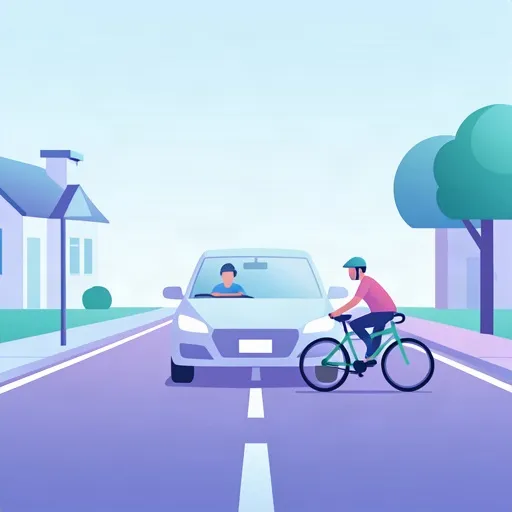
When exiting a driveway, residential zone, or internal road in Poland, you are legally classified as joining traffic, regardless of whether a yield sign is present. This article explains why the standard 'right-hand rule' does not apply in these situations and why you have an absolute obligation to yield to every other road user. Mastering this concept is essential for safety and for answering tricky priority-related questions on your official theory exam.
Article content overview
One of the most frequent sources of confusion for students preparing for the Polish driving theory exam is determining priority when leaving non-public areas. Many drivers mistakenly believe that if there is no "Yield" sign, the standard right-hand rule applies, or that they are entering a standard intersection. In reality, Polish traffic law is very specific about this: exiting a driveway, a residential zone, or an internal road is legally classified as "włączanie się do ruchu" (joining traffic). Understanding this status is essential for both your exam success and daily safety on Polish roads.
The legal concept of joining traffic is a fundamental principle in Polish road law. It dictates that whenever you move from a place that is not a public road onto a public road, you are essentially initiating a new maneuver into the flow of traffic. Because you are the one entering the stream of other vehicles, the burden of ensuring safety rests entirely on your shoulders. You do not have priority over anyone; you must yield to every single road user, including cars, cyclists, and pedestrians, regardless of which direction they are coming from.
The act of entering a public road from a non-public area, which places an absolute obligation on the driver to yield to all other participants, regardless of the presence of traffic signs.
A common misconception is that this duty only exists if a specific road sign is present. However, the requirement to yield when joining traffic is a statutory rule that applies even in the total absence of signage. Whether you are leaving a shopping center, a residential driveway, or an "internal road" (droga wewnętrzna), the law treats you as the party responsible for finding a safe gap that does not force other users to brake or change their trajectory.
Residential zones and internal roads are frequently encountered in urban planning, and they carry specific rules that often appear in theoretical exam questions. When you see signs marking the end of a residential zone or an internal road, you must treat your subsequent entry onto the public road as an act of joining traffic. The absence of a Stop sign or a Yield sign does not grant you the right to enter the main road freely.
Many exam questions will present a scenario where a driver is exiting a private area into a busy street without any warning signs. The trick is to identify that the lack of signs is irrelevant because the status of the road you are exiting is the determining factor. If the location is not a public road, your priority is effectively zero until you have safely entered the flow of traffic.
It is crucial to differentiate between an intersection of two public roads and the exit of a private area. At a standard intersection of public roads, the right-hand rule or signage dictates priority. However, when exiting a private area, these rules are suspended in your favor because you are not yet a participant in the standard flow of the intersection.
| Scenario | Priority Determination |
|---|---|
| Standard Intersection | Signage, or the Right-Hand Rule if signs are absent. |
| Exiting Driveway | Always yields; you are joining traffic. |
| Exiting Residential Zone | Always yields; you are joining traffic. |
| Exiting Internal Road | Always yields; you are joining traffic. |
Never assume you have the right of way just because the driver on the main road is far away. If your entry forces them to adjust their speed or direction, you have failed the legal requirement to yield and could be held liable in the event of a collision.
The theory exam often uses complex visual descriptions to test if you can identify the type of road you are exiting. Questions may involve a scenario with a pedestrian crossing or a cycle lane running parallel to the road you are joining. Remember that your duty to yield extends beyond just motorized vehicles. You must verify that your entry does not endanger pedestrians on the sidewalk or cyclists in the bike lane, both of whom have the right of way while you are in the process of joining the main carriageway.
When you encounter these questions, always scan for the origin of the vehicle. If the car is emerging from a property or an area marked by specific signs like "Koniec strefy zamieszkania," the correct answer will almost always involve giving priority to all other road users. Maintaining this focus on the "joining traffic" definition will help you avoid the most common traps involving the improper application of the right-hand rule.
In Polish traffic law, exiting any private area (driveway, residential zone, or internal road) onto a public road is legally 'włączanie się do ruchu' and carries an absolute obligation to yield to all road users, regardless of signage. Unlike standard intersections where the right-hand rule or signs determine priority, private exits place full responsibility on the joining driver. This applies even when no traffic signs are present, and your duty extends to pedestrians and cyclists, not just vehicles. On the theory exam, look for the origin of the vehicle - if it is leaving a private or marked area, the correct answer will always involve yielding priority to other road users.
A short set of high-value points that capture the most important ideas from this article.
Exiting any driveway, residential zone, or internal road onto a public road is legally classified as 'włączanie się do ruchu' (joining traffic)
When joining traffic, you must yield to ALL road users including vehicles, cyclists, and pedestrians regardless of signage
The right-hand rule (zasada prawej ręki) does not apply when exiting private areas - you always yield
Your priority is effectively zero until you have fully entered the public road flow
The obligation to yield when joining traffic is a statutory rule that applies even when no yield or stop signs are present
'Włączanie się do ruchu' is the legal term for entering a public road from a non-public area
End of residential zone (D41) and end of internal road (D47) signs mark the point where you must yield
Your duty to yield extends to pedestrians on sidewalks and cyclists in bike lanes, not just motor vehicles
At standard intersections of two public roads, the right-hand rule or signage determines priority - this is different from private exits
If your entry forces any road user to brake or change direction, you have violated the yield requirement
Assuming the right-hand rule applies when exiting a driveway because no yield sign is visible
Only checking for cars and ignoring pedestrians on the sidewalk or cyclists in bike lanes
Thinking that a driver being far away on the main road means you have priority to enter
Believing the absence of a Stop or Yield sign grants the right to proceed without yielding
Confusing the exit from a private area with a standard intersection of two public roads
Article content overview
A short set of high-value points that capture the most important ideas from this article.
Exiting any driveway, residential zone, or internal road onto a public road is legally classified as 'włączanie się do ruchu' (joining traffic)
When joining traffic, you must yield to ALL road users including vehicles, cyclists, and pedestrians regardless of signage
The right-hand rule (zasada prawej ręki) does not apply when exiting private areas - you always yield
Your priority is effectively zero until you have fully entered the public road flow
The obligation to yield when joining traffic is a statutory rule that applies even when no yield or stop signs are present
'Włączanie się do ruchu' is the legal term for entering a public road from a non-public area
End of residential zone (D41) and end of internal road (D47) signs mark the point where you must yield
Your duty to yield extends to pedestrians on sidewalks and cyclists in bike lanes, not just motor vehicles
At standard intersections of two public roads, the right-hand rule or signage determines priority - this is different from private exits
If your entry forces any road user to brake or change direction, you have violated the yield requirement
Assuming the right-hand rule applies when exiting a driveway because no yield sign is visible
Only checking for cars and ignoring pedestrians on the sidewalk or cyclists in bike lanes
Thinking that a driver being far away on the main road means you have priority to enter
Believing the absence of a Stop or Yield sign grants the right to proceed without yielding
Confusing the exit from a private area with a standard intersection of two public roads
Explore related topics, search based questions, and concepts that learners often look up when studying Joining Traffic Priority Rules. These themes reflect real search intent and help you understand how this topic connects to wider driving theory knowledge in Poland.
Find clear and practical answers to common questions learners often have about Joining Traffic Priority Rules. This section helps explain difficult points, remove confusion, and reinforce the key driving theory concepts that matter for learners in Poland.
Yes. Exiting a non-public area is legally defined as 'włączanie się do ruchu' (joining traffic), which places an absolute obligation on the driver to yield to all other traffic participants, including vehicles, cyclists, and pedestrians.
No. The right-hand rule only applies at intersections of public roads. When you are joining traffic from a private area, you lose priority regardless of which side other vehicles are approaching from.
No. The duty to yield when joining traffic from a private area, residential zone, or internal road exists by default under Polish traffic law. You must yield even in the absence of A-7 (yield) or B-20 (stop) signs.
Failing to yield when joining traffic creates a high risk of collisions and is a common reason for failing the practical and theory driving exams. Legally, you are responsible for any incident caused by failing to grant priority to those already on the public road.
After finding your specific article, continue your targeted learning by exploring related topics or diving deeper into practice questions. Our extensive library ensures you have all the resources needed to confidently prepare for your Polish driving license theory exam. Discover more guides and solidify your understanding of Polish road rules.