
Understanding the rights of vulnerable road users is fundamental for both passing your driving theory exam and ensuring safety on Polish roads. This article breaks down the legal obligations of drivers at pedestrian crossings, cycling lanes, and in residential zones where pedestrians have priority. You will learn how to correctly interpret traffic situations involving mobility devices and the mandatory behaviors required to avoid common test mistakes.
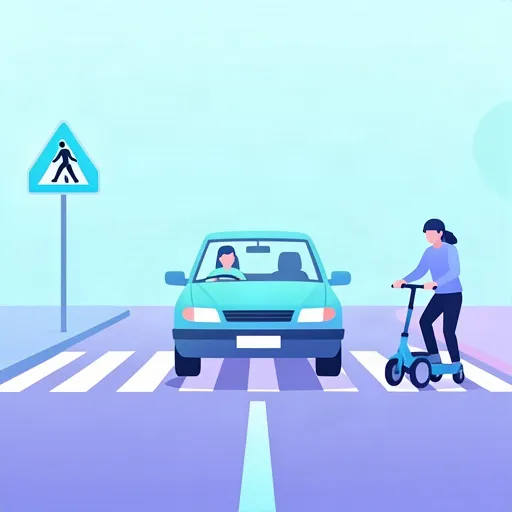
Article content overview
Mastering the rules regarding vulnerable road users is a fundamental step in preparing for the Polish driving theory exam. In Poland, traffic law places a high priority on the protection of pedestrians and cyclists, who are defined as vulnerable participants due to their lack of protective equipment. As a driver, you must internalize the specific legal obligations surrounding pedestrian crossings and bicycle lanes to ensure safety and to avoid costly errors on your theory test.
The cornerstone of Polish traffic law regarding pedestrians is found in the Law on Road Traffic (Prawo o ruchu drogowym). Current regulations dictate that a driver approaching a pedestrian crossing must exercise particular caution and reduce speed to ensure that no pedestrian is endangered. Crucially, this obligation applies not only to those already on the crossing but also to individuals who are entering it.
A duty imposed on the driver to increase vigilance and adjust their speed to a level that allows for an immediate reaction to any potential threat or change in traffic conditions, especially in areas where vulnerable road users are present.
You are legally required to yield to a pedestrian who is currently on the crossing or in the act of stepping onto it. While you do not need to wait for the pedestrian to reach the far sidewalk before moving—provided they have safely passed the path of your vehicle—you must never force a pedestrian to stop or accelerate because of your presence. Failure to observe this, or attempting to overtake a vehicle that has slowed down to yield to a pedestrian, is one of the most common causes of exam failure and carries severe penalties.
Never overtake a vehicle at a pedestrian crossing or immediately before it, unless the traffic at that crossing is controlled by traffic lights or a police officer. Overtaking in these restricted zones is a frequent "critical error" in the practical phase and a major topic for theory exam questions.
Interactions with cyclists require a similar level of care. Cyclists often share road space via designated cycle lanes or paths that cross the main carriageway. When approaching a bicycle crossing, you must yield to any cyclist who is already on the crossing. It is essential to maintain a safe lateral distance when passing a cyclist on the road, with current best practice and legal recommendations suggesting a minimum of 1 meter, though maintaining 1.5 meters is safer and highly encouraged.
The Polish theory exam frequently tests your knowledge of how to behave around people with limited mobility. If you encounter a person using a mobility device—such as a wheelchair or an electronic assistance vehicle—you must treat them with the same priority as a pedestrian. Furthermore, if you see an individual with a visible physical disability or a person using an assistive device attempting to cross the road outside of a marked pedestrian crossing, you have a moral and legal obligation to stop and allow them to pass safely.
This article covers the core legal obligations drivers have toward vulnerable road users in Poland, based on the Law on Road Traffic. It establishes that drivers must exercise particular caution at pedestrian and bicycle crossings, yielding to anyone already on or entering the crossing, and must never overtake at pedestrian crossings unless controlled by traffic signals. The content explains specific safe-distance requirements for passing cyclists and clarifies that mobility device users and people with disabilities receive the same legal priority as pedestrians. A step-by-step process is provided for systematically checking and yielding at crossings, making this essential material for both exam preparation and real-world safe driving practice.
A short set of high-value points that capture the most important ideas from this article.
Drivers must exercise 'particular caution' at pedestrian crossings by reducing speed to allow immediate reaction to any hazard
Pedestrians who are on the crossing or entering it have priority, and you must yield until they have cleared your path
Never overtake another vehicle at or immediately before a pedestrian crossing unless the crossing is controlled by traffic lights or a police officer
When passing a cyclist on the road, maintain a minimum lateral distance of 1 meter, with 1.5 meters being the safer recommendation
People using mobility devices and individuals with visible disabilities must be treated with the same priority as pedestrians
'Particular Caution' means heightened vigilance combined with speed reduction sufficient for immediate reaction
You do not need to wait for a pedestrian to reach the far sidewalk before proceeding, only until they have safely passed your vehicle's path
Cycle crossings (sign D-6a) require you to yield to cyclists already on the crossing just like pedestrian crossings
Overtaking at pedestrian crossings is a critical error in practical exams and a common theory exam failure topic
In residential zones, pedestrians have total priority and may use the full width of the road
Believing you must wait for pedestrians to reach the opposite sidewalk before proceeding — you only need to ensure they have cleared your lane
Overtaking a vehicle that has stopped to yield to a pedestrian at a crossing
Failing to check side mirrors and blind spots for cyclists when turning at intersections with cycle crossings
Not maintaining the required lateral distance when passing cyclists, especially in narrow road sections
Assuming mobility device users have different priority rules — they are treated identically to pedestrians under Polish law
Article content overview
A short set of high-value points that capture the most important ideas from this article.
Drivers must exercise 'particular caution' at pedestrian crossings by reducing speed to allow immediate reaction to any hazard
Pedestrians who are on the crossing or entering it have priority, and you must yield until they have cleared your path
Never overtake another vehicle at or immediately before a pedestrian crossing unless the crossing is controlled by traffic lights or a police officer
When passing a cyclist on the road, maintain a minimum lateral distance of 1 meter, with 1.5 meters being the safer recommendation
People using mobility devices and individuals with visible disabilities must be treated with the same priority as pedestrians
'Particular Caution' means heightened vigilance combined with speed reduction sufficient for immediate reaction
You do not need to wait for a pedestrian to reach the far sidewalk before proceeding, only until they have safely passed your vehicle's path
Cycle crossings (sign D-6a) require you to yield to cyclists already on the crossing just like pedestrian crossings
Overtaking at pedestrian crossings is a critical error in practical exams and a common theory exam failure topic
In residential zones, pedestrians have total priority and may use the full width of the road
Believing you must wait for pedestrians to reach the opposite sidewalk before proceeding — you only need to ensure they have cleared your lane
Overtaking a vehicle that has stopped to yield to a pedestrian at a crossing
Failing to check side mirrors and blind spots for cyclists when turning at intersections with cycle crossings
Not maintaining the required lateral distance when passing cyclists, especially in narrow road sections
Assuming mobility device users have different priority rules — they are treated identically to pedestrians under Polish law
Explore related topics, search based questions, and concepts that learners often look up when studying Safety Rules for Vulnerable Road Users. These themes reflect real search intent and help you understand how this topic connects to wider driving theory knowledge in Poland.
Find clear and practical answers to common questions learners often have about Safety Rules for Vulnerable Road Users. This section helps explain difficult points, remove confusion, and reinforce the key driving theory concepts that matter for learners in Poland.
You must yield to any pedestrian who is already on the crossing or clearly entering it. While you don't have to stop if a pedestrian is only approaching, you must exercise particular caution and reduce your speed to ensure you can stop if necessary.
When approaching a cycle crossing, you must exercise particular caution and yield to any cyclist, scooter rider, or person on a personal transport device who is already on the crossing.
Yes, drivers must exercise particular caution and yield to persons with impaired mobility or those using mobility devices when they are entering a pedestrian crossing, as they are granted full protection under Polish traffic law.
No, it is strictly forbidden to overtake a vehicle at a pedestrian crossing or immediately before it, unless the traffic at that crossing is being directed by a police officer or a traffic signal.
After finding your specific article, continue your targeted learning by exploring related topics or diving deeper into practice questions. Our extensive library ensures you have all the resources needed to confidently prepare for your Polish driving license theory exam. Discover more guides and solidify your understanding of Polish road rules.