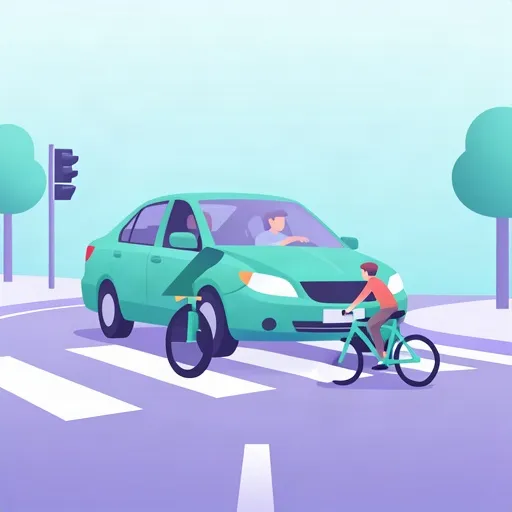
Learners often struggle with the distinction between cyclists already on a crossing and those merely approaching one. This guide explains the legal requirements of the Polish Highway Code, helping you navigate these situations safely and avoid common mistakes on your theory exam. By understanding when you must yield and when you can proceed, you will improve both your hazard perception and your overall test performance.
Article content overview
Understanding the precise rules regarding bicycle crossings is a fundamental requirement for every aspiring driver in Poland. The Polish Highway Code (Prawo o ruchu drogowym) contains specific regulations designed to protect vulnerable road users, yet these rules are frequently misunderstood by both novice and experienced motorists. Mastering these concepts is not just about avoiding a fine; it is essential for passing your Polish driving theory exam and, more importantly, for ensuring safety on our roads.
In Poland, a bicycle crossing is a portion of the road intended for cyclists to cross the carriageway. It is typically marked by specific signage and horizontal road markings. When you approach such a crossing, the law dictates that you must exercise special caution and adjust your speed to ensure that you can safely yield to anyone already occupying the crossing.
A common mistake made by candidates during the theory exam is assuming that a cyclist approaching the crossing always has absolute priority. This is not the case. According to the current regulations, a driver must yield specifically to a cyclist who is already on the crossing. If a cyclist is merely waiting at the edge of the cycle path, they do not automatically hold the right of way over your vehicle, provided you are continuing straight.
There is one crucial scenario that frequently appears as a trap in theory exam questions: turning into a side road. When you are driving a motor vehicle and intend to turn into a crossroad, the rules of priority change significantly. Even if the cyclist has not yet entered the crossing, you are legally obligated to yield to them if they are proceeding straight across the road you are about to exit.
This requirement applies regardless of whether the cycle path is running parallel to the main road you are currently on. Many drivers fail to account for cyclists moving along the periphery of the intersection, leading to dangerous "right-hook" collisions. If you are turning right or left into a side street, you must yield to any cyclist moving straight ahead, as they are effectively treated as a vehicle traveling alongside you.
To help you clarify when you must yield and when you have the right of way, consider the following table based on the Polish Highway Code:
| Situation | Cyclist's Status | Driver Obligation |
|---|---|---|
| Driving straight | Approaching crossing | No mandatory yield |
| Driving straight | Already on crossing | Must yield |
| Turning into side road | Approaching or on crossing | Must yield |
| Moving through intersection | Cyclist is crossing | Must yield |
The Polish theory exam tests your ability to distinguish between standard road priority and specific protections for cyclists. A common trap is the assumption that a cyclist "gains" priority by simply riding into the road. If a cyclist enters the crossing suddenly—giving the driver no reasonable chance to stop—they are not granted priority by the law. However, you must always maintain the "principle of limited trust," which means you should never rely on other road users to act perfectly.
Always remember that the prohibition on overtaking applies to bicycle crossings as well. You are strictly forbidden from overtaking a vehicle on or immediately before a bicycle crossing, unless the traffic at that location is being directed by lights or a traffic officer. Violating this rule is considered a serious traffic offense and carries heavy penalties.
Article content overview
Explore related topics, search based questions, and concepts that learners often look up when studying Bicycle Crossing Priority Rules. These themes reflect real search intent and help you understand how this topic connects to wider driving theory knowledge in Poland.
Find clear and practical answers to common questions learners often have about Bicycle Crossing Priority Rules. This section helps explain difficult points, remove confusion, and reinforce the key driving theory concepts that matter for learners in Poland.
No, you are only required to yield to a cyclist who is already on the bicycle crossing. You generally do not have to yield to a cyclist who is only approaching the crossing.
When you are turning into a side road, you must yield to any cyclist who is traveling straight on the road, bicycle path, or lane you are crossing, regardless of whether they have already entered the crossing or are still approaching it.
The D-6a sign marks a bicycle crossing. It informs drivers to exercise special caution and reduce speed because they are approaching a point where cyclists may enter the roadway.
No, it is strictly forbidden to overtake a vehicle at a bicycle crossing or directly before it, unless the traffic at that location is controlled by traffic lights or a traffic officer.
After finding your specific article, continue your targeted learning by exploring related topics or diving deeper into practice questions. Our extensive library ensures you have all the resources needed to confidently prepare for your Polish driving license theory exam. Discover more guides and solidify your understanding of Polish road rules.