
This lesson dives into the essential EU working-time regulations for professional Category D bus drivers in Poland. You'll learn about maximum driving hours, required breaks, and rest periods crucial for preventing fatigue and ensuring road safety. Understanding these rules and the proper use of a tachograph is vital for both your Polish theory exam and your professional career. It builds upon your understanding of general Polish traffic law and Category D requirements.
Lesson content overview
Professional bus drivers operating within the European Union are subject to stringent working-time regulations designed to enhance road safety and ensure fair working conditions. These regulations, primarily set forth by the EU and transposed into national law, dictate maximum driving hours, mandatory breaks, and minimum rest periods. Understanding and meticulously adhering to these rules is not merely a legal obligation but a fundamental aspect of safe and responsible professional driving. Non-compliance carries severe penalties, including fines, license suspension, and, critically, a heightened risk of fatigue-related collisions.
This comprehensive lesson, part of the Polish Category D Driving Licence Theory Course for Bus Drivers, will equip you with the essential knowledge to navigate these regulations. You will learn about the integration of legislated limits with the technical systems used to record driver activity, particularly the tachograph, which serves as the objective record-keeper of a driver's day. By mastering these concepts, you will be able to plan compliant schedules, manage your fatigue effectively, and fulfill your legal obligations for accurate data management.
The core principle behind EU working-time regulations is to prevent driver fatigue, which significantly impairs perception, reaction time, and decision-making abilities. By standardizing driver-hour rules across member states, the EU aims to create a uniform safety baseline for all commercial passenger transport, including bus services. These regulations apply to most professional bus drivers operating vehicles over 3.5 tonnes and are crucial for both cross-border and domestic operations.
The amount of time a professional bus driver can spend actively driving within a 24-hour period is strictly limited. The maximum daily driving time is legally capped at 9 hours. This limit is in place to control cumulative fatigue experienced over a single day.
However, there is some flexibility: this daily limit can be extended to 10 hours, but only on two occasions within any given week. This extension is intended to accommodate occasional operational demands but must be managed carefully to avoid excessive fatigue. Drivers must schedule their driving, breaks, and rest periods meticulously to ensure they remain within these daily limits. Exceeding these thresholds, even by a small margin, constitutes a violation and can lead to penalties. It is important to distinguish "driving time" from "working time," as only the actual movement of the vehicle counts towards the daily driving limit, not activities like loading, unloading, or waiting.
Beyond the daily limits, EU regulations also address long-term fatigue by imposing maximum driving times over longer periods. The maximum weekly driving time is set at 56 hours. This means that a driver's total accumulated driving hours within a single week must not exceed this figure.
Furthermore, there is a bi-weekly cumulative driving limit: a driver cannot exceed 90 hours of driving over any two consecutive weeks. This rule ensures that even if a driver has a higher-driving week (e.g., 56 hours), the subsequent week must be adjusted accordingly to keep the two-week total below 90 hours. Fleet planners and individual drivers must monitor these cumulative totals carefully. Any overtime or additional driving hours must be balanced with compensatory rest periods to remain compliant and prevent the accumulation of long-term fatigue.
To interrupt continuous driving and restore alertness, drivers are required to take regular breaks. A mandatory break of at least 45 minutes must be taken after 4.5 hours of cumulative driving. This break can be taken as a single, uninterrupted 45-minute period, or it can be split into two parts: an initial break of at least 15 minutes, followed by a second break of at least 30 minutes. Critically, the second break must be at least 30 minutes, and the total must be at least 45 minutes.
These breaks are essential for physiological recovery, allowing drivers to rest their eyes, stretch, and engage in other non-driving activities. Drivers must plan their routes and schedules to incorporate these mandatory breaks. Short stops for coffee or quick errands do not count as a valid break unless they meet the minimum duration thresholds and are properly recorded. The tachograph must register these breaks, typically as "other work" or "rest."
Ensuring adequate rest between shifts is paramount for driver recovery and safety. A daily rest period is defined as a minimum of 11 consecutive hours of rest within each 24-hour period. This means that once a driver finishes all duties for the day, they must be off-duty for at least 11 uninterrupted hours before they can commence their next shift.
There is a provision for a split daily rest: a driver can take a daily rest in two separate periods, provided the first period is at least 3 hours and the second period is at least 9 hours. The total must still sum to at least 12 hours (3+9), maintaining the overall rest requirement. It is crucial to understand that short naps or fragmented periods of inactivity do not qualify as daily rest; only uninterrupted periods of the required length are compliant. Failure to observe the full daily rest period invalidates the day's driving record and can lead to significant penalties.
To prevent cumulative fatigue over multiple working days, professional drivers are also required to take regular weekly rest periods. A regular weekly rest period must be at least 45 continuous hours. This provides an extended period for comprehensive physical and mental recovery.
Under certain conditions, a driver may take a reduced weekly rest period of a minimum of 24 continuous hours. However, any reduction in weekly rest must be compensated for by an equivalent period of rest taken en bloc before the end of the third week following the week in question. This compensatory rest must be attached to another rest period of at least 9 hours. For example, if a driver takes a 24-hour reduced weekly rest, they must compensate for the missing 21 hours (45 - 24 = 21) within three weeks by adding 21 hours to another daily or weekly rest period. Proper planning and tracking are essential to manage these compensatory rests.
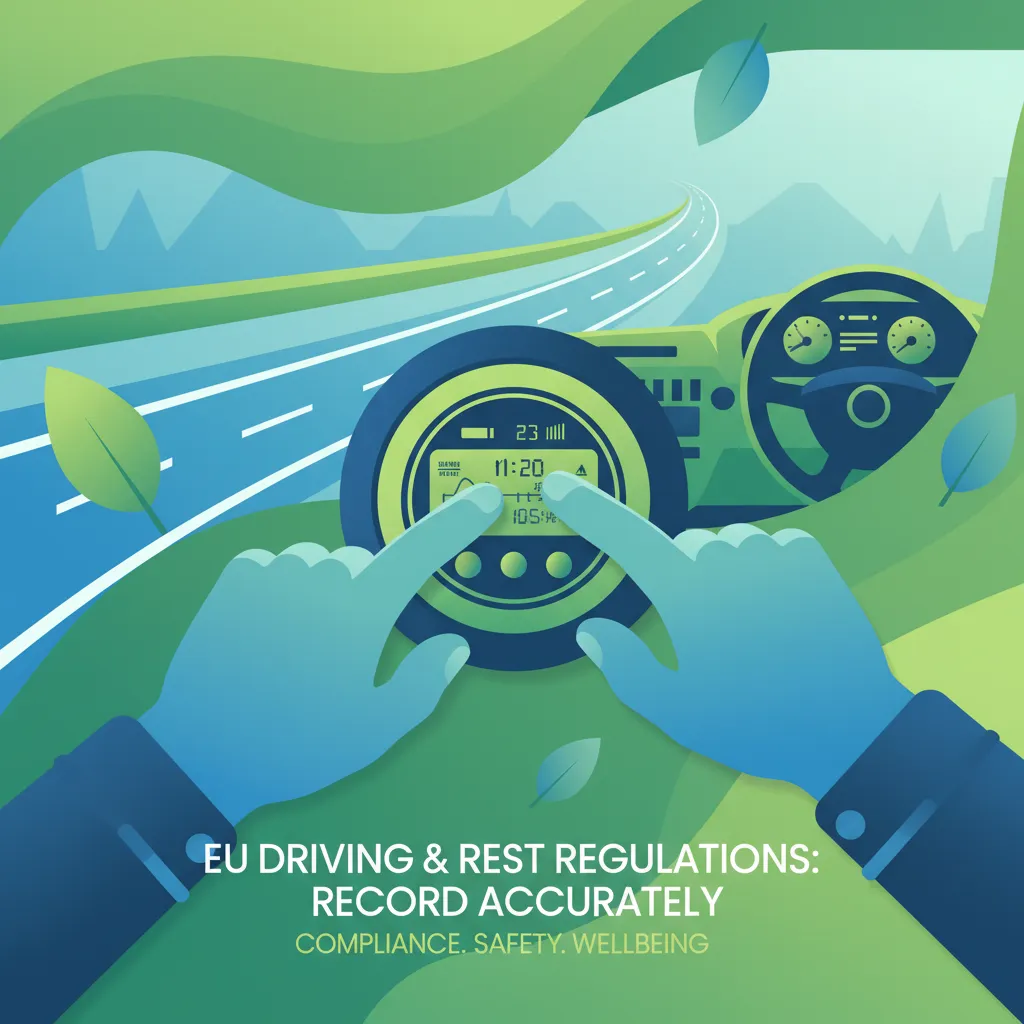
The tachograph system is the cornerstone of enforcing working-time regulations. It is a legally mandated device that automatically records a driver's activities, providing an objective and tamper-proof record of compliance.
Historically, vehicles were equipped with analogue tachographs, which used wax-coated paper charts to graphically record speed, distance, driving time, and other activities. While these charts provided a physical record, they were susceptible to limited data retention and a higher risk of manipulation.
Today, almost all new commercial passenger vehicles (over 3.5 tonnes) in the EU must be fitted with digital tachographs. These advanced electronic devices store data on the driver's smart card and in the unit's internal memory. Digital tachographs encrypt data, making it tamper-proof and providing a highly reliable record of driver activities. They automatically record events such as driving, other work, availability, and rest periods, along with vehicle speed and distance. Drivers must understand that a malfunctioning tachograph cannot be ignored; any fault must be reported immediately, and activities must be manually recorded until the device is repaired or replaced.
The driver card is a personal smart card that every professional driver must possess and use when operating a vehicle fitted with a digital tachograph. This card stores personal identification details and a comprehensive record of the driver's activities for up to 28 days (and the unit stores up to 365 days) of activity.
It is a legal requirement for the driver card to be inserted into the tachograph unit before commencing any driving period and to be removed only when the driver finishes their shift or ceases driving the vehicle. The card records the start and end of each driving session, changes in activity (driving, other work, rest), and any fault events. Drivers must always carry their valid driver card when operating a tachograph-equipped vehicle. Using a vehicle without a valid card inserted, or using another driver's card, constitutes a serious violation and can lead to severe penalties.
Maintaining the integrity and availability of tachograph data is crucial for enforcement and auditing purposes. Data retention rules stipulate that all recorded tachograph data, whether digital or analogue, must be retained for at least one year. For digital tachographs, this includes data stored on the vehicle unit's memory (which typically holds 28 days of detailed data) and on the driver's card (which holds data for up to 365 days).
Transport companies are legally obligated to regularly download data from both the vehicle unit (at least every 90 days) and the driver card (at least every 28 days) and securely store these records. This data must be readily available to enforcement authorities upon request during roadside inspections or company audits. During an inspection, officers can retrieve data directly from the driver card, the vehicle unit, or request archived company records. Falsification, alteration, or deletion of tachograph data is a serious criminal offense and is subject to severe fines, license suspension, and even imprisonment.
The EU working-time regulations are a complex framework, primarily stemming from a few key directives and regulations, which are then transposed into national law, such as in Poland.
These regulations are designed to be strictly enforced. For example, a driver driving 10 hours on three consecutive days would be in clear violation of the daily extension rule. Similarly, a driver logging 70 hours in week 1 and 80 hours in week 2 would exceed the 90-hour bi-weekly cumulative limit, leading to significant penalties. Proper adherence to these laws ensures both personal safety and legal compliance for the driver and the transport operator.
Professional drivers and transport operators often encounter situations that can inadvertently or intentionally lead to violations of working-time regulations. Awareness of these common pitfalls is key to maintaining compliance.
Understanding the theoretical rules is one thing; applying them in real-world scenarios is another. Here are some examples illustrating correct and incorrect behaviors for professional bus drivers.
Setting: A city bus driver operates a route from 7:00 AM to 3:00 PM in moderate traffic. Rule in Focus: Minimum 45-minute break after 4.5 hours of driving. Correct Behavior: The driver starts at 7:00 AM and drives for 4 hours and 15 minutes, reaching 11:15 AM. At this point, the driver stops for a mandatory 45-minute lunch break, which is recorded as "other work" or "rest" on the tachograph. They resume driving at 12:00 PM, ensuring compliance with the break rule before reaching the 4.5-hour driving limit. Incorrect Behavior: The driver continues driving past 11:30 AM (4.5 hours of driving) without taking a 45-minute break. This violates the cumulative driving time rule and the mandatory break requirement.
Setting: An inter-city coach driver is on a long-distance journey from 9:00 AM to 9:00 PM, involving mixed motorway and rural roads. Rule in Focus: Daily driving limit of 9 hours (or 10 twice a week) and weekly limit of 56 hours. Correct Behavior: The driver plans two blocks of 4 hours and 30 minutes of driving, each separated by a 45-minute break. This results in a total of 9 hours of driving for the day. The driver also ensures their overall weekly schedule keeps their cumulative driving under 56 hours and their two-week total under 90 hours. For instance, if they drive 9 hours daily for five days, they would have 45 hours for the week, allowing for flexibility in the next week. Incorrect Behavior: The driver attempts to complete the journey faster by driving 9 hours and 45 minutes in a single day, exceeding the 9-hour daily limit without utilizing the 10-hour extension correctly or taking sufficient breaks.
Setting: A regional bus driver experiences a digital tachograph malfunction at 2:00 PM during their shift. Rule in Focus: Mandatory reporting and manual logging during a tachograph fault. Correct Behavior: The driver immediately records a "fault" entry on the tachograph unit (if possible) and begins to keep a detailed handwritten log of their activities (driving time, other work, breaks, rest) on the back of the printout or on a separate sheet. They report the malfunction to their fleet manager as soon as safely possible and ensure the tachograph is repaired or replaced promptly, ideally within seven calendar days. Incorrect Behavior: The driver ignores the tachograph fault and continues driving without making any manual records, hoping it won't be noticed. This would lead to severe penalties during an inspection due to unrecorded activity.
Setting: A driver's weekly schedule necessitates a reduced weekly rest of 24 hours on Sunday due to operational demand. Rule in Focus: Compensation for reduced weekly rest within three weeks. Correct Behavior: The driver takes their 24-hour rest period on Sunday. Within the next three weeks, they identify a suitable opportunity to add the compensatory 21 hours (45 hours - 24 hours = 21 hours) to another rest period of at least 9 hours. For example, they combine 21 hours with an 11-hour daily rest, creating a 32-hour rest period later in the week. Incorrect Behavior: The driver takes the 24-hour rest on Sunday but fails to take the compensatory 21 hours within the three-week window, thereby violating the weekly rest regulations.
Setting: A night shift bus driver starts their shift at 10:00 PM and finishes at 6:00 AM the following morning. Rule in Focus: Minimum 11-hour daily rest period. Correct Behavior: Upon finishing at 6:00 AM, the driver ensures they do not start their next shift until 5:00 PM the same day at the earliest (6:00 AM + 11 hours = 5:00 PM). This provides the mandatory 11 consecutive hours of daily rest. Incorrect Behavior: The driver begins their next shift at 3:00 PM, providing only 9 hours of rest (from 6:00 AM to 3:00 PM). This breaches the daily rest rule, leading to a violation.
The rigorous EU working-time regulations are fundamentally rooted in safety. Driver fatigue is a major contributing factor to road accidents, particularly in commercial transport.
By strictly adhering to these regulations, drivers contribute directly to their own safety, the safety of their passengers, and other road users.
Understanding EU working-time regulations and tachograph use is fundamental for any professional bus driver. This lesson provides a strong foundation, building upon your understanding from earlier topics like Polish Traffic Law Fundamentals for Public Transport and Category D Eligibility and Prerequisites. The principles of fatigue management discussed here will also be critical in future lessons, particularly in Safe Maneuvering & Urban Operations where driver alertness is paramount, and Passenger Safety & Comfort, which integrates rest periods with service schedules to ensure a smooth journey for passengers.
This lesson covers EU working-time regulations essential for Polish Category D bus drivers, including daily driving limits of 9 hours (extendable to 10), weekly limits of 56 hours, and bi-weekly limits of 90 hours. A mandatory 45-minute break is required after 4.5 hours of cumulative driving, and drivers must observe a minimum 11-hour daily rest period with options for split rest. The tachograph system, whether analogue or digital, records driver activities and requires a personal driver card; data must be retained for at least one year. Violations including falsification of records, exceeding limits, or improper use of the driver card carry severe penalties and are critical topics for the Polish theory exam.
A short set of high-value points that capture the most important learning from this lesson.
Daily driving is limited to 9 hours, extendable to 10 hours on only two occasions per week.
A mandatory break of at least 45 minutes must be taken after 4.5 hours of cumulative driving, and this break can be split into 15 and 30-minute segments.
Drivers must have a minimum 11 consecutive hours of daily rest, with an optional split of 3 hours plus 9 hours totaling at least 12 hours.
Digital tachographs record driving time, other work, availability, and rest; the driver card must be inserted before driving and stores data for up to 365 days.
Reduced weekly rest of 24 hours must be compensated with an equivalent rest period taken within three weeks.
Explore all units and lessons included in this driving theory course.
Bi-weekly cumulative driving must not exceed 90 hours over any two consecutive weeks.
Driver card data must be retained for at least 365 days; vehicle unit data must be downloaded at least every 90 days.
Weekly rest is normally 45 hours, but 24 hours is permitted as a reduced option when compensated.
Driving time counts only when the vehicle is moving; loading, unloading, and waiting do not count toward daily limits.
Tachograph malfunction must be reported immediately and manual records kept until the device is repaired.
Taking breaks shorter than 45 minutes or using short stops for coffee as a substitute for the mandatory break.
Exceeding the 9-hour daily limit even by 30 minutes, which still constitutes a violation.
Failing to compensate for a reduced 24-hour weekly rest within the three-week deadline.
Operating without inserting the driver card, which makes all activity unrecorded and illegal.
Combining short trips to avoid the 4.5-hour cumulative driving threshold without taking a proper break.
Lesson content overview
A short set of high-value points that capture the most important learning from this lesson.
Daily driving is limited to 9 hours, extendable to 10 hours on only two occasions per week.
A mandatory break of at least 45 minutes must be taken after 4.5 hours of cumulative driving, and this break can be split into 15 and 30-minute segments.
Drivers must have a minimum 11 consecutive hours of daily rest, with an optional split of 3 hours plus 9 hours totaling at least 12 hours.
Digital tachographs record driving time, other work, availability, and rest; the driver card must be inserted before driving and stores data for up to 365 days.
Reduced weekly rest of 24 hours must be compensated with an equivalent rest period taken within three weeks.
Explore all units and lessons included in this driving theory course.
Bi-weekly cumulative driving must not exceed 90 hours over any two consecutive weeks.
Driver card data must be retained for at least 365 days; vehicle unit data must be downloaded at least every 90 days.
Weekly rest is normally 45 hours, but 24 hours is permitted as a reduced option when compensated.
Driving time counts only when the vehicle is moving; loading, unloading, and waiting do not count toward daily limits.
Tachograph malfunction must be reported immediately and manual records kept until the device is repaired.
Taking breaks shorter than 45 minutes or using short stops for coffee as a substitute for the mandatory break.
Exceeding the 9-hour daily limit even by 30 minutes, which still constitutes a violation.
Failing to compensate for a reduced 24-hour weekly rest within the three-week deadline.
Operating without inserting the driver card, which makes all activity unrecorded and illegal.
Combining short trips to avoid the 4.5-hour cumulative driving threshold without taking a proper break.
Explore search topics learners often look for when studying EU Working-Time Regulations and Tachograph Use. These topics reflect common questions about road rules, driving situations, safety guidance, and lesson level theory preparation for learners in Poland.
Browse additional driving theory lessons that cover connected traffic rules, road signs, and common driving situations related to this topic. Improve your understanding of how different rules interact across everyday traffic scenarios.
Understand the legal framework for driving hours, mandatory breaks, and rest periods for professional bus drivers in Poland. Covers EU regulations and their application for compliance and driver safety.

This lesson provides an overview of the key EU regulations that harmonize the road transport industry across member states. It focuses on the standardized rules for drivers' hours and rest periods, which are designed to combat fatigue and enhance safety. The content also explains the principles of cabotage—the transport of goods within one member state by a haulier from another—and the necessary documentation for smooth and legal cross-border operations.

This lesson explores the physiological and psychological aspects of driver fatigue, covering its warning signs and strategies for maintaining concentration. It outlines the legal framework for work-time limits and mandatory rest periods, monitored via tachograph. Practical advice on schedule planning and nutrition is provided to help sustain alertness and reduce accident risk.

This lesson offers a detailed guide to the use of the tachograph, an essential tool for ensuring compliance with drivers' hours regulations. It explains how to operate both analogue and digital tachographs, correctly use the driver card, and accurately record all periods of work, availability, breaks, and rest. Learners will understand the specific legal limits on driving time and the minimum required rest periods, as well as the procedures followed during roadside inspections by transport authorities.

This lesson addresses the critical safety issue of driver fatigue. It explains the physiological causes of fatigue, including disruption to circadian rhythms, and teaches drivers to recognize its early warning signs. The content reviews the legal requirements for breaks and rest periods in detail and provides practical strategies for managing sleep hygiene and using alertness techniques to ensure they remain focused and responsive while on duty, thereby preventing fatigue-related incidents.

This lesson details the speed limits applicable to buses in Poland across urban, rural, and motorway settings. It emphasizes how vehicle size and passenger load influence safe operating speeds and required stopping distances. The content also covers speed-control device usage and practical techniques for maintaining consistent speed while ensuring passenger comfort.

This lesson focuses on the key provisions of the Polish road traffic act relevant to public transport. It explains the legal classification of buses, mandatory safety equipment, and the hierarchy of road users. Learners will understand the specific obligations of bus drivers, potential penalties for non-compliance, and the required operational documentation.
Learn the essential rules for using digital tachographs and driver cards in Poland. Covers data recording, retention, inspections, and avoiding common compliance pitfalls for professional drivers.
This lesson offers a detailed guide to the use of the tachograph, an essential tool for ensuring compliance with drivers' hours regulations. It explains how to operate both analogue and digital tachographs, correctly use the driver card, and accurately record all periods of work, availability, breaks, and rest. Learners will understand the specific legal limits on driving time and the minimum required rest periods, as well as the procedures followed during roadside inspections by transport authorities.
This lesson explores the physiological and psychological aspects of driver fatigue, covering its warning signs and strategies for maintaining concentration. It outlines the legal framework for work-time limits and mandatory rest periods, monitored via tachograph. Practical advice on schedule planning and nutrition is provided to help sustain alertness and reduce accident risk.
This lesson details the speed limits applicable to buses in Poland across urban, rural, and motorway settings. It emphasizes how vehicle size and passenger load influence safe operating speeds and required stopping distances. The content also covers speed-control device usage and practical techniques for maintaining consistent speed while ensuring passenger comfort.

This lesson details the exact requirements to qualify for a Category D driving licence. It covers the minimum age, the mandatory medical examinations for health fitness, and the hierarchy of prerequisite licences like Category B and C. You will also learn about the accredited training process and the necessary documentation for certification.

This lesson examines the compulsory training structure for professional Category C drivers. It outlines the required components of certified training programs, including both theoretical instruction and practical driving experience. Learners will understand the standards for competence assessment, the structure of the official licensing examinations, and the legal obligation to maintain accurate training records to demonstrate compliance with professional driver qualifications.
This lesson focuses on the critical documentation every professional driver must carry and maintain. It covers the driver's licence, vehicle registration, and tachograph records, explaining their legal importance and proper management. Learners will also study the requirements for transport permits, cargo declarations, and safety inspection reports, ensuring full compliance with Polish and EU regulations to avoid penalties and operational delays during roadside checks.
This lesson focuses on the key provisions of the Polish road traffic act relevant to public transport. It explains the legal classification of buses, mandatory safety equipment, and the hierarchy of road users. Learners will understand the specific obligations of bus drivers, potential penalties for non-compliance, and the required operational documentation.

This lesson focuses on the stringent health standards mandated for operating heavy goods vehicles. It details the required medical assessments, including vision, cardiovascular, and neurological checks, that prospective drivers must pass. Learners will understand the process of obtaining a medical certificate, the requirements for periodic renewals to ensure ongoing fitness for duty, and the legal implications of failing to meet these essential health criteria for professional driving.

This lesson explores the priority hierarchy for buses at different intersections, roundabouts, and pedestrian crossings. Learners will understand how traffic signals and signs affect their approach and how to safely navigate roundabouts with correct lane discipline. Special attention is given to yielding to pedestrians, especially near bus stops.
Find clear answers to common questions learners have about EU Working-Time Regulations and Tachograph Use. Learn how the lesson is structured, which driving theory objectives it supports, and how it fits into the overall learning path of units and curriculum progression in Poland. These explanations help you understand key concepts, lesson flow, and exam focused study goals.
A professional Category D driver can typically drive for a maximum of 9 hours per day, which can be extended to 10 hours twice a week. It's crucial to always adhere to these limits to prevent fatigue and ensure safety, as well as to comply with Polish and EU regulations.
After a driving period of 4.5 hours, a driver must take an uninterrupted break of at least 45 minutes. This break can also be split into a 15-minute break followed by a 30-minute break, distributed over the 4.5-hour driving period.
The primary purpose of a tachograph is to accurately record a driver's activities, including driving time, other work, periods of availability, and rest. This ensures compliance with EU working-time regulations, prevents fatigue, and provides legal evidence in case of inspections or accidents.
Yes, a regular weekly rest period (at least 45 hours) can be reduced to a minimum of 24 hours (reduced weekly rest). However, any reduction must be compensated by an equivalent period of rest taken en bloc before the end of the third week following the week in question.
Failing to accurately record tachograph data or violating working-time regulations can lead to significant penalties for both the driver and the transport company, including fines and potential licence points in Poland. It also compromises road safety due to driver fatigue.
Build custom practice sessions tailored precisely to your needs. Focus on areas requiring improvement, review specific Polish road signs, or master complex traffic rules to ensure full preparation for your official driving license exam.