
This lesson focuses on the critical manoeuvering skills required for safely reversing large passenger vehicles into confined spaces like bus bays and terminals. Mastering these techniques is essential for both your Class D theory exam and your professional performance as a bus driver. You will build upon your understanding of vehicle dimensions from earlier lessons to ensure precision and safety.
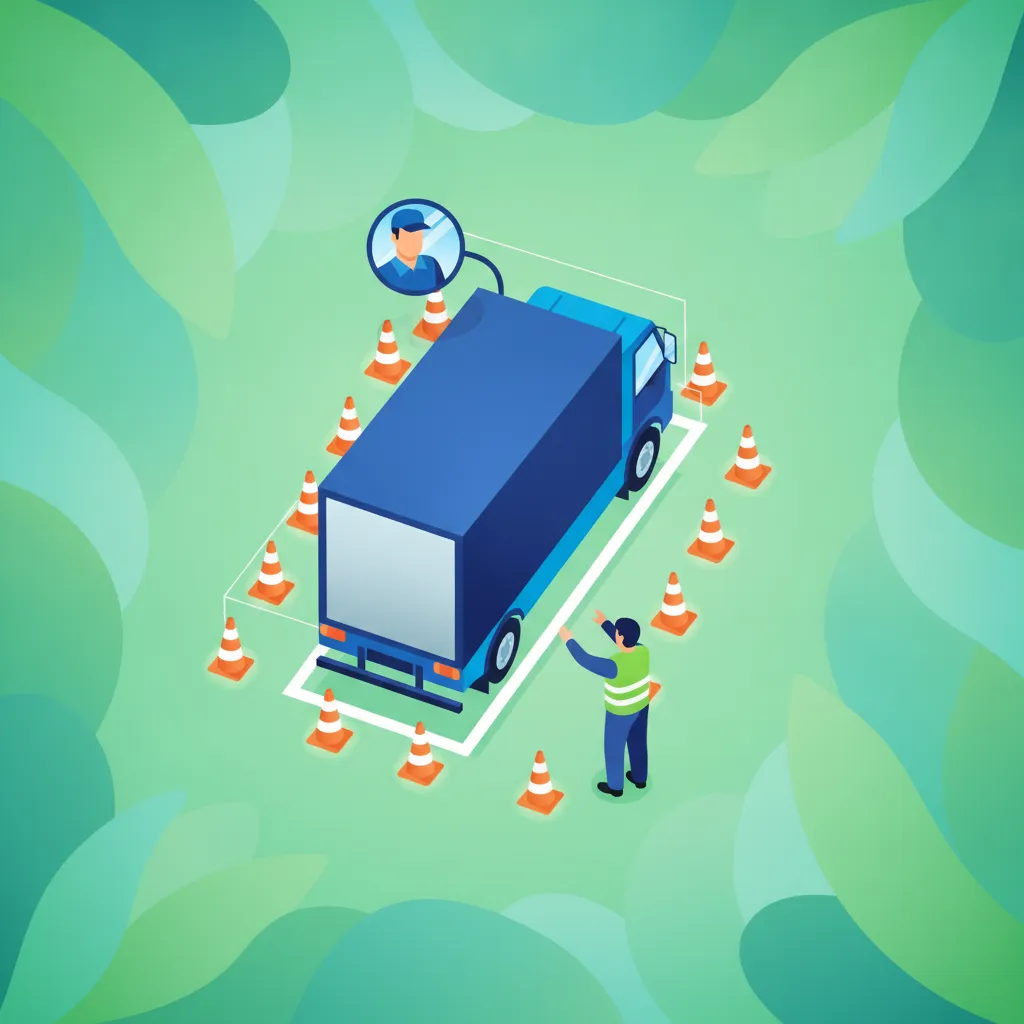
Lesson content overview
Operating a large passenger vehicle under a Class D licence (D Sınıfı Ehliyet) requires a level of vehicle control and spatial awareness that goes far beyond standard passenger car driving. Among the most challenging maneuvers a professional driver must master is reversing in confined spaces.
Whether you are positioning an urban transit bus into a tight bus bay (otobüs cebi), aligning a long-distance coach at a busy terminal loading dock, or navigating a narrow depot alleyway, executing a reverse maneuver safely demands an absolute command of your vehicle's dimensions, physical dynamics, and visibility systems.
This lesson details the theoretical principles, physical dynamics, legal frameworks, and step-by-step techniques necessary to safely and professionally execute reversing maneuvers in restricted environments.
Reversing a large passenger vehicle is inherently hazardous because of the vehicle's design and physical size. Unlike passenger cars, large buses and coaches have massive blind spots, delayed steering responses, and significant body overhangs that complicate movement in tight spaces.
Before putting a vehicle in reverse, a driver must understand its specific dimensions:
When you turn the steering wheel while reversing, the front wheels guide the front of the vehicle, but the pivot point is the rear axle.
The lateral movement of the vehicle's body overhang beyond the path of the wheels during a turn. When reversing and steering to the left, the rear overhang swings out to the right, and vice versa.
A driver must continuously monitor both the side of the vehicle in the direction of the turn and the opposite side where the tail swing is occurring to prevent the side or rear corner of the bus from striking obstacles.
To mitigate the inherent risks of backward movement, drivers must adhere to five core operational principles. These principles ensure that every reverse maneuver is deliberate, controlled, and safe.
Speed is the single most critical factor in reversing safety. When moving backward, you must maintain a slow, walking-pace speed—typically between 5 to 10 km/h.
You must never rely on a single mirror or a single visual angle. Reversing requires an active, rhythmic scanning cycle:
Professional drivers never begin a reverse maneuver blindly. They utilize a structured planning phase before shifting into reverse.
Always Remember the G.O.A.L. Rule: Get Out And Look. If you are unsure of the space behind your vehicle, apply the parking brake, secure the vehicle, step out, and inspect the path yourself. Never guess the distance.
Large commercial passenger vehicles have extensive blind spots directly behind the rear panel and along both sides of the body. Overcoming these blind spots requires the precise adjustment and coordinated use of all available visibility systems.
Before starting the vehicle, you must adjust all mirrors to fit your driving posture.
Modern passenger buses are equipped with backup cameras and ultrasonic parking sensors. While highly beneficial, these systems have limitations that every driver must understand:
Reversing into a confined space, such as a bus bay or terminal dock, must follow a strict, methodical procedure to ensure total control.
[Phase 1: Pre-Maneuver Assessment]
       │
       ▼
[Phase 2: Vehicle Positioning]
       │
       ▼
[Phase 3: Execution & Control]
       │
       ▼
[Phase 4: Final Positioning & Securing]
Under the Turkish Highway Traffic Code (Karayolları Trafik Kanunu) and its accompanying regulations, reversing maneuvers are strictly governed to protect public safety.
Drivers are legally prohibited from reversing on any highway or street unless it is absolutely necessary (e.g., executing a parking maneuver, clearing an obstruction, or navigating a dead-end street).
When reversing is necessary, the driver must yield the right-of-way to all other traffic, including oncoming vehicles, cyclists, and pedestrians.
In Turkey, pedestrians and cyclists always have the right of way. If a pedestrian steps behind your vehicle while you are reversing, you must halt the maneuver immediately. Failing to yield to pedestrians in loading zones or bus terminals carries severe administrative fines and points deduction on your professional driver's licence.
According to traffic safety guidelines, if a driver's rearward visibility is completely obstructed, or if the maneuvering space is exceptionally tight, the driver must not reverse without the assistance of a trained spotter or guide (işaretçi).
Failing to execute reversing maneuvers correctly leads to traffic violations, property damage, and severe safety hazards. Professional drivers must avoid these common errors:
Safe reversing techniques must adapt to changing environmental conditions, vehicle loads, and lighting scenarios.
Understanding the physical consequences of your actions is key to mastering vehicle control. The table below outlines common actions and their direct effects during reversing maneuvers.
| Action / Cause | Immediate Physical Effect | Safety Outcome / Risk |
|---|---|---|
| Reversing too fast (> 10 km/h) | Reduced reaction time, increased braking distance, and higher kinetic impact energy. | Severe risk of collision; inability to stop for pedestrians stepping into blind spots. |
| Oversteering (large wheel inputs) | Rapid, exaggerated movement of the rear axle and severe tail swing. | Loss of vehicle alignment; high risk of striking side walls or pillars. |
| Relying only on the back-up camera | Loss of lateral situational awareness. | Collisions due to side blind spots or unmonitored tail swing. |
| Failing to use a spotter in a blind bay | Driving blind into a zone with zero rear visibility. | High risk of hitting low overhead beams, terminal walls, or pedestrians. |
| Executing small, gradual steering inputs | Smooth, predictable path tracking and manageable tail swing. | Precise control; easy alignment with terminal bays and minimal risk of hitting curbs. |
To fully master reversing in confined spaces, drivers should already be familiar with several foundational driving concepts, and use this knowledge to prepare for more advanced operational scenarios.
To successfully and safely reverse a Class D passenger vehicle in any confined space, remember these essential guidelines:
Reversing large Class D passenger vehicles in confined spaces demands precise control due to massive blind spots, significant rear overhang, and extended wheelbase that creates tail swing during turns. The G.O.A.L. method (Get Out And Look) is essential before starting any reverse maneuver, followed by maintaining a walking pace of 5-10 km/h and executing a continuous scanning cycle across all mirrors, cameras, and direct sight lines. Drivers must anticipate tail swing direction, use a spotter when rear visibility is completely blocked, and yield unconditionally to pedestrians and cyclists under Turkish traffic law. Failure to control speed, monitor blind spots, or follow systematic procedures leads to property damage, injuries, and professional licence penalties.
A short set of high-value points that capture the most important learning from this lesson.
Tail swing is the opposite-direction movement of the vehicle's rear overhang during reversing turns, requiring you to monitor both the turning side and the swinging side.
The G.O.A.L. rule (Get Out And Look) is mandatory when rear visibility is uncertain—never guess distances in confined spaces.
Reversing speed must stay between 5-10 km/h (walking pace) to allow time for observation and instant hazard response.
Mirrors and cameras are supplementary tools only; continuous physical mirror scanning across left, right, and direct line-of-sight is required throughout the maneuver.
Under Turkish traffic law, pedestrians and cyclists always have right-of-way during reversing, and failure to yield carries administrative fines.
Explore all units and lessons included in this driving theory course.
A standard single-deck bus reaches up to 12 metres and an articulated bus exceeds 18 metres—these dimensions create massive blind spots requiring constant monitoring.
If your rear view is completely obstructed, use a trained spotter and stop immediately if you lose sight of them.
Convex mirrors distort distance but reveal a broader field of view for spotting low-profile obstacles near rear wheels.
Wet conditions and night driving reduce visibility significantly—clean mirrors and cameras before starting and reduce speed further.
Small, gradual steering inputs prevent rapid tail swing; oversteering causes loss of vehicle alignment and collisions.
Relying exclusively on rear-view cameras creates dangerous blind spots along the vehicle's sides and fails to monitor tail swing.
Turning the steering wheel too early or too late causes wheels to hit curbs or tail swing to strike adjacent structures.
Reversing faster than 10 km/h drastically reduces reaction time and increases collision impact severity.
Skipping mirror adjustment before reversing leaves massive blind spots, forcing drivers to guess rear tire positions relative to curbs.
Attempting to force a turn when alignment is lost risks collision; instead, stop and perform a corrective pull-forward shunt.
Lesson content overview
A short set of high-value points that capture the most important learning from this lesson.
Tail swing is the opposite-direction movement of the vehicle's rear overhang during reversing turns, requiring you to monitor both the turning side and the swinging side.
The G.O.A.L. rule (Get Out And Look) is mandatory when rear visibility is uncertain—never guess distances in confined spaces.
Reversing speed must stay between 5-10 km/h (walking pace) to allow time for observation and instant hazard response.
Mirrors and cameras are supplementary tools only; continuous physical mirror scanning across left, right, and direct line-of-sight is required throughout the maneuver.
Under Turkish traffic law, pedestrians and cyclists always have right-of-way during reversing, and failure to yield carries administrative fines.
Explore all units and lessons included in this driving theory course.
A standard single-deck bus reaches up to 12 metres and an articulated bus exceeds 18 metres—these dimensions create massive blind spots requiring constant monitoring.
If your rear view is completely obstructed, use a trained spotter and stop immediately if you lose sight of them.
Convex mirrors distort distance but reveal a broader field of view for spotting low-profile obstacles near rear wheels.
Wet conditions and night driving reduce visibility significantly—clean mirrors and cameras before starting and reduce speed further.
Small, gradual steering inputs prevent rapid tail swing; oversteering causes loss of vehicle alignment and collisions.
Relying exclusively on rear-view cameras creates dangerous blind spots along the vehicle's sides and fails to monitor tail swing.
Turning the steering wheel too early or too late causes wheels to hit curbs or tail swing to strike adjacent structures.
Reversing faster than 10 km/h drastically reduces reaction time and increases collision impact severity.
Skipping mirror adjustment before reversing leaves massive blind spots, forcing drivers to guess rear tire positions relative to curbs.
Attempting to force a turn when alignment is lost risks collision; instead, stop and perform a corrective pull-forward shunt.
Explore search topics learners often look for when studying Techniques for Reversing Large Vehicles in Confined Spaces. These topics reflect common questions about road rules, driving situations, safety guidance, and lesson level theory preparation for learners in Turkey.
Browse additional driving theory lessons that cover connected traffic rules, road signs, and common driving situations related to this topic. Improve your understanding of how different rules interact across everyday traffic scenarios.
Learn the theory behind navigating long-wheelbase vehicles through complex city environments. This lesson covers handling narrow roundabouts, tight corners, and managing traffic flow while operating large passenger transport in busy Turkish metropolitan areas.

This lesson delves into specific manoeuvring strategies required when navigating both tight urban environments and open rural roads with large passenger vehicles. Learners will explore techniques for handling narrow streets, tight turns, and intersections, while maintaining safety and efficiency. The content emphasizes planning and execution of manoeuvres based on road conditions and vehicle dimensions.
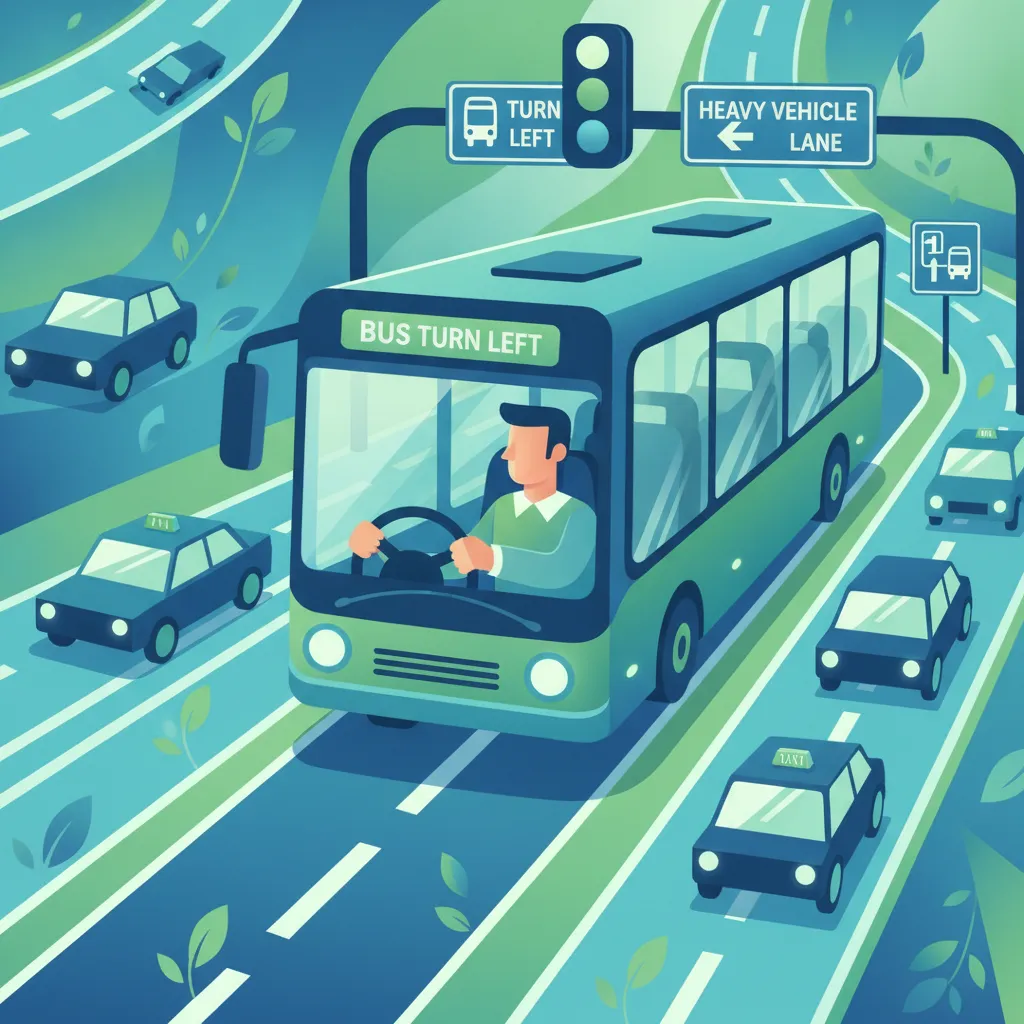
Learners will explore strategies for navigating congested urban traffic environments while operating large passenger vehicles. The lesson covers lane selection, adherence to traffic signals, and the use of bus lanes where applicable. Understanding how to maintain smooth traffic flow while ensuring passenger safety is crucial for efficient urban transportation.

This lesson focuses on the challenges and techniques required when maneuvering goods vehicles in confined spaces such as loading docks, narrow streets, and urban environments. It addresses the importance of spatial awareness, precision driving, and understanding vehicle dimensions to avoid collisions. Learners will explore strategies for effective parking, reversing, and handling blind spots safely.

Learners will explore the fundamentals of maintaining correct lane discipline, focusing on appropriate lane positioning, understanding lane markings, and executing lane changes safely. Emphasis is placed on the unique considerations for large passenger vehicles within the lane, such as width and maneuverability. The lesson also addresses the impact of proper lane discipline on overall traffic flow and safety.

This lesson explores the unique challenges faced during urban deliveries, such as navigating restricted loading zones, traffic congestion, and narrow streets. Learners will learn strategies for safe maneuvering, efficient loading and unloading, and maintaining situational awareness in high-pedestrian traffic areas. Emphasis is placed on complying with local regulations and optimizing time management.

Learners will examine the complexities of operating in environments where various road users, including pedestrians, cyclists, and motorcyclists, coexist. The lesson emphasizes the need for heightened situational awareness, defensive driving techniques, and proactive hazard anticipation. Strategies for navigating mixed traffic safely, especially in congested urban areas, are highlighted.
Understand the theoretical principles of managing extensive blind spots in passenger coaches and buses. This guide explores the systematic use of mirrors, rear-view camera integration, and situational awareness techniques required to safely monitor vehicle surroundings during operation.

This lesson introduces the proper utilization of mirrors, rearview cameras, and additional sensor systems to enhance situational awareness for goods vehicle drivers. Learners will understand the importance of correctly adjusting mirrors for optimal coverage, interpreting camera feeds, and relying on sensor alerts. The lesson emphasizes integrating modern safety technology into daily driving practices.

This lesson focuses on identifying and managing blind spots specific to goods vehicles, which are larger and have more extensive blind zones compared to standard cars. Learners will explore techniques for blind spot detection using mirrors, rearview cameras, and sensor systems, ensuring safe lane changes and maneuvering. The lesson emphasizes the importance of continuous observation and modern safety technology.

Learners will explore the proper adjustment and utilization of mirrors, rear-view cameras, and blind spot sensors to maximize visibility while operating a passenger vehicle. The lesson covers the optimal positioning of mirrors for comprehensive coverage, interpreting camera and sensor alerts, and integrating these tools into safe driving practices. Proper use of these technologies reduces blind spots and enhances overall situational awareness.

This lesson addresses the challenges of safely reversing a goods vehicle, including the identification of blind spots and rear visibility limitations. It covers proper mirror and rearview camera usage, as well as strategies for maintaining awareness of obstacles and the trailer's path. The lesson also emphasizes the importance of reversing alarms and slow, controlled vehicle movements.

This lesson highlights the critical nature of blind spots for motorcyclists, teaching strategies to recognize and mitigate these hidden areas. Learners will practice techniques for checking blind spots before lane changes and overtaking, ensuring they are fully aware of surrounding traffic. The lesson emphasizes how proper mirroring and head checks can significantly reduce the risk of collisions.

This lesson focuses on the execution of safe right and left turns with large passenger vehicles, emphasizing the identification and management of blind spots. Learners will understand the correct use of turn signals, proper positioning within the turn, and the importance of thorough observation before and during turning. Strategies for minimizing blind spot exposure are also covered.

This lesson focuses on protecting vulnerable road users, such as pedestrians, cyclists, and motorcyclists, in mixed traffic environments. Learners will examine specific strategies for increased vigilance, anticipatory driving, and properly yielding to these users. The lesson also covers high-risk zones, such as school areas and public transport stops, emphasizing the need for heightened safety.

Proper road positioning is your primary shield against being squeezed, sideswiped, or overlooked by larger motor vehicles in daily traffic. This lesson explains how to ride in the center or slightly off-center of your lane to prevent unsafe overtaking within the same lane. You will study how to identify the massive blind spots of buses and trucks, maintain appropriate following distances, and execute overtaking maneuvers with maximum safety margin and clear signal warning.

In this lesson, learners explore the essential techniques for safe reversing. Topics include using mirrors, rearview cameras, and checking blind spots. The lesson emphasizes the importance of maintaining low speeds, checking the rear area, and being aware of obstacles. Real-world examples illustrate common reversing mistakes and how to avoid them.

This lesson covers the proper usage, maintenance, and alignment of the vehicle's lighting systems, including high beams, low beams, and fog lights. It explains the legal requirements for activating lights during daytime, twilight, tunnel crossings, and heavy rain. Drivers will learn how to avoid blinding oncoming motorists while maintaining visibility.
Find clear answers to common questions learners have about Techniques for Reversing Large Vehicles in Confined Spaces. Learn how the lesson is structured, which driving theory objectives it supports, and how it fits into the overall learning path of units and curriculum progression in Turkey. These explanations help you understand key concepts, lesson flow, and exam focused study goals.
The most important factor is constant observation. Because large vehicles have extensive blind spots, you must rely on a combination of all mirrors, rear-view cameras, and, if available, a banksman or guide to ensure the path remains clear of pedestrians and obstacles.
You must adjust all side and front-view mirrors before starting any manoeuvre. Remember that cameras are a supplement to, not a replacement for, your visual checks. Always move at a walking pace to allow yourself enough time to react if a hazard appears in your blind spot.
Yes, the theory exam often tests your knowledge of professional driving conduct, which includes safe terminal approaches and manoeuvring in bus bays. You need to understand how to position the vehicle to allow for easy passenger boarding and alignment with the platform.
Large vehicles have significant momentum. By maintaining a very slow, controlled speed, you ensure that you can stop instantly if a person or small object enters your path. It also gives you better steering control to compensate for the vehicle's long wheelbase.
Use our comprehensive practice search to find exactly the Turkish driving theory questions you need to master. Whether reviewing specific road signs, traffic rules, or first aid scenarios, select your perfect practice set and boost your confidence for the official ehliyet sınavı.