
This lesson provides essential training on identifying and managing the significant blind spots inherent to large goods vehicles. As part of our Professional Goods Vehicle Theory course, it builds on your knowledge of vehicle dimensions to help you navigate safely and pass the MTSK e-sınav requirements.

Lesson content overview
Operating a commercial goods vehicle—whether it falls under the C1, C, C1E, or CE license categories—requires a completely different spatial awareness than driving a standard passenger car. Due to their elevated cabs, extended lengths, and solid cargo boxes or trailers, heavy goods vehicles (HGVs) possess massive, obscured areas where other road users can completely disappear from the driver's view. These areas are known as blind spots (kör noktalar).
For professional drivers in Turkey, mastering blind spot identification is not merely a technical skill; it is a legal and moral obligation under the Turkish Highway Traffic Regulation (Karayolları Trafik Yönetmeliği). This lesson provides a comprehensive guide to identifying these dangerous zones, utilizing advanced mirror systems, integrating modern safety technologies, and executing maneuvers safely to protect all road users, particularly vulnerable ones like cyclists, motorcyclists, and pedestrians.
Unlike passenger cars, which generally have small blind spots caused by the window pillars (A, B, and C-pillars), goods vehicles have extensive blind zones that can easily swallow large vehicles, let alone pedestrians or cyclists. A professional driver must treat these zones as "no-zone" areas where they must assume a hazard exists until proven otherwise.
Because the driver's cab in modern commercial vehicles is positioned high above the road, a significant blind spot exists directly in front of the vehicle’s bumper.
In left-hand drive countries like Turkey, the right-side blind spot is the largest, most hazardous side zone. Because the driver sits on the left side of the cab, the distance to the right side of the vehicle makes direct observation through the window highly limited.
Although closer to the driver's seat, the left side still contains a dangerous blind spot that extends from the driver's door diagonally backward.
Unlike passenger vehicles with rear windows, goods vehicles with solid cargo bodies, tankers, or trailers have a completely obstructed rear view.
Under European and Turkish type-approval regulations, modern goods vehicles are required to be equipped with a comprehensive set of mirrors. Understanding the specific function and coverage of each mirror class is essential for mitigating blind spots.
Commercial vehicles over 3.5 tonnes are equipped with specialized mirror classes (Classes II through VI) designed to cover distinct sectors around the vehicle's cab and body, reducing blind spots to the absolute minimum allowed by physical constraints.
Mirrors only work effectively when adjusted correctly. Drivers must adjust all mirrors at the start of every shift while sitting in their normal driving position. Even a minor displacement of a few millimetres in mirror alignment can expand a blind spot by several metres at the rear of the vehicle.
While mirrors provide excellent indirect vision, they can never completely replace direct human vision. A head check or shoulder check (omuz üstü bakış) is the physical rotation of the driver's torso and head to look directly through the side windows of the cab.
In goods vehicles, a shoulder check is critical for clearing the immediate lateral zones next to the cab doors before making lateral movements.
To address the inherent physical limitations of mirrors, modern commercial vehicles are increasingly equipped with Advanced Driver Assistance Systems (ADAS) specifically designed for blind spot management.
These systems use radar or ultrasonic sensors mounted along the sides of the truck and trailer to scan adjacent lanes.
Rearview cameras are vital for reversing maneuvers, especially in tight urban delivery zones or loading docks in Turkey's bustling commercial districts.
A structured observation and execution sequence is vital for ensuring that no road user is caught in a blind spot during a lane transition.
Initial Mirror Scan: Assess the traffic situation far behind and in the adjacent lanes using your Class II (main) and Class IV (wide-angle) mirrors.
Signal Intent early: Activate your direction indicator (turn signal) at least 3 to 5 seconds before initiating any lateral movement. This alerts other road users of your intention, giving those in your blind spots time to accelerate out of them or drop back.
Secondary Mirror and Sensor Check: Re-check your mirrors to see if any vehicle has reacted to your signal. Verify that your Blind Spot Monitoring (BSM) warning lights are clear.
Lean and Scan (Seat Rocking): Shift your torso forward and backward in your seat while looking at the side mirrors to shift your viewing angles, helping to reveal any hidden motorcycles or small cars.
Execute Maneuver Smoothly: Steer gently into the destination lane. Do not make sudden, aggressive steering adjustments. Maintain a consistent speed or accelerate slightly to match the flow of traffic in the new lane.
The physical dimensions of a goods vehicle are highly dynamic. Changes in vehicle load, trailer attachment, and vehicle configuration directly alter the size and positioning of your blind spots.
A professional driver must adapt their blind spot management strategies to changing road and environmental conditions.
During adverse weather conditions—such as the dense fog common in the Marmara region or heavy winter snowfall in Central Anatolia—mirror visibility is severely degraded.
The nature of blind spot risks changes dramatically depending on the road type:
Failing to properly manage blind spots leads to severe traffic violations, administrative fines, and, most importantly, catastrophic accidents. Professional drivers must avoid these common errors:
In Turkey, the Karayolları Trafik Yönetmeliği establishes strict rules for lane changes and vehicle maneuvering.
To ensure professional safety on Turkish roads:
This lesson covers the critical skill of identifying and managing blind spots in heavy goods vehicles, which are significantly larger than those in passenger cars due to vehicle dimensions and driver positioning. It details four distinct blind zones (front, right-side, left-side, and rear) with specific hazard characteristics and mitigation strategies using mirror classes II through VI. Key procedures include proper mirror adjustment, the five-step lane-change protocol, seat rocking techniques, and understanding how trailer articulation alters blind spot geometry during turns. The lesson also covers modern ADAS safety systems, environmental adaptations for Turkish weather conditions, and the legal requirements under the Karayolları Trafik Yönetmeliği, particularly Article 54 governing lane changes. These skills are essential for passing the MTSK e-sınav for C-category licences and ensuring safety around vulnerable road users.
A short set of high-value points that capture the most important learning from this lesson.
Goods vehicles have four major blind zones: front (1-3m), right side (largest hazard), left side, and rear (up to 10-15m), each requiring specific mirror coverage
Mirror Classes IV, V, and VI are mandatory convex mirrors on commercial vehicles that address side, close-proximity, and front blind spots respectively
The right-side blind spot in Turkey is the most dangerous zone due to left-hand drive configuration, causing severe underrun collisions with cyclists
Articulated vehicles create dynamic blind spots during turns as the trailer's off-tracking angle changes the effective blind zone geometry
Modern safety technology (BSM, cameras, sensors) supplements mirrors but never replaces physical mirror checks and shoulder/head checks
Explore all units and lessons included in this driving theory course.
Signal at least 3-5 seconds before any lane change to give road users time to exit your blind spots
If you cannot see the truck driver's face in the side mirror, the driver cannot see you—this is the mirror reflection rule
Complete all mirror checks BEFORE initiating a turn; once the trailer begins articulating, mirrors show only the trailer body, not the road
Readjust all mirrors after loading or unloading cargo, as suspension changes alter mirror vertical angles
Seat rocking (shifting torso forward and backward while viewing mirrors) reveals hidden vehicles by changing viewing angles around cab obstructions
Relying solely on Blind Spot Monitoring systems without performing manual mirror and shoulder checks; sensors can fail to detect small fast objects like e-scooters
Assuming that because BSM warning lights are not active, a lane is clear—sensors have limitations in rain, mud, snow, and with very small objects
Skipping the shoulder check and seat rocking technique, thinking wide-angle convex mirrors provide sufficient coverage
Failing to extend or adjust mirrors when attaching a wider trailer, leaving massive side blind zones unaddressed
Driving away from a standstill without checking Class VI front mirror for pedestrians or vehicles immediately in front of the bumper
Lesson content overview
A short set of high-value points that capture the most important learning from this lesson.
Goods vehicles have four major blind zones: front (1-3m), right side (largest hazard), left side, and rear (up to 10-15m), each requiring specific mirror coverage
Mirror Classes IV, V, and VI are mandatory convex mirrors on commercial vehicles that address side, close-proximity, and front blind spots respectively
The right-side blind spot in Turkey is the most dangerous zone due to left-hand drive configuration, causing severe underrun collisions with cyclists
Articulated vehicles create dynamic blind spots during turns as the trailer's off-tracking angle changes the effective blind zone geometry
Modern safety technology (BSM, cameras, sensors) supplements mirrors but never replaces physical mirror checks and shoulder/head checks
Explore all units and lessons included in this driving theory course.
Signal at least 3-5 seconds before any lane change to give road users time to exit your blind spots
If you cannot see the truck driver's face in the side mirror, the driver cannot see you—this is the mirror reflection rule
Complete all mirror checks BEFORE initiating a turn; once the trailer begins articulating, mirrors show only the trailer body, not the road
Readjust all mirrors after loading or unloading cargo, as suspension changes alter mirror vertical angles
Seat rocking (shifting torso forward and backward while viewing mirrors) reveals hidden vehicles by changing viewing angles around cab obstructions
Relying solely on Blind Spot Monitoring systems without performing manual mirror and shoulder checks; sensors can fail to detect small fast objects like e-scooters
Assuming that because BSM warning lights are not active, a lane is clear—sensors have limitations in rain, mud, snow, and with very small objects
Skipping the shoulder check and seat rocking technique, thinking wide-angle convex mirrors provide sufficient coverage
Failing to extend or adjust mirrors when attaching a wider trailer, leaving massive side blind zones unaddressed
Driving away from a standstill without checking Class VI front mirror for pedestrians or vehicles immediately in front of the bumper
Explore search topics learners often look for when studying Identification of Blind Spots in Goods Vehicles. These topics reflect common questions about road rules, driving situations, safety guidance, and lesson level theory preparation for learners in Turkey.
Browse additional driving theory lessons that cover connected traffic rules, road signs, and common driving situations related to this topic. Improve your understanding of how different rules interact across everyday traffic scenarios.
Learn the professional strategies for safe reversing and navigating confined spaces with large goods vehicles. This guide explains how to manage off-tracking, use spotters effectively, and handle trailer dynamics to prevent collisions in urban environments and loading zones according to Turkish traffic regulations.

This lesson focuses on the challenges and techniques required when maneuvering goods vehicles in confined spaces such as loading docks, narrow streets, and urban environments. It addresses the importance of spatial awareness, precision driving, and understanding vehicle dimensions to avoid collisions. Learners will explore strategies for effective parking, reversing, and handling blind spots safely.

This lesson delves into specific manoeuvring strategies required when navigating both tight urban environments and open rural roads with large passenger vehicles. Learners will explore techniques for handling narrow streets, tight turns, and intersections, while maintaining safety and efficiency. The content emphasizes planning and execution of manoeuvres based on road conditions and vehicle dimensions.

This lesson explores effective turning strategies for goods vehicles, focusing on managing the larger turn radius required due to vehicle size and load. Learners will understand how to approach corners safely, adjust speed, use signals appropriately, and compensate for off-tracking. The lesson also highlights how load distribution impacts turning dynamics and the importance of vehicle control.
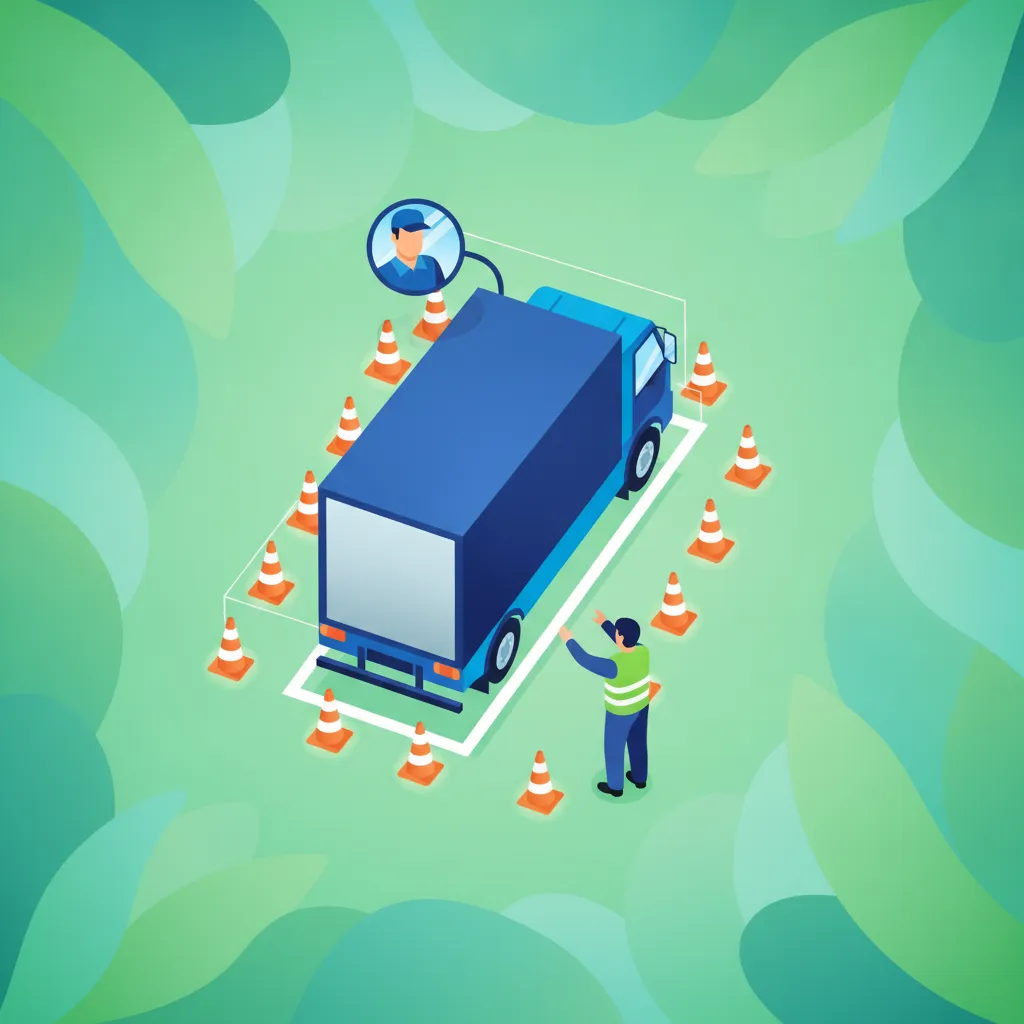
Learners will acquire skills for safely reversing large passenger vehicles in limited spaces, such as bus bays and loading docks. The lesson covers the effective use of mirrors, rear-view cameras, and precise steering inputs to navigate obstacles. Emphasis is placed on slow, controlled movements and constant observation to avoid collisions.

This lesson addresses the challenges of safely reversing a goods vehicle, including the identification of blind spots and rear visibility limitations. It covers proper mirror and rearview camera usage, as well as strategies for maintaining awareness of obstacles and the trailer's path. The lesson also emphasizes the importance of reversing alarms and slow, controlled vehicle movements.

This lesson explores the unique challenges faced during urban deliveries, such as navigating restricted loading zones, traffic congestion, and narrow streets. Learners will learn strategies for safe maneuvering, efficient loading and unloading, and maintaining situational awareness in high-pedestrian traffic areas. Emphasis is placed on complying with local regulations and optimizing time management.

This lesson examines the specific road space requirements necessary for large goods vehicles to operate safely and efficiently. Topics include the need for adequate lane width, lateral clearance, and turning lanes to accommodate wider and longer vehicles. Learners will explore the proper use of shoulders, overtaking procedures, and the impact of large vehicles on overall road capacity in traffic.

This lesson focuses on the critical importance of lane discipline and proper lane usage for large goods vehicles. Learners will understand the challenges posed by wider vehicle dimensions, the necessity of maintaining adequate lane occupancy, and the need for precise lane keeping. Emphasis is placed on selecting appropriate lanes, adhering to traffic flow, and ensuring general highway safety.

Learners will explore strategies for navigating congested urban traffic environments while operating large passenger vehicles. The lesson covers lane selection, adherence to traffic signals, and the use of bus lanes where applicable. Understanding how to maintain smooth traffic flow while ensuring passenger safety is crucial for efficient urban transportation.

This lesson covers the techniques and safety considerations for docking a goods vehicle in loading areas and performing precision parking maneuvers. Learners will learn how to align the vehicle correctly, use reverse gears effectively, and communicate with spotters when necessary. Emphasis is placed on maintaining situational awareness, checking for obstacles, and ensuring secure dock operations.
Understand the legal requirements and safe practices for lane changes while operating heavy goods vehicles on motorways and highways. This lesson covers signal timing, mirror scanning sequences, and how to safely navigate multi-lane traffic flows to maintain safety and compliance under the Turkish Highway Traffic Regulation.
This lesson focuses on the critical importance of lane discipline and proper lane usage for large goods vehicles. Learners will understand the challenges posed by wider vehicle dimensions, the necessity of maintaining adequate lane occupancy, and the need for precise lane keeping. Emphasis is placed on selecting appropriate lanes, adhering to traffic flow, and ensuring general highway safety.

Learners will explore the fundamentals of maintaining correct lane discipline, focusing on appropriate lane positioning, understanding lane markings, and executing lane changes safely. Emphasis is placed on the unique considerations for large passenger vehicles within the lane, such as width and maneuverability. The lesson also addresses the impact of proper lane discipline on overall traffic flow and safety.
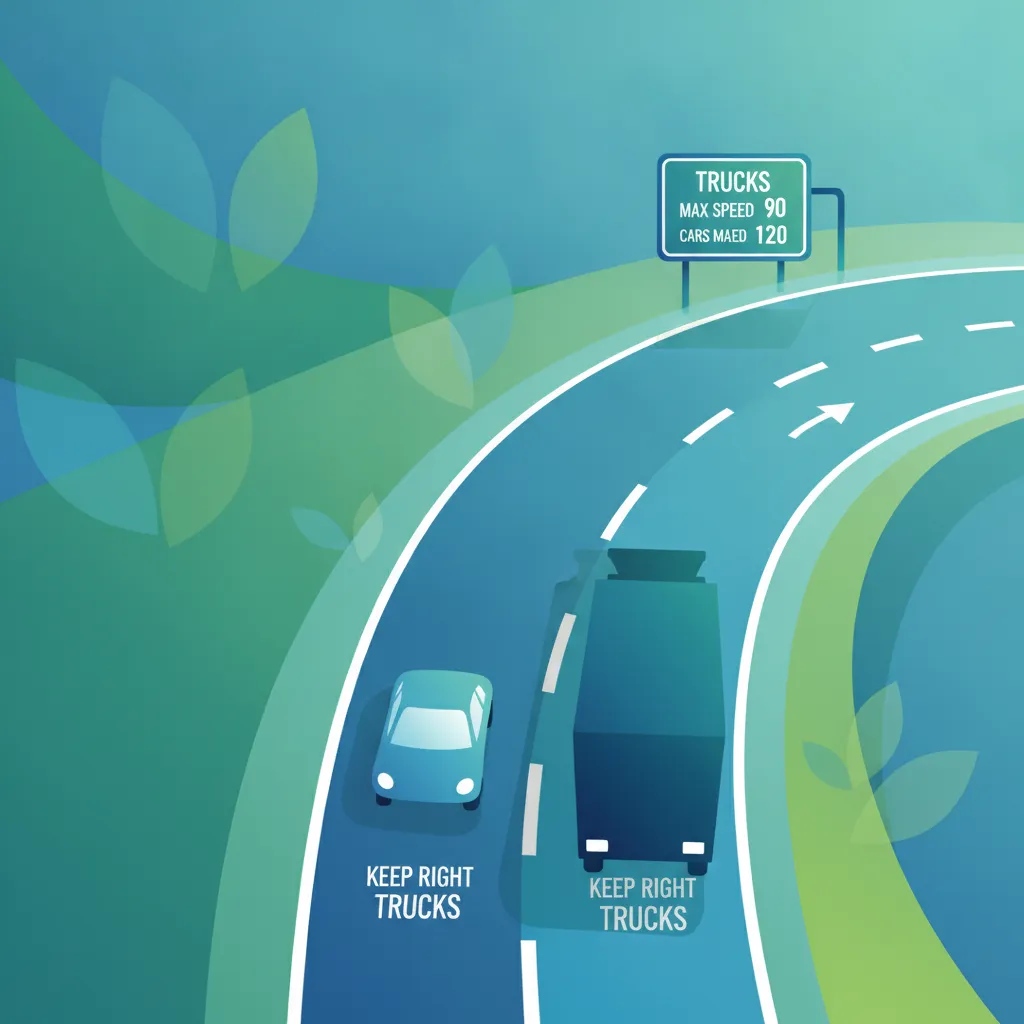
This lesson addresses the specific considerations for goods vehicle operation on highways and expressways, covering speed limits, lane discipline, safe merging, and overtaking. Learners will learn how to adapt to traffic flow, manage heavy vehicle dynamics at higher speeds, and ensure safe operation. The lesson emphasizes the importance of vigilance and proper lane usage to prevent accidents.
Find clear answers to common questions learners have about Identification of Blind Spots in Goods Vehicles. Learn how the lesson is structured, which driving theory objectives it supports, and how it fits into the overall learning path of units and curriculum progression in Turkey. These explanations help you understand key concepts, lesson flow, and exam focused study goals.
Goods vehicles have significantly higher seating positions, greater width, and longer frames. This creates large areas immediately to the sides, front, and rear where smaller vehicles, pedestrians, or cyclists remain invisible to the driver even with standard mirror configurations.
The front-view mirror is specifically designed to eliminate the blind spot directly in front of the vehicle cabin, which is critical for identifying children or small objects during low-speed maneuvers or when starting from a stop in urban traffic.
You should use a continuous scanning cycle of your primary, wide-angle, and curb mirrors. Before signaling and commencing any lateral movement, perform a final check to ensure no road user has entered your blind zone.
No, sensors and cameras are supplementary safety tools. Relying solely on technology can lead to errors; you must always combine electronic alerts with active visual observation through your mirrors to ensure complete coverage.
Use our comprehensive practice search to find exactly the Turkish driving theory questions you need to master. Whether reviewing specific road signs, traffic rules, or first aid scenarios, select your perfect practice set and boost your confidence for the official ehliyet sınavı.