
This lesson focuses on the complex task of reversing large goods vehicles, a critical skill for your professional driving career. You will learn to identify blind spots, utilize mirrors and cameras effectively, and apply safety protocols required by the Turkish Highway Traffic Regulation.

Lesson content overview
Reversing a commercial goods vehicle is one of the most demanding maneuvers a professional driver must perform. Whether you are operating a rigid truck (Category C1 or C) or an articulated vehicle with a trailer (Category C1E or CE), reversing presents severe visibility challenges. Because large vehicles lack a direct line of sight through a rear window, drivers must rely entirely on indirect vision systems—such as mirrors and camera monitor systems—and auditory warning devices.
Under the Turkish Highway Traffic Regulation (Karayolları Trafik Yönetmeliği), professional drivers are held to a high standard of safety. Reversing collisions, though often occurring at low speeds, frequently result in severe property damage, serious injuries, or fatalities, particularly involving vulnerable road users (VRUs) like pedestrians, cyclists, and motorcyclists. This lesson details the critical techniques, legal requirements, and physical principles required to execute safe reversing maneuvers and eliminate blind spot risks.
When a driver reverses a large goods vehicle, the pivot dynamics and spatial requirements change dramatically compared to forward motion. In a rigid truck, the rear overhang—the distance between the rear axle and the tail of the vehicle—swings outward in the opposite direction of the turn. In articulated vehicles (CE license category), the trailer reacts counter-intuitively to steering inputs, requiring precise micro-adjustments.
Understanding how your vehicle moves in reverse is the first step toward preventing collisions. Because you are pushing the vehicle backward, any steering input takes longer to register in the trailer's path, but once the trailer begins to angle, the jackknife threshold can be reached rapidly if speed is not strictly controlled.
A blind spot (kör nokta) is any area around the vehicle that cannot be directly or indirectly observed by the driver. For commercial goods vehicles, these zones are significantly larger than those of passenger cars.
The physical areas surrounding a vehicle that are completely obscured from the driver's direct field of view and are not captured by standard, properly adjusted mirrors.
A standard heavy vehicle has four primary blind spot zones:
The No-Zone Hazard: Never assume that because you cannot see an obstacle in your side mirrors, the path behind you is clear. The rear blind spot of a semi-trailer can easily swallow an entire passenger car, let alone a pedestrian or cyclist.
To compensate for these extensive blind spots, modern goods vehicles are equipped with a suite of mirrors and electronic aids. However, these tools are only effective if they are properly adjusted before the vehicle begins to move.
Under European and Turkish vehicle standards, heavy goods vehicles must be equipped with various classes of mirrors:
Before starting any trip or after changing drivers, you must perform the following mirror adjustment procedure:
Backup cameras and camera monitor systems (CMS) provide invaluable assistance, but they must not replace active mirror scanning.
The Turkish Highway Traffic Regulation (Karayolları Trafik Yönetmeliği) mandates strict protocols for heavy vehicles executing maneuvers. Violation of these rules not only carries heavy financial fines and penalty points on your professional driver's license but also places full liability on the driver in the event of an accident.
Before starting any reversing maneuver, the driver is legally required to ensure that all mirrors are adjusted to provide the maximum possible field of view.
Drivers must perform a physical head check (turning the head to look through the side windows) to cover areas immediately outside the cab door that mirrors might distort or miss.
Unless local signage indicates a lower speed, professional drivers must execute all reversing maneuvers at a controlled, slow speed, generally recognized as a maximum of 5 km/h (walking pace).
Commercial vehicles over a certain weight threshold must be equipped with an audible reversing alarm that sounds automatically when reverse gear is engaged.
A driver must maintain active, continuous scanning of the rear and sides of the vehicle throughout the entire reversing process.
To safely execute a reverse maneuver in a real-world scenario, such as backing into a narrow loading bay or reversing out of a driveway, follow this standardized operational sequence:
Spotter Safety: A spotter must never stand directly behind the reversing vehicle. They should stand at a safe distance where they have a clear view of both the rear of the truck and the driver's side mirror.
Professional drivers must adapt their reversing strategies to match environmental conditions, as visibility and traction can vary wildly.
During heavy rain or fog, water droplets on mirrors and camera lenses can severely distort light and obscure objects.
In poorly lit industrial areas or during night deliveries, standard reversing lights (geri vites lambaları) may not provide sufficient illumination.
Reversing on busy city streets introduces high densities of vulnerable road users, who are often distracted by mobile phones or wearing headphones.
Failing to adhere to safe reversing standards can lead to severe operational and legal issues:
To master safe reversing, professional drivers must continuously refine their spatial awareness and mirror-scanning habits. Understanding the physical layout of your vehicle's blind spots and adhering strictly to legal speed limits and procedural checklists will ensure you protect both your vehicle and the public.
This lesson covers the critical skill of safely reversing heavy goods vehicles for Turkish professional drivers holding C1, C, C1E, or CE licenses. It explains the four primary blind spot zones around commercial vehicles and the specific mirror classes (II, IV, V, VI) required by vehicle standards to compensate for visibility limitations. The lesson details five mandatory legal rules under Turkish Highway Traffic Regulation, including the 5 km/h maximum reversing speed, mandatory reversing alarms for N2/N3 vehicles, and continuous scanning requirements. Key procedures include the G.O.A.L. pre-reversing check, the Five-Point Scan routine, and proper spotter communication protocols. Drivers must also adapt techniques for adverse weather, nighttime operations, and high-traffic urban zones where vulnerable road users are most at risk.
A short set of high-value points that capture the most important learning from this lesson.
Reversing a heavy goods vehicle requires full reliance on indirect vision systems because large vehicles lack direct rear visibility.
Heavy vehicles have four primary blind spot zones: Near-Right, Near-Left, Far-Right/Far-Left, and the massive rear No-Zone directly behind the trailer or body.
The G.O.A.L. method (Get Out And Look) is the essential first step before initiating any reversing maneuver—physically walking around the vehicle to assess hazards.
Turkish law mandates a maximum reversing speed of 5 km/h and requires continuous environmental scanning from the moment reverse gear is engaged until the vehicle stops.
Class II, IV, V, and VI mirrors each serve specific purposes and must be properly adjusted before any reversing operation.
Explore all units and lessons included in this driving theory course.
Class IV mirrors provide wide-angle views for adjacent lanes; Class V kerb mirrors view the area immediately adjacent to the cab door; Class VI front mirrors prevent low-speed forward collisions with pedestrians.
Never fixate on a backup camera screen for more than two consecutive seconds—practice continuous Left Mirror -> Camera -> Right Mirror -> Camera scanning.
When reversing articulated vehicles, steering inputs take longer to register in the trailer's path, but once the trailer angles, jackknife can occur rapidly if speed is not controlled.
A spotter must never stand directly behind the reversing vehicle and should have clear view of both the truck's rear and the driver's side mirror.
Reversing on highways (otoyollar) or one-way streets is strictly prohibited under Turkish traffic law except under highly specific emergency conditions.
Relying solely on a backup camera while ignoring side mirrors, leading to side-swipe collisions with structural pillars or parked vehicles.
Turning the steering wheel too far or too fast when reversing an articulated vehicle, causing the trailer to swing out rapidly and jackknife.
Assuming the path behind is clear simply because nothing appears in side mirrors—the rear blind spot of a semi-trailer can swallow an entire passenger car.
Failing to clean mirror surfaces or activate mirror heaters in adverse weather, resulting in distorted or obscured visibility.
Not using a spotter in highly congested urban delivery zones, especially when rear view is completely obstructed.
Lesson content overview
A short set of high-value points that capture the most important learning from this lesson.
Reversing a heavy goods vehicle requires full reliance on indirect vision systems because large vehicles lack direct rear visibility.
Heavy vehicles have four primary blind spot zones: Near-Right, Near-Left, Far-Right/Far-Left, and the massive rear No-Zone directly behind the trailer or body.
The G.O.A.L. method (Get Out And Look) is the essential first step before initiating any reversing maneuver—physically walking around the vehicle to assess hazards.
Turkish law mandates a maximum reversing speed of 5 km/h and requires continuous environmental scanning from the moment reverse gear is engaged until the vehicle stops.
Class II, IV, V, and VI mirrors each serve specific purposes and must be properly adjusted before any reversing operation.
Explore all units and lessons included in this driving theory course.
Class IV mirrors provide wide-angle views for adjacent lanes; Class V kerb mirrors view the area immediately adjacent to the cab door; Class VI front mirrors prevent low-speed forward collisions with pedestrians.
Never fixate on a backup camera screen for more than two consecutive seconds—practice continuous Left Mirror -> Camera -> Right Mirror -> Camera scanning.
When reversing articulated vehicles, steering inputs take longer to register in the trailer's path, but once the trailer angles, jackknife can occur rapidly if speed is not controlled.
A spotter must never stand directly behind the reversing vehicle and should have clear view of both the truck's rear and the driver's side mirror.
Reversing on highways (otoyollar) or one-way streets is strictly prohibited under Turkish traffic law except under highly specific emergency conditions.
Relying solely on a backup camera while ignoring side mirrors, leading to side-swipe collisions with structural pillars or parked vehicles.
Turning the steering wheel too far or too fast when reversing an articulated vehicle, causing the trailer to swing out rapidly and jackknife.
Assuming the path behind is clear simply because nothing appears in side mirrors—the rear blind spot of a semi-trailer can swallow an entire passenger car.
Failing to clean mirror surfaces or activate mirror heaters in adverse weather, resulting in distorted or obscured visibility.
Not using a spotter in highly congested urban delivery zones, especially when rear view is completely obstructed.
Explore search topics learners often look for when studying Safe Reversing Techniques and Spotting Blind Spots. These topics reflect common questions about road rules, driving situations, safety guidance, and lesson level theory preparation for learners in Turkey.
Browse additional driving theory lessons that cover connected traffic rules, road signs, and common driving situations related to this topic. Improve your understanding of how different rules interact across everyday traffic scenarios.
Understand the complex pivot dynamics and steering geometry required for articulated vehicles. This lesson details how to manage trailer paths, avoid jackknifing, and maintain control during tight turns or restricted maneuvering, ensuring safe operation as mandated by Turkish highway traffic legislation for heavy vehicle drivers.

This lesson focuses on the specific manoeuvring techniques required when operating articulated vehicles or those towing trailers. Learners will understand the dynamics of pivot points, the causes and mitigation of trailer sway, and how to execute turns safely with a trailer attached. Proper coupling checks and trailer length considerations are emphasized for safe operations on public roads.

This lesson focuses on the challenges and techniques required when maneuvering goods vehicles in confined spaces such as loading docks, narrow streets, and urban environments. It addresses the importance of spatial awareness, precision driving, and understanding vehicle dimensions to avoid collisions. Learners will explore strategies for effective parking, reversing, and handling blind spots safely.

This lesson explores effective turning strategies for goods vehicles, focusing on managing the larger turn radius required due to vehicle size and load. Learners will understand how to approach corners safely, adjust speed, use signals appropriately, and compensate for off-tracking. The lesson also highlights how load distribution impacts turning dynamics and the importance of vehicle control.

This lesson delves into the concept of centre of gravity and its critical impact on the stability of goods vehicles. Learners will explore how load height and distribution affect side and dynamic stability, particularly during braking, cornering, and evasive maneuvers. The lesson explains the increased rollover risk associated with a high centre of gravity and provides strategies for managing weight.

This lesson delves into specific manoeuvring strategies required when navigating both tight urban environments and open rural roads with large passenger vehicles. Learners will explore techniques for handling narrow streets, tight turns, and intersections, while maintaining safety and efficiency. The content emphasizes planning and execution of manoeuvres based on road conditions and vehicle dimensions.

In this lesson, learners will examine the key factors that affect a motorcycle's stability and overall control, including weight distribution, gyroscopic forces, and rider input. The lesson will cover techniques for maintaining balance during both straight and curved riding, as well as strategies for handling sudden maneuvers or adverse road conditions. Understanding these concepts is crucial for safety.

This lesson covers the techniques and safety considerations for docking a goods vehicle in loading areas and performing precision parking maneuvers. Learners will learn how to align the vehicle correctly, use reverse gears effectively, and communicate with spotters when necessary. Emphasis is placed on maintaining situational awareness, checking for obstacles, and ensuring secure dock operations.

This lesson examines the effects of load dynamics on vehicle stability during acceleration and deceleration. Learners will learn how cargo can shift and affect handling, particularly during sudden speed changes or emergency braking situations. The lesson emphasizes proper load securing, gradual acceleration, and controlled braking to maintain stability and prevent serious accidents.

This lesson addresses the techniques required for safely navigating grades and slopes with heavy goods vehicles. Learners will explore the use of engine braking, proper gear selection, and auxiliary retarders to manage speed on steep downhill sections. The lesson also covers strategies for starting on uphill grades without rollback, considering vehicle weight and load distribution.
Examine the specific challenges of navigating heavy goods vehicles through congested urban environments. Learn effective strategies for interacting safely with cyclists, pedestrians, and motorcyclists, and identify how to mitigate risks when performing urban deliveries within the framework of Turkish traffic safety and urban driving regulations.

This lesson explores the unique challenges faced during urban deliveries, such as navigating restricted loading zones, traffic congestion, and narrow streets. Learners will learn strategies for safe maneuvering, efficient loading and unloading, and maintaining situational awareness in high-pedestrian traffic areas. Emphasis is placed on complying with local regulations and optimizing time management.

Learners will explore strategies for navigating congested urban traffic environments while operating large passenger vehicles. The lesson covers lane selection, adherence to traffic signals, and the use of bus lanes where applicable. Understanding how to maintain smooth traffic flow while ensuring passenger safety is crucial for efficient urban transportation.
This lesson focuses on the challenges and techniques required when maneuvering goods vehicles in confined spaces such as loading docks, narrow streets, and urban environments. It addresses the importance of spatial awareness, precision driving, and understanding vehicle dimensions to avoid collisions. Learners will explore strategies for effective parking, reversing, and handling blind spots safely.
This lesson delves into specific manoeuvring strategies required when navigating both tight urban environments and open rural roads with large passenger vehicles. Learners will explore techniques for handling narrow streets, tight turns, and intersections, while maintaining safety and efficiency. The content emphasizes planning and execution of manoeuvres based on road conditions and vehicle dimensions.

This lesson examines the critical interactions between goods vehicles and vulnerable road users such as pedestrians, cyclists, and motorcyclists, particularly in urban environments. Learners will explore right-of-way rules, maintaining safe distances, and strategies for anticipating the actions of these road users. The lesson emphasizes the importance of clear communication and protective driving.
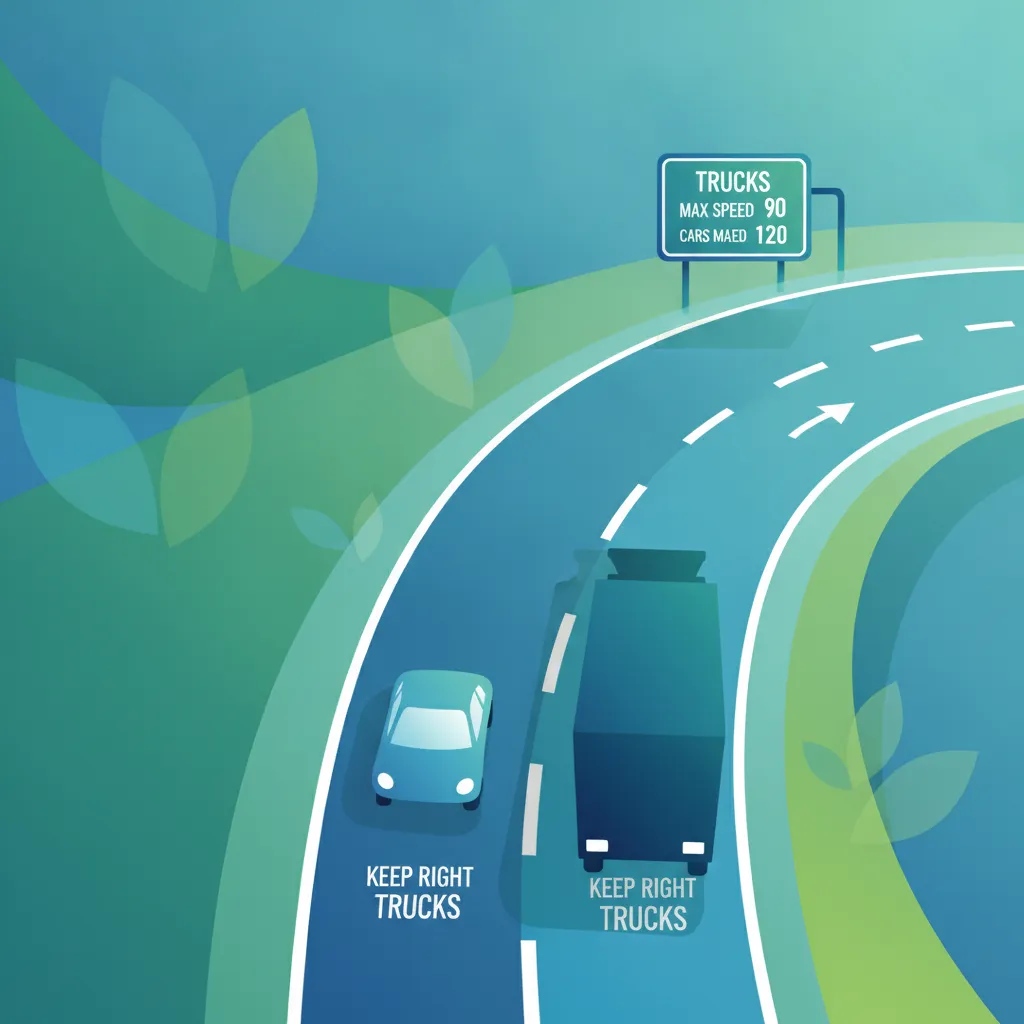
This lesson addresses the specific considerations for goods vehicle operation on highways and expressways, covering speed limits, lane discipline, safe merging, and overtaking. Learners will learn how to adapt to traffic flow, manage heavy vehicle dynamics at higher speeds, and ensure safe operation. The lesson emphasizes the importance of vigilance and proper lane usage to prevent accidents.

This lesson explores the unique challenges encountered when driving goods vehicles on rural roads, including narrow widths, sharp curves, animal crossings, and varying road surface conditions. Learners will understand the importance of adjusting speed, maintaining vigilance, and respecting road markings. Emphasis is placed on safe navigation practices to mitigate risks associated with rural areas.

This lesson focuses on the critical importance of lane discipline and proper lane usage for large goods vehicles. Learners will understand the challenges posed by wider vehicle dimensions, the necessity of maintaining adequate lane occupancy, and the need for precise lane keeping. Emphasis is placed on selecting appropriate lanes, adhering to traffic flow, and ensuring general highway safety.
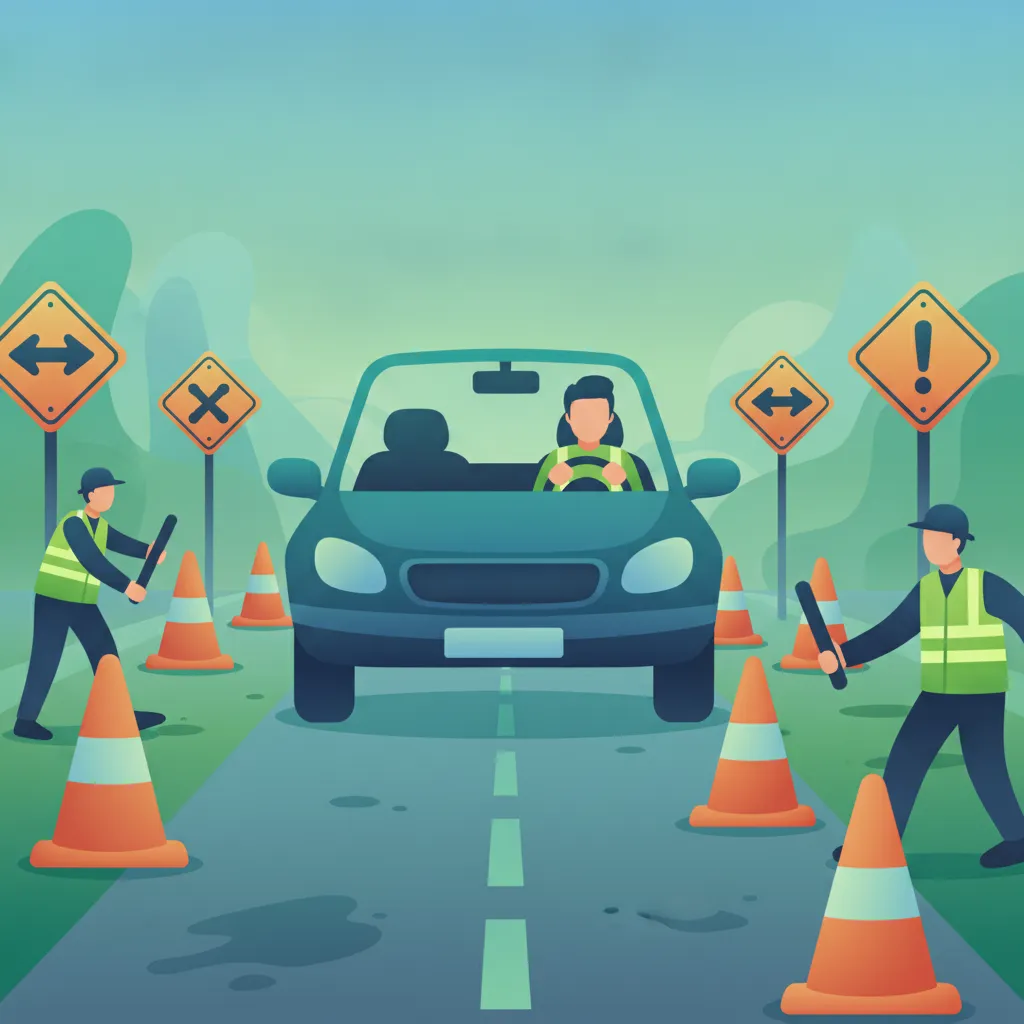
This lesson focuses on the safe navigation of goods vehicles through roadworks and construction zones. Learners will examine the importance of recognizing temporary signs, adhering to reduced speed limits, and maintaining heightened caution around workers and equipment. The lesson emphasizes the need for special attention due to the altered road environment and hazards specific to heavy vehicles.

This lesson focuses on identifying and managing blind spots specific to goods vehicles, which are larger and have more extensive blind zones compared to standard cars. Learners will explore techniques for blind spot detection using mirrors, rearview cameras, and sensor systems, ensuring safe lane changes and maneuvering. The lesson emphasizes the importance of continuous observation and modern safety technology.
Find clear answers to common questions learners have about Safe Reversing Techniques and Spotting Blind Spots. Learn how the lesson is structured, which driving theory objectives it supports, and how it fits into the overall learning path of units and curriculum progression in Turkey. These explanations help you understand key concepts, lesson flow, and exam focused study goals.
When reversing an articulated vehicle, the trailer reacts in the opposite direction to the steering input. Developing an intuitive understanding of the jack-knife effect and pivot points is crucial for your theory exam and real-world safety.
No, cameras are supplementary aids. Turkish traffic regulations emphasize that drivers must maintain a direct and mirror-based assessment of the vehicle's surroundings to ensure no blind spots are missed.
If you cannot safely monitor your path, you must stop the vehicle immediately. In professional environments, you should utilize a banksman or spotter to guide your movement, as permitted by safety protocols.
While some specific loading areas may require it, reliance on reversing alarms and external spotters is the standard. Always check local site-specific regulations for professional goods vehicles.
Use our comprehensive practice search to find exactly the Turkish driving theory questions you need to master. Whether reviewing specific road signs, traffic rules, or first aid scenarios, select your perfect practice set and boost your confidence for the official ehliyet sınavı.