
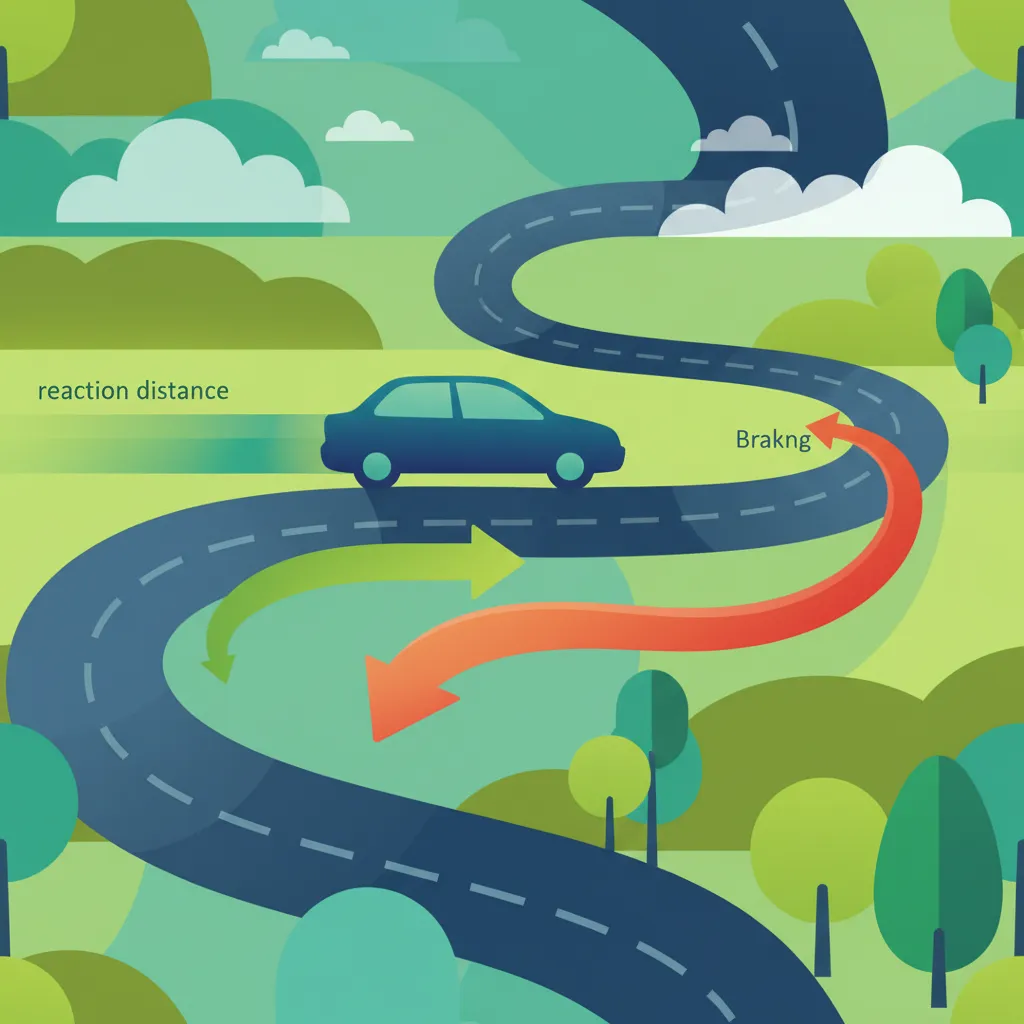
Stopping distance is the complete length a vehicle travels from the moment a driver identifies a hazard to when the vehicle comes to a complete halt. It is composed of two distinct phases: reaction distance and braking distance. Recognizing the factors that influence both — especially the dramatic effect of speed — is fundamental for anticipating dangers and driving safely on Polish roads.
Theory topic content overview
Read the full theory topic guide for Stopping Distance Basics with structured, easy-to-scan content built for learners in Poland. This detailed section explains the exact rule, meaning, traffic context, comparison points, and exam logic behind this Polish driving theory topic so you can study faster, understand the concept more clearly, and avoid common interpretation mistakes on the theory test.
Stopping distance, known in Polish driving theory as droga zatrzymania, is the total ground a vehicle covers from the moment a driver first perceives a hazard until the vehicle comes to a complete standstill. It's not just about applying the brakes; it's a comprehensive measure that includes both the driver's reaction and the vehicle's braking capability.
This crucial distance is composed of two distinct parts:
Droga Reakcji): The distance your vehicle travels during your czas reakcji (reaction time) – from the instant you identify a hazard to the moment your foot actually presses the brake pedal.Droga Hamowania): The distance your vehicle travels from the moment the brakes are applied until the vehicle comes to a full stop.Understanding this dual nature of droga zatrzymania is fundamental for safe driving and a key aspect of the Polish driving licence exam.
Misjudging droga zatrzymania is a leading cause of collisions. For drivers in Poland, where road conditions can vary significantly from pristine motorways (autostrady) to less maintained rural roads (drogi wiejskie), and weather can shift rapidly, grasping this concept is paramount.
bezpieczny odstęp) you must maintain to react and stop without colliding with the vehicle ahead.droga zatrzymania are common, often testing your knowledge of the factors that influence it, particularly the non-linear effect of speed and the distinction between reaction and braking components. Polish theory exams frequently highlight how driver delays or adverse conditions dramatically extend this distance.Let's break down the components of droga zatrzymania in more detail.
Droga Reakcji)This is the "human factor" component. It begins when your brain registers a hazard (e.g., a child running into the road, a sudden stop light) and ends when your physical action (moving your foot to the brake) starts.
Factors influencing Reaction Distance:
czas reakcji.czas reakcji.czas reakcji.In typical conditions, a driver's average czas reakcji is around 1 second. At 50 km/h, your vehicle travels approximately 14 meters in 1 second. If your reaction is delayed by just half a second, that's an additional 7 meters traveled before you even begin to brake. Exam questions, like those in the Polish theory test, often emphasize how even a 1-second delay can increase droga zatrzymania by several dozen meters on an expressway due to higher speeds.
Droga Hamowania)This is the "vehicle and road" factor component. It starts the moment your brakes engage and ends when the vehicle is completely stationary.
Factors influencing Braking Distance:
Droga hamowania does not increase linearly with speed. Instead, it increases roughly with the square of the speed. This means if you double your speed, your braking distance will increase approximately fourfold. For example, if you brake distance is 6 metres at 30 km/h, it will be around 24 metres at 60 km/h. This relationship is frequently tested in Polish driving exams for all vehicle categories.droga hamowania.droga hamowania.droga hamowania. This is particularly relevant during Polish winters.droga hamowania.droga hamowania.droga hamowania on all surfaces, especially loose ones. Without ABS, strong braking can lead to losing steerability, as noted in Polish exam questions.droga hamowania, while braking uphill shortens it.The non-linear increase in droga hamowania with speed is perhaps the single most important concept regarding droga zatrzymania. Many learners underestimate this.
Imagine:
droga hamowania might be about 6 meters.This exponential relationship is why even slight increases in speed, especially on Polish drogi ekspresowe or autostrady, drastically reduce your safety margin. Always remember: doubling your speed roughly quadruples your braking distance.
To truly master droga zatrzymania, avoid these common pitfalls:
droga zatrzymania only refers to droga hamowania. Remember, it always includes the droga reakcji as well.Czas Reakcji: While droga hamowania is affected by physics, droga reakcji is entirely dependent on the driver. Even a small delay here has significant consequences, especially at higher speeds.droga hamowania.droga zatrzymania.Consider these common situations on Polish roads:
przejście dla pieszych (pedestrian crossing) in rain: Your czas reakcji might be slightly delayed if visibility is poor, and the wet road surface will severely extend your droga hamowania. Therefore, your total droga zatrzymania will be much longer than in dry conditions. You must reduce your speed significantly and be prepared to stop.droga ekspresowa or autostrada: At speeds of 120-140 km/h, your droga zatrzymania becomes enormous. A 1-second delay in czas reakcji at these speeds means traveling an additional 33-39 meters before you even hit the brakes. Maintaining a substantial bezpieczny odstęp (at least 2-3 seconds) is absolutely vital to accommodate this extended distance.droga wiejska (rural road): Animals, potholes, or slow-moving agricultural vehicles can appear suddenly. If your czas reakcji is slow due to distraction or fatigue, and your vehicle is not well-maintained (e.g., worn tyres), your droga zatrzymania could be dangerously long, making an accident almost inevitable.To drive safely and pass your Polish driving theory exam, internalize these principles:
czas reakcji.droga hamowania.Bezpieczny Odstęp: Keep a safe following distance that allows you to comfortably cover your droga zatrzymania if the vehicle in front stops suddenly. A good rule of thumb in Poland is the "three-second rule" in good conditions, increasing to four or more seconds in adverse weather.droga hamowania.czas reakcji directly determines a significant portion of your droga zatrzymania.By understanding and applying these principles, you'll be a safer driver on Polish roads and well-prepared for your theory exam.
Stopping distance is the total distance covered from hazard perception to full stop, combining reaction distance (distance traveled during the driver's reaction time) and braking distance (distance traveled while actively braking). Speed is the dominant factor: braking distance increases roughly with the square of speed, meaning doubling speed quadruples braking distance—knowledge frequently tested in Polish driving exams. Reaction distance depends on driver factors such as alertness, fatigue, distraction, and substance use, while braking distance depends on vehicle and road factors including speed, tyre condition, road surface, and vehicle load. Understanding this dual nature helps drivers maintain appropriate following distances and adapt speed to conditions, which is essential for safe driving across Poland's diverse road types from motorways to rural roads.
A short set of high-value points that capture the most important ideas from this theory explanation.
Stopping distance is the sum of reaction distance (before brakes) and braking distance (during braking), covering the total ground from hazard perception to full stop.
Doubling your speed quadruples braking distance, not doubles it—this non-linear relationship is the most critical concept for safe driving.
Reaction distance depends entirely on the driver: at 50 km/h, a 1-second reaction time means traveling 14 meters before brakes are even applied.
Road conditions dramatically affect braking distance: wet roads, ice, snow, or worn tyres can multiply stopping distance several times over.
Speed limits represent maximum safe speeds under ideal conditions; in adverse weather, heavy traffic, or poor visibility, safe speed must be significantly lower.
Reaction distance (droga reakcji) + Braking distance (droga hamowania) = Stopping distance (droga zatrzymania)
Braking distance increases with the square of speed—tripling speed makes it nine times longer.
Driver alertness, fatigue, distraction, and substance use directly lengthen reaction time and thus total stopping distance.
ABS prevents wheel lock-up and maintains steerability but does not necessarily shorten braking distance on all surfaces.
Maintain at least a 3-second following distance in good conditions, increasing it in adverse weather on Polish roads.
Confusing braking distance with stopping distance—stopping distance always includes reaction distance as well.
Underestimating how severely reaction delays add to stopping distance, especially at motorway speeds where 1 second = 33-39 extra meters.
Assuming ABS automatically means shorter stopping distances; it maintains control, not necessarily distance.
Ignoring how road surface conditions (wet, icy, gravel) dramatically extend braking distance compared to dry asphalt.
Treating the speed limit as a safe speed in all conditions rather than the maximum under ideal circumstances.
Start with a short, direct summary of Stopping Distance Basics before reading the full explanation below.
Stopping distance is the sum of reaction distance (distance traveled before applying brakes) and braking distance (distance traveled while braking). It's the total ground covered from perceiving a hazard to coming to a full stop. Speed is the most significant factor, as doubling your speed can quadruple your braking distance, making it essential for safety and understanding traffic rules in Poland.
Review the most important terms, rule signals, and traffic concepts linked to Stopping Distance Basics.
Explore related theory topic pages connected to Stopping Distance Basics and continue with the next useful rule explanation.
See the common search queries learners use when trying to understand Stopping Distance Basics in Poland.

Continue your preparation by exploring specific Polish driving theory topics in detail. Review each section to reinforce your understanding of traffic rules, road signs, and safe driving practices. Our comprehensive explanations are structured to support your learning journey and help you confidently approach the official driving licence theory exam.
Polish Driving Theory TopicsTheory topic content overview
A short set of high-value points that capture the most important ideas from this theory explanation.
Stopping distance is the sum of reaction distance (before brakes) and braking distance (during braking), covering the total ground from hazard perception to full stop.
Doubling your speed quadruples braking distance, not doubles it—this non-linear relationship is the most critical concept for safe driving.
Reaction distance depends entirely on the driver: at 50 km/h, a 1-second reaction time means traveling 14 meters before brakes are even applied.
Road conditions dramatically affect braking distance: wet roads, ice, snow, or worn tyres can multiply stopping distance several times over.
Speed limits represent maximum safe speeds under ideal conditions; in adverse weather, heavy traffic, or poor visibility, safe speed must be significantly lower.
Reaction distance (droga reakcji) + Braking distance (droga hamowania) = Stopping distance (droga zatrzymania)
Braking distance increases with the square of speed—tripling speed makes it nine times longer.
Driver alertness, fatigue, distraction, and substance use directly lengthen reaction time and thus total stopping distance.
ABS prevents wheel lock-up and maintains steerability but does not necessarily shorten braking distance on all surfaces.
Maintain at least a 3-second following distance in good conditions, increasing it in adverse weather on Polish roads.
Confusing braking distance with stopping distance—stopping distance always includes reaction distance as well.
Underestimating how severely reaction delays add to stopping distance, especially at motorway speeds where 1 second = 33-39 extra meters.
Assuming ABS automatically means shorter stopping distances; it maintains control, not necessarily distance.
Ignoring how road surface conditions (wet, icy, gravel) dramatically extend braking distance compared to dry asphalt.
Treating the speed limit as a safe speed in all conditions rather than the maximum under ideal circumstances.
Start with a short, direct summary of Stopping Distance Basics before reading the full explanation below.
Stopping distance is the sum of reaction distance (distance traveled before applying brakes) and braking distance (distance traveled while braking). It's the total ground covered from perceiving a hazard to coming to a full stop. Speed is the most significant factor, as doubling your speed can quadruple your braking distance, making it essential for safety and understanding traffic rules in Poland.
Review the most important terms, rule signals, and traffic concepts linked to Stopping Distance Basics.
Explore related theory topic pages connected to Stopping Distance Basics and continue with the next useful rule explanation.
See the common search queries learners use when trying to understand Stopping Distance Basics in Poland.
Continue your preparation by exploring specific Polish driving theory topics in detail. Review each section to reinforce your understanding of traffic rules, road signs, and safe driving practices. Our comprehensive explanations are structured to support your learning journey and help you confidently approach the official driving licence theory exam.
Polish Driving Theory TopicsUse this exam-focused revision tip to understand how Stopping Distance Basics is likely to appear in theory questions for learners in Poland. This section helps you identify the most testable part of the rule, avoid common traps, and remember the concept more effectively during Polish driving theory exam preparation.
For the Polish driving exam, pay close attention to the non-linear relationship between speed and braking distance; doubling speed quadruples braking distance. Also, clearly differentiate between reaction distance (influenced by driver state) and braking distance (influenced by speed, road, and vehicle conditions). Many questions will test these distinctions and their impact on safety.
Read direct answers to the most common learner questions about Stopping Distance Basics in Poland. This FAQ focuses on rule confusion, practical meaning, comparison with similar concepts, and the exact uncertainties that appear most often in Polish driving theory revision and exam preparation.
Stopping distance is the total distance your vehicle travels from the moment you detect a hazard to the point where your vehicle comes to a complete standstill.
Reaction distance is the distance your vehicle covers while you perceive the hazard and react by moving your foot to the brake. Braking distance is the distance covered from the moment the brakes are applied until the vehicle stops completely.
In Polish driving theory, it's crucial to know that reaction distance increases proportionally with speed, but braking distance increases roughly with the square of your speed. This means doubling your speed can quadruple your braking distance, significantly extending your total stopping distance.
Key factors include the driver's reaction time (affected by fatigue, distraction), vehicle speed, condition of the road surface (wet, icy, dry), tire quality and pressure, brake effectiveness, and vehicle weight. These factors are often tested in the Polish driving exam.
The Polish driving exam frequently tests your knowledge of stopping distance, especially the relationship between speed and braking, and the various factors that influence it. Understanding this concept is essential for answering questions on hazard perception and safe following distances.
On wet, icy, or gravel roads, or when visibility is poor, you must significantly reduce your speed and increase your following distance to compensate for the extended stopping distance. This is a critical aspect of safe driving in Poland's varied conditions.
While Anti-lock Braking System (ABS) helps prevent skidding and allows you to steer while braking forcefully, it doesn't always shorten the stopping distance, especially on loose surfaces like gravel or snow. Its primary benefit is maintaining control during emergency braking.
Yes, 'droga zatrzymania' is the official Polish term for total stopping distance. It's composed of 'droga reakcji' (reaction distance) and 'droga hamowania' (braking distance).
Build custom practice sessions tailored precisely to your needs. Focus on areas requiring improvement, review specific Polish road signs, or master complex traffic rules to ensure full preparation for your official driving license exam.