
This lesson details the critical speed regulations and necessary driving adaptations for heavy goods vehicles in Turkey. You will learn how vehicle weight, dimensions, and cargo influence safe operating speeds to ensure you are fully prepared for the professional theory exam.
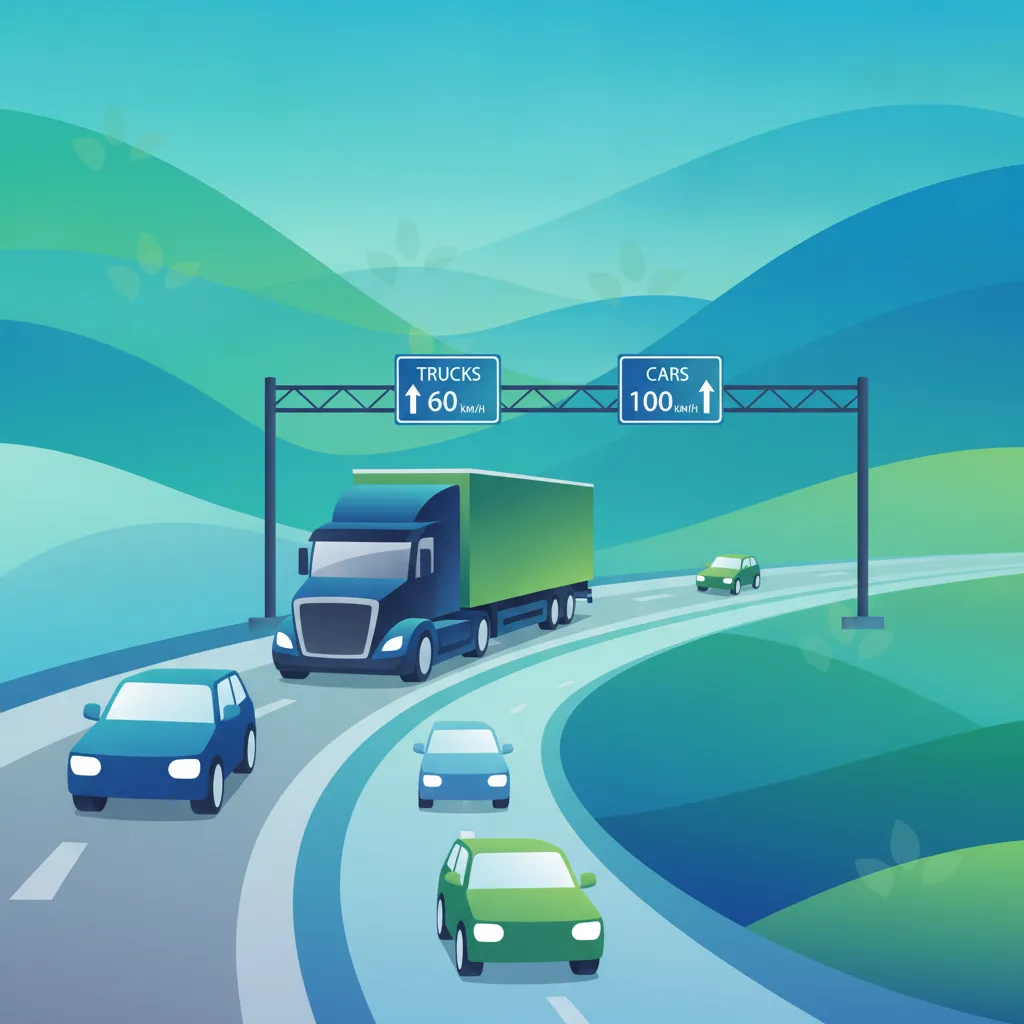
Lesson content overview
Operating a heavy goods vehicle (HGV) such as a large rigid truck or an articulated tractor-trailer combination requires more than basic driving skills. It demands a deep understanding of physics, a precise knowledge of the law, and constant situational awareness. Because of their immense mass and large dimensions, heavy vehicles behave very differently from passenger cars.
This lesson covers the legal speed limits for commercial goods vehicles under the Turkish Highway Traffic Regulation (Karayolları Trafik Yönetmeliği), explores how vehicle load and road design impact control, and explains how to adapt your speed to maintain safety under all driving conditions.
In Turkey, speed limits are strictly regulated by vehicle classification and road type. For professional drivers operating vehicles under Class C1, C, C1E, or CE licenses, understanding these specific speed caps is critical to avoiding heavy fines, license point penalties, and, most importantly, devastating road accidents.
The legal maximum speeds for heavy goods vehicles (specifically trucks with a maximum permissible mass exceeding 3.5 tonnes, referred to as Kamyon in Turkish law) are lower than those for passenger cars. This discrepancy exists because a heavy vehicle's momentum makes high-speed operation highly dangerous.
The table below outlines the maximum legal speeds under the Turkish Highway Traffic Regulation for heavy goods vehicles (Trucks/Kamyon):
| Road Classification (Turkish / English) | Maximum Legal Speed (Trucks / Class C) |
|---|---|
| Yerleşim Yeri İçi / Urban or Residential Areas | 50 km/h |
| Çift Yönlü Şehirlerarası Karayolları / Two-way Intercity Highways | 80 km/h |
| Bölünmüş Yollar / Divided Highways or Carriageways | 85 km/h |
| Otoyollar / Motorways or Expressways | 90 km/h |
For combination vehicles, such as a tractor-trailer (Class CE) or smaller truck-trailer configurations (Class C1E), these limits may be further restricted depending on the specific combination type, trailer weight, and whether dangerous goods are being transported.
Dangerous Goods Exception: Vehicles carrying hazardous or dangerous materials (Tehlikeli Madde Taşıyan Araçlar) are subject to significantly lower speed limits. Outside residential areas, their maximum speed is strictly capped at 50 km/h on two-way intercity roads, 60 km/h on divided roads, and 70 km/h on motorways.
A fundamental reason for lower heavy vehicle speed limits is the physics of motion. The relationship between a vehicle’s mass (), its speed (), and its kinetic energy () is expressed by the physical formula:
Because speed is squared in this equation, doubling your speed quadruples the kinetic energy that your vehicle's braking system must convert into heat to bring the vehicle to a stop.
Total stopping distance is comprised of two distinct components: Thinking Distance (Reaction Distance) and Braking Distance.
Reaction Phase (Thinking Distance): The distance your vehicle travels from the moment you perceive a hazard to the moment your foot touches the brake pedal. For an alert driver, this takes about 1.5 seconds. At 80 km/h, a truck travels approximately 33 meters before the brakes are even applied.
Brake Lag Phase: Heavy vehicles use air brake systems, which experience a natural delay (around 0.4 seconds) as air travels through the lines to activate the brake chambers.
Braking Phase (Braking Distance): The physical distance the vehicle travels after the brakes are engaged. This distance increases exponentially with speed and is heavily extended by the vehicle’s overall weight (load).
If a passenger car and a fully loaded Class C truck both apply their brakes at 80 km/h, the passenger car may stop within 35 to 40 meters. The heavy truck, however, can easily require 80 to 100 meters or more to come to a complete stop, even under dry, ideal conditions.
A professional driver must never treat the legal speed limit as a target. The law requires you to adapt your speed to the prevailing conditions. Even if the posted limit is 80 km/h, driving at that speed during heavy rain or fog constitutes dangerous driving.
Speed must be actively adjusted when navigating:
A heavy vehicle's dynamic behavior changes drastically depending on whether it is empty or fully loaded, and how that load is positioned.
The total weight of the vehicle including the chassis, body, fuel, driver, passengers, and cargo. It is the actual operating mass of the vehicle.
A fully loaded truck has massive momentum, requiring far longer distances to decelerate. However, an empty truck also presents unique risks. Without weight pressing down on the drive axles, tire traction is reduced, making the vehicle more susceptible to rear-wheel lockups, skidding, and trailer swing (for articulated vehicles) during sudden braking.
[High Center of Gravity] ---> Greater lean in curves ---> High rollover risk at speed
[Low/Secured Load]      ---> Stable handling        ---> Predictable cornering behavior
When a vehicle changes speed or direction, the kinetic energy causes the cargo to shift if it is not securely anchored.
Relying solely on your vehicle’s service brakes (the foot brake pedal) when managing speed on long descents is a recipe for disaster. Heavy vehicles generate massive amounts of friction heat during braking, which can lead to a dangerous condition known as brake fade.
Brake fade occurs when the brake drums or discs overheat to the point where the friction material loses its gripping capability. The pedal will feel soft or non-responsive, and the vehicle will fail to decelerate.
To prevent brake fade on downward slopes (eğimli yollar), professional drivers must utilize alternative deceleration methods.
Analyze the Slope: Observe road signs indicating the gradient percentage (e.g., a 10% descent) to assess the severity of the hill.
Select a Lower Gear Before Starting: Shift into a lower gear before the descent begins. The general rule is to use the same gear to descend a hill that you would need to climb it.
Utilize Engine Braking: By releasing the accelerator pedal in a low gear, the natural compression of the engine helps hold the vehicle back without using the service brakes.
Engage Auxiliary Retarders: Activate your vehicle's engine exhaust brake or hydraulic/electromagnetic retarder. These systems slow the drive shaft or exhaust flow, absorbing energy and controlling speed without generating heat in the wheel brakes.
Apply Snub Braking if Needed: If your speed still creeps up, apply the service brakes firmly for a few seconds to reduce speed, then release them completely to let them cool. Never ride the brakes lightly down the entire hill.
The distance you keep behind the vehicle in front of you is your ultimate safety margin. Because a loaded truck requires much more space to stop, your following distance must scale upward with your speed.
Under perfect dry conditions, a professional driver should maintain a minimum following distance of at least three seconds behind the vehicle ahead. To calculate this, choose a stationary object (like a sign or bridge shadow) and count "one-thousand-and-one, one-thousand-and-two, one-thousand-and-three" after the lead vehicle passes it. If you reach the object before finishing, you are too close.
[Lead Car] -------- (3-Second Safe Gap / Dry Road) -------- [Loaded Truck (Class C)]
[Lead Car] ---------------- (6+ Second Safe Gap / Wet Road) ---------------- [Loaded Truck]
In wet or poor visibility conditions, this gap must be doubled to six seconds or more.
The Turkish Highway Traffic Regulation states that under normal conditions, the minimum following distance should correspond to the distance the vehicle travels in half its speed value (expressed in meters). For example, if you are traveling at 80 km/h, your minimum physical distance should be 40 meters.
However, for specific vehicle classes, stricter rules apply:
Professional drivers are held to a higher standard of safety. Violating speed and handling regulations can result in severe consequences, including driving bans, heavy administrative fines, and criminal prosecution in the event of an accident.
By maintaining disciplined control over your accelerator, anticipating changes in terrain, and respecting the laws of physics, you ensure a safe, efficient, and professional driving career.
To reinforce your understanding of speed dynamics, vehicle limits, and stopping behaviors, explore the following resources and practice tests.
Explore all units and lessons included in this driving theory course.
Lesson content overview
Explore all units and lessons included in this driving theory course.
Explore search topics learners often look for when studying Speed Regulations and Adaptations for Heavy Vehicles. These topics reflect common questions about road rules, driving situations, safety guidance, and lesson level theory preparation for learners in Turkey.
Browse additional driving theory lessons that cover connected traffic rules, road signs, and common driving situations related to this topic. Improve your understanding of how different rules interact across everyday traffic scenarios.
Learn the mechanics of heavy-duty air brakes, the role of engine retarders, and how to safely navigate steep gradients. Understand the technical requirements for maintaining control and preventing brake fade during long descents in professional goods transport under Turkish road legislation.

This lesson addresses the techniques required for safely navigating grades and slopes with heavy goods vehicles. Learners will explore the use of engine braking, proper gear selection, and auxiliary retarders to manage speed on steep downhill sections. The lesson also covers strategies for starting on uphill grades without rollback, considering vehicle weight and load distribution.

This lesson provides an in-depth understanding of the braking systems used in goods vehicles, including air and hydraulic brakes. Learners will explore the limitations of these systems, such as brake fade and overheating, especially under heavy loads. The lesson also covers essential maintenance practices and regular brake inspections to ensure optimal performance and safe stopping distances.

This lesson presents effective braking strategies designed to safeguard passengers and prevent wheel lock-up or skidding. Learners will become familiar with progressive braking, the use of ABS, and techniques for maintaining vehicle stability during sudden stops. Proper braking ensures passenger comfort and reduces accident risk, especially in adverse road conditions.

This lesson examines the effects of load dynamics on vehicle stability during acceleration and deceleration. Learners will learn how cargo can shift and affect handling, particularly during sudden speed changes or emergency braking situations. The lesson emphasizes proper load securing, gradual acceleration, and controlled braking to maintain stability and prevent serious accidents.
This lesson focuses on effectively managing road closures and detours that affect goods vehicle routes. Learners will explore strategies for obtaining real-time information, updating navigation systems, and planning alternate routes to maintain efficiency and compliance. Emphasis is placed on safety considerations, communication with dispatch centers, and adhering to traffic management.

Learners will explore methods for achieving smooth acceleration and deceleration, focusing on gradual throttle application and progressive brake pressure to maintain passenger comfort and vehicle stability. The lesson highlights the importance of anticipating road conditions and traffic flow to avoid abrupt speed changes, thereby enhancing safety and reducing fuel consumption.
In this lesson, learners will explore the fundamentals of safe braking techniques for motorcycles, focusing on the coordinated use of front and rear brakes. Emphasis will be placed on understanding the impact of weight transfer during deceleration, the optimal braking points for both emergency and normal stopping scenarios, and adapting braking strategies to different road surfaces and weather conditions.

This lesson focuses on the importance of maintaining safe following distances for goods vehicles, taking into account longer braking distances and increased load. Learners will learn how to calculate appropriate gaps based on speed, road conditions, and vehicle dynamics. The lesson emphasizes safe following practices to prevent rear-end collisions and improve overall traffic safety in Turkey.

Learners will explore techniques for adjusting driving styles based on different road surface conditions, such as gravel, potholes, and wet pavement. The lesson emphasizes the importance of adapting speed, braking, and steering inputs to maintain vehicle control and passenger comfort. Strategies for detecting and responding to road hazards are discussed to ensure safety across diverse driving environments.
Learners will examine the complexities of operating in environments where various road users, including pedestrians, cyclists, and motorcyclists, coexist. The lesson emphasizes the need for heightened situational awareness, defensive driving techniques, and proactive hazard anticipation. Strategies for navigating mixed traffic safely, especially in congested urban areas, are highlighted.
Explore the specific challenges of maneuvering large commercial vehicles in congested city centers. Understand how to manage blind spots and safely interact with pedestrians, cyclists, and motorcyclists to ensure full compliance with urban traffic safety standards and professional driving etiquette.
Learners will explore strategies for navigating congested urban traffic environments while operating large passenger vehicles. The lesson covers lane selection, adherence to traffic signals, and the use of bus lanes where applicable. Understanding how to maintain smooth traffic flow while ensuring passenger safety is crucial for efficient urban transportation.

This lesson examines the critical interactions between goods vehicles and vulnerable road users such as pedestrians, cyclists, and motorcyclists, particularly in urban environments. Learners will explore right-of-way rules, maintaining safe distances, and strategies for anticipating the actions of these road users. The lesson emphasizes the importance of clear communication and protective driving.

This lesson focuses on protecting vulnerable road users, such as pedestrians, cyclists, and motorcyclists, in mixed traffic environments. Learners will examine specific strategies for increased vigilance, anticipatory driving, and properly yielding to these users. The lesson also covers high-risk zones, such as school areas and public transport stops, emphasizing the need for heightened safety.
This lesson delves into specific manoeuvring strategies required when navigating both tight urban environments and open rural roads with large passenger vehicles. Learners will explore techniques for handling narrow streets, tight turns, and intersections, while maintaining safety and efficiency. The content emphasizes planning and execution of manoeuvres based on road conditions and vehicle dimensions.
Learners will examine the complexities of operating in environments where various road users, including pedestrians, cyclists, and motorcyclists, coexist. The lesson emphasizes the need for heightened situational awareness, defensive driving techniques, and proactive hazard anticipation. Strategies for navigating mixed traffic safely, especially in congested urban areas, are highlighted.
This lesson explores the unique challenges faced during urban deliveries, such as navigating restricted loading zones, traffic congestion, and narrow streets. Learners will learn strategies for safe maneuvering, efficient loading and unloading, and maintaining situational awareness in high-pedestrian traffic areas. Emphasis is placed on complying with local regulations and optimizing time management.

Learners will identify the different categories of vulnerable road users and understand the heightened risks they face. The lesson emphasizes the importance of recognizing these users, anticipating their actions, and taking proactive measures to ensure their safety while operating passenger vehicles. Strategies for mitigating danger and fostering a protective driving environment are explored.
This lesson focuses on how the size and dimensions of goods vehicles influence their interaction with road infrastructure and overall traffic flow. It discusses the increased road space occupancy, especially in urban settings, and the implications for lane usage, bridge clearances, and tunnel dimensions. Learners will gain insight into the infrastructure challenges posed by large vehicles, including wear on road surfaces.

Learners will explore the fundamentals of maintaining correct lane discipline, focusing on appropriate lane positioning, understanding lane markings, and executing lane changes safely. Emphasis is placed on the unique considerations for large passenger vehicles within the lane, such as width and maneuverability. The lesson also addresses the impact of proper lane discipline on overall traffic flow and safety.
This lesson focuses on the critical importance of lane discipline and proper lane usage for large goods vehicles. Learners will understand the challenges posed by wider vehicle dimensions, the necessity of maintaining adequate lane occupancy, and the need for precise lane keeping. Emphasis is placed on selecting appropriate lanes, adhering to traffic flow, and ensuring general highway safety.
Find clear answers to common questions learners have about Speed Regulations and Adaptations for Heavy Vehicles. Learn how the lesson is structured, which driving theory objectives it supports, and how it fits into the overall learning path of units and curriculum progression in Turkey. These explanations help you understand key concepts, lesson flow, and exam focused study goals.
No. Professional goods vehicles are subject to specific, lower speed limits on highways and urban roads compared to private cars. You must strictly adhere to the limits assigned to your specific vehicle weight class to ensure safety and legal compliance.
A fully loaded vehicle has a much higher center of gravity and significantly longer stopping distance. You must drive slower and increase your following distance to compensate for the increased kinetic energy during braking or cornering.
Learners often forget to adjust for the specific vehicle category. Always verify if the exam question refers to your professional vehicle class, as standard passenger car limits do not apply.
Yes. Heavy vehicles require proactive speed management on gradients to avoid brake fade. You should use engine braking and maintain a lower speed before starting the descent.
Use our comprehensive practice search to find exactly the Turkish driving theory questions you need to master. Whether reviewing specific road signs, traffic rules, or first aid scenarios, select your perfect practice set and boost your confidence for the official ehliyet sınavı.