
This lesson explores the technical and legal requirements for managing axle load limits and payload in heavy goods vehicles. By understanding these principles, you will be prepared for exam questions concerning vehicle weight distribution, stability, and the legal consequences of exceeding your vehicle's specific operating limits.

Lesson content overview
Operating heavy goods vehicles, especially within the Austrian Driving License Theory Course for categories C, C1, C1E, and CE, requires a deep understanding of vehicle mass and its distribution. This lesson focuses on two critical concepts: axle load limits (Achslast) and payload (Nutzlast). While the overall permissible mass of a vehicle is a fundamental limit, the way that mass is distributed across individual axles is equally, if not more, important for safety, vehicle integrity, and road preservation.
Proper management of these factors is not just a matter of legal compliance; it directly impacts vehicle stability, braking performance, and the longevity of vehicle components. Mastering these concepts ensures you can operate heavy goods vehicles safely and efficiently on Austria's diverse road network, from bustling city streets to challenging alpine passes.
Before delving into the specifics of axle load and payload, it is essential to grasp their relationship with the vehicle's total mass. The overall vehicle mass is the sum of the vehicle's empty weight, its load, fluids (like fuel), and all occupants (driver and passengers). This total mass is subject to a maximum legal limit, but this limit alone does not guarantee safe operation. The distribution of that mass across the vehicle's axles is what truly dictates safety and compliance.
The Permissible Overall Mass (zulässiges Gesamtgewicht – zGG), also known as the Allowed Gross Vehicle Mass, is the absolute maximum weight that your vehicle is legally allowed to have when fully loaded. This limit is set during the vehicle's registration and is prescribed by law to ensure both safe operation and the protection of road infrastructure. Exceeding the zGG is a serious offense in Austria, regardless of how the load is distributed.
This maximum mass is a crucial starting point for any loading operation. It defines the ultimate ceiling for how much total weight your vehicle can carry, including its own weight, fuel, driver, passengers, and cargo. You must always ensure that the total actual mass of your vehicle never surpasses its registered zGG.
The maximum total mass (vehicle + load + occupants + fuel) allowed by vehicle registration and traffic law.
The Payload (Nutzlast) refers to the actual usable load-carrying capacity of your heavy goods vehicle. It represents the net weight of goods or cargo that the vehicle can legally transport. Calculating the payload accurately is vital for planning logistics and ensuring that your vehicle remains within its permissible limits.
The payload is not simply the zGG. Instead, it is derived by subtracting the vehicle's tare weight (empty weight, including all standard equipment and a full tank of fuel), the weight of the driver, and any passengers from the zGG. Any cargo, including packaging materials and load securing equipment, contributes to the payload. A common misunderstanding is to load cargo up to the zGG without accounting for the weight of the driver, passengers, and fuel, which can easily lead to an overloaded vehicle.
Start with the vehicle's Permissible Overall Mass (zGG).
Subtract the vehicle's empty weight (tare weight), which includes its standard equipment and a full tank of fuel.
Further subtract the weight of the driver and any passengers.
The remaining value is your maximum Payload (Nutzlast).
While zGG and payload determine the total permissible weight, Axle Load Limits (Achslast) specify the maximum permissible weight that a single axle or an axle group (like a tandem axle) may bear. This is arguably the most critical aspect of load management for heavy goods vehicles. Even if your total vehicle mass is well within the zGG, exceeding the Achslast on just one axle can lead to severe consequences.
Austrian regulations define specific axle load limits for different types of axles, acknowledging their varying structural capacities and roles in vehicle operation. These limits are designed to prevent structural damage to the vehicle's axles, suspension, and tires, and to minimize wear and tear on road surfaces and bridge structures.
The maximum permissible weight that a single axle or an axle group (e.g., tandem axle) may bear, as defined by regulation and vehicle specifications.
Heavy goods vehicles often feature various axle configurations, each with its own specific load limits and operational characteristics. Understanding these differences is crucial for effective load distribution.
Exceeding the Achslast for any of these axles can compromise the vehicle's integrity, lead to reduced braking efficiency, affect handling, and result in substantial fines.
Do not assume that complying with the overall Permissible Gross Vehicle Mass (zGG) automatically means your axle loads are safe or legal. Uneven load distribution is a common cause of individual axle overload, even when the total mass is within limits.
The way cargo is arranged within a heavy goods vehicle profoundly impacts its load distribution. This distribution, in turn, directly dictates the actual weight exerted on each axle and profoundly influences the vehicle's overall stability and handling characteristics. Proper load distribution is a cornerstone of safe and compliant heavy vehicle operation.
Load distribution refers to the spatial arrangement of cargo along the vehicle's longitudinal (front-to-rear), lateral (side-to-side), and vertical (height) axes. Every item loaded, and its position, shifts the vehicle's center of gravity (CoG). An optimized CoG, typically low and centered, is crucial for stability.
The stability and handling of a heavy goods vehicle are direct consequences of its load distribution. An improperly loaded vehicle can become unstable, unpredictable, and significantly more dangerous to operate.
Always aim for a load distribution that keeps the center of gravity as low and as close to the center of the vehicle's wheelbase as possible. This typically provides the best balance of stability, steering control, and braking performance.
Operating heavy goods vehicles in Austria requires strict adherence to specific traffic and vehicle regulations concerning mass, dimensions, and load securing. These laws are designed to protect road users, maintain infrastructure, and ensure safe transport operations. As a professional driver, understanding and complying with these regulations is a fundamental responsibility.
Several sections of the Austrian Road Traffic Act (StVZO) directly address vehicle loading:
The StVZO § 36 – Driver Responsibility (Fahrerverantwortung) places a direct and significant burden on the driver. Before commencing any journey, the driver is legally obliged to ensure that the vehicle, including its load, complies with all relevant legal requirements regarding mass, dimensions, and load securing. This means a pre-trip inspection must include verifying the load.
Traffic authorities, particularly the police and customs officials, are authorized under StVZO § 38 – Weight Checks (Gewichtskontrollen) to conduct spot checks. They may direct vehicles to designated weighing stations to verify both the overall mass and the individual axle loads. Violations can lead to severe penalties, including hefty fines, points on your license, vehicle detention until the load is adjusted, and even legal proceedings in serious cases.
Despite clear regulations, violations concerning axle load limits and payload are unfortunately common. Many drivers underestimate the complexity of load distribution, leading to infractions that carry significant risks and penalties. Understanding these common pitfalls is vital for avoiding them.
One of the most frequent and dangerous violations is overloading a single axle while the total vehicle mass remains within the zGG. This often occurs when heavy items are concentrated in one area of the loading space (e.g., all heavy pallets at the very rear) without considering the impact on individual axle loads.
Another common mistake is to load cargo up to the maximum permissible gross vehicle mass (zGG) without accurately factoring in the weight of the driver, passengers, and a full tank of fuel.
Loading cargo predominantly at the rear of the vehicle, particularly behind the rear axle, creates a rear-heavy load distribution. This significantly shifts the vehicle's center of gravity rearward.
Austria's mountainous terrain features numerous alpine passes and bridges with specific, often stricter, weight and axle load restrictions. These are put in place to protect the structural integrity of these constructions.
Effective load management is not a static task; it requires dynamic consideration of various environmental and operational factors. Weather conditions, the type of road, and the vehicle's current state can all influence optimal load distribution and safety.
Adverse weather significantly impacts a heavy goods vehicle's traction, braking, and stability, making proper load distribution even more critical.
Austria's geography means heavy vehicle drivers frequently encounter challenging road conditions, necessitating specific load management practices.
The actual load on an axle is not always static; it can change dynamically during operation.
Achieving safe and legal transport of heavy goods involves more than just theoretical knowledge; it requires practical application of load management principles before and during a journey. Diligent checks and smart loading strategies are paramount.
Before every journey, especially with a laden heavy goods vehicle, a thorough pre-trip inspection is legally mandated and critical for safety. This inspection must specifically include load verification.
Check Documentation: Verify the vehicle's Permissible Overall Mass (zGG) and individual axle load limits (Achslast) from the vehicle registration documents.
Calculate Payload: Re-calculate the maximum payload, accounting for the actual weight of the vehicle, fuel, driver, and any passengers.
Weigh the Load: Whenever possible, use calibrated scales (e.g., at loading docks, public weighbridges) to measure the total cargo weight and, ideally, individual axle loads.
Review Load Distribution: Visually inspect the cargo placement. Ensure heavy items are low and centrally located. Check for any obvious lateral imbalances or rear-heavy loading.
Verify Securing: Confirm that all cargo is correctly secured using appropriate methods (straps, chains, chocks, anti-slip mats) in accordance with StVZO § 35 to prevent movement.
Adjust Tire Pressures: Ensure tire pressures are correct for the anticipated load, as specified by the manufacturer. Incorrect pressure can exacerbate the effects of overloading.
Different types of cargo require tailored loading strategies to ensure compliance with axle load limits and optimal stability.
Always err on the side of caution. If you are unsure about the weight or distribution, seek guidance or verify the load. The consequences of overloading far outweigh the time taken to ensure compliance.
Understanding the specific terminology is crucial for comprehending and discussing vehicle loading concepts. Here are key terms from this lesson:
This lesson has provided a foundational understanding of axle load limits and payload management. To solidify your knowledge and prepare for your Austrian heavy goods vehicle theory exam, consider exploring related topics and practicing with relevant questions.
This lesson explains the critical distinction between Permissible Overall Mass (zGG), Payload (Nutzlast), and individual Axle Load Limits (Achslast) for heavy goods vehicles in Austria. Proper payload calculation requires subtracting the vehicle's tare weight, driver, passengers, and fuel from the zGG. Load distribution across longitudinal, lateral, and vertical axes determines actual axle loads and directly impacts vehicle stability, braking performance, and steering control. Austrian traffic law (StVZO) mandates strict compliance with both overall mass and individual axle limits, with drivers bearing legal responsibility for pre-trip verification. Common violations include overloading individual axles while staying within total mass limits, neglecting fuel and driver weight in calculations, and improper rear-heavy loading that compromises steering and braking safety.
A short set of high-value points that capture the most important learning from this lesson.
Axle load limits (Achslast) apply to individual axles or axle groups, not just the total vehicle mass, so complying with zGG does not guarantee axle load compliance.
Payload (Nutzlast) is calculated by subtracting tare weight, driver weight, passenger weight, and fuel from the Permissible Overall Mass (zGG), not simply the cargo weight.
Load distribution along longitudinal, lateral, and vertical axes directly affects vehicle stability, braking efficiency, and steering control.
A rear-heavy load shifts the center of gravity backward, reducing steering axle grip and front-wheel braking effectiveness.
Dynamic weight transfer during acceleration, braking, and cornering can cause already borderline axle loads to exceed their legal limits.
Explore all units and lessons included in this driving theory course.
StVZO § 55 governs axle load limits, StVZO § 41 governs overall mass limits, and StVZO § 35 requires proper load securing to prevent cargo movement.
The steering axle typically has lower load limits than drive axles, while tandem and tridem axles share combined limits across all their constituent axles.
Heavier cargo should always be placed low and as close to the vehicle's center of gravity as possible to maximize stability.
A full diesel tank can weigh several hundred kilograms and must be included in all payload calculations before loading cargo.
Alpine passes and bridges in Austria often have stricter, localized axle load and mass restrictions that override standard limits.
Loading cargo up to the zGG without accounting for driver weight, passengers, and fuel, which immediately exceeds the permissible overall mass.
Concentrating heavy items in one area (such as all heavy pallets at the rear) to overload a single axle while keeping total mass within legal limits.
Assuming that being under the overall mass limit automatically means all individual axle loads are within their permitted limits.
Ignoring route-specific weight restrictions when planning journeys through alpine passes or across weight-restricted bridges.
Failing to account for dynamic load transfer, which can push an axle load over its limit during braking or cornering maneuvers.
Lesson content overview
A short set of high-value points that capture the most important learning from this lesson.
Axle load limits (Achslast) apply to individual axles or axle groups, not just the total vehicle mass, so complying with zGG does not guarantee axle load compliance.
Payload (Nutzlast) is calculated by subtracting tare weight, driver weight, passenger weight, and fuel from the Permissible Overall Mass (zGG), not simply the cargo weight.
Load distribution along longitudinal, lateral, and vertical axes directly affects vehicle stability, braking efficiency, and steering control.
A rear-heavy load shifts the center of gravity backward, reducing steering axle grip and front-wheel braking effectiveness.
Dynamic weight transfer during acceleration, braking, and cornering can cause already borderline axle loads to exceed their legal limits.
Explore all units and lessons included in this driving theory course.
StVZO § 55 governs axle load limits, StVZO § 41 governs overall mass limits, and StVZO § 35 requires proper load securing to prevent cargo movement.
The steering axle typically has lower load limits than drive axles, while tandem and tridem axles share combined limits across all their constituent axles.
Heavier cargo should always be placed low and as close to the vehicle's center of gravity as possible to maximize stability.
A full diesel tank can weigh several hundred kilograms and must be included in all payload calculations before loading cargo.
Alpine passes and bridges in Austria often have stricter, localized axle load and mass restrictions that override standard limits.
Loading cargo up to the zGG without accounting for driver weight, passengers, and fuel, which immediately exceeds the permissible overall mass.
Concentrating heavy items in one area (such as all heavy pallets at the rear) to overload a single axle while keeping total mass within legal limits.
Assuming that being under the overall mass limit automatically means all individual axle loads are within their permitted limits.
Ignoring route-specific weight restrictions when planning journeys through alpine passes or across weight-restricted bridges.
Failing to account for dynamic load transfer, which can push an axle load over its limit during braking or cornering maneuvers.
Explore search topics learners often look for when studying Axle Load Limits (Achslast) and Payload (Nutzlast). These topics reflect common questions about road rules, driving situations, safety guidance, and lesson level theory preparation for learners in Austria.
Browse additional driving theory lessons that cover connected traffic rules, road signs, and common driving situations related to this topic. Improve your understanding of how different rules interact across everyday traffic scenarios.
Explore the serious legal, safety, and mechanical consequences of violating Austrian axle load (Achslast) and payload (Nutzlast) regulations for heavy goods vehicles. Understand common violations and their impact on roads and vehicle integrity.

This lesson details the legal ramifications of operating an overloaded heavy vehicle in Austria, which include significant fines and penalty points. It also emphasizes the severe safety risks, such as compromised braking performance and increased mechanical stress on the vehicle. Understanding these consequences reinforces the importance of strict adherence to weight limits.

This lesson explains the critical relationship between load distribution, the vehicle's centre of gravity, and its stability. It details how incorrect placement of cargo can negatively affect handling, increase the risk of rollovers, and reduce braking efficiency. Achieving a balanced load is a key component of safe heavy vehicle operation.

This lesson explains the physical principles of load distribution and its direct impact on a vehicle's centre of gravity and stability. It details how to arrange cargo to maintain a low centre of gravity and ensure weight is distributed correctly over the axles. Proper load distribution is fundamental to safe handling and preventing rollovers.

This lesson provides guidance on how to strategically distribute a load across both the main vehicle and its trailer. It covers planning the placement of cargo to maintain a stable centre of gravity for the entire combination. This holistic approach to loading is crucial for safe handling and adhering to individual vehicle and axle weight limits.

This lesson explains the severe consequences of a load shift while the vehicle is in motion. It details how sudden movement of cargo can drastically alter the vehicle's stability, making it difficult to steer or brake effectively. This can lead to a loss of control or a rollover, highlighting the importance of proper load securing.
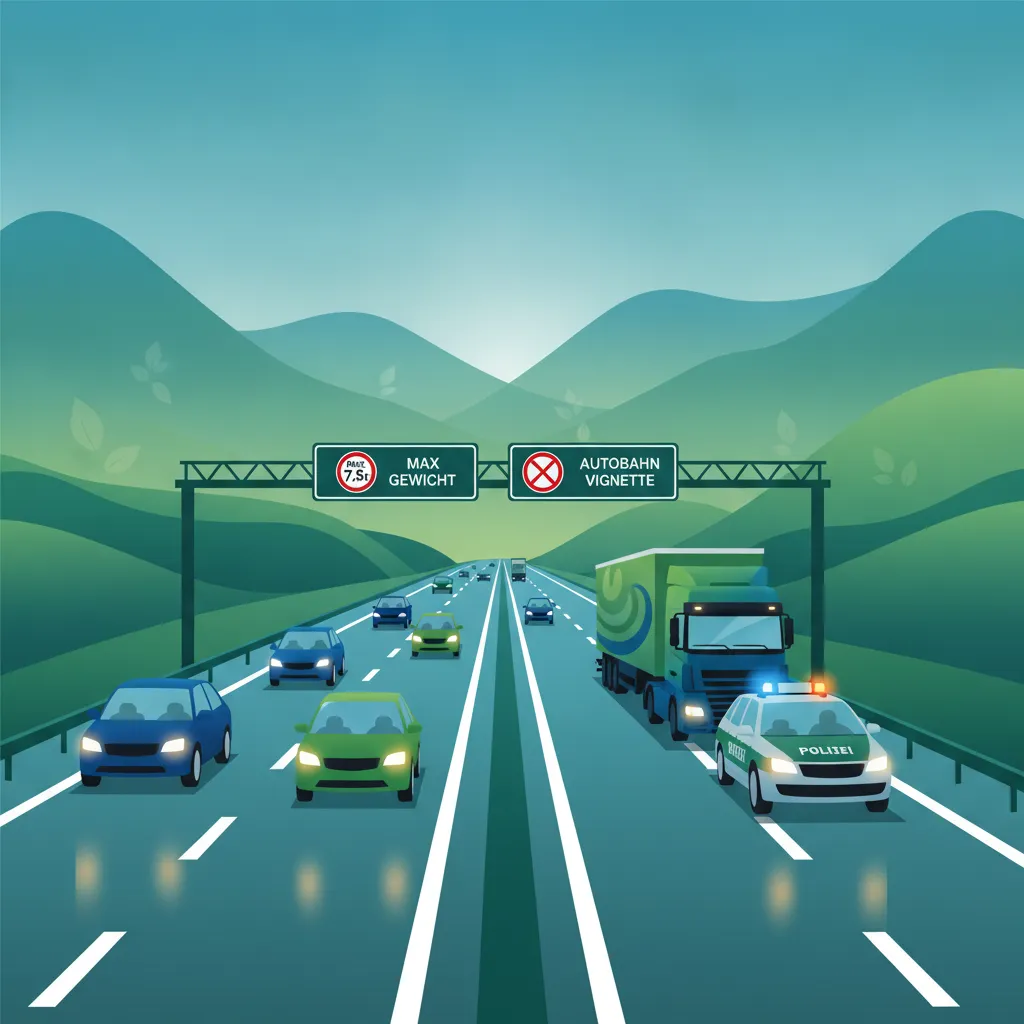
This lesson explains the system of penalties and enforcement for heavy vehicle operations in Austria. It covers the fines and penalty points associated with common traffic violations, such as overloading or insecure loads. Learners will understand the role of authorities in conducting roadside checks and inspections to ensure regulatory compliance.

This lesson covers the specific weight restrictions that apply to sensitive infrastructure like Alpine passes and bridges throughout Austria. It explains how to identify these limits through road signage and incorporate them into route planning. Adhering to these restrictions is vital for preventing structural damage and ensuring safety in challenging terrain.

This lesson focuses on the legal restrictions concerning a heavy vehicle's dimensions, including maximum height, width, and length. It teaches drivers how to interpret road signs and supplemental plates that indicate these limits. This knowledge is crucial for route planning, especially when navigating under bridges, through tunnels, and on restricted roads.

This lesson details the regulations for heavy goods vehicles on Austria's high-speed road network. It covers the specific speed limits, rules on lane usage (e.g., when overtaking is permitted), and procedures for entering and exiting the motorway. Adherence to these rules is crucial for safety in a fast-paced environment.

This lesson details the general traffic rules applicable to heavy goods vehicles on Austrian roads, highlighting differences from passenger car regulations. It covers key topics such as right-of-way at intersections, specific rules for overtaking, maintaining proper lane discipline, and adhering to designated speed limits. Understanding these rules is critical for safe integration into mixed traffic.
Understand the specific axle load (Achslast) and payload (Nutzlast) regulations and considerations for heavy vehicles operating on Austrian alpine passes and bridges. Learn about unique weight restrictions and safety measures.
This lesson covers the specific weight restrictions that apply to sensitive infrastructure like Alpine passes and bridges throughout Austria. It explains how to identify these limits through road signage and incorporate them into route planning. Adhering to these restrictions is vital for preventing structural damage and ensuring safety in challenging terrain.
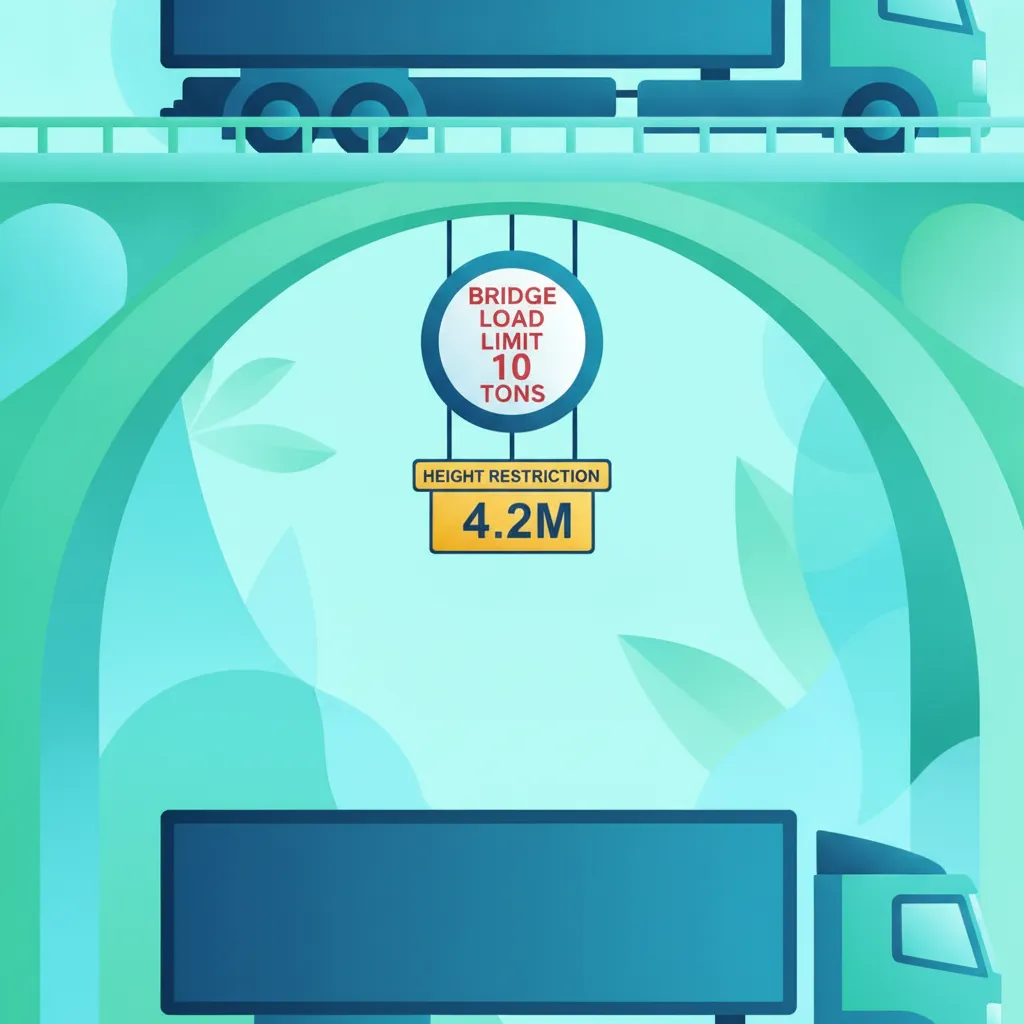
This lesson focuses on the critical importance of observing posted weight and height limits for bridges and other structures. It explains how to read the relevant signage and stresses the driver's responsibility to know their vehicle's exact height and weight. Ignoring these limits can lead to catastrophic structural failure and severe legal consequences.
This lesson focuses on the legal restrictions concerning a heavy vehicle's dimensions, including maximum height, width, and length. It teaches drivers how to interpret road signs and supplemental plates that indicate these limits. This knowledge is crucial for route planning, especially when navigating under bridges, through tunnels, and on restricted roads.

This lesson explains the critical importance of properly securing any load, whether inside the vehicle, on a roof rack, or in a trailer. It covers the principles of correct weight distribution to maintain the vehicle's center of gravity and stability. Learners will understand the legal requirements and best practices for using tie-downs and other securing methods to prevent items from shifting or falling, which could create a serious hazard on the road.
This lesson details the legal ramifications of operating an overloaded heavy vehicle in Austria, which include significant fines and penalty points. It also emphasizes the severe safety risks, such as compromised braking performance and increased mechanical stress on the vehicle. Understanding these consequences reinforces the importance of strict adherence to weight limits.
This lesson details the regulations for heavy goods vehicles on Austria's high-speed road network. It covers the specific speed limits, rules on lane usage (e.g., when overtaking is permitted), and procedures for entering and exiting the motorway. Adherence to these rules is crucial for safety in a fast-paced environment.

This lesson consolidates the legal restrictions on the maximum dimensions and weight for different vehicle combinations in Austria. It covers how to read signs indicating these limits and the importance of compliance for route planning. Adhering to these regulations is essential for legal operation and avoiding fines.

This lesson covers the practical aspects of planning a route for a heavy goods vehicle. It explains how to use maps and specialized GPS systems to identify and avoid roads with height, weight, or other restrictions. Proactive route planning is essential for ensuring an efficient, legal, and safe journey.
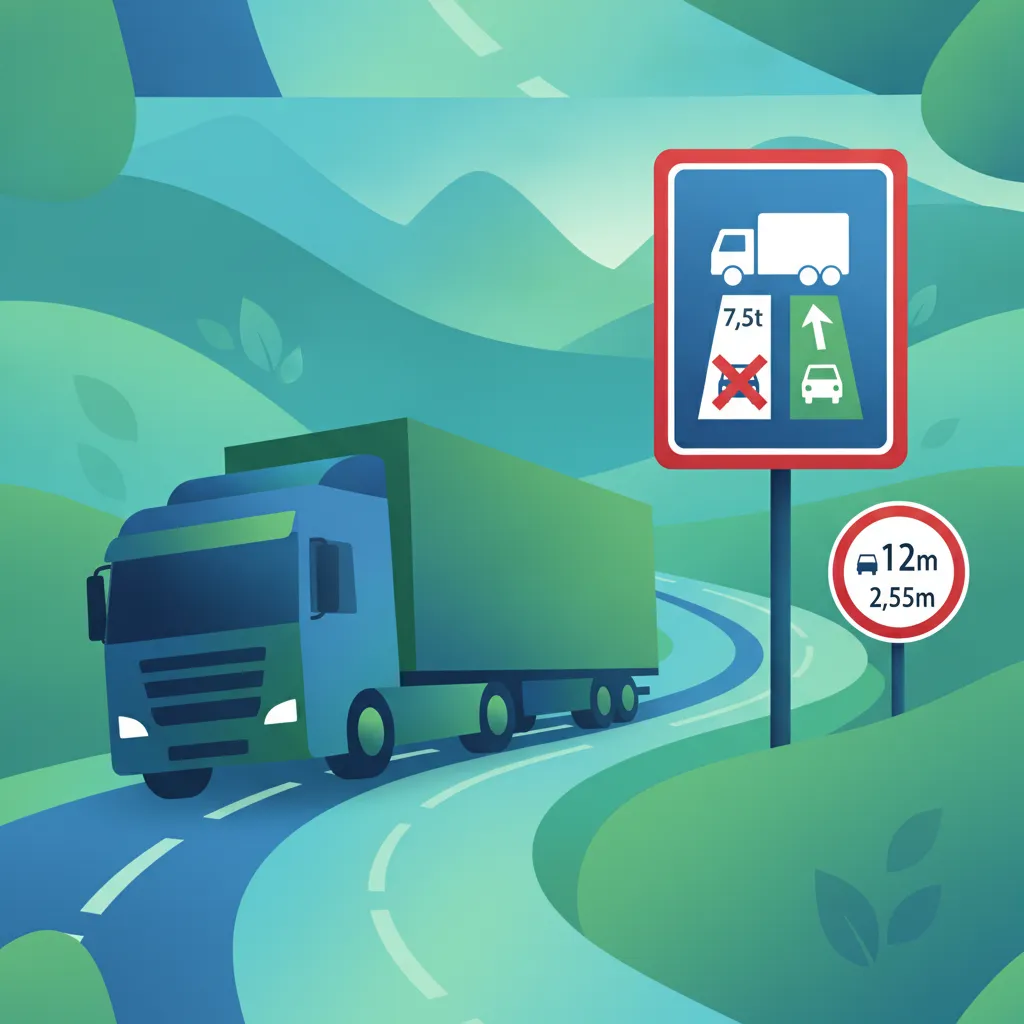
This lesson focuses on the specific Austrian road signs and supplemental plates that apply to heavy goods vehicles. It explains how to interpret signage indicating weight limits, height and width restrictions, lane usage rules, and other critical regulatory information. Correctly understanding these signs is essential for legal compliance and safe navigation on Austria's roads.
This lesson details the general traffic rules applicable to heavy goods vehicles on Austrian roads, highlighting differences from passenger car regulations. It covers key topics such as right-of-way at intersections, specific rules for overtaking, maintaining proper lane discipline, and adhering to designated speed limits. Understanding these rules is critical for safe integration into mixed traffic.
Find clear answers to common questions learners have about Axle Load Limits (Achslast) and Payload (Nutzlast). Learn how the lesson is structured, which driving theory objectives it supports, and how it fits into the overall learning path of units and curriculum progression in Austria. These explanations help you understand key concepts, lesson flow, and exam focused study goals.
The permissible total mass (zGG) is the maximum weight a vehicle is legally allowed to weigh, while the actual mass is the current weight of the vehicle plus its load. You must ensure the actual mass never exceeds the zGG during operation.
Yes. Even if your vehicle is below the zGG, exceeding the specific load limit for a single axle (Achslast) is a legal violation and poses significant safety risks to vehicle stability and road infrastructure.
Payload should be distributed to keep the centre of gravity as low and central as possible. Uneven distribution can shift this point, making the vehicle prone to tipping or loss of control, especially during sharp turns on alpine roads.
The exam will test your understanding of the principles of load distribution and the impact of weight limits. You need to know how to identify if a loading scenario is safe and legal based on the provided vehicle data.
Refine your study plan by searching for specific Austrian driving theory practice sets. Pinpoint questions related to particular road rules, signs, or challenge levels, and begin practicing immediately to reinforce your knowledge and excel in your official exam with confidence. Get started with focused revision today.