
In this lesson, you will learn the critical distinction between a vehicle's permissible overall mass (zGG) and its actual mass. Understanding these figures is essential for professional HGV drivers in Austria to ensure safe operation, avoid overloading fines, and correctly calculate available payload during your daily routes.
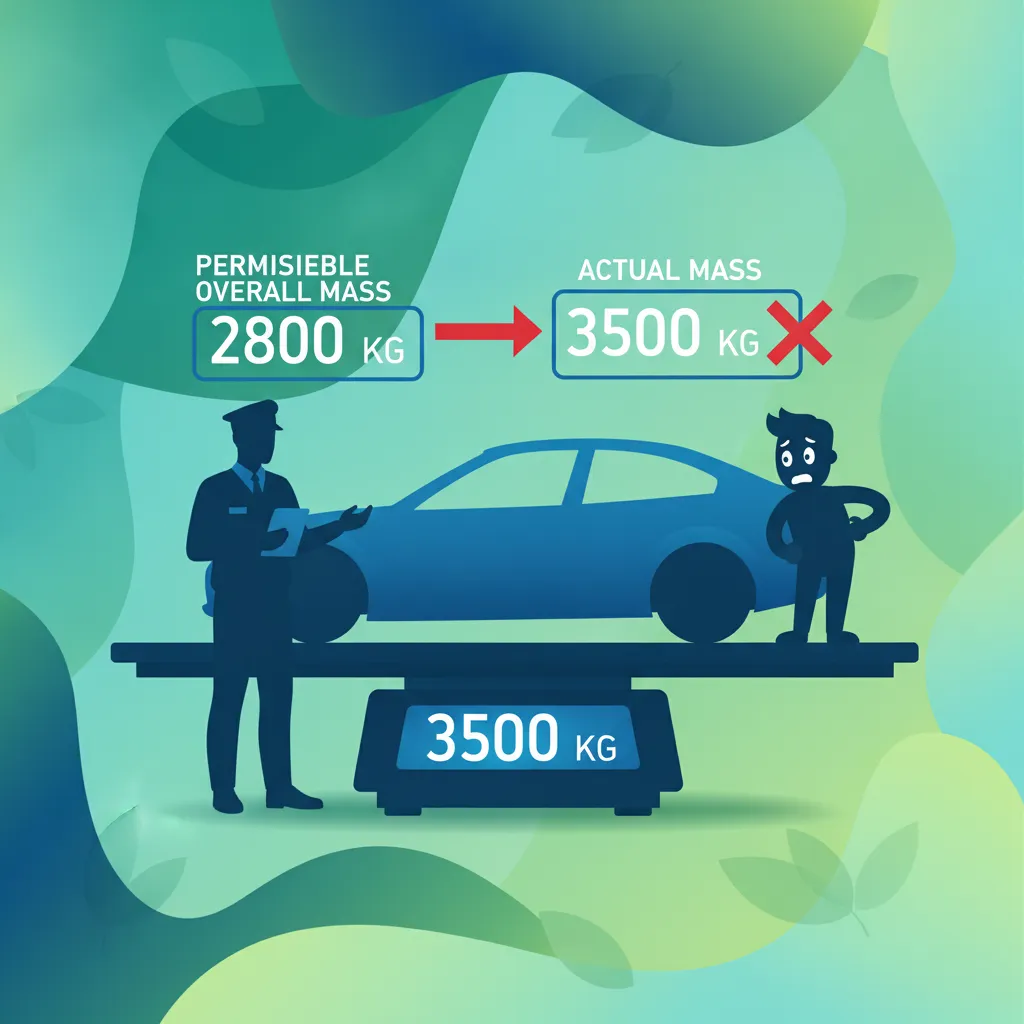
Lesson content overview
Operating heavy goods vehicles (HGVs) within the Austrian Driving License Theory Course for Heavy Goods Vehicles (C, C1, C1E, CE) requires a profound understanding of vehicle mass and weight limits. This lesson delves into the critical distinction between the legally defined permissible overall mass (zulässige Gesamtmasse, or zGG) and the vehicle’s actual mass (tatsächliche Masse). Mastering these concepts is not just a regulatory necessity but a fundamental pillar of road safety, ensuring your vehicle operates within its design limits and protects both infrastructure and other road users.
For drivers of heavy goods vehicles, accurately managing vehicle mass is paramount. Overloading can severely impact a vehicle's handling, braking efficiency, tire wear, and overall stability, dramatically increasing the risk of accidents. Beyond safety, exceeding permissible weight limits leads to significant legal penalties, including hefty fines and even vehicle impoundment in severe cases. This lesson provides the essential knowledge to correctly calculate available payload, understand legal implications, and ensure full compliance with Austrian traffic regulations.
The permissible overall mass (zulässige Gesamtmasse, or zGG) is the maximum total weight that a vehicle, or a vehicle-trailer combination, is legally allowed to have when operating on public roads. This crucial figure is determined by the vehicle manufacturer and officially recorded in the vehicle's registration documents (e.g., Typenschein or Zulassungsbescheinigung).
The legally defined maximum total mass a vehicle or vehicle-trailer combination may have while on the road, as specified in its official registration documents.
The primary purpose of the zGG is to prevent overloading. Operating a vehicle beyond its design limits compromises structural integrity, places undue stress on components like the chassis, axles, and tires, and significantly degrades safety systems. It also protects road infrastructure, such as bridges and road surfaces, from excessive wear and damage. As a driver, you must ensure that your vehicle's combined weight never exceeds its declared zGG under any circumstances, to avoid legal penalties and severe safety hazards.
Permissible overall mass can apply to:
It is a common misunderstanding to confuse zGG with the vehicle's empty weight (curb weight or Eigengewicht). The zGG represents the absolute ceiling, including everything within the vehicle: its own weight, fuel, passengers, and all cargo.
The actual mass (tatsächliche Masse) refers to the measured total weight of your vehicle or vehicle-trailer combination at any given moment. This includes every component contributing to the total weight:
The current measured total weight of a vehicle or vehicle-trailer combination, comprising the unladen vehicle weight plus the weight of passengers, fuel, cargo, and any attached trailers.
The actual mass is dynamic; it changes as fuel is consumed, cargo is loaded or unloaded, or passengers enter or exit the vehicle. Its purpose is to provide an objective measurement that can be compared against the static, legally defined permissible overall mass (zGG). Drivers are legally responsible for knowing their vehicle's actual mass, particularly after loading or unloading cargo, and ensuring it never exceeds the zGG. This often requires using certified weighing equipment, such as weighbridges, at loading points or designated control stations. Relying on estimates or potentially inaccurate vehicle scales can lead to inadvertent overloading and serious legal consequences.
Payload (Nutzlast) is a critical figure for any heavy goods vehicle operator. It represents the maximum weight that can be added to the unladen vehicle without exceeding its permissible overall mass (zGG). Essentially, it tells you how much cargo, passengers, and additional equipment you can safely and legally carry.
The maximum weight that can be loaded onto a vehicle without exceeding its permissible overall mass (zGG), calculated as zGG minus the unladen mass.
The calculation for payload is straightforward:
Identify the Permissible Overall Mass (zGG): Find this value in your vehicle's registration documents.
Identify the Unladen Mass (Eigengewicht): This is the vehicle's weight with standard equipment and a full fuel tank, but without cargo or passengers. This figure is also found in your vehicle's documentation.
Calculate Payload: Subtract the Unladen Mass from the zGG.
Payload = Permissible Overall Mass (zGG) – Unladen Mass (Eigengewicht)
For example, if your heavy truck has a zGG of 24,000 kg and an unladen mass of 12,000 kg, your maximum payload is 12,000 kg. This means you can load up to 12,000 kg of cargo, passengers, and any additional accessories. Accurate payload calculation is crucial for load planning, preventing overloading, and ensuring safe operation. It's important to remember that this payload must account for everything added to the unladen vehicle, including the driver, co-driver, passengers, and any spare parts or tools.
Never assume that fuel consumption significantly increases your available payload during a journey. While a full tank adds weight, the primary payload calculation must be based on the vehicle being ready for operation with its full operating fluids.
While adhering to the permissible overall mass (zGG) is fundamental, it is equally important to respect axle load limits (Achslast). These limits specify the maximum permissible weight that each individual axle of a vehicle or trailer can bear. Even if your vehicle's total actual mass is below its zGG, exceeding the limit on any single axle constitutes a legal violation and poses significant safety risks.
The weight exerted on a single axle of a vehicle or trailer, which must not exceed the axle’s legally prescribed maximum limit.
Axle load limits are set to protect the vehicle's axles, suspension, tires, and braking system from excessive stress. Overloaded axles can lead to premature component failure, reduced tire grip, compromised braking performance, and unstable handling. They also contribute disproportionately to road wear and infrastructure damage.
The relationship between overall mass and axle loads is one of critical balance. The zGG dictates the absolute maximum total weight, but the load must be distributed correctly across the vehicle's axles to ensure each one remains within its specific Achslast. For instance, a trailer might have a single axle with a limit of 9,000 kg. Loading 10,000 kg over that axle, even if the total combination mass is well within its zGG, would be an Achslast violation. This highlights why understanding and managing load distribution is just as vital as monitoring the overall mass.
Load distribution refers to how cargo weight is arranged across the vehicle's loading area, directly influencing the weight exerted on each axle. Proper load distribution is critical not only for adhering to axle load limits but also for maintaining the vehicle's stability, handling characteristics, and braking efficiency.
The strategic arrangement of cargo weight within a vehicle to ensure that axle load limits are respected and the vehicle's stability and handling characteristics are maintained.
An improperly distributed load can lead to several dangerous situations:
Achslast, even if the total zGG is not breached. This can damage the axle, tires, and suspension.While load distribution does not alter the vehicle's overall mass (zGG), it is indispensable for safe operation within that limit. Professional drivers must be skilled in calculating and adjusting load placement to achieve optimal weight distribution. This often involves using appropriate load securing techniques to prevent cargo from shifting during transit, which could suddenly alter axle loads and the vehicle's center of gravity.
Adherence to specific regulations concerning vehicle mass is mandatory for all heavy goods vehicle drivers in Austria. These rules are designed to protect road users, maintain road infrastructure, and ensure safe vehicle operation.
Drivers must ensure that the total actual mass of their vehicle or vehicle-trailer combination never exceeds its officially declared permissible overall mass (zGG). This rule applies universally, regardless of road type or current load status. It prevents situations where vehicle components are overstressed, handling is compromised, and the risk of accidents increases.
Before commencing any journey, and especially after loading or unloading cargo, drivers are legally obligated to determine the vehicle's actual mass. This must be done using verified, certified weighing devices, such as a weighbridge. Relying on estimates is insufficient and can lead to unintentional overloading.
All cargo transported must be adequately secured to prevent any movement or shift during transit. Unsecured loads can suddenly alter the vehicle's center of gravity and axle loads, critically compromising stability, steering, and braking, especially during emergency maneuvers or on uneven terrain.
Certain routes, particularly alpine passes and bridges, may have specific, often lower, weight restrictions than the general zGG. These limits are posted via road signs and must be strictly observed. They are put in place to protect sensitive infrastructure and ensure safety on challenging gradients and structures.
Drivers must always carry the vehicle registration certificate (Zulassungsbescheinigung) or equivalent official documentation that clearly displays the permissible overall mass (zGG) and individual axle load limits. This documentation enables law enforcement officers to verify compliance during roadside checks.
Overloading and improper mass management are among the most frequently observed violations for heavy goods vehicle drivers. Understanding these common pitfalls can help prevent costly mistakes and enhance safety.
Vehicle mass and its compliance with regulations are not static concepts; they are influenced by various environmental and operational conditions. Professional drivers must consider these contextual variations to ensure continuous safety and legality.
Adverse weather significantly impacts a vehicle's dynamics, especially an overloaded one.
Different road types impose varying demands on a vehicle’s mass management.
The current state of the vehicle can subtly affect mass compliance.
The presence of vulnerable road users (pedestrians, cyclists, motorcyclists) demands heightened caution. An overloaded heavy goods vehicle has significantly longer stopping distances and reduced maneuverability. In urban areas or near schools, strict adherence to mass limits is not just about avoiding fines; it's about minimizing the risk of severe injury or fatality to others. Extra vigilance and strict compliance are non-negotiable in environments shared with unprotected road users.
The regulations surrounding permissible overall mass and actual mass are rooted deeply in fundamental physics and practical safety considerations. Overloading a heavy goods vehicle is not merely a technical breach; it introduces severe risks that can have catastrophic consequences.
Applying the knowledge of zGG and actual mass in practical situations is crucial for safe and legal heavy goods vehicle operation. Here are some common scenarios that professional drivers encounter:
Setting: An urban distribution center in Vienna, dry weather, daytime. The Challenge: A driver needs to load diverse goods into a delivery truck with a permissible overall mass (zGG) of 13,000 kg. The truck's unladen mass (Eigengewicht) is 4,000 kg. Rule Application: The driver must ensure the total actual mass (unladen mass + fuel + driver/passengers + cargo) does not exceed 13,000 kg. The available payload (Nutzlast) is 13,000 kg - 4,000 kg = 9,000 kg.
Setting: A snowy mountain pass in Tyrol, limited visibility due to fog. The Challenge: A truck with a zGG of 26,000 kg and an actual mass of 22,000 kg needs to cross a pass. Along the route, there's a sign indicating a bridge with a maximum permissible mass of 18,000 kg. Rule Application: The driver must observe specific route restrictions, even if the vehicle's general zGG is higher.
Setting: A logistics yard, clear weather, preparing for a cross-country journey. The Challenge: A tractor unit with a zGG of 18,000 kg is being coupled with a semi-trailer that has its own zGG of 30,000 kg. The combination's maximum permissible overall mass is 40,000 kg. The trailer's unladen mass is 8,000 kg, and it's being loaded with 28,000 kg of goods. Rule Application: Both the individual vehicle/trailer zGGs and the combination's zGG must be respected.
Understanding and managing vehicle mass is a core competency for heavy goods vehicle drivers in Austria.
zGG – Unladen Mass, this represents the maximum weight you can load onto your vehicle. Accurate calculation is essential for planning.This lesson teaches the essential distinction between permissible overall mass (zGG), the legally defined maximum total weight from registration documents, and actual mass (tatsächliche Masse), the vehicle's current measured weight including fuel, passengers, and cargo. Learners must master the payload calculation (zGG minus unladen mass) and understand that exceeding axle load limits on any single axle is a violation even when total mass is within zGG. The lesson emphasizes that Austrian drivers must use certified weighbridges, respect route-specific bridge and alpine pass restrictions, and secure all loads to prevent dangerous weight redistribution. Safety implications include increased braking distances, reduced stability, and component strain from overloading, all governed by fundamental physics principles.
A short set of high-value points that capture the most important learning from this lesson.
Permissible overall mass (zGG) is the absolute maximum total weight your vehicle or combination may have, found in registration documents.
Actual mass (tatsächliche Masse) is your vehicle's current measured weight including everything: unladen mass, fuel, passengers, and cargo.
Payload (Nutzlast) is calculated as zGG minus unladen mass (Eigengewicht) and represents the maximum legal load weight.
Axle load limits (Achslast) apply to each individual axle; you can exceed an axle limit even while within total zGG.
Route-specific weight restrictions on bridges and alpine passes can be lower than your vehicle's general zGG and must always be observed.
Explore all units and lessons included in this driving theory course.
Payload formula: Nutzlast = zGG - Eigengewicht (unladen mass)
Never exceed zGG regardless of road type, and never exceed individual axle load limits regardless of total mass
Use certified weighbridges for accurate actual mass; estimates are legally insufficient
Every passenger, all cargo, full fuel tank, and any trailer must be included in actual mass calculations
Seasonal or route-specific weight restrictions override general zGG limits on alpine roads and bridges
Underestimating fuel tank weight when calculating available payload before loading cargo
Failing to secure cargo properly, allowing it to shift forward during braking and overload front axles
Assuming the vehicle's zGG applies everywhere, ignoring lower bridge or pass restrictions posted on route
Forgetting to include passenger weight after payload calculation is complete
Installing heavy aftermarket equipment without recalculating unladen mass and remaining payload
Lesson content overview
A short set of high-value points that capture the most important learning from this lesson.
Permissible overall mass (zGG) is the absolute maximum total weight your vehicle or combination may have, found in registration documents.
Actual mass (tatsächliche Masse) is your vehicle's current measured weight including everything: unladen mass, fuel, passengers, and cargo.
Payload (Nutzlast) is calculated as zGG minus unladen mass (Eigengewicht) and represents the maximum legal load weight.
Axle load limits (Achslast) apply to each individual axle; you can exceed an axle limit even while within total zGG.
Route-specific weight restrictions on bridges and alpine passes can be lower than your vehicle's general zGG and must always be observed.
Explore all units and lessons included in this driving theory course.
Payload formula: Nutzlast = zGG - Eigengewicht (unladen mass)
Never exceed zGG regardless of road type, and never exceed individual axle load limits regardless of total mass
Use certified weighbridges for accurate actual mass; estimates are legally insufficient
Every passenger, all cargo, full fuel tank, and any trailer must be included in actual mass calculations
Seasonal or route-specific weight restrictions override general zGG limits on alpine roads and bridges
Underestimating fuel tank weight when calculating available payload before loading cargo
Failing to secure cargo properly, allowing it to shift forward during braking and overload front axles
Assuming the vehicle's zGG applies everywhere, ignoring lower bridge or pass restrictions posted on route
Forgetting to include passenger weight after payload calculation is complete
Installing heavy aftermarket equipment without recalculating unladen mass and remaining payload
Explore search topics learners often look for when studying Permissible Overall Mass (zGG) and Actual Mass (tatsächliche Masse). These topics reflect common questions about road rules, driving situations, safety guidance, and lesson level theory preparation for learners in Austria.
Browse additional driving theory lessons that cover connected traffic rules, road signs, and common driving situations related to this topic. Improve your understanding of how different rules interact across everyday traffic scenarios.
Understand the critical difference between permissible overall mass (zGG) and actual mass for Austrian HGVs. Learn how to calculate payload and ensure compliance with legal weight regulations for safe operation and avoidance of penalties.

This lesson details the importance of managing axle load limits (Achslast) and their relationship to the vehicle's payload (Nutzlast). It explains how uneven load distribution can lead to exceeding individual axle limits, even if the total mass is legal. Proper management of axle loads is essential for vehicle stability, road preservation, and legal compliance.

This lesson explains the specific definitions and limitations of the C1, C1E, C, and CE heavy-goods vehicle licence categories in Austria. It details the permissible vehicle mass, axle configurations, and rules for trailer combinations associated with each category. Understanding these distinctions is fundamental for ensuring legal compliance and selecting the correct licence for specific vehicle configurations.

This lesson details the legal ramifications of operating an overloaded heavy vehicle in Austria, which include significant fines and penalty points. It also emphasizes the severe safety risks, such as compromised braking performance and increased mechanical stress on the vehicle. Understanding these consequences reinforces the importance of strict adherence to weight limits.

This lesson explains the physical principles of load distribution and its direct impact on a vehicle's centre of gravity and stability. It details how to arrange cargo to maintain a low centre of gravity and ensure weight is distributed correctly over the axles. Proper load distribution is fundamental to safe handling and preventing rollovers.

This lesson details the general traffic rules applicable to heavy goods vehicles on Austrian roads, highlighting differences from passenger car regulations. It covers key topics such as right-of-way at intersections, specific rules for overtaking, maintaining proper lane discipline, and adhering to designated speed limits. Understanding these rules is critical for safe integration into mixed traffic.

This lesson consolidates the legal restrictions on the maximum dimensions and weight for different vehicle combinations in Austria. It covers how to read signs indicating these limits and the importance of compliance for route planning. Adhering to these regulations is essential for legal operation and avoiding fines.
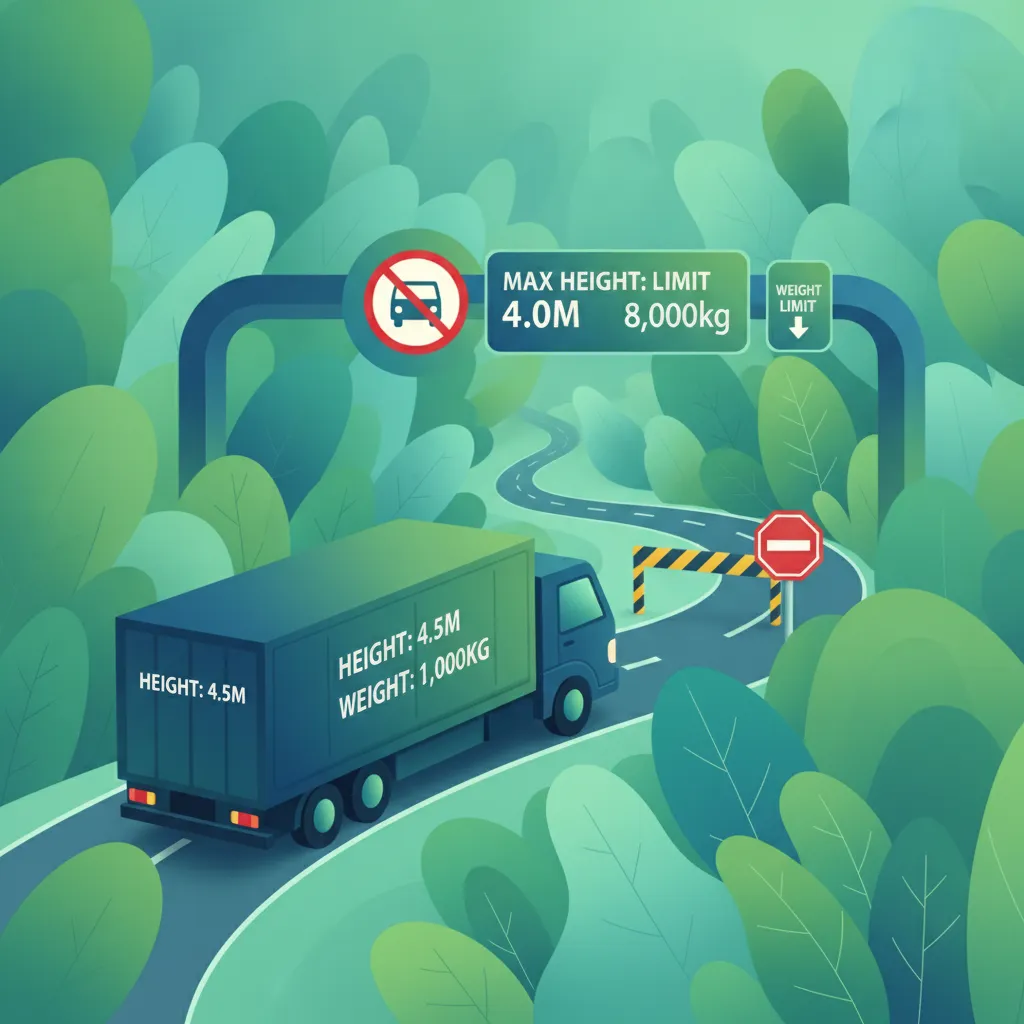
This lesson covers the practical aspects of planning a route for a heavy goods vehicle. It explains how to use maps and specialized GPS systems to identify and avoid roads with height, weight, or other restrictions. Proactive route planning is essential for ensuring an efficient, legal, and safe journey.

This lesson focuses on the legal restrictions concerning a heavy vehicle's dimensions, including maximum height, width, and length. It teaches drivers how to interpret road signs and supplemental plates that indicate these limits. This knowledge is crucial for route planning, especially when navigating under bridges, through tunnels, and on restricted roads.
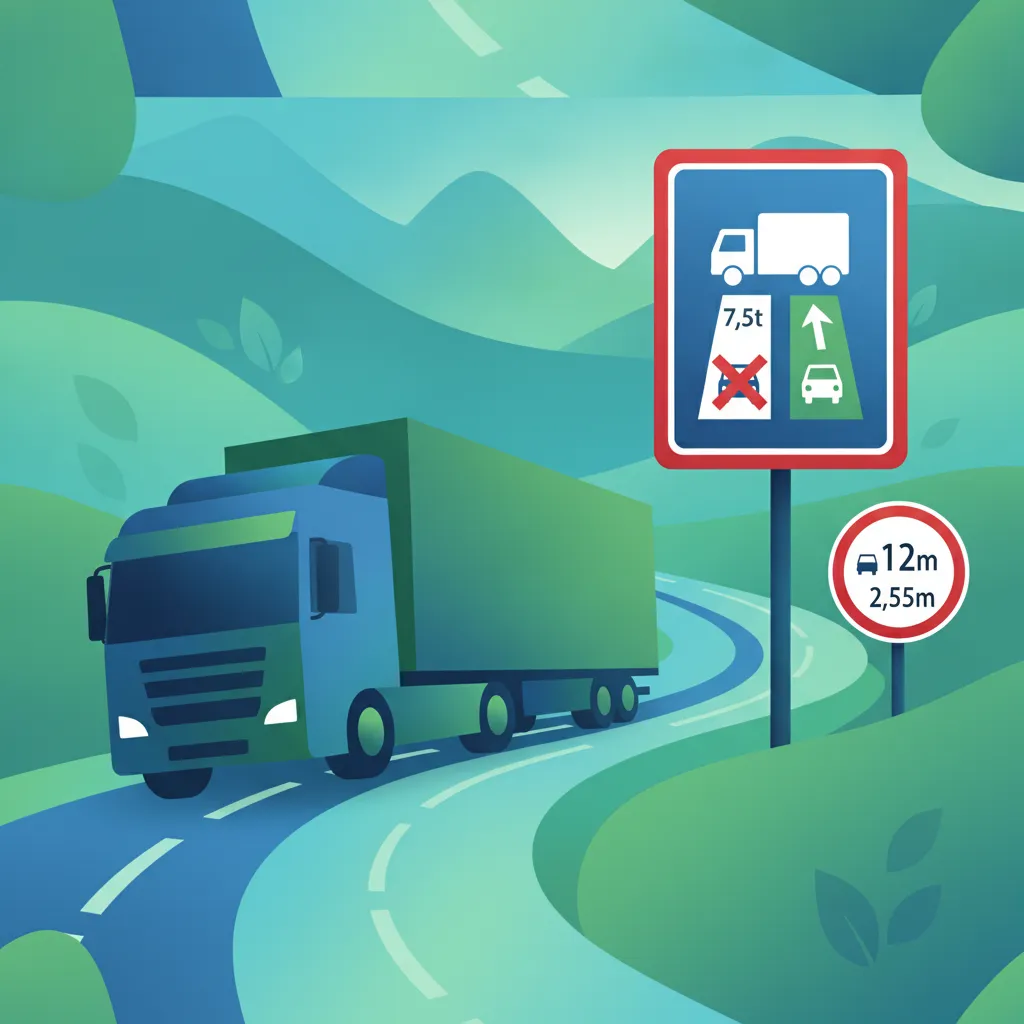
This lesson focuses on the specific Austrian road signs and supplemental plates that apply to heavy goods vehicles. It explains how to interpret signage indicating weight limits, height and width restrictions, lane usage rules, and other critical regulatory information. Correctly understanding these signs is essential for legal compliance and safe navigation on Austria's roads.

This lesson explains the critical relationship between load distribution, the vehicle's centre of gravity, and its stability. It details how incorrect placement of cargo can negatively affect handling, increase the risk of rollovers, and reduce braking efficiency. Achieving a balanced load is a key component of safe heavy vehicle operation.
Learn about specific weight limits for alpine passes, bridges, and tunnels in Austria. Understand how to identify and comply with route-specific restrictions that differ from general vehicle mass limits.

This lesson covers the specific weight restrictions that apply to sensitive infrastructure like Alpine passes and bridges throughout Austria. It explains how to identify these limits through road signage and incorporate them into route planning. Adhering to these restrictions is vital for preventing structural damage and ensuring safety in challenging terrain.
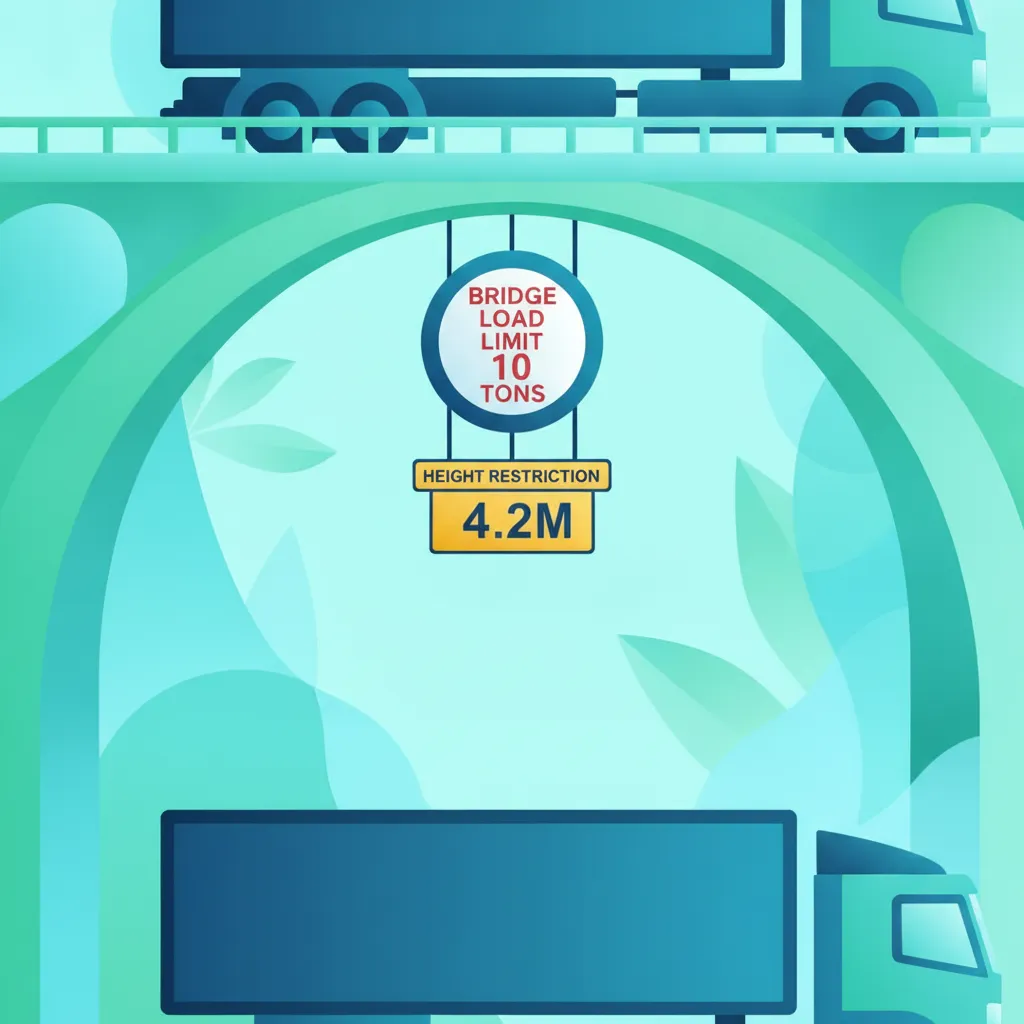
This lesson focuses on the critical importance of observing posted weight and height limits for bridges and other structures. It explains how to read the relevant signage and stresses the driver's responsibility to know their vehicle's exact height and weight. Ignoring these limits can lead to catastrophic structural failure and severe legal consequences.
This lesson covers the practical aspects of planning a route for a heavy goods vehicle. It explains how to use maps and specialized GPS systems to identify and avoid roads with height, weight, or other restrictions. Proactive route planning is essential for ensuring an efficient, legal, and safe journey.
This lesson focuses on the legal restrictions concerning a heavy vehicle's dimensions, including maximum height, width, and length. It teaches drivers how to interpret road signs and supplemental plates that indicate these limits. This knowledge is crucial for route planning, especially when navigating under bridges, through tunnels, and on restricted roads.

This lesson details the regulations for heavy goods vehicles on Austria's high-speed road network. It covers the specific speed limits, rules on lane usage (e.g., when overtaking is permitted), and procedures for entering and exiting the motorway. Adherence to these rules is crucial for safety in a fast-paced environment.
This lesson focuses on the specific Austrian road signs and supplemental plates that apply to heavy goods vehicles. It explains how to interpret signage indicating weight limits, height and width restrictions, lane usage rules, and other critical regulatory information. Correctly understanding these signs is essential for legal compliance and safe navigation on Austria's roads.

This lesson addresses the challenge of manoeuvring a large vehicle through streets not designed for its size. It covers how to assess vertical and horizontal clearances, plan the vehicle's path through tight turns, and heed all restrictive signage. Careful planning and slow, precise control are essential for success.
This lesson consolidates the legal restrictions on the maximum dimensions and weight for different vehicle combinations in Austria. It covers how to read signs indicating these limits and the importance of compliance for route planning. Adhering to these regulations is essential for legal operation and avoiding fines.
Find clear answers to common questions learners have about Permissible Overall Mass (zGG) and Actual Mass (tatsächliche Masse). Learn how the lesson is structured, which driving theory objectives it supports, and how it fits into the overall learning path of units and curriculum progression in Austria. These explanations help you understand key concepts, lesson flow, and exam focused study goals.
The zGG (zulässige Gesamtmasse) is the maximum legally permitted weight of the vehicle including its load, as stated in the registration documents. The actual mass (tatsächliche Masse) is the current weight of the vehicle and its load at any given moment, which is what you must measure on a weighbridge.
Questions in the Austrian HGV theory exam often present scenarios where you must calculate if a vehicle is overloaded based on its curb weight, cargo, and driver weight. Understanding these terms ensures you can correctly determine if a vehicle is legally fit for the road.
Overloading severely compromises braking performance, steering responsiveness, and vehicle stability, particularly on the steep gradients found on Austrian alpine routes. It increases the risk of tire failure and mechanical damage, while also posing severe legal risks for the driver and transport company.
Refine your study plan by searching for specific Austrian driving theory practice sets. Pinpoint questions related to particular road rules, signs, or challenge levels, and begin practicing immediately to reinforce your knowledge and excel in your official exam with confidence. Get started with focused revision today.