
This lesson explores the critical weight restrictions applied to sensitive infrastructure throughout Austria, including Alpine passes and bridges. You will learn how to identify mandatory road signs and apply these limits when planning routes for C, C1, C1E, and CE categories to ensure safety and legal compliance.

Lesson content overview
Driving heavy goods vehicles (HGVs) in Austria, particularly within its stunning yet challenging Alpine regions, demands a profound understanding of specific weight restrictions. These limits are crucial for maintaining the integrity of sensitive infrastructure such as bridges and mountain passes, ensuring the safety of all road users, and preventing severe legal consequences. This lesson, part of the Austrian Driving License Theory Course for Heavy Goods Vehicles (C, C1, C1E, CE), provides a detailed guide to interpreting these restrictions and incorporating them into your daily operations and route planning.
Alpine passes and bridges are engineered with specific load-bearing capacities. Exceeding these limits can lead to structural damage, premature deterioration, or even catastrophic collapse, jeopardizing public safety and incurring immense repair costs. For professional HGV drivers, understanding and strictly adhering to these regulations is not merely a legal obligation but a fundamental aspect of responsible and safe driving. It is essential for protecting valuable infrastructure and ensuring the continued flow of goods and services.
This lesson specifically targets drivers operating vehicles in the C, C1, C1E, and CE categories within Austria. It focuses on the practical application of weight restrictions, covering how to identify limits through road signage, calculate your vehicle's current weight, and plan routes accordingly. A solid grasp of vehicle mass, axle loads, payload, and load distribution—concepts covered in earlier lessons such as "Mass, Dimensions, Axle Loads, Payload and Operating Limits"—is a prerequisite for fully understanding the critical information presented here.
Navigating Austria's mountainous terrain with heavy vehicles requires an appreciation for the foundational principles behind weight restrictions. These principles guide both infrastructure design and driver responsibility, ensuring safety and operational efficiency.
The structural capacity principle defines the maximum load that a bridge or an Alpine pass can safely support without compromising its integrity. Bridges, tunnels, and elevated sections of road are designed to withstand specific static and dynamic loads. Overloading can cause stress fractures, material fatigue, and structural deformation, leading to potential failure. For HGV drivers, this means respecting the limits established by engineers to protect these vital transport links.
The signage compliance principle mandates strict adherence to all weight restriction signs. These signs are the primary means by which authorities communicate permissible loads, axle weights, and dimensions. They provide clear, observable guidance for drivers, indicating where and what types of restrictions apply. Ignoring these signs constitutes a serious traffic violation under the Austrian Straßenverkehrsordnung (StVO), leading to significant legal penalties and posing considerable safety risks.
Effective load distribution is paramount when operating heavy goods vehicles. This principle involves the careful arrangement of cargo across the vehicle and its combination (trailer or semi-trailer) to ensure that no single axle exceeds its permissible load and that the overall mass remains within limits. Proper distribution not only prevents infrastructure damage but also maintains vehicle stability, especially on steep gradients and tight curves characteristic of Alpine roads. An evenly distributed load is crucial for safe and legal operation.
The route planning principle emphasizes the necessity of selecting a road network that legally and safely accommodates the heavy vehicle's loaded weight and dimensions. This proactive approach prevents last-minute detours, delays, and potential legal issues. Drivers and fleet managers must research and verify all weight restrictions along a planned route before commencing a journey. Utilizing up-to-date mapping and navigation systems that factor in HGV-specific restrictions is a best practice for efficiency and compliance.
Specific road signs are used throughout Austria to convey weight and dimension restrictions. Understanding these signs is fundamental for all heavy goods vehicle drivers.
The maximum overall mass, known in Austria as zulässiges Gesamtgewicht (zGG), indicates the total permissible weight of a vehicle. This includes the unladen weight of the vehicle itself, its cargo (payload), fuel, driver, passengers, and any attached trailers. This limit is critical because it represents the total force a vehicle exerts on the road surface and any structures it traverses.
The sign, typically a red circle with a white background and the maximum tonnage displayed in black, means that if your vehicle's actual total weight exceeds this limit, you must not proceed. For instance, a sign showing "7.5 t" prohibits any vehicle with an overall mass greater than 7.5 tonnes from passing. Failing to observe this restriction is a direct violation of Austrian traffic law and carries severe penalties.
Axle load limits, or Achslast, specify the maximum permissible weight that a single axle or a group of axles (e.g., tandem axle) may bear. While a vehicle's overall mass might be within limits, an improperly distributed load can cause one or more axles to exceed their individual maximum capacity.
This sign, also a red circle with a white background, shows a single axle graphic with a number indicating the maximum permissible load in tonnes. Bridges are particularly sensitive to axle loads, as concentrated weight on a small area can cause localized structural fatigue. Drivers must calculate and understand their vehicle's axle loads and ensure they are within the limits posted, especially on older bridges or those in challenging terrain.
Height restrictions, or Höhenbeschränkung, are limits on vehicle height designed to ensure safe passage under bridges, through tunnels, and beneath other overhead structures. These signs are essential for preventing dangerous collisions with infrastructure.
This sign features a red circle with a white background and a graphic indicating height in meters. It is imperative for HGV drivers to know their vehicle's exact height, including any cargo that extends upwards. An incorrect assumption or oversight can lead to severe damage to both the vehicle and the structure, potential injuries, and significant delays. Always verify your vehicle's height before attempting to pass through a restricted area.
Bridge load capacity refers to the maximum weight a bridge is structurally designed to support. This capacity is influenced by factors such as the bridge's age, construction materials, design, and condition. For HGV drivers, it's crucial to understand that bridge capacity is not always solely about the overall mass but also about how that mass is distributed across axles. A bridge might allow a higher overall mass if it is distributed over more axles, but individual axle load limits will always apply. Therefore, both the total vehicle mass and individual axle loads must fall within the bridge's specified limits. Overlooking either can lead to structural overstress, even if one parameter seems compliant.
Load distribution is the strategic placement of cargo to achieve optimal weight balance across all axles, ensuring that no individual axle or the overall vehicle exceeds its legal limits. The center of gravity (CoG) is the theoretical point where the entire weight of the vehicle is concentrated. For heavy vehicles, especially on uneven terrain or during braking and cornering, a well-managed CoG is vital for stability. Improper load distribution can lead to:
Drivers must be familiar with proper loading techniques to distribute weight evenly and keep the CoG as low as possible. This is particularly important for articulated vehicles and those carrying liquid loads or heavy, concentrated items.
Adherence to specific rules and regulations is not just a recommendation but a legal mandate for heavy goods vehicle drivers in Austria. The Austrian Straßenverkehrsordnung (StVO) provides the legal framework for these requirements.
Drivers operating heavy goods vehicles must always obey signs indicating the maximum permissible overall mass (zGG). These signs are legally binding for all heavy vehicles on Austrian roads where they are posted. A violation can result in substantial fines, vehicle impoundment, and potential legal proceedings. The rationale behind this rule is to prevent structural overload on bridges, tunnels, and road surfaces, thereby preserving infrastructure and ensuring safe passage for everyone.
Strict adherence to axle load limits (Achslast) displayed on signs is mandatory. This applies to each individual axle or axle group of a vehicle, particularly on bridges with specific restrictions. Ignoring these limits can cause immediate and localized damage to bridge structures, leading to unsafe conditions and costly repairs. Drivers are responsible for knowing their vehicle's current axle loads and ensuring they do not exceed any posted limits.
Height clearance signs must be observed without exception. Vehicles that exceed the indicated height are strictly prohibited from entering the restricted area and must find an alternative route. This rule is in place to prevent severe collisions with bridge undercarriages, tunnel ceilings, and other overhead obstructions. Such collisions can result in extensive damage, road closures, and serious safety hazards. Drivers must verify their vehicle's loaded height before commencing their journey.
When a weight or dimension restriction sign is encountered, and the vehicle exceeds that restriction, the driver is legally required to stop before the sign. This prevents illegal entry into the restricted zone and allows the driver to safely assess the situation, consult maps, or find an alternative route. Attempting to proceed or bypass such a sign is a serious offense that can endanger both the driver and public infrastructure.
Vehicles must be loaded in such a way that the combined axle loads, and individual axle loads, do not exceed the limits specified for particular Alpine passes and bridges. This requirement underscores the importance of proper load distribution. It's not enough for the overall mass to be within limits; each part of the vehicle must also comply with its specific load allowances. This protects the structural integrity of the road and bridge network, which is under greater stress in mountainous regions.
Route planning must explicitly incorporate known weight and dimension restrictions. Before embarking on a journey with a heavy vehicle, drivers should verify all potential routes for applicable restrictions. If a planned route is found to be impassable due to weight limits, an alternative route must be identified and confirmed. This proactive approach minimizes delays, avoids illegal situations, and ensures the efficient and compliant operation of heavy goods vehicles.
Even experienced drivers can fall victim to common misunderstandings or challenging situations related to weight restrictions. Being aware of these can help prevent serious errors.
A frequent violation occurs when a driver proceeds past a weight restriction sign, assuming it applies only to the immediate structure (e.g., the bridge directly ahead) rather than a longer stretch of road or a series of structures. This misinterpretation can lead to an overweight vehicle crossing multiple bridges or navigating a restricted pass, causing potential damage and accumulating penalties. Drivers must always assume that a restriction sign applies to the entire road segment beyond the sign unless otherwise indicated by a specific "End of Restriction" sign.
Even if the overall vehicle mass is within permissible limits, incorrect load distribution can lead to a rear or front axle exceeding its individual Achslast. For example, placing heavy cargo predominantly at the rear can overload the rear axle while the front axle remains underloaded. This scenario violates axle load limits, increases wear on specific components, and poses a risk to bridge structures designed for balanced loads. Proper planning and securing of cargo are essential to distribute weight evenly across all axles.
Ignoring a height restriction sign, often due to a driver's unfamiliarity with the vehicle's exact height or a miscalculation, can result in a dangerous and costly collision with overhead infrastructure. This can cause significant damage to the vehicle, structural integrity of the bridge or tunnel, and lead to major traffic disruptions. Always verify vehicle height, especially when carrying unusual or high loads.
In emergency situations, a driver might feel compelled to use a restricted bridge or pass without proper authority. However, weight and dimension restrictions remain in effect even in emergencies. Attempting to bypass a restriction without explicit permission from authorities (e.g., police or road management) is illegal and extremely dangerous. Always seek alternative approved routes or contact emergency services for guidance.
A common misconception is that newer or visibly robust bridges can handle higher loads than what is signposted. This is incorrect. Posted restrictions are based on engineering assessments and safety margins. Always respect the posted limits, regardless of the apparent age or condition of the bridge. Overloading, even on a seemingly strong bridge, can contribute to long-term fatigue and hidden structural damage.
It's possible for a vehicle's overall mass (zGG) to exceed the permissible total, even if individual axle loads are below their respective limits. This typically happens when a vehicle has many axles, distributing the load, but the combined total is too high for the general road or structure. Both overall mass and axle loads must comply with all posted limits.
While weight restriction signs apply regardless of weather, extreme conditions like heavy snowfall or severe icing can effectively reduce the safe load-bearing capacity of certain structures. Dynamic loads, such as those caused by braking or acceleration on slippery surfaces, can exert greater stress. Drivers should exercise extra caution in adverse weather and be prepared to reduce speed or even stop if conditions make compliance with weight limits unsafe.
Operating heavy vehicles effectively requires an understanding of how various external and internal factors interact with weight restrictions.
Weather conditions significantly impact the safe operation of heavy vehicles. In heavy snowfall or icy conditions, the effective load capacity of bridges might be reduced due to the additional weight of snow or ice, or increased dynamic forces from braking on slippery surfaces. Drivers must be extra cautious, reduce speed, and consider any official advisories to reduce load further if necessary. Low visibility conditions (fog, heavy rain) also make it harder to spot restriction signs in time, necessitating a reduced speed and heightened awareness.
Alpine passes inherently feature steep gradients, sharp turns, and often narrower roads compared to motorways. These characteristics increase the dynamic forces exerted by heavy vehicles, amplifying the effective stress on bridge structures and road surfaces. Strict adherence to weight limits is therefore even more critical in these environments. Overloaded vehicles can struggle with braking efficiency and stability on declines and curves, making compliance with Achslast and zGG essential for safety.
The state of your vehicle, particularly its tire pressure, plays a role in how weight is distributed and absorbed. Under-inflated tires can lead to uneven weight distribution, increased rolling resistance, and reduced load-bearing capacity, potentially causing individual axles to effectively exceed their limits. Drivers must ensure tires are correctly inflated according to the load carried and manufacturer specifications to maintain optimal load distribution and safety.
Overloaded heavy vehicles have significantly longer stopping distances and reduced maneuverability. This increased risk poses a greater danger to vulnerable road users such as pedestrians, cyclists, and motorcyclists, especially in urban areas or shared-use zones often found near Alpine villages. Adhering to weight limits directly contributes to shorter stopping distances and improved vehicle control, enhancing safety for everyone on the road.
The cause-and-effect relationship regarding weight restrictions is clear:
Understanding theoretical concepts is crucial, but applying them in real-world scenarios solidifies learning. Here are a few practical examples:
Setting: You are driving an Austrian heavy goods vehicle, a fully loaded 10-tonne truck, approaching an Alpine pass. You encounter a sign that reads "zGG 7,5 t".
Rule/Application: The sign indicates that the maximum permissible overall mass for this section of the road is 7.5 tonnes. Your vehicle's current overall mass of 10 tonnes exceeds this limit.
Correct Behavior: You immediately stop your truck before the sign, consult your map or GPS for an alternative route that can accommodate your vehicle's weight, and safely turn around or reroute.
Incorrect Behavior: You proceed with your 10-tonne truck, violating the restriction, risking structural damage to the pass or bridges, and facing a significant fine.
Setting: Your heavy vehicle is loaded with a very dense, concentrated cargo. You are approaching a bridge with a sign "Achslast V 9 t". You know your vehicle's overall mass is 20 tonnes, spread over three axles, which is acceptable for the bridge's overall limit. However, your central axle currently bears 10 tonnes due to cargo placement.
Rule/Application: The sign specifies a maximum axle load of 9 tonnes. Despite your overall mass being within limits, your central axle exceeds this Achslast restriction.
Correct Behavior: You must not cross the bridge. You would need to either redistribute the cargo to bring the central axle's load below 9 tonnes or find an alternative route that does not have this specific axle load restriction.
Incorrect Behavior: You proceed, causing excessive stress on the bridge's structure at the point of the overloaded axle, potentially leading to structural fatigue and damage.
Setting: You are driving a vehicle combination (truck with a tall trailer) towards a tunnel entrance marked with a sign "H 4.0 m". Your trailer, when loaded, has a total height of 4.1 meters.
Rule/Application: The tunnel has a height restriction of 4.0 meters. Your vehicle combination, at 4.1 meters, exceeds this limit.
Correct Behavior: You stop before the tunnel entrance and reroute, selecting an alternative path that has sufficient height clearance for your vehicle.
Incorrect Behavior: You attempt to pass through the tunnel, resulting in a collision with the tunnel ceiling, causing extensive damage to your vehicle and the infrastructure, and potentially blocking traffic for hours.
Setting: You are planning a long-haul delivery route through the Austrian Alps with a 15-tonne heavy goods vehicle for the following week.
Rule/Application: Proactive route planning requires checking all potential Alpine passes and bridges for weight restrictions that might apply to your vehicle's overall mass, axle loads, and dimensions.
Correct Behavior: You use specialized HGV navigation software or consult up-to-date road atlases that indicate weight restrictions. You identify a route that is verified to be unrestricted for a 15-tonne vehicle or plan for alternative routes around known restricted areas. This ensures a smooth and compliant journey.
Incorrect Behavior: You rely solely on standard car navigation or proceed without prior checks. You encounter multiple unforeseen restrictions, forcing last-minute, time-consuming, and potentially illegal detours, causing delays and frustration.
Navigating Austria's challenging Alpine terrain with heavy goods vehicles requires meticulous attention to weight restrictions. As a professional driver in the Austrian Driving License Theory Course for Heavy Goods Vehicles, your ability to understand, interpret, and comply with these rules is paramount for safety, legal compliance, and infrastructure preservation. Always identify and interpret weight restriction signs for overall mass (zGG), axle load (Achslast), and height clearance (Höhenbeschränkung). Precisely calculate your vehicle's overall mass and individual axle loads, ensuring they do not exceed posted limits. Strategically distribute your cargo to maintain axle loads within permissible limits and keep the center of gravity low, enhancing stability. Critically, plan your routes ahead of time, using all available information to avoid prohibited bridges and passes, and always be prepared to adapt your loading strategies or find alternative routes when restrictions are encountered. Maintaining awareness of environmental factors and understanding the severe legal and safety implications of non-compliance will ensure you operate responsibly and professionally on Austria's roads.
This lesson covers Austria's weight and dimension restrictions for heavy goods vehicles on Alpine passes and bridges, essential for C, C1, C1E, and CE category drivers. It explains how to interpret key road signs (C11 for total mass, C12 for axle load, C16 for height) and emphasizes that both overall vehicle mass and individual axle loads must fall within posted limits. Proper load distribution is critical—not only for legal compliance but for vehicle stability and bridge safety. Drivers must plan routes proactively using HGV-specific navigation, as restrictions apply to road segments and must be respected regardless of the apparent age or condition of infrastructure.
A short set of high-value points that capture the most important learning from this lesson.
Weight restriction signs (zGG, Achslast, Höhenbeschränkung) are legally binding throughout Austria and must be obeyed without exception
Both total vehicle mass AND individual axle loads must comply with posted limits—passing one does not mean passing both
Proper cargo distribution is essential to prevent individual axles from exceeding limits even when overall mass is within permissible range
Weight restriction signs apply to the entire road segment beyond them unless an 'End of Restriction' sign is displayed
Strategic route planning before departure is mandatory for legal and safe HGV operation through restricted Alpine areas
Explore all units and lessons included in this driving theory course.
zGG (Zulässiges Gesamtgewicht) specifies maximum total vehicle mass including load, fuel, driver, and any trailers
Achslast indicates the maximum permissible weight on a single axle or axle group, critical for bridge safety
Höhenbeschränkung signs show maximum vehicle height clearance for tunnels and bridges
Load distribution must keep the center of gravity low and evenly balanced across all axles
Signage C11 indicates total mass limits, C12 indicates axle load limits, and C16 indicates height limits
Assuming a weight restriction sign applies only to the immediate bridge rather than the entire road segment ahead
Proceeding past a restriction sign without first checking whether the vehicle actually exceeds the posted limit
Miscalculating vehicle height, especially for truck-trailer combinations or vehicles with elevated cargo loads
Assuming newer or visually robust bridges can handle higher loads than what is posted on restriction signs
Focusing only on overall vehicle mass while neglecting individual axle load calculations that may exceed limits
Lesson content overview
A short set of high-value points that capture the most important learning from this lesson.
Weight restriction signs (zGG, Achslast, Höhenbeschränkung) are legally binding throughout Austria and must be obeyed without exception
Both total vehicle mass AND individual axle loads must comply with posted limits—passing one does not mean passing both
Proper cargo distribution is essential to prevent individual axles from exceeding limits even when overall mass is within permissible range
Weight restriction signs apply to the entire road segment beyond them unless an 'End of Restriction' sign is displayed
Strategic route planning before departure is mandatory for legal and safe HGV operation through restricted Alpine areas
Explore all units and lessons included in this driving theory course.
zGG (Zulässiges Gesamtgewicht) specifies maximum total vehicle mass including load, fuel, driver, and any trailers
Achslast indicates the maximum permissible weight on a single axle or axle group, critical for bridge safety
Höhenbeschränkung signs show maximum vehicle height clearance for tunnels and bridges
Load distribution must keep the center of gravity low and evenly balanced across all axles
Signage C11 indicates total mass limits, C12 indicates axle load limits, and C16 indicates height limits
Assuming a weight restriction sign applies only to the immediate bridge rather than the entire road segment ahead
Proceeding past a restriction sign without first checking whether the vehicle actually exceeds the posted limit
Miscalculating vehicle height, especially for truck-trailer combinations or vehicles with elevated cargo loads
Assuming newer or visually robust bridges can handle higher loads than what is posted on restriction signs
Focusing only on overall vehicle mass while neglecting individual axle load calculations that may exceed limits
Explore search topics learners often look for when studying Weight Restrictions on Alpine Passes and Bridges. These topics reflect common questions about road rules, driving situations, safety guidance, and lesson level theory preparation for learners in Austria.
Browse additional driving theory lessons that cover connected traffic rules, road signs, and common driving situations related to this topic. Improve your understanding of how different rules interact across everyday traffic scenarios.
Understand critical weight and dimension limits for heavy vehicles on Austrian Alpine passes and bridges. Learn how to interpret signage, plan routes, and ensure compliance with traffic laws to prevent damage and ensure safety.

This lesson focuses on the legal restrictions concerning a heavy vehicle's dimensions, including maximum height, width, and length. It teaches drivers how to interpret road signs and supplemental plates that indicate these limits. This knowledge is crucial for route planning, especially when navigating under bridges, through tunnels, and on restricted roads.
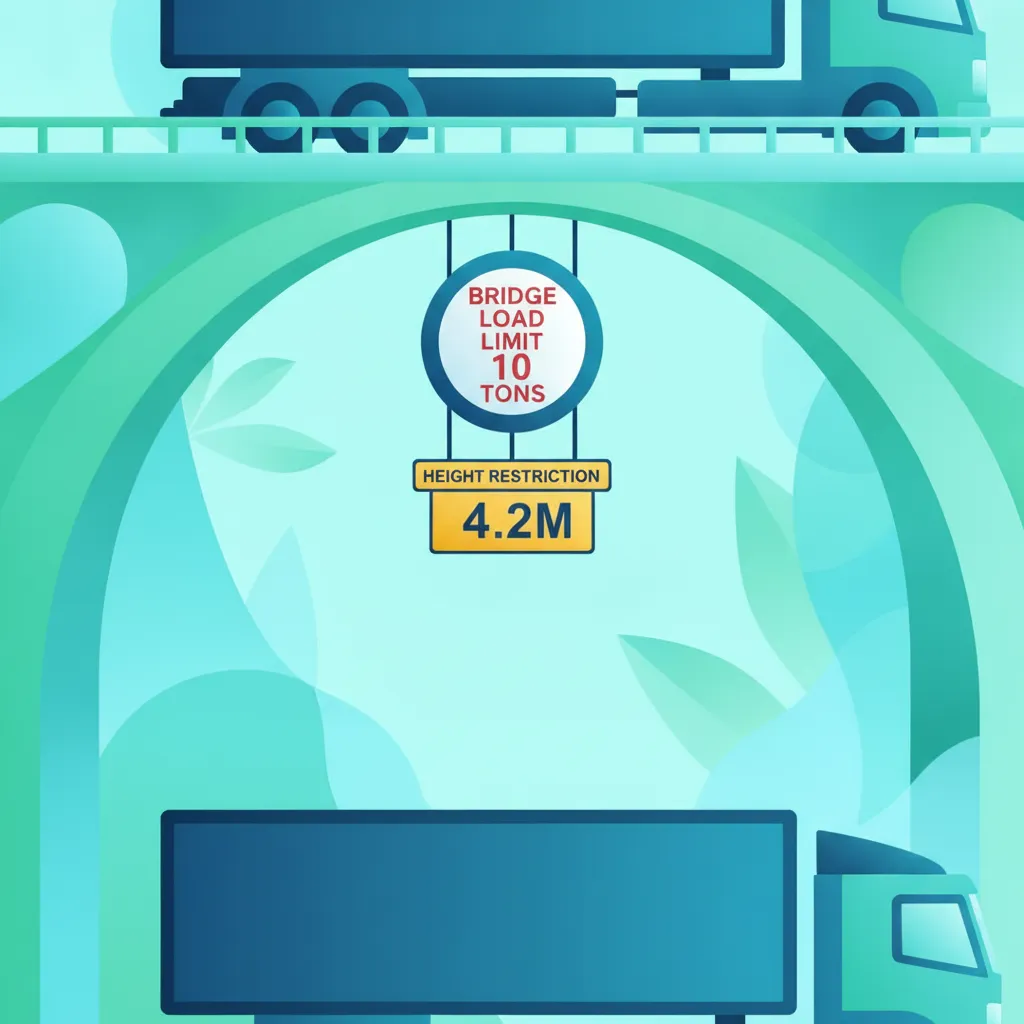
This lesson focuses on the critical importance of observing posted weight and height limits for bridges and other structures. It explains how to read the relevant signage and stresses the driver's responsibility to know their vehicle's exact height and weight. Ignoring these limits can lead to catastrophic structural failure and severe legal consequences.

This lesson consolidates the legal restrictions on the maximum dimensions and weight for different vehicle combinations in Austria. It covers how to read signs indicating these limits and the importance of compliance for route planning. Adhering to these regulations is essential for legal operation and avoiding fines.
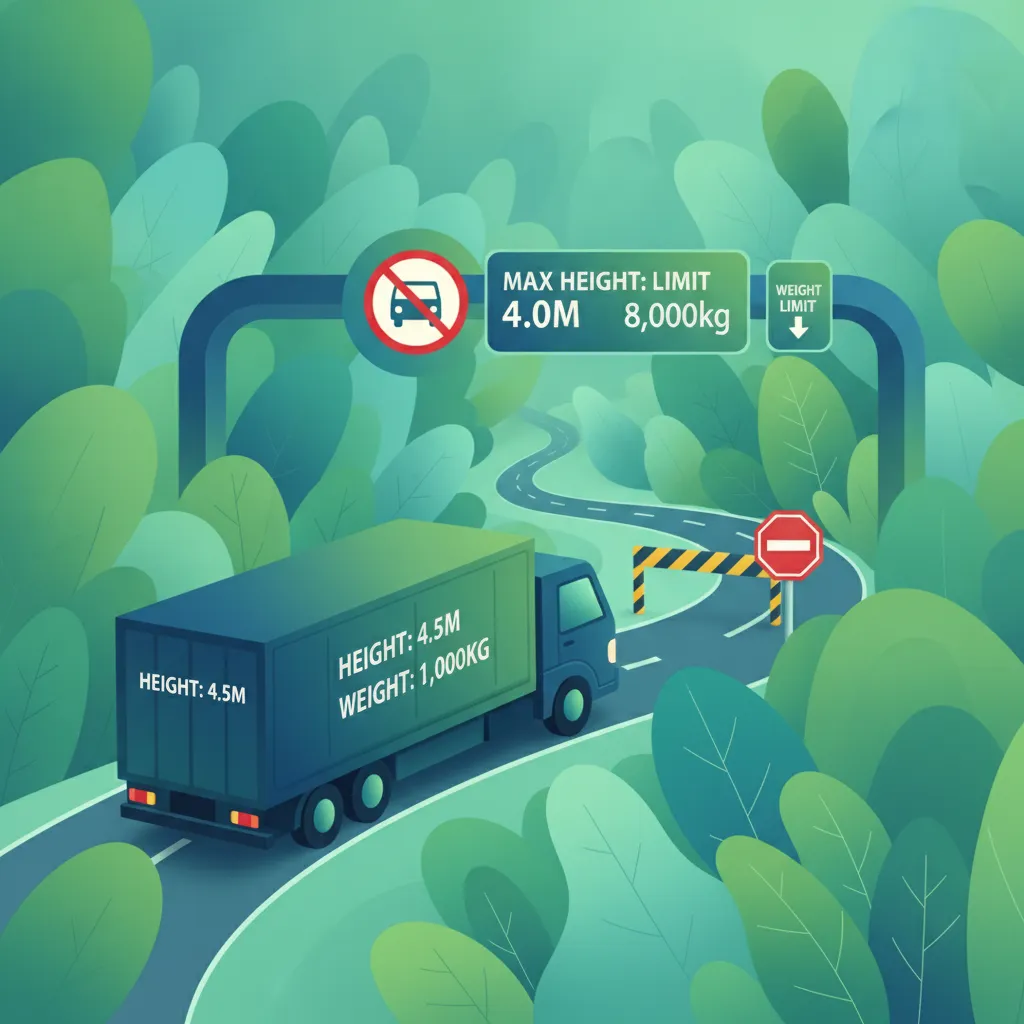
This lesson covers the practical aspects of planning a route for a heavy goods vehicle. It explains how to use maps and specialized GPS systems to identify and avoid roads with height, weight, or other restrictions. Proactive route planning is essential for ensuring an efficient, legal, and safe journey.

This lesson details the legal ramifications of operating an overloaded heavy vehicle in Austria, which include significant fines and penalty points. It also emphasizes the severe safety risks, such as compromised braking performance and increased mechanical stress on the vehicle. Understanding these consequences reinforces the importance of strict adherence to weight limits.

This lesson prepares drivers for the demanding conditions of Alpine driving. It covers techniques for managing speed on steep up-hill and down-hill sections, being prepared for sudden weather changes, and following safety protocols inside mountain tunnels. This specialized knowledge is essential for operating safely in mountainous terrain.

This lesson details the regulations for heavy goods vehicles on Austria's high-speed road network. It covers the specific speed limits, rules on lane usage (e.g., when overtaking is permitted), and procedures for entering and exiting the motorway. Adherence to these rules is crucial for safety in a fast-paced environment.
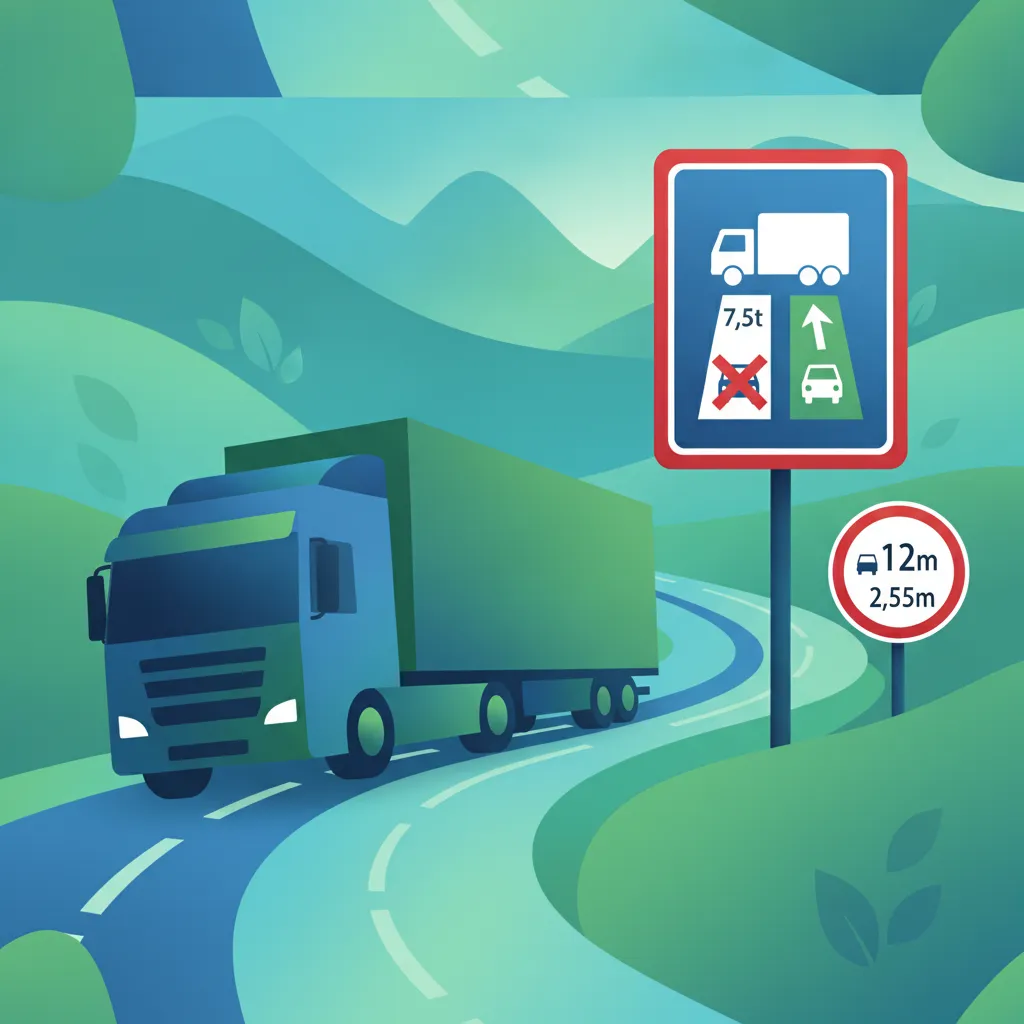
This lesson focuses on the specific Austrian road signs and supplemental plates that apply to heavy goods vehicles. It explains how to interpret signage indicating weight limits, height and width restrictions, lane usage rules, and other critical regulatory information. Correctly understanding these signs is essential for legal compliance and safe navigation on Austria's roads.

This lesson details the general traffic rules applicable to heavy goods vehicles on Austrian roads, highlighting differences from passenger car regulations. It covers key topics such as right-of-way at intersections, specific rules for overtaking, maintaining proper lane discipline, and adhering to designated speed limits. Understanding these rules is critical for safe integration into mixed traffic.

This lesson provides critical techniques for managing vehicle speed on the steep, long gradients found on Alpine roads. It emphasizes selecting the correct gear before the descent and using auxiliary braking systems to maintain a safe, controlled speed. These practices are essential to prevent service brake overheating and potential failure (brake fade).
Explore how proper load distribution and understanding vehicle stability are crucial for heavy goods vehicles operating on challenging Austrian Alpine roads and crossing bridges with weight restrictions. Learn theory for safe operation.

This lesson explains the critical relationship between load distribution, the vehicle's centre of gravity, and its stability. It details how incorrect placement of cargo can negatively affect handling, increase the risk of rollovers, and reduce braking efficiency. Achieving a balanced load is a key component of safe heavy vehicle operation.

This lesson explains the physical principles of load distribution and its direct impact on a vehicle's centre of gravity and stability. It details how to arrange cargo to maintain a low centre of gravity and ensure weight is distributed correctly over the axles. Proper load distribution is fundamental to safe handling and preventing rollovers.

This lesson provides guidance on how to strategically distribute a load across both the main vehicle and its trailer. It covers planning the placement of cargo to maintain a stable centre of gravity for the entire combination. This holistic approach to loading is crucial for safe handling and adhering to individual vehicle and axle weight limits.

This lesson explains the severe consequences of a load shift while the vehicle is in motion. It details how sudden movement of cargo can drastically alter the vehicle's stability, making it difficult to steer or brake effectively. This can lead to a loss of control or a rollover, highlighting the importance of proper load securing.
This lesson prepares drivers for the demanding conditions of Alpine driving. It covers techniques for managing speed on steep up-hill and down-hill sections, being prepared for sudden weather changes, and following safety protocols inside mountain tunnels. This specialized knowledge is essential for operating safely in mountainous terrain.
This lesson provides critical techniques for managing vehicle speed on the steep, long gradients found on Alpine roads. It emphasizes selecting the correct gear before the descent and using auxiliary braking systems to maintain a safe, controlled speed. These practices are essential to prevent service brake overheating and potential failure (brake fade).

This lesson explains the destabilizing effect of strong crosswinds on vehicles with a large surface area, such as trucks and trailers. It teaches drivers to anticipate these conditions on exposed sections of road, like bridges or open plains. The lesson covers techniques such as reducing speed and making subtle steering corrections to maintain lane position.

This lesson details the importance of managing axle load limits (Achslast) and their relationship to the vehicle's payload (Nutzlast). It explains how uneven load distribution can lead to exceeding individual axle limits, even if the total mass is legal. Proper management of axle loads is essential for vehicle stability, road preservation, and legal compliance.

This lesson explains the critical importance of properly securing any load, whether inside the vehicle, on a roof rack, or in a trailer. It covers the principles of correct weight distribution to maintain the vehicle's center of gravity and stability. Learners will understand the legal requirements and best practices for using tie-downs and other securing methods to prevent items from shifting or falling, which could create a serious hazard on the road.

Driving a heavy vehicle in the Alps requires specific skills to manage its energy and momentum. This lesson focuses on using lower gears and auxiliary braking systems (retarder/engine brake) to control speed on long descents and prevent brake overheating. It also covers the correct line and technique for navigating tight hairpin turns safely and efficiently.
Find clear answers to common questions learners have about Weight Restrictions on Alpine Passes and Bridges. Learn how the lesson is structured, which driving theory objectives it supports, and how it fits into the overall learning path of units and curriculum progression in Austria. These explanations help you understand key concepts, lesson flow, and exam focused study goals.
An axle load limit specifically restricts the pressure applied to any single axle, which protects bridge decks from structural damage, while a total weight limit refers to the combined actual mass of the entire vehicle or combination. You must ensure you comply with both.
Weight restrictions on Alpine passes can vary based on weather, seasonal conditions, and specific vehicle categories. Always check the specific signage for your vehicle class (e.g., C vs. CE) as some passes impose lower limits for long articulated vehicles.
You must legally plan an alternative route using designated heavy vehicle corridors. Ignoring these signs can lead to severe penalties and poses a significant risk to the stability of the bridge structure.
In Austria, weight restriction signs usually refer to the actual mass of the vehicle. However, in exam questions, it is vital to know the distinction between the weight marked on your vehicle papers and the weight you are currently carrying.
Refine your study plan by searching for specific Austrian driving theory practice sets. Pinpoint questions related to particular road rules, signs, or challenge levels, and begin practicing immediately to reinforce your knowledge and excel in your official exam with confidence. Get started with focused revision today.