
This lesson provides a comprehensive overview of dimension restrictions for heavy goods vehicles in Austria. You will learn to interpret height, width, and length limit signs, ensuring you can plan routes safely and avoid legal penalties during your career as a professional driver.

Lesson content overview
Navigating the roads of Austria as a heavy goods vehicle (HGV) driver requires a thorough understanding of legal dimension restrictions. These limits are not arbitrary; they are critical for preventing accidents, protecting infrastructure like bridges and tunnels, and ensuring safe and efficient traffic flow. This lesson, part of your Austrian Driving License Theory Course for Heavy Goods Vehicles, will equip you with the knowledge to interpret dimension-related road signs, understand supplemental plates, and plan your routes effectively to comply with all regulations.
The physical dimensions of your heavy goods vehicle – its height, width, and length – directly influence where and how you can operate it on public roads. Exceeding these limits can lead to severe consequences, from costly vehicle and infrastructure damage (such as bridge strikes or tunnel collisions) to serious accidents endangering yourself and other road users. Austrian road traffic regulations, specifically the Straßenverkehrsordnung (StVO), define these maximum dimensions and the standardized signage used to communicate them.
Understanding these restrictions is fundamental for proactive route planning. Before embarking on any journey, especially through unfamiliar territory, mountainous regions, or urban centers, a professional driver must verify that their vehicle's dimensions, including any load protrusions, conform to the limits of the intended route. This knowledge is crucial for safe navigation and avoiding legal penalties.
Every heavy goods vehicle operating on Austrian public roads is subject to statutory maximum dimensions. These are the general limits, which can be further reduced by specific road signs and supplemental plates. It is crucial to always know your vehicle's exact dimensions, including any load that might extend beyond its physical structure.
The legal maximum height for standard heavy goods vehicles in Austria is generally 4.0 meters. This limit applies across most of the road network. However, this general limit is frequently reduced in specific locations due to overhead structures.
Height restriction signs are typically placed well in advance of overhead obstacles such as bridges, tunnels, underpasses, or arched passages. When you encounter a height restriction sign, you must compare the indicated maximum height with your vehicle's actual height. This includes any equipment mounted on the roof, such as air conditioning units, load securing devices, or cargo that protrudes upwards.
Always account for any upward-protruding cargo or vehicle modifications when determining your vehicle's total height. A seemingly small addition can turn a compliant vehicle into an overheight hazard, leading to a bridge strike.
Common Misunderstandings: A frequent error is assuming that the standard 4.0 meters always applies. Drivers must actively look for and obey lower height limits posted for specific road sections. Ignoring these signs is a common cause of bridge strikes and tunnel collisions, which can result in significant damage and traffic disruption.
Cross-Sectional Clearance: This term refers to the vertical space available between the road surface and the lowest point of any overhead structure. Height restriction signs are installed precisely where this clearance falls below the standard maximum, ensuring drivers are warned in time to react or take an alternate route.
The standard legal maximum width for heavy goods vehicles in Austria is typically 2.55 meters. This limit is in place to ensure vehicles can safely occupy road lanes and pass other traffic without causing collisions or obstruction. Vehicles carrying specific temperature-controlled cargo may have a slightly increased width of 2.60 meters.
Similar to height, specific road sections, such as narrow urban streets, certain tunnels, or lanes adjacent to barriers, may have reduced width limits. Width restriction signs indicate the maximum permissible width for a particular lane or road segment. If your vehicle, including its load, exceeds this width, you are prohibited from using that lane or road.
Practical Implications: Overwidth vehicles may be directed to use specific lanes (often the outermost lane where more lateral clearance might be available) or, in severe cases, be required to take an alternative route. This is particularly relevant in densely built-up areas where lane width provision, the minimum required width for a lane to safely accommodate a vehicle while allowing lateral clearance, is crucial.
Common Misunderstandings: Drivers sometimes believe that the standard 2.55-meter width limit applies universally, disregarding lane-specific or route-specific reductions. Failure to observe these signs can lead to side collisions with other vehicles, road infrastructure (like barriers), or even pedestrians if the vehicle encroaches onto sidewalks.
Length restrictions are imposed to ensure that heavy vehicles can maneuver safely, especially around bends, through intersections, and within confined spaces like tunnels or urban areas, without causing blockages or posing a hazard.
General length limits vary depending on the vehicle type:
Length restriction signs, often accompanied by supplemental plates, specify the maximum overall vehicle length allowed on a particular road section. These are frequently found at tunnel entrances, on bridges, or in areas with tight turning radii where the turning circle of a long vehicle would be problematic.
Practical Meaning: If your vehicle's overall length, including any load that protrudes beyond the vehicle's extremities, exceeds the posted limit, you must choose an alternative route or obtain a special permit if available. Ignoring length restrictions can lead to difficulties in turning, blocking intersections, and creating dangerous situations due to insufficient maneuvering space.
Common Misunderstandings: Some drivers mistakenly assume length limits only apply to the vehicle's "box" length, overlooking the total overall length that includes the coupling mechanism, drawbar, and any load overhang. Maneuvering space, discussed in later lessons, is directly affected by vehicle length.
While primary dimension restriction signs provide general limits, Ergänzungszeichen (supplemental plates or supplementary signs) offer crucial, more granular information. These plates are attached directly beneath the main sign and refine the restriction, often making it specific to a particular lane or context. Understanding these supplemental plates is paramount for safe and compliant driving.
Ignoring a supplemental plate is equivalent to ignoring the primary restriction itself and can lead to serious violations. They serve to provide route-specific supplemental restrictions that reflect local infrastructure constraints.
Austrian traffic regulations define specific numbers for supplemental plates that indicate dimension restrictions. These are crucial for understanding the full scope of a restriction:
Ergänzungszeichen 45 (Maximum Vehicle Length for a Lane): This plate specifies a maximum length limit that applies only to the lane indicated by an arrow.
Example: A general road sign might permit a 13-meter vehicle, but a supplemental plate (45) under it could show "12 m" with an arrow pointing to the inner lane, meaning that specific lane is restricted to vehicles 12 meters or less. Longer vehicles must use other lanes or a different route.
Ergänzungszeichen 49 (Maximum Width for a Lane): This plate indicates a maximum width limit that is specific to the lane shown by an arrow.
Example: A road section might have a standard 2.55-meter width limit, but a supplemental plate (49) with an arrow pointing to the rightmost lane could show "2.3 m," restricting that specific lane due to a barrier proximity or narrow shoulder.
Ergänzungszeichen 53 (Reduced Height for a Lane or Segment): This plate specifies a reduced height limit for a particular lane or a specific segment of the road, often shown with an arrow.
Example: Under a bridge, the main sign might show "4.0 m," but a supplemental plate (53) could show "3.5 m" with an arrow pointing to the outer lane. This would indicate that due to a specific structural element or uneven road surface, that particular lane has a lower effective clearance.
Always read the primary dimension restriction sign in conjunction with any attached supplemental plates. The combination provides the complete and accurate instruction for that specific location, ensuring compliance and preventing accidents.
Adherence to dimension restrictions is a mandatory legal obligation for all heavy goods vehicle drivers in Austria. The Straßenverkehrsordnung (StVO) is the primary legal framework that sets these rules.
Drivers are legally responsible for knowing their vehicle's exact dimensions, including the maximum height, width, and length with any load. This responsibility extends to verifying these dimensions against all posted road signs and supplemental plates encountered on their route. The legal basis for these rules stems from the necessity to ensure public safety and prevent damage to expensive public infrastructure.
If your vehicle exceeds a dimension restriction, you are legally obligated to select an alternative route that can safely accommodate your vehicle. This often involves prior route planning using specialized maps or GPS systems designed for heavy vehicles.
Failure to comply with dimension restrictions can result in significant legal consequences, including:
Even experienced drivers can sometimes make errors regarding dimension restrictions. Awareness of these common pitfalls and understanding contextual variations can significantly reduce risk and improve safety.
Effective route planning is the cornerstone of avoiding dimension-related incidents. Before commencing a journey, especially one involving unfamiliar roads, it is imperative to consult maps and GPS systems designed for heavy goods vehicles that provide dimension-specific routing information.
Know Your Vehicle: Accurately measure and record your vehicle's (and combination's) exact height, width, and length, including any permanent fixtures or typical load configurations. Always carry these specifications with you.
Utilize HGV Navigation: Use commercial vehicle GPS systems or online mapping tools that allow you to input your vehicle's dimensions, providing routes that avoid known restrictions and highlight potential hazards.
Check Local Signage Diligently: Even with sophisticated route planning, always remain vigilant for local signs and supplemental plates that may indicate temporary or very specific restrictions not present in your navigation data. Road conditions can change rapidly.
Plan Alternate Routes: Identify potential alternative routes in advance, especially for known critical points like low bridges, narrow tunnels, or challenging alpine passes. This allows for quick, safe diversions if a restriction is encountered.
Maintain Safety Margins: It is good practice to leave a safety margin, for example, assuming an effective clearance 10-20 cm less than the posted height, especially in winter or when navigating unknown terrain. This accounts for minor road surface variations or measurement inaccuracies.
Let's consider a few practical scenarios that heavy goods vehicle drivers might encounter in Austria, demonstrating correct and incorrect behavior.
Setting: You are driving a heavy goods vehicle on a rural road towards a bridge. A circular sign clearly shows a maximum height restriction of 3.6 meters. Your vehicle, including its load, measures 3.4 meters in height.
Correct Action: You observe the sign, compare it to your vehicle's known height (3.4m), and confidently proceed under the bridge, maintaining a safe speed and adequate clearance. Your vehicle is well within the permissible limit.
Incorrect Action: You are driving a vehicle that is 3.8 meters high. Without proper attention to the sign or misjudging your vehicle's height, you attempt to pass under the bridge, resulting in a collision with the bridge structure. This causes significant damage to your vehicle and the bridge, leads to traffic disruption, and incurs legal penalties.
Setting: You are navigating a two-lane urban street with your 2.5-meter wide truck. Ahead, a width restriction sign is displayed, and beneath it, a supplemental plate (Ergänzungszeichen 49) indicates a maximum width of 2.3 meters for the left lane, identified by an arrow pointing left. The right lane has no specific width restriction, implying the standard 2.55-meter limit.
Correct Action: You identify the supplemental plate and its specific restriction for the left lane. Since your 2.5-meter wide truck exceeds the 2.3-meter limit for the left lane, you ensure your vehicle remains in the right lane, which can safely accommodate your vehicle's width.
Incorrect Action: You disregard the supplemental plate and mistakenly enter the left lane, believing the main sign's broader implication applies to all lanes. This could lead to your truck scraping against a barrier, other vehicles, or encroaching dangerously close to the curb or sidewalk, potentially causing an accident and legal consequences.
Setting: You are driving a 13-meter long semi-trailer towards a mountain tunnel. The main sign at the entrance indicates a maximum overall vehicle length of 12 meters for the tunnel. Directly below it, a supplemental plate (Ergänzungszeichen 45) specifically restricts the inner (left) lane to vehicles no longer than 10 meters, shown with an arrow. The outer (right) lane, however, does not have this specific lane-based length restriction.
Correct Action: Recognizing that your 13-meter vehicle exceeds the overall 12-meter limit for the tunnel, you immediately seek an alternative route. If an alternate route is not available or if the overall limit allowed your vehicle but not the inner lane, you would have to ensure you only use the outer lane where no specific length restriction is displayed. The safest approach for an overlength vehicle is always to find a compliant route.
Incorrect Action: You might incorrectly assume the 12-meter limit allows your 13-meter vehicle, or you might enter the inner lane, disregarding the 10-meter supplemental restriction. Proceeding with an overlength vehicle into a restricted tunnel or lane can lead to traffic obstruction, difficulty in maneuvering (especially in emergencies), and create a serious safety hazard requiring emergency intervention.
Mastering the rules around heavy goods vehicle dimensions is an indispensable skill for every professional driver in Austria. It goes beyond simply knowing your vehicle's measurements; it requires a proactive approach to route planning, diligent observation of all road signage – especially the crucial supplemental plates – and a keen awareness of how environmental and loading conditions can affect your vehicle's effective dimensions. By prioritizing compliance, you contribute significantly to road safety, protect valuable infrastructure, and ensure your professional integrity as a heavy vehicle operator. This knowledge is foundational for safe and legal heavy vehicle operation in Austria.
This lesson covers Austria's legal dimension restrictions for heavy goods vehicles (C and CE categories), including maximum height of 4.0 meters, width of 2.55 meters, and variable length limits depending on vehicle type. It emphasizes reading both primary restriction signs and their attached supplemental plates (Ergänzungszeichen 45, 49, 53), which provide lane-specific or context-specific limits. Drivers must account for roof-mounted equipment, load protrusions, and winter conditions that reduce effective clearance. Non-compliance can result in fines, vehicle impoundment, liability for infrastructure damage, and serious safety hazards.
A short set of high-value points that capture the most important learning from this lesson.
Standard heavy vehicle height limit in Austria is 4.0 meters, but always check for locally posted lower restrictions before proceeding
Maximum width for most HGVs is 2.55 meters (2.60m for temperature-controlled cargo), but lane-specific restrictions may apply
Length limits vary: rigid trucks up to 12.0m, articulated combinations up to 18.75m, with special permits up to 25.25m for modular vehicles
Supplemental plates (Ergänzungszeichen) provide lane-specific or context-specific restrictions that override general signs when attached
Drivers are legally responsible for knowing their vehicle's exact dimensions, including load protrusions and roof-mounted equipment
Explore all units and lessons included in this driving theory course.
Ergänzungszeichen 45 = lane-specific length limit, 49 = lane-specific width limit, 53 = lane-specific reduced height
Winter snow and ice accumulation raises the road surface, effectively reducing clearance under bridges and through tunnels
Ignoring a supplemental plate is equivalent to ignoring the primary restriction itself and carries the same penalties
If your vehicle exceeds any dimension restriction, you must take an alternate route—proceeding is a legal violation
Total vehicle length includes the coupling mechanism, drawbar, and any load overhang, not just the vehicle body
Only reading the primary dimension sign and overlooking the lane-specific details on attached supplemental plates
Forgetting to account for roof-mounted equipment like air conditioning units, cranes, or antennae when checking height clearance
Assuming the standard 4.0m height or 2.55m width applies universally, ignoring posted reductions in specific locations like historic urban centers or alpine routes
Failing to use HGV-specific navigation systems that highlight dimension-restricted areas before starting a journey
Entering a tunnel or bridge approach without verifying the posted clearance against total vehicle height including load
Lesson content overview
A short set of high-value points that capture the most important learning from this lesson.
Standard heavy vehicle height limit in Austria is 4.0 meters, but always check for locally posted lower restrictions before proceeding
Maximum width for most HGVs is 2.55 meters (2.60m for temperature-controlled cargo), but lane-specific restrictions may apply
Length limits vary: rigid trucks up to 12.0m, articulated combinations up to 18.75m, with special permits up to 25.25m for modular vehicles
Supplemental plates (Ergänzungszeichen) provide lane-specific or context-specific restrictions that override general signs when attached
Drivers are legally responsible for knowing their vehicle's exact dimensions, including load protrusions and roof-mounted equipment
Explore all units and lessons included in this driving theory course.
Ergänzungszeichen 45 = lane-specific length limit, 49 = lane-specific width limit, 53 = lane-specific reduced height
Winter snow and ice accumulation raises the road surface, effectively reducing clearance under bridges and through tunnels
Ignoring a supplemental plate is equivalent to ignoring the primary restriction itself and carries the same penalties
If your vehicle exceeds any dimension restriction, you must take an alternate route—proceeding is a legal violation
Total vehicle length includes the coupling mechanism, drawbar, and any load overhang, not just the vehicle body
Only reading the primary dimension sign and overlooking the lane-specific details on attached supplemental plates
Forgetting to account for roof-mounted equipment like air conditioning units, cranes, or antennae when checking height clearance
Assuming the standard 4.0m height or 2.55m width applies universally, ignoring posted reductions in specific locations like historic urban centers or alpine routes
Failing to use HGV-specific navigation systems that highlight dimension-restricted areas before starting a journey
Entering a tunnel or bridge approach without verifying the posted clearance against total vehicle height including load
Explore search topics learners often look for when studying Height, Width, Length Restrictions and Supplements. These topics reflect common questions about road rules, driving situations, safety guidance, and lesson level theory preparation for learners in Austria.
Browse additional driving theory lessons that cover connected traffic rules, road signs, and common driving situations related to this topic. Improve your understanding of how different rules interact across everyday traffic scenarios.
Understand the crucial details provided by supplemental plates (Ergänzungszeichen) related to height, width, and length restrictions for heavy vehicles in Austria. Learn how these signs refine general limits for specific lanes and scenarios to ensure safe driving and compliance.
This lesson covers informational signs that provide guidance, directions, and distances to help with navigation. It also explains the critical role of supplementary plates (Zusatztafeln), which are placed below main signs to add conditions, exceptions, or clarifications. Learners will understand how to interpret these sign combinations correctly to make informed decisions about route planning, lane choice, and applicable rules.
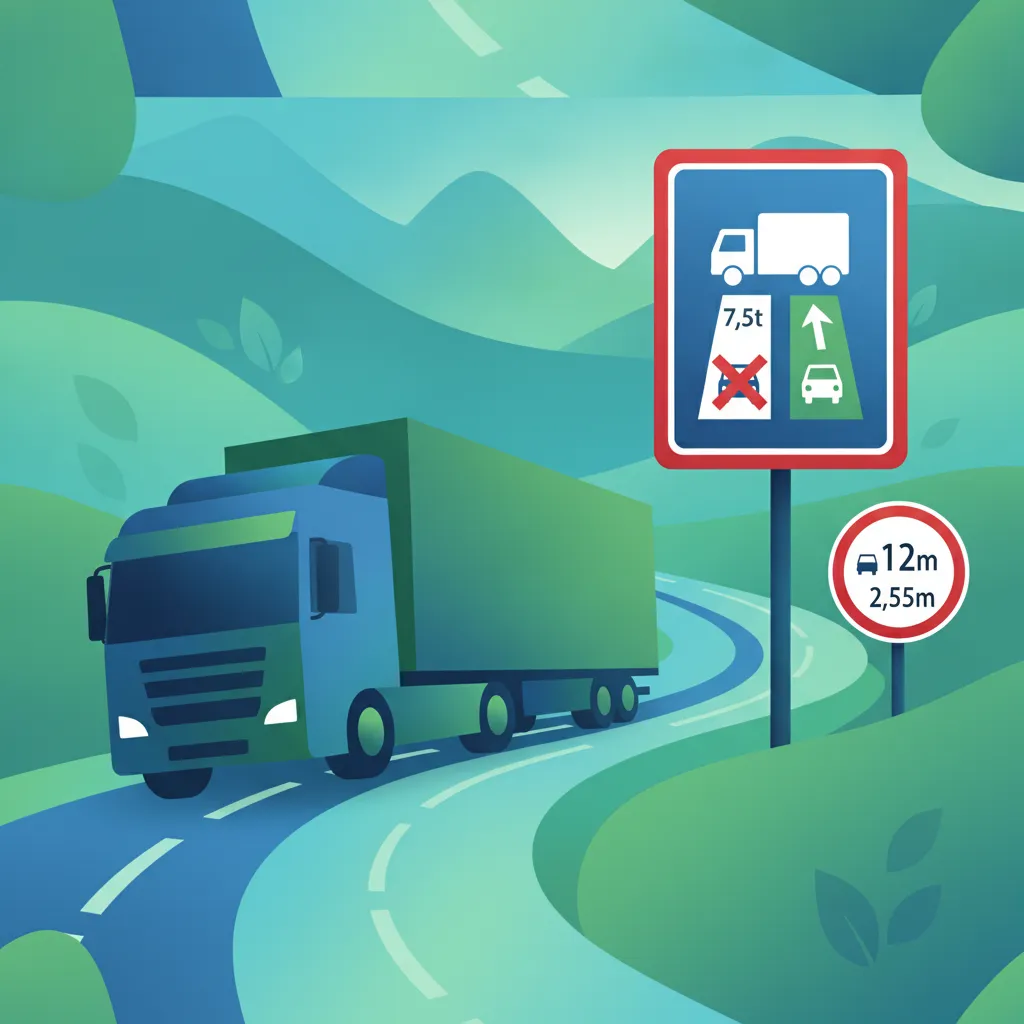
This lesson focuses on the specific Austrian road signs and supplemental plates that apply to heavy goods vehicles. It explains how to interpret signage indicating weight limits, height and width restrictions, lane usage rules, and other critical regulatory information. Correctly understanding these signs is essential for legal compliance and safe navigation on Austria's roads.
Explore common errors drivers make regarding vehicle height, width, and length restrictions in Austria. This lesson uses practical scenarios to illustrate risks and safe navigation strategies for heavy goods vehicles under bridges and through tunnels.

This lesson consolidates the legal restrictions on the maximum dimensions and weight for different vehicle combinations in Austria. It covers how to read signs indicating these limits and the importance of compliance for route planning. Adhering to these regulations is essential for legal operation and avoiding fines.

This lesson details the legal ramifications of operating an overloaded heavy vehicle in Austria, which include significant fines and penalty points. It also emphasizes the severe safety risks, such as compromised braking performance and increased mechanical stress on the vehicle. Understanding these consequences reinforces the importance of strict adherence to weight limits.

This lesson focuses on the critical importance of observing posted weight and height limits for bridges and other structures. It explains how to read the relevant signage and stresses the driver's responsibility to know their vehicle's exact height and weight. Ignoring these limits can lead to catastrophic structural failure and severe legal consequences.
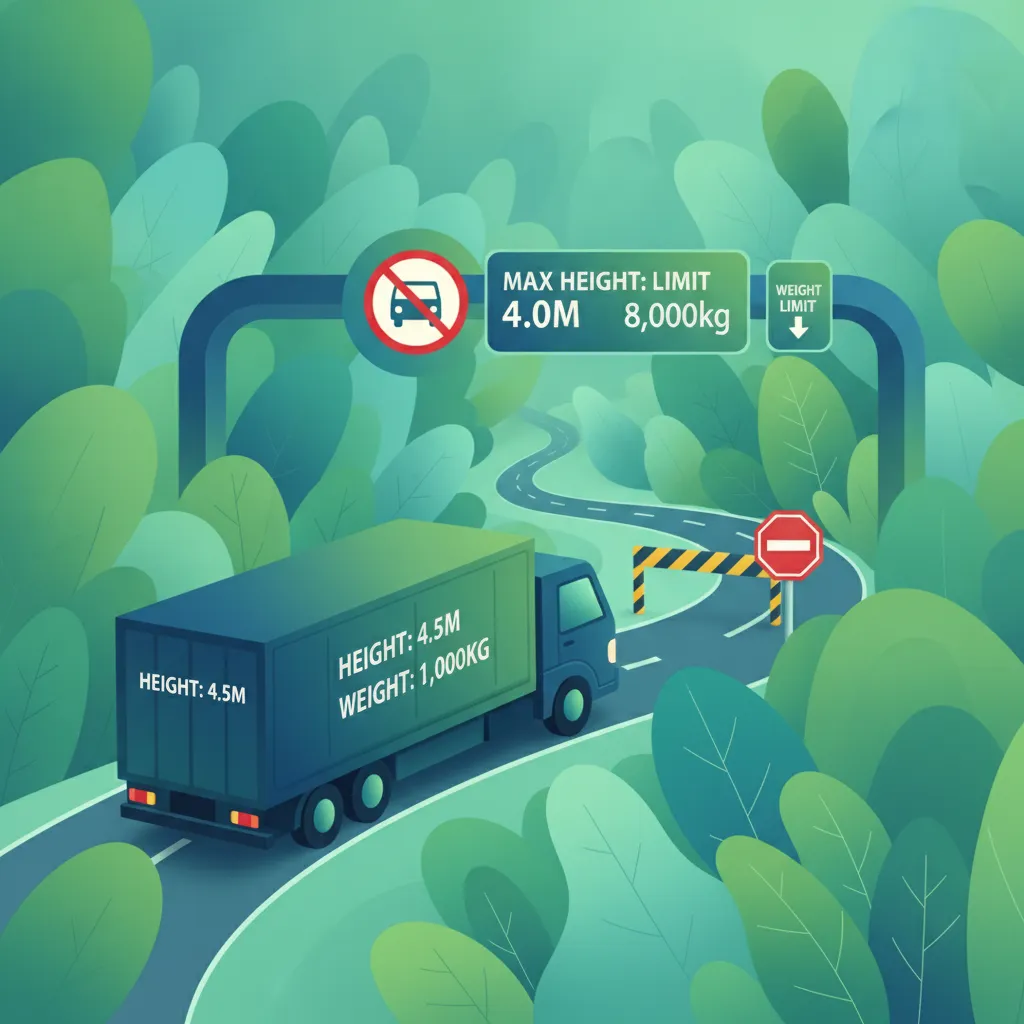
This lesson covers the practical aspects of planning a route for a heavy goods vehicle. It explains how to use maps and specialized GPS systems to identify and avoid roads with height, weight, or other restrictions. Proactive route planning is essential for ensuring an efficient, legal, and safe journey.

This lesson covers the specific weight restrictions that apply to sensitive infrastructure like Alpine passes and bridges throughout Austria. It explains how to identify these limits through road signage and incorporate them into route planning. Adhering to these restrictions is vital for preventing structural damage and ensuring safety in challenging terrain.

This lesson addresses the challenge of manoeuvring a large vehicle through streets not designed for its size. It covers how to assess vertical and horizontal clearances, plan the vehicle's path through tight turns, and heed all restrictive signage. Careful planning and slow, precise control are essential for success.
This lesson explains the system of penalties and enforcement for heavy vehicle operations in Austria. It covers the fines and penalty points associated with common traffic violations, such as overloading or insecure loads. Learners will understand the role of authorities in conducting roadside checks and inspections to ensure regulatory compliance.

This lesson details the general traffic rules applicable to heavy goods vehicles on Austrian roads, highlighting differences from passenger car regulations. It covers key topics such as right-of-way at intersections, specific rules for overtaking, maintaining proper lane discipline, and adhering to designated speed limits. Understanding these rules is critical for safe integration into mixed traffic.
This lesson focuses on the specific Austrian road signs and supplemental plates that apply to heavy goods vehicles. It explains how to interpret signage indicating weight limits, height and width restrictions, lane usage rules, and other critical regulatory information. Correctly understanding these signs is essential for legal compliance and safe navigation on Austria's roads.

This lesson provides an overview of the legal framework governing heavy vehicle drivers in Austria. It details the potential penalties for violations, including fines, penalty points, and the risk of licence suspension. A clear understanding of these consequences reinforces the importance of compliant and responsible driving.
Find clear answers to common questions learners have about Height, Width, Length Restrictions and Supplements. Learn how the lesson is structured, which driving theory objectives it supports, and how it fits into the overall learning path of units and curriculum progression in Austria. These explanations help you understand key concepts, lesson flow, and exam focused study goals.
Yes, dimension restrictions, especially height limits, are strictly enforced on all public roads in Austria. You must always be aware of your vehicle's current dimensions, including any load overhang, as these limits are designed to prevent collisions with infrastructure like bridges and tunnels.
If you see a width restriction sign, you must not proceed if your vehicle's width (including mirrors) exceeds the stated limit. You should plan an alternative route in advance and always check your vehicle's documentation for the exact width specifications.
Absolutely. Supplemental plates often clarify specific conditions, such as times of day, exemptions for local traffic, or specific vehicle categories. Ignoring these plates can lead to traffic offences and safety risks.
The Austrian theory exam includes scenarios where you must determine if a vehicle can safely navigate a specific road based on posted dimension limits. Understanding these rules is a core component of professional driving safety and legal compliance.
Refine your study plan by searching for specific Austrian driving theory practice sets. Pinpoint questions related to particular road rules, signs, or challenge levels, and begin practicing immediately to reinforce your knowledge and excel in your official exam with confidence. Get started with focused revision today.