
This lesson provides a critical overview of managing bridge load limits and height restrictions when operating heavy goods vehicles in Austria. As a professional driver, you must understand how to interpret specific road signs and calculate your vehicle dimensions to prevent structural damage and severe legal penalties. This knowledge is essential for safe route planning and passing your C-category theory exam.
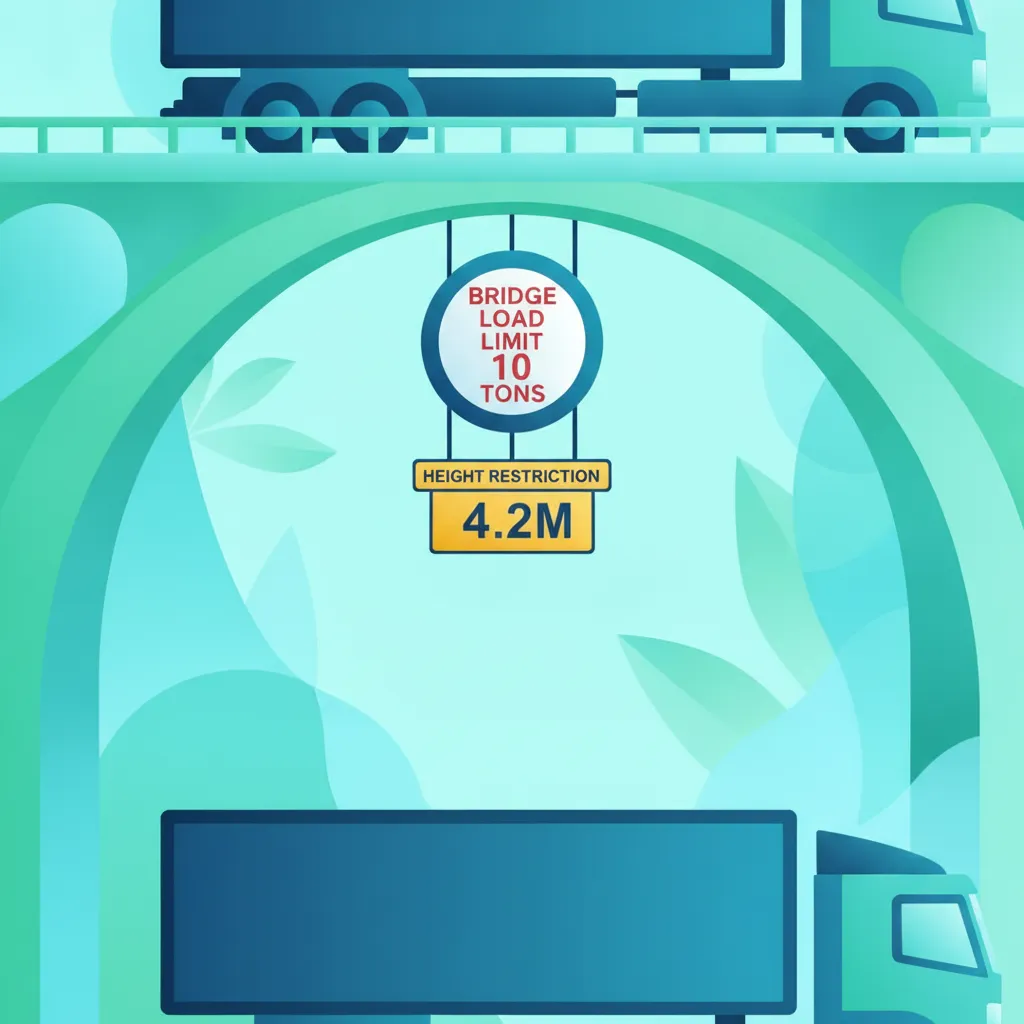
Lesson content overview
Operating heavy goods vehicles (HGVs) in Austria requires meticulous attention to various road regulations, with bridge load limits and height restrictions being among the most critical. As a professional driver preparing for your Austrian heavy-goods vehicle theory exam, understanding these limitations is paramount not only for safety but also for the preservation of vital infrastructure and legal compliance. Ignoring these restrictions can lead to catastrophic structural failure, severe vehicle damage, significant traffic disruptions, and serious legal penalties. This lesson will equip you with the knowledge to identify, interpret, and comply with all relevant signage and regulations, ensuring safe and responsible operation.
Bridges and other overhead structures, such such as underpasses and tunnels, are engineered to support specific maximum weights and to provide certain vertical clearances. These design parameters ensure their long-term integrity and the safety of all road users. For heavy goods vehicles, which exert significant static and dynamic forces, adhering to these limits is non-negotiable.
The primary reason for bridge load and height limits is safety. Exceeding a bridge's maximum permissible weight can overstress its components, leading to structural fatigue, cracking, or even collapse. Similarly, a vehicle exceeding an overhead structure's clearance height will collide with it, potentially causing severe damage to both the vehicle and the structure, leading to debris falling, road closures, and a high risk of injury or fatality. These incidents have widespread consequences, including extensive repair costs and prolonged traffic disruptions.
As a heavy goods vehicle driver in Austria, you carry a significant legal and professional responsibility to ensure your vehicle complies with all road regulations. This includes knowing your vehicle’s exact dimensions (height, width, length) and total weight (Gross Vehicle Weight – GVW), including its load and any trailers. The Austrian Road Traffic Act (Straßenverkehrsordnung, StVO) mandates strict adherence to posted limits, and violations are met with severe penalties, underscoring the importance of pre-trip planning and vigilant observation.
Failing to observe bridge load limits or height restrictions is not just a minor infraction; it can be considered professional negligence with severe legal and financial repercussions, including significant fines and potential criminal charges.
Bridge weight limits specify the maximum total weight that a bridge can safely support. These limits are usually expressed in tonnes (t) and are crucial for preventing structural damage. Heavy goods vehicle drivers must understand how to calculate their vehicle's total weight and interpret the relevant signage.
The Gross Vehicle Weight (GVW) is the total weight of your vehicle, including the chassis, engine, fuel, passengers, cargo, and any attached trailers. This is the primary figure you'll compare against posted bridge limits. However, it's not always sufficient to only check the GVW.
Many bridges, especially older or structurally weaker ones, also have axle load limits. These specify the maximum weight that can be supported by a single axle or a group of axles. A vehicle might be within the total GVW limit but still exceed an individual axle load limit if the cargo is unevenly distributed. Proper load distribution is therefore critical.
The total weight exerted on the road surface by all wheels attached to a specific axle or an axle group. This must be considered in conjunction with the vehicle's total Gross Vehicle Weight (GVW).
In Austria, bridge weight limits are communicated through standardized road signs.
This sign, typically a white square with a red border, prominently displays a number in tonnes (e.g., "10 t"). This indicates the absolute maximum GVW allowed. In some cases, additional signs might specify limits for individual axles, often appearing below the main weight limit sign. These supplementary signs might show a diagram of an axle with a weight value (e.g., "Axle: 5 t"). Always assume the most restrictive limit applies.
Before attempting to cross any bridge with a posted weight limit, you must:
Always keep your vehicle's documentation, including its permissible maximum loads and dimensions, readily accessible. Regular checks of your current load and its distribution are part of a professional driver's routine.
Overhead structures such as bridges, underpasses, and tunnels have specific clearance heights – the minimum vertical distance from the road surface to the lowest point of the structure. Exceeding these limits inevitably leads to a collision, causing significant damage and danger.
The clearance height is the vertical space available for vehicles to pass underneath safely. This measurement is always taken from the highest point of the road surface beneath the structure to the lowest point of the structure itself. For heavy goods vehicles, knowing your vehicle's precise maximum height is critical. This includes the height of the vehicle itself, any cargo loaded onto the roof or extending above the cab, and the height of any trailer.
The minimum vertical distance between the road surface and the underside of an overhead structure (e.g., bridge, tunnel roof). It is measured in meters and must not be exceeded by any part of the vehicle, including its load.
Height restrictions in Austria are indicated by clear, standardized road signs.
This sign, typically a white rectangular sign with a red border, displays the height in meters (e.g., "4.0 m") accompanied by a schematic diagram showing a vehicle with an arrow indicating the height. The number signifies the absolute maximum height permissible.
Before approaching any overhead structure with a posted height limit, you must:
Never assume a height clearance sign is merely advisory. These limits are absolute. A minor miscalculation or an assumption of "just enough space" can lead to a catastrophic collision, potentially resulting in serious injury, fatalities, and extensive damage.
Official signage is your primary source of information regarding bridge restrictions. Recognizing and correctly interpreting these signs, as defined by the Austrian Road Sign Regulations (Straßenverkehrsordnung, StVO), is a core competency for heavy goods vehicle drivers.
Beyond the specific weight and height limit signs, you may encounter:
The Austrian Road Traffic Act (§ 50 StVO) places a clear Route Planning Obligation on professional drivers. This means you are legally required to plan your route in advance, taking into account your vehicle's dimensions, weight, and any known restrictions. Relying solely on general GPS systems without specific HGV settings is insufficient and can lead to dangerous situations and legal repercussions.
Know Your Vehicle: Accurately measure and record your vehicle's maximum height and total GVW when fully loaded. This includes any specific axle loads.
Utilize HGV-Specific Navigation: Use satellite navigation systems or apps designed specifically for heavy goods vehicles, which typically include databases of weight and height restrictions.
Consult Road Maps and Local Information: Cross-reference digital routes with physical maps and, if possible, local road authority websites or traffic information, especially for less-traveled routes or during construction seasons.
Plan Alternatives: Always have an alternative route in mind in case you encounter an unexpected restriction or temporary closure.
Pre-Trip Checks: Before departure, ensure all cargo is properly secured and evenly distributed to avoid exceeding axle limits during transit.
The way cargo is distributed within your heavy goods vehicle has a direct impact on axle loads and, consequently, on a bridge's structural integrity.
Even if your total GVW is within a bridge's limit, poor load distribution can lead to individual axles being overloaded. Concentrating heavy cargo over a single axle, or within a very short wheelbase, can exert excessive local stress on bridge components. This can be particularly problematic for older bridges not designed for modern HGV axle configurations.
Proper load securing, as covered in Lesson 5 (Load Distribution, Load Securing and Stability), is crucial. Cargo shifts during transit, especially during braking or cornering, can alter axle loads dynamically, potentially causing an otherwise compliant vehicle to suddenly exceed a per-axle limit on a bridge.
Bridge load and height restrictions are typically static, but external conditions can influence how safely you can adhere to them and the dynamic stress your vehicle exerts.
Violating bridge load or height restrictions in Austria carries serious legal consequences, reflecting the potential for severe damage and danger.
The Austrian Road Traffic Act (Straßenverkehrsordnung) and Vehicle Act (Kraftfahrgesetz, KFG) outline penalties which can include:
The Route Planning Obligation (StVO § 50) for professional drivers means that ignorance of a restriction is rarely an acceptable defense. You are expected to have checked your route in advance.
Understanding the "why" behind these regulations reinforces their importance.
Successfully navigating bridges and overhead structures with a heavy goods vehicle demands a combination of knowledge, vigilance, and adherence to professional standards.
By diligently applying these principles, you contribute to road safety, protect vital infrastructure, and uphold your professional responsibilities as a heavy goods vehicle driver in Austria.
This lesson covers the critical topic of bridge load limits and height restrictions for heavy goods vehicles in Austria. Drivers must know their vehicle's exact Gross Vehicle Weight (GVW), individual axle loads, and fully-loaded height to safely navigate posted restrictions. Key Austrian traffic signs under StVO § 39 (weight limits) and § 40 (height limits) communicate these restrictions, with temporary signs always overriding permanent ones. The Route Planning Obligation requires professional drivers to use HGV-specific navigation and verify restrictions before departure. Non-compliance carries severe penalties including substantial fines, driving license points, vehicle impoundment, and potential criminal liability for structural damage.
A short set of high-value points that capture the most important learning from this lesson.
Gross Vehicle Weight (GVW) is the total weight of your vehicle including all cargo and trailers, and must not exceed posted bridge limits.
Axle load limits are equally important as GVW limits; a vehicle within total weight may still exceed individual axle restrictions if cargo is unevenly distributed.
Clearance height signs indicate the absolute maximum vehicle height permitted, including all cargo and roof equipment, with no exceptions.
Temporary restriction signs always override permanent signage and must be strictly observed regardless of other posted limits.
The Route Planning Obligation under StVO § 50 requires professional drivers to plan routes accounting for their vehicle's exact dimensions and weight.
Explore all units and lessons included in this driving theory course.
Measure vehicle height in its fully loaded state accounting for suspension droop under load, not when empty.
Combined weight and height restriction signs exist; always read both values carefully before proceeding.
Suspension droop and trailer coupling height can slightly alter your vehicle's overall height when loaded compared to specifications.
During adverse weather, especially heavy snow, temporary weight restrictions may be imposed that are lower than permanent limits.
Ignorance of a restriction is not an acceptable defense; you are legally required to check your route in advance using appropriate HGV-specific navigation.
Checking only GVW against limits while ignoring per-axle load restrictions, leading to structural overload on unevenly loaded vehicles.
Using vehicle height specifications without measuring actual loaded height, failing to account for cargo and suspension compression.
Assuming height clearance signs are advisory rather than absolute maximum limits that cannot be exceeded.
Relying on general GPS navigation without HGV-specific settings that include weight and height restriction databases.
Overlooking temporary restriction signs that lower limits during maintenance or construction periods.
Lesson content overview
A short set of high-value points that capture the most important learning from this lesson.
Gross Vehicle Weight (GVW) is the total weight of your vehicle including all cargo and trailers, and must not exceed posted bridge limits.
Axle load limits are equally important as GVW limits; a vehicle within total weight may still exceed individual axle restrictions if cargo is unevenly distributed.
Clearance height signs indicate the absolute maximum vehicle height permitted, including all cargo and roof equipment, with no exceptions.
Temporary restriction signs always override permanent signage and must be strictly observed regardless of other posted limits.
The Route Planning Obligation under StVO § 50 requires professional drivers to plan routes accounting for their vehicle's exact dimensions and weight.
Explore all units and lessons included in this driving theory course.
Measure vehicle height in its fully loaded state accounting for suspension droop under load, not when empty.
Combined weight and height restriction signs exist; always read both values carefully before proceeding.
Suspension droop and trailer coupling height can slightly alter your vehicle's overall height when loaded compared to specifications.
During adverse weather, especially heavy snow, temporary weight restrictions may be imposed that are lower than permanent limits.
Ignorance of a restriction is not an acceptable defense; you are legally required to check your route in advance using appropriate HGV-specific navigation.
Checking only GVW against limits while ignoring per-axle load restrictions, leading to structural overload on unevenly loaded vehicles.
Using vehicle height specifications without measuring actual loaded height, failing to account for cargo and suspension compression.
Assuming height clearance signs are advisory rather than absolute maximum limits that cannot be exceeded.
Relying on general GPS navigation without HGV-specific settings that include weight and height restriction databases.
Overlooking temporary restriction signs that lower limits during maintenance or construction periods.
Explore search topics learners often look for when studying Bridge Load Limits and Height Restrictions. These topics reflect common questions about road rules, driving situations, safety guidance, and lesson level theory preparation for learners in Austria.
Browse additional driving theory lessons that cover connected traffic rules, road signs, and common driving situations related to this topic. Improve your understanding of how different rules interact across everyday traffic scenarios.
Learn essential route planning strategies for heavy goods vehicles in Austria. Understand how to comply with bridge load limits and height restrictions to avoid fines and ensure safe passage on Austrian roads.
This lesson covers the practical aspects of planning a route for a heavy goods vehicle. It explains how to use maps and specialized GPS systems to identify and avoid roads with height, weight, or other restrictions. Proactive route planning is essential for ensuring an efficient, legal, and safe journey.

This lesson covers the specific weight restrictions that apply to sensitive infrastructure like Alpine passes and bridges throughout Austria. It explains how to identify these limits through road signage and incorporate them into route planning. Adhering to these restrictions is vital for preventing structural damage and ensuring safety in challenging terrain.

This lesson focuses on the legal restrictions concerning a heavy vehicle's dimensions, including maximum height, width, and length. It teaches drivers how to interpret road signs and supplemental plates that indicate these limits. This knowledge is crucial for route planning, especially when navigating under bridges, through tunnels, and on restricted roads.

This lesson addresses the challenge of manoeuvring a large vehicle through streets not designed for its size. It covers how to assess vertical and horizontal clearances, plan the vehicle's path through tight turns, and heed all restrictive signage. Careful planning and slow, precise control are essential for success.

This lesson consolidates the legal restrictions on the maximum dimensions and weight for different vehicle combinations in Austria. It covers how to read signs indicating these limits and the importance of compliance for route planning. Adhering to these regulations is essential for legal operation and avoiding fines.
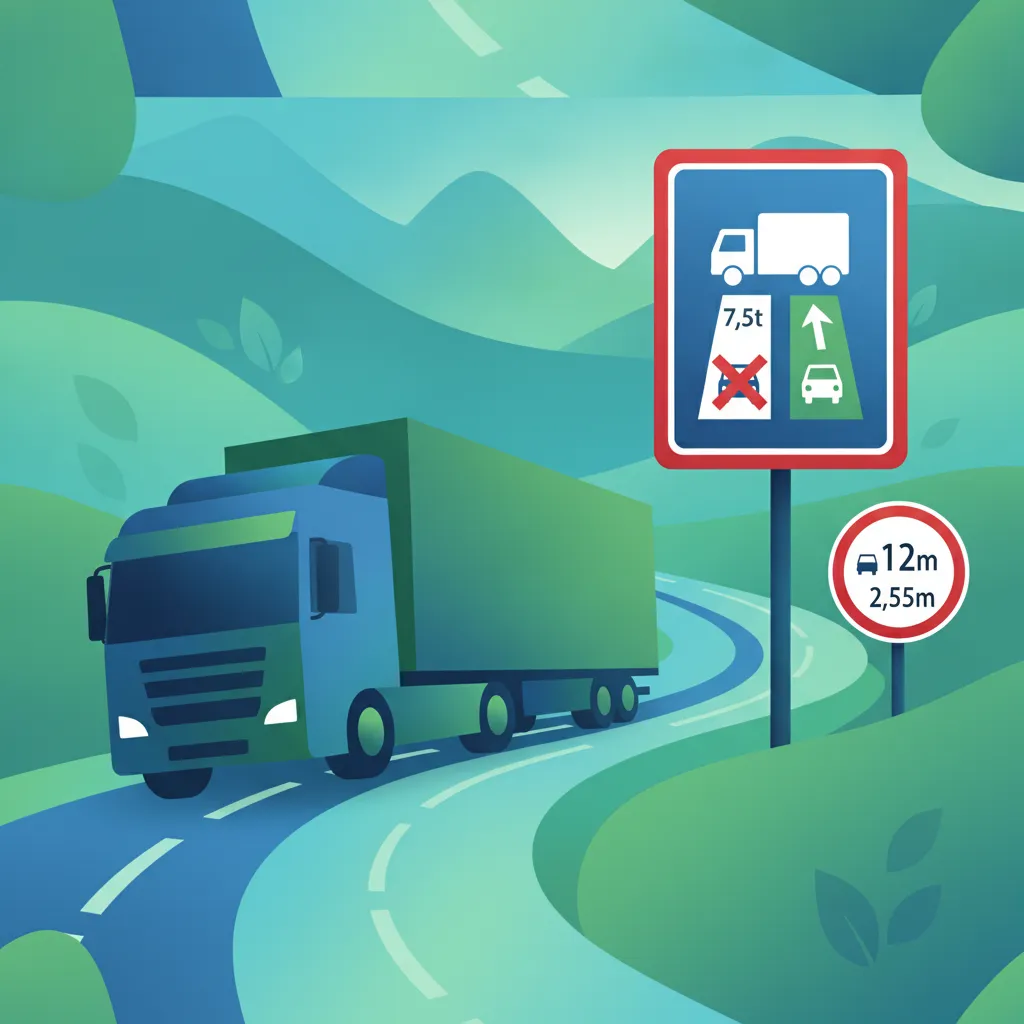
This lesson focuses on the specific Austrian road signs and supplemental plates that apply to heavy goods vehicles. It explains how to interpret signage indicating weight limits, height and width restrictions, lane usage rules, and other critical regulatory information. Correctly understanding these signs is essential for legal compliance and safe navigation on Austria's roads.

This lesson details the regulations for heavy goods vehicles on Austria's high-speed road network. It covers the specific speed limits, rules on lane usage (e.g., when overtaking is permitted), and procedures for entering and exiting the motorway. Adherence to these rules is crucial for safety in a fast-paced environment.

This lesson details the general traffic rules applicable to heavy goods vehicles on Austrian roads, highlighting differences from passenger car regulations. It covers key topics such as right-of-way at intersections, specific rules for overtaking, maintaining proper lane discipline, and adhering to designated speed limits. Understanding these rules is critical for safe integration into mixed traffic.
Master the interpretation of Austrian road signs detailing bridge weight limits (StVO § 39) and height clearances (StVO § 40). Essential knowledge for professional drivers to ensure compliance and safety.
This lesson covers the specific weight restrictions that apply to sensitive infrastructure like Alpine passes and bridges throughout Austria. It explains how to identify these limits through road signage and incorporate them into route planning. Adhering to these restrictions is vital for preventing structural damage and ensuring safety in challenging terrain.
This lesson focuses on the specific Austrian road signs and supplemental plates that apply to heavy goods vehicles. It explains how to interpret signage indicating weight limits, height and width restrictions, lane usage rules, and other critical regulatory information. Correctly understanding these signs is essential for legal compliance and safe navigation on Austria's roads.
This lesson focuses on the legal restrictions concerning a heavy vehicle's dimensions, including maximum height, width, and length. It teaches drivers how to interpret road signs and supplemental plates that indicate these limits. This knowledge is crucial for route planning, especially when navigating under bridges, through tunnels, and on restricted roads.
This lesson covers the practical aspects of planning a route for a heavy goods vehicle. It explains how to use maps and specialized GPS systems to identify and avoid roads with height, weight, or other restrictions. Proactive route planning is essential for ensuring an efficient, legal, and safe journey.
This lesson consolidates the legal restrictions on the maximum dimensions and weight for different vehicle combinations in Austria. It covers how to read signs indicating these limits and the importance of compliance for route planning. Adhering to these regulations is essential for legal operation and avoiding fines.
This lesson details the regulations for heavy goods vehicles on Austria's high-speed road network. It covers the specific speed limits, rules on lane usage (e.g., when overtaking is permitted), and procedures for entering and exiting the motorway. Adherence to these rules is crucial for safety in a fast-paced environment.
Find clear answers to common questions learners have about Bridge Load Limits and Height Restrictions. Learn how the lesson is structured, which driving theory objectives it supports, and how it fits into the overall learning path of units and curriculum progression in Austria. These explanations help you understand key concepts, lesson flow, and exam focused study goals.
In Austria, professional drivers are legally responsible for knowing their vehicle's total height, including any load. Road signs for bridges and tunnels indicate the absolute limit; failing to observe these can result in severe structural damage to the infrastructure and your vehicle, leading to heavy fines or license revocation.
Yes, bridge load limits often refer to the actual total mass or axle load permitted on the structure, which may differ from the general permissible total mass (zGG). You must be able to distinguish between general weight restriction signs and those specific to bridge structural integrity.
The exam uses image-based questions where you must identify restricted signs and calculate if your vehicle can safely pass based on provided weight or height figures. You are expected to apply these rules to realistic delivery or transit scenarios.
In Austria, signs typically show the minimum clearance. However, as a professional driver, you should always account for a safety margin and ensure you know your vehicle's configuration, as loads or roof-mounted equipment may alter your effective height.
Refine your study plan by searching for specific Austrian driving theory practice sets. Pinpoint questions related to particular road rules, signs, or challenge levels, and begin practicing immediately to reinforce your knowledge and excel in your official exam with confidence. Get started with focused revision today.