
This lesson explores the essential relationship between cargo placement, the centre of gravity, and heavy vehicle handling in Austria. By mastering these principles, you will learn how to maintain stability, prevent dangerous load shifts, and ensure safer braking performance on the road. This knowledge is critical for your C, C1, C1E, and CE licence theory exams and real-world professional driving.

Lesson content overview
Operating heavy goods vehicles (HGVs) in Austria demands a profound understanding of how cargo affects vehicle stability and safety. Proper load distribution isn't just a recommendation; it's a critical safety determinant and a legal requirement for all C, C1, C1E, and CE license holders. This lesson explores the intricate relationship between where a load is positioned within your vehicle or combination and its overall dynamic stability, significantly influencing handling, braking efficiency, and the risk of rollover.
This lesson is foundational for understanding advanced topics like load securing techniques, braking dynamics, and the specific challenges of driving vehicle combinations and trailers.
The way cargo is arranged within a heavy vehicle directly impacts its centre of gravity (CoG), the loads on individual axles, and the vehicle's overall stability. Incorrect load placement can compromise handling predictability, increase stopping distances, heighten the risk of rollovers, and even lead to severe structural damage or tyre failure. Beyond the immediate safety concerns, improper loading can also result in significant legal penalties, including fines and potential vehicle impoundment under Austrian traffic law. Achieving a balanced and secure load is therefore a core component of safe and lawful heavy vehicle operation, ensuring not only your safety but also that of other road users.
The Centre of Gravity (CoG) is the imaginary point at which the entire weight of the vehicle and its load can be considered to act. Its position – both longitudinally (front-to-back) and vertically (up-and-down) – is the single most important factor determining a heavy vehicle's stability. A driver must always strive to keep the CoG as low and as central as possible to maintain optimal control and safety.
The longitudinal CoG refers to the front-to-back position of the vehicle's combined weight. If the CoG shifts too far forward or backward, it disproportionately loads the front or rear axles, respectively. A forward-shifted longitudinal CoG can lead to excessive weight on the steering axle, making steering heavy and potentially overloading the front tyres. Conversely, a rearward-shifted longitudinal CoG reduces the load on the steering axle, making the steering feel light and less responsive, severely affecting control, especially during cornering. This imbalance can also contribute to dangerous trailer sway in vehicle combinations.
The vertical CoG is the height of the vehicle's combined weight above the ground. This dimension is paramount for preventing rollovers, particularly for HGVs which are inherently tall. A higher vertical CoG increases the rollover moment, which is the rotational force that can cause a vehicle to tip over during cornering or when encountering uneven road surfaces. Even minor shifts in a high vertical CoG can dramatically reduce a vehicle's stability, making it far more susceptible to rolling over, even at relatively low speeds or during moderate turns. Placing heavy items as low as possible within the cargo area is crucial for maintaining a safe vertical CoG.
Axle loads (Achslast) refer to the total weight exerted by a vehicle's individual axles onto the road surface. Austrian regulations, as well as vehicle manufacturer specifications, prescribe maximum permissible axle loads to prevent structural damage, tyre failure, and excessive road wear. Exceeding these limits for any single axle, even if the total vehicle weight is within limits, is illegal and highly dangerous.
The steering axle (front axle) is crucial for directional control. If the steering axle is underloaded, the steering can become overly light and imprecise, making the vehicle difficult to control, particularly at higher speeds or in crosswinds. Conversely, an overloaded steering axle makes steering heavy and unresponsive, increases wear on front tyres, and can compromise braking efficiency if the front brakes are overstressed. Proper payload distribution must ensure sufficient, but not excessive, load on the steering axle to maintain predictable handling.
The drive axle (rear axle) provides traction, while trailing axles (on multi-axle trucks or trailers) distribute weight. Overloading these axles can lead to severe consequences, including premature tyre wear, blowouts, damage to the suspension system, and compromised braking performance. An overloaded drive axle can also reduce the effective load on the steering axle, creating an unstable driving dynamic. When loading, it is essential to distribute the cargo evenly across all axles, ensuring each remains within its individual permissible limit to maintain overall vehicle integrity and safety.
Payload distribution (Nutzlastverteilung) is the strategic arrangement of cargo weight along the vehicle's length to achieve balanced axle loads and an optimal CoG position. This practice is fundamental to maintaining a heavy vehicle's stability and predictability.
While less common than rear-heavy scenarios, front-heavy loading occurs when a disproportionate amount of cargo weight is positioned over or forward of the front axle. This can lead to excessive load on the steering axle, making the vehicle difficult to steer and potentially overloading the front tyres. Increased front tyre wear, reduced steering response, and compromised front brake efficiency are common outcomes, all of which diminish the driver's control over the vehicle.
Rear-heavy loading is a particularly hazardous scenario. When too much weight is concentrated at the rear, it significantly lightens the front (steering) axle. This reduces steering effectiveness, impairs front braking performance, and can cause the vehicle to feel unstable, especially when cornering or encountering bumps. For tractor-trailer combinations, a rear-heavy trailer can induce dangerous trailer sway, making the entire rig difficult to control and increasing the risk of jack-knifing or rollover. Proper loading dictates that the CoG should be kept forward of the rear axle and as close to the centre of the wheelbase as practically possible.
The goal of optimal payload distribution is to achieve even loading, where cargo weight is distributed as uniformly as possible between the axles. This approach ensures that all axles operate within their permissible limits, maintains a stable CoG, and provides predictable handling characteristics. Balanced loading reduces stress on vehicle components, minimises tyre wear, and maximises braking efficiency, contributing significantly to overall road safety. When possible, heavy items should be placed in the middle section of the load area, directly over or slightly ahead of the drive axles.
Load distribution is not just a static concern; it constantly changes as a vehicle moves. Understanding dynamic load distribution — the real-time shifts in weight during driving manoeuvres — is crucial for safe heavy vehicle operation.
Longitudinal load transfer refers to the redistribution of weight along the vehicle's length during changes in speed.
Drivers must account for these dynamic shifts by ensuring the initial static load distribution provides sufficient margins to safely absorb these forces.
Lateral load transfer occurs during cornering. As a heavy vehicle turns, centrifugal force pushes the vehicle outwards, causing weight to shift from the inner wheels (on the inside of the turn) to the outer wheels (on the outside of the turn).
To mitigate this risk, cargo must be positioned centrally across the vehicle's width, and heavy items should always be placed as low as possible. Drivers must also adjust their speed when cornering, especially with high or unstable loads.
Even with perfectly balanced static load distribution, cargo can shift dramatically during dynamic manoeuvres if not properly secured. Load securing (Ladungssicherung) refers to the methods and devices used to prevent any movement of cargo during transport. This includes preventing sliding, tipping, rolling, or falling of goods.
Proper load securing is not just about keeping items on the vehicle; it's an integral part of maintaining the planned load distribution throughout the journey. A sudden shift in cargo, even a small one, can drastically alter the CoG and axle loads, potentially causing a loss of control, an accident, or leading to the load spilling onto the road. Austrian regulations, often referencing VDI guidelines (e.g., VDI 2243), specify the required strength and methods for securing different types of cargo. This includes using appropriate blocking and bracing, tightening (strapping) systems with sufficient breaking strength, and containment nets or tarpaulins.
Always double-check your load securing before starting a journey and after any significant stops, especially on long routes or after navigating challenging terrain.
Austrian law places strict requirements on heavy vehicle operators regarding load distribution and securing. These regulations are designed to ensure road safety, prevent damage to infrastructure, and protect all road users. Non-compliance can lead to severe penalties.
The maximum permissible overall mass (zGG - Zulässiges Gesamtgewicht) is the absolute maximum weight a vehicle (or combination) is allowed to have, including its own weight, fuel, driver, passengers, and cargo. This limit is defined by the vehicle's registration certificate and national regulations (UGVR § 33). Exceeding the zGG is a serious offence.
Equally important are the axle load limits (Achslast), which dictate the maximum weight each individual axle can bear. These limits are specified by both the vehicle manufacturer and the Austrian Road Traffic Act (StVO § 31). It is crucial to ensure that no single axle is overloaded, even if the total zGG is respected. Modern heavy vehicles are often equipped with onboard weighing systems or can be checked at weighbridges to ensure compliance.
Austrian law (e.g., ASV § 2) explicitly mandates that cargo must be positioned in a way that ensures vehicle stability and road safety. Key principles include:
The law requires that all cargo be adequately secured to prevent movement during normal driving conditions, including braking, acceleration, cornering, and driving over uneven surfaces (BauV G 1994, often referencing VDI guidelines). This means:
Despite clear regulations and best practices, common mistakes in load distribution persist, often leading to dangerous situations and legal repercussions.
A frequent error is to assume that as long as the total vehicle weight (zGG) is within limits, the load distribution is acceptable. However, concentrating too much weight over a single axle can easily exceed its Achslast limit.
Stacking cargo too high, especially heavy items, significantly raises the vertical CoG. This is a particular risk for flatbed trucks or vehicles carrying multiple layers of pallets.
Placing a heavy load predominantly on one side of the vehicle creates an uneven lateral distribution. This might occur if a driver is rushing or if the cargo naturally lends itself to a one-sided arrangement.
Failing to use appropriate or sufficiently strong load securing (Ladungssicherung) devices is another common mistake. Using frayed straps, too few straps, or incorrectly applied blocking materials can have severe consequences.
The impact of load distribution on stability is not static; it interacts significantly with environmental and operational conditions. Professional drivers must consider these factors when planning their load and during transit.
Wet, icy, or snow-covered roads dramatically reduce tyre grip and adhesion. In these conditions, the effects of a sub-optimal load distribution are greatly amplified.
Austria's mountainous terrain, with its numerous Alpine roads and steep gradients, poses unique challenges for heavy vehicle stability.
The dynamics of tractor-trailer combinations are more complex due to the articulated nature of the units. Load distribution on a trailer or semi-trailer affects not only the trailer itself but also the tractor unit.
Understanding and correctly applying the principles of load distribution are non-negotiable for safe and legal heavy vehicle operation in Austria. It is a continuous responsibility for every professional driver.
Mastering these concepts forms the bedrock of responsible and professional heavy vehicle driving, ensuring safety for yourself, your cargo, and everyone else on the road.
This lesson explains how cargo placement directly affects a heavy vehicle's centre of gravity and stability, which is critical for safe HGV operation in Austria. The centre of gravity must be kept low and centrally positioned to prevent rollovers, while axle loads must be balanced and within legal limits for every individual axle. Dynamic forces during braking and cornering constantly shift weight distribution, making proper initial loading and load securing essential throughout the journey. Austrian regulations mandate specific requirements for permissible total mass, axle load limits, cargo placement, and securing methods, with severe penalties for non-compliance. Understanding these principles is vital for passing the C, C1, C1E, and CE licence theory exams and for safe professional heavy vehicle driving, especially on challenging Alpine routes.
A short set of high-value points that capture the most important learning from this lesson.
The centre of gravity (CoG) is the primary determinant of vehicle stability; keep it as low and as centrally positioned as possible.
Individual axle load limits (Achslast) must be respected for every axle, not just the total vehicle mass (zGG).
Payload must be balanced both longitudinally (front-to-back) and laterally (side-to-side) to maintain predictable handling.
Dynamic forces during braking (longitudinal transfer) and cornering (lateral transfer) can dramatically alter stability even from a properly distributed static load.
Load securing (Ladungssicherung) is essential to prevent cargo movement that can instantly shift the CoG and compromise safety.
Explore all units and lessons included in this driving theory course.
Heavy items should always be placed as low as possible and positioned over or slightly ahead of the drive axles for optimal stability.
Rear-heavy loading reduces steering axle load, causing light steering, poor front braking, and dangerous trailer sway.
A high vertical CoG dramatically increases rollover risk during cornering or on uneven surfaces.
During braking, weight transfers forward; during acceleration, weight transfers rearward—account for these shifts when planning loads.
Austrian law requires cargo to be secured to prevent movement during normal driving including braking, cornering, and driving over uneven surfaces.
Assuming total vehicle weight within zGG limits means axle loads are acceptable—individual axle limits can still be exceeded.
Stacking cargo too high, especially heavy items, which raises the vertical CoG and significantly increases rollover susceptibility.
Placing heavy loads predominantly on one side, creating uneven lateral distribution that overloads tyres on one side and reduces overall grip.
Failing to use adequate load securing devices, or using frayed straps or insufficient strapping, allowing cargo to shift during transit.
Not accounting for dynamic load transfer—driving too fast on corners or braking too hard with a rear-heavy load that is already near limits.
Lesson content overview
A short set of high-value points that capture the most important learning from this lesson.
The centre of gravity (CoG) is the primary determinant of vehicle stability; keep it as low and as centrally positioned as possible.
Individual axle load limits (Achslast) must be respected for every axle, not just the total vehicle mass (zGG).
Payload must be balanced both longitudinally (front-to-back) and laterally (side-to-side) to maintain predictable handling.
Dynamic forces during braking (longitudinal transfer) and cornering (lateral transfer) can dramatically alter stability even from a properly distributed static load.
Load securing (Ladungssicherung) is essential to prevent cargo movement that can instantly shift the CoG and compromise safety.
Explore all units and lessons included in this driving theory course.
Heavy items should always be placed as low as possible and positioned over or slightly ahead of the drive axles for optimal stability.
Rear-heavy loading reduces steering axle load, causing light steering, poor front braking, and dangerous trailer sway.
A high vertical CoG dramatically increases rollover risk during cornering or on uneven surfaces.
During braking, weight transfers forward; during acceleration, weight transfers rearward—account for these shifts when planning loads.
Austrian law requires cargo to be secured to prevent movement during normal driving including braking, cornering, and driving over uneven surfaces.
Assuming total vehicle weight within zGG limits means axle loads are acceptable—individual axle limits can still be exceeded.
Stacking cargo too high, especially heavy items, which raises the vertical CoG and significantly increases rollover susceptibility.
Placing heavy loads predominantly on one side, creating uneven lateral distribution that overloads tyres on one side and reduces overall grip.
Failing to use adequate load securing devices, or using frayed straps or insufficient strapping, allowing cargo to shift during transit.
Not accounting for dynamic load transfer—driving too fast on corners or braking too hard with a rear-heavy load that is already near limits.
Explore search topics learners often look for when studying Impact of Load Distribution on Stability. These topics reflect common questions about road rules, driving situations, safety guidance, and lesson level theory preparation for learners in Austria.
Browse additional driving theory lessons that cover connected traffic rules, road signs, and common driving situations related to this topic. Improve your understanding of how different rules interact across everyday traffic scenarios.
Understand the specific axle load limits (Achslast) for HGVs in Austria. Learn how correct load distribution ensures compliance, prevents overloading, and maintains vehicle stability for safe driving.

This lesson details the importance of managing axle load limits (Achslast) and their relationship to the vehicle's payload (Nutzlast). It explains how uneven load distribution can lead to exceeding individual axle limits, even if the total mass is legal. Proper management of axle loads is essential for vehicle stability, road preservation, and legal compliance.

This lesson explains the specific definitions and limitations of the C1, C1E, C, and CE heavy-goods vehicle licence categories in Austria. It details the permissible vehicle mass, axle configurations, and rules for trailer combinations associated with each category. Understanding these distinctions is fundamental for ensuring legal compliance and selecting the correct licence for specific vehicle configurations.

This lesson focuses on the legal restrictions concerning a heavy vehicle's dimensions, including maximum height, width, and length. It teaches drivers how to interpret road signs and supplemental plates that indicate these limits. This knowledge is crucial for route planning, especially when navigating under bridges, through tunnels, and on restricted roads.

This lesson explains the physical principles of load distribution and its direct impact on a vehicle's centre of gravity and stability. It details how to arrange cargo to maintain a low centre of gravity and ensure weight is distributed correctly over the axles. Proper load distribution is fundamental to safe handling and preventing rollovers.

This lesson covers the specific weight restrictions that apply to sensitive infrastructure like Alpine passes and bridges throughout Austria. It explains how to identify these limits through road signage and incorporate them into route planning. Adhering to these restrictions is vital for preventing structural damage and ensuring safety in challenging terrain.

This lesson details the legal ramifications of operating an overloaded heavy vehicle in Austria, which include significant fines and penalty points. It also emphasizes the severe safety risks, such as compromised braking performance and increased mechanical stress on the vehicle. Understanding these consequences reinforces the importance of strict adherence to weight limits.

This lesson details the general traffic rules applicable to heavy goods vehicles on Austrian roads, highlighting differences from passenger car regulations. It covers key topics such as right-of-way at intersections, specific rules for overtaking, maintaining proper lane discipline, and adhering to designated speed limits. Understanding these rules is critical for safe integration into mixed traffic.

This lesson covers the practical aspects of planning a route for a heavy goods vehicle. It explains how to use maps and specialized GPS systems to identify and avoid roads with height, weight, or other restrictions. Proactive route planning is essential for ensuring an efficient, legal, and safe journey.

This lesson consolidates the legal restrictions on the maximum dimensions and weight for different vehicle combinations in Austria. It covers how to read signs indicating these limits and the importance of compliance for route planning. Adhering to these regulations is essential for legal operation and avoiding fines.
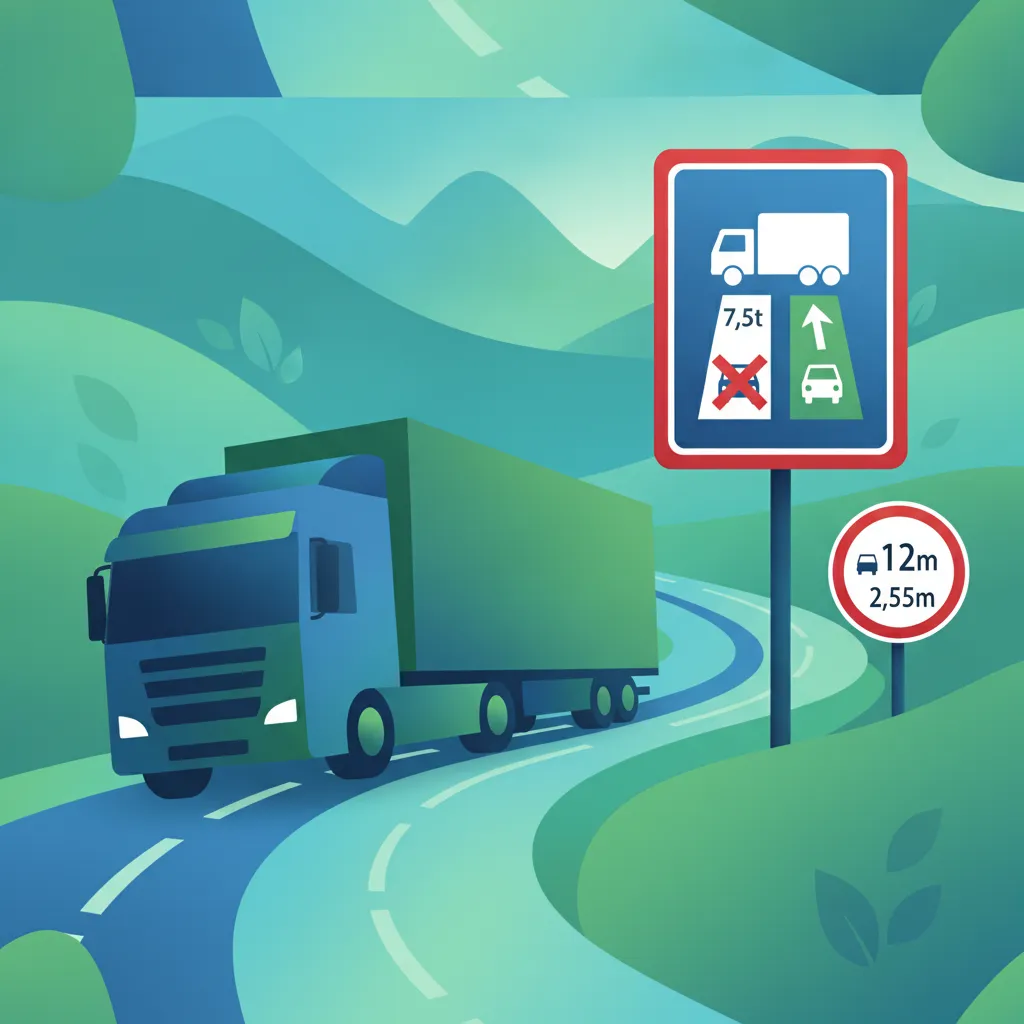
This lesson focuses on the specific Austrian road signs and supplemental plates that apply to heavy goods vehicles. It explains how to interpret signage indicating weight limits, height and width restrictions, lane usage rules, and other critical regulatory information. Correctly understanding these signs is essential for legal compliance and safe navigation on Austria's roads.
Explore how braking, acceleration, and cornering cause dynamic load transfer. Learn to manage these forces and understand their impact on vehicle stability and rollover risk for your Austrian C licence.

This lesson explains the severe consequences of a load shift while the vehicle is in motion. It details how sudden movement of cargo can drastically alter the vehicle's stability, making it difficult to steer or brake effectively. This can lead to a loss of control or a rollover, highlighting the importance of proper load securing.
This lesson explains the physical principles of load distribution and its direct impact on a vehicle's centre of gravity and stability. It details how to arrange cargo to maintain a low centre of gravity and ensure weight is distributed correctly over the axles. Proper load distribution is fundamental to safe handling and preventing rollovers.

This lesson provides guidance on how to strategically distribute a load across both the main vehicle and its trailer. It covers planning the placement of cargo to maintain a stable centre of gravity for the entire combination. This holistic approach to loading is crucial for safe handling and adhering to individual vehicle and axle weight limits.

This lesson explains the physics of an articulated vehicle and the factors that can lead to a jackknife, where the trailer swings out and folds against the tractor. It discusses common causes, such as improper braking on slippery surfaces or excessive speed in a turn. Learners will understand the crucial preventative measures to avoid this dangerous loss of control.

This lesson focuses on the phenomenon of off-tracking, where the rear wheels of a trailer follow a path inside that of the tractor's wheels during a turn. It explains how to anticipate this effect and allow extra space when cornering to avoid running over curbs, signs, or other roadside objects. Managing off-tracking is a key skill for navigating intersections and roundabouts.

This lesson prepares drivers for the emergency scenario of a shifting or lost load. It covers how to react to the sudden change in vehicle handling, safely pull over, and assess the situation. The lesson also explains the driver's responsibility for securing the scene and reporting the incident to prevent hazards for other road users.

This lesson covers the proper techniques for performing an emergency braking manoeuvre in a heavy vehicle. It explains how to apply maximum braking force without losing control, especially in vehicles equipped with an Anti-lock Braking System (ABS). The lesson also discusses how hard braking can affect cargo and the importance of proper load securing.

This lesson details the location and size of the significant blind spots to the front, sides, and rear of large vehicles. It explains how the vehicle's size and articulation create these 'no-zones' where other road users can disappear from view. Recognizing these areas is the first step toward developing safe observation habits.

This lesson explains the critical importance of properly securing any load, whether inside the vehicle, on a roof rack, or in a trailer. It covers the principles of correct weight distribution to maintain the vehicle's center of gravity and stability. Learners will understand the legal requirements and best practices for using tie-downs and other securing methods to prevent items from shifting or falling, which could create a serious hazard on the road.

This lesson provides practical strategies for safely reversing in challenging environments like narrow streets or busy loading zones. It emphasizes the 'get out and look' principle, the proper use of mirrors and cameras, and the critical safety role of a reliable spotter. Executing these manoeuvres slowly and cautiously is paramount to avoiding collisions.
Find clear answers to common questions learners have about Impact of Load Distribution on Stability. Learn how the lesson is structured, which driving theory objectives it supports, and how it fits into the overall learning path of units and curriculum progression in Austria. These explanations help you understand key concepts, lesson flow, and exam focused study goals.
A high centre of gravity makes a heavy vehicle significantly more prone to rolling over, especially during sharp turns or sudden lane changes. Keeping the heaviest items as low as possible and centered is the most effective way to minimize this risk.
Improper load distribution can lead to an uneven weight transfer onto the axles. If the load is too far forward or backward, it may reduce the braking force on specific wheels, significantly increasing your stopping distance and potentially causing the vehicle to lose traction.
The biggest risk is a loss of vehicle control, specifically jackknifing or rollovers in corners. It can also cause premature wear on tyres and brake systems, which can lead to mechanical failure during transit.
While you won't need to perform complex physics equations, the theory test will present scenarios where you must identify the safest loading method among several options. You must demonstrate an understanding of weight placement and its immediate impact on vehicle dynamics.
Refine your study plan by searching for specific Austrian driving theory practice sets. Pinpoint questions related to particular road rules, signs, or challenge levels, and begin practicing immediately to reinforce your knowledge and excel in your official exam with confidence. Get started with focused revision today.