
This lesson details the legal consequences and penalties associated with traffic violations in Austria, essential for every rider to understand. By learning how the enforcement system works, including fines and the demerit point system, you will develop a stronger sense of responsibility required for the A1, A2, and A licence categories.

Lesson content overview
As an aspiring or current motorcyclist in Austria, a thorough understanding of traffic laws and their enforcement is not just about passing an exam; it is crucial for ensuring your safety and the safety of others on the road. This lesson delves into the legal framework governing traffic violations, focusing on fines, the demerit point system, licence suspension, and the severe penalties for major offenses. By comprehending these consequences, riders can make informed decisions that promote consistent adherence to all traffic regulations and contribute to overall road safety in Austria.
The Austrian traffic penalty system is a structured framework designed to deter unsafe riding behaviors, enforce compliance with road rules, and ultimately promote road safety. It achieves these goals through a combination of financial penalties, administrative actions like demerit points, and restrictions on riding privileges. This comprehensive approach ensures that consequences are proportionate to the severity of the violation, encouraging responsible conduct among all road users.
Understanding the potential legal consequences of traffic violations is paramount for several reasons. Firstly, it provides a strong incentive for riders to consistently follow traffic laws, reducing the likelihood of accidents and injuries. Secondly, for those preparing for the Austrian motorcycle theory test, knowledge of penalties is a direct component of the curriculum, essential for exam success. Finally, knowing the legal ramifications allows riders to anticipate outcomes of non-compliance, fostering a proactive approach to safe riding. This knowledge is not merely theoretical; it underpins practical decision-making on Austrian roads, from alpine passes to urban intersections.
The Austrian traffic enforcement system operates on several fundamental principles, ensuring fairness and effectiveness:
Fines are monetary penalties imposed for specific traffic offenses, varying significantly based on the nature and severity of the violation. These amounts are determined by the Austrian Road Traffic Act (StVO) and associated regulations, which are regularly updated. Riders typically receive a ticket or notification detailing the fine amount and the timeframe for payment. Prompt payment can sometimes lead to a reduction in the fine.
Minor offenses typically carry the lowest fines and often result in zero or minimal demerit points. These violations are generally considered to have a lower direct impact on immediate road safety but contribute to traffic disorder.
Examples include minor parking violations, minor speed excesses (e.g., less than 10 km/h over the limit), or failing to signal a turn correctly where it doesn't cause immediate danger. While individually small, repeated minor offenses can still accumulate over time and lead to more significant consequences, especially under progressive penalty schemes.
Moderate offenses carry higher fines and often attract demerit points. These violations have a more direct potential to cause accidents or disrupt traffic flow significantly.
Common examples include speeding between 10-30 km/h over the posted limit, running a red light, using a mobile phone without a hands-free device, or certain right-of-way violations. These offenses are taken more seriously due to their increased risk factor.
Serious offenses incur substantial fines, a higher number of demerit points, and often lead to immediate administrative actions like licence suspension. These are violations that pose significant danger to all road users.
Examples include speeding more than 30 km/h over the limit, driving under the influence of alcohol or drugs, dangerous overtaking maneuvers, or causing an accident due to gross negligence. These offenses reflect a greater disregard for traffic laws and public safety.
When a traffic violation occurs, it is typically registered by police officers, speed cameras, or other automated enforcement systems. The rider then receives a fine notice (Strafverfügung or Organmandat). This notice will specify the offense, the fine amount, and the payment deadline.
In some cases, especially for minor offenses detected by police on the spot, an "Organmandat" can be issued, allowing for immediate payment or payment within a short period, often with a slight reduction in the fine. If a fine is disputed, there is usually a legal process to appeal it within a specified timeframe, typically through the administrative court system. It is a common misconception that fines can be simply ignored if not paid immediately; unpaid fines will lead to further legal action, potentially including higher penalties or even vehicle impoundment.
Austria employs a demerit points system, officially known as the "Vormerksystem" (pre-warning system), to track traffic violations and encourage long-term safe riding behavior. Unlike systems that directly suspend a licence after a certain number of points, the Austrian Vormerksystem functions more as a progressive warning system, leading to consequences only after accumulating a specific number of points for particularly serious offenses.
Points are allocated only for specific, predefined serious offenses that pose a significant risk to road safety. Not every fine-carrying violation results in demerit points. The number of points awarded depends on the severity and type of the violation. For example, driving without a helmet or certain serious speeding infractions will incur points, while a minor parking ticket typically will not. Points are added to a rider's record only after a conviction, not merely an accusation or initial fine notice.
The Vormerksystem has clear thresholds that trigger administrative actions:
Points on a rider's record do not remain indefinitely. Each demerit point expires after a period of three years, provided no further demerit-point offenses are committed. This means that if you maintain a clean record for three consecutive years, any previously accrued points will be removed, and your point count will reset. This encourages sustained safe riding over time and offers a path for riders to clear their record. However, if a new demerit-point offense occurs within the three-year window, the expiration period for all points is typically reset.
Licence suspension is the temporary withdrawal of a rider's authorization to operate a motorcycle, while revocation is a permanent withdrawal. In Austria, these measures are serious consequences designed to protect public safety by removing unsafe riders from the road. Suspension can be triggered by accumulating demerit points or by a single, severe violation.
Short-term licence suspensions are typically issued for periods ranging from one to three months. These are commonly triggered by:
During a short-term suspension, the rider is legally prohibited from operating any motor vehicle. Violating this prohibition can lead to even more severe penalties, including extended suspensions, larger fines, or criminal charges.
Longer suspensions, ranging from six months to several years, or even permanent revocation, are reserved for the most severe offenses. These typically involve:
Reinstatement of a suspended licence is not automatic and usually involves specific requirements designed to ensure the rider is fit to return to the road. These can include:
Serving the Suspension Period: The mandatory suspension period must be fully completed.
Mandatory Courses: For certain offenses (e.g., DUI), riders may be required to complete specific educational or rehabilitation programs, such as traffic psychology seminars or alcohol/drug awareness courses.
Medical Examinations: A medical assessment may be required to confirm the rider's physical and mental fitness to drive, especially after alcohol/drug-related offenses or if health concerns were a factor in the suspension.
Psychological Assessment: A traffic psychology evaluation might be necessary to assess the rider's attitude towards traffic rules and identify any underlying behavioral issues.
Retesting: In some cases, particularly after long-term suspensions, riders may be required to retake parts or all of the driving theory and practical exams to prove their competence and knowledge.
Failing to meet any of these requirements will prevent the licence from being reinstated. The process emphasizes a return to safe riding through education and verification of competence.
The concept of progressive penalties is central to Austrian traffic law enforcement. It means that the severity of fines and demerit points increases for repeat offenses of the same or similar type within a defined timeframe, typically 12 to 24 months. This system is designed to deter recidivism and encourage consistent safe driving habits.
The primary rationale behind progressive penalties is to strongly discourage habitual non-compliance. A single violation might be an oversight, but repeated infractions suggest a pattern of disregard for traffic laws. By escalating the consequences, the system aims to:
Consider a common scenario like speeding:
The exact progression and time windows can vary depending on the specific type of violation, but the principle remains the same: persistent rule-breaking leads to increasingly severe legal and administrative repercussions.
Major offense penalties are reserved for high-risk violations that not only endanger public safety but often carry criminal liability in addition to administrative traffic penalties. These offenses typically result in extensive fines, longer periods of licence suspension or revocation, and potentially mandatory imprisonment.
Driving Under the Influence (DUI), referred to as "Trunkenheit am Steuer" or "Fahren unter Alkoholeinfluss," is among the most serious traffic offenses in Austria. The legal blood alcohol concentration (BAC) limit for motorcyclists is 0.5‰ (0.05%). For probationary drivers and professional drivers, a stricter limit of 0.1‰ applies.
Driving under the influence of illegal drugs carries similarly severe penalties, often including immediate licence withdrawal and mandatory drug screenings and assessments.
Reckless driving encompasses a range of dangerous behaviors, including excessively high speeding (e.g., more than 50 km/h over the limit), dangerous overtaking maneuvers, street racing, or deliberately causing accidents. These actions pose an immediate and severe risk to life and property.
Penalties for reckless driving and extreme speeding are substantial:
A hit-and-run incident, known as "Fahrerflucht" in Austria, occurs when a driver flees the scene of an accident without providing their details or rendering aid, particularly if others are injured. This is a very serious criminal offense.
The legal consequences for a hit-and-run are severe and can include:
Adhering to specific traffic regulations is fundamental to safe riding. Violating these rules incurs various penalties, reinforcing their importance.
Speed limits are established to enhance safety by reducing collision severity and increasing reaction time. In Austria, common speed limits include 50 km/h in urban areas, 100 km/h on rural roads, and 130 km/h on motorways, with variations for specific zones or road conditions. Exceeding these limits is strictly prohibited.
As previously noted, the maximum permissible BAC for experienced motorcyclists in Austria is 0.5‰ (0.05%). For probationary drivers, the limit is a stricter 0.1‰. Alcohol significantly impairs judgment, coordination, and reaction time, making riding extremely dangerous.
Austrian law mandates that motorcyclists and their passengers must wear a certified protective helmet at all times while riding. This rule is critical for rider safety, significantly reducing the risk of head injuries in the event of an accident.
Understanding and correctly applying right-of-way rules is vital, especially at intersections, to prevent collisions. In Austria, these rules are determined by road signs, traffic lights, and the general "right-before-left" rule where no other indications are present.
Overtaking must always be executed safely, with clear visibility and without endangering other road users. Special caution is required when dealing with tram tracks in urban areas. Overtaking on tram tracks is generally prohibited unless it can be done safely without impeding trams or other traffic.
Understanding common pitfalls can help motorcyclists avoid fines, points, and accidents. Many violations stem from minor oversights or underestimations of risk.
Many riders wrongly believe that speed cameras or police ignore minor speed excesses (e.g., 5-10 km/h over the limit). This is a mistake.
Attempting to "beat" a red light by accelerating through an intersection or entering just as it changes is extremely dangerous.
Some riders might skip wearing a helmet for very short rides or when moving their motorcycle in an unconstrained area.
Misunderstanding the strictness of BAC limits, especially 0.5‰, is a common error.
Riders sometimes assume that demerit points disappear quickly or can be negotiated.
Traffic laws and penalties, while fixed, interact with real-world riding conditions. Riders must always adapt their behavior based on various contextual factors to ensure safety and avoid violations that could be exacerbated by conditions.
Adverse weather (rain, snow, ice, fog) and poor road conditions (potholes, gravel, construction) significantly affect motorcycle handling, braking distances, and visibility. While speed limits remain the same, adhering to them might not be safe.
Carrying a passenger or luggage changes a motorcycle's center of gravity, braking distance, and acceleration.
Pedestrians and cyclists are highly vulnerable in traffic and must always be given priority and extra consideration. This includes at crosswalks, shared paths, and intersections.
Understanding the legal consequences and penalties for traffic violations is a cornerstone of responsible motorcycling in Austria. The system, encompassing fines, the Demerit Points System (Vormerksystem), progressive penalties, and severe sanctions for major offenses, is designed not merely to punish but to educate, deter, and ultimately ensure the safety of all road users. From adhering to basic speed limits and BAC regulations to wearing a helmet and respecting right-of-way, every action you take on your motorcycle has legal implications. By internalizing these rules and their consequences, you contribute to a safer road environment, protect your riding privileges, and prepare yourself not just for the Austrian motorcycle theory exam, but for a lifetime of safe and responsible riding.
This lesson covers the Austrian traffic enforcement framework for motorcyclists, detailing fines for minor, moderate, and serious offenses, the Vormerksystem demerit point structure with its three-threshold progression, and the conditions for licence suspension or revocation. Key areas include specific BAC limits (0.5‰ experienced, 0.1‰ probationary), point expiration rules (three years), and the severe criminal and administrative consequences for major offenses like DUI, extreme speeding, and hit-and-run. Understanding these penalties reinforces the importance of consistent compliance and provides the knowledge needed to avoid costly fines, licence restrictions, and criminal liability while riding in Austria.
A short set of high-value points that capture the most important learning from this lesson.
The Austrian Vormerksystem tracks demerit points for serious offenses, with 1 point triggering a warning, 2 points requiring mandatory Nachschulung training, and 3 points leading to at least three months licence suspension within a two-year period.
The legal BAC limit for experienced motorcyclists in Austria is 0.5‰ (0.05%), with stricter limits of 0.1‰ for probationary drivers.
Points in the Vormerksystem expire after three years if no further demerit-point offenses are committed, providing a path to a clean record.
Progressive penalties mean repeat offenses of the same type within 12-24 months result in escalating fines and point allocations, not just isolated consequences.
Major offenses like DUI, extreme speeding, or hit-and-run (Fahrerflucht) carry criminal liability in addition to administrative penalties, potentially including imprisonment.
Explore all units and lessons included in this driving theory course.
Demerit points are only allocated for predefined serious offenses after conviction, not merely a fine notice or accusation.
Points do not automatically reset quickly—three years of clean behavior is required for expiration, and a new offense resets the entire period.
For BAC violations, penalties escalate across four distinct ranges: 0.5-0.79‰, 0.8-1.19‰, 1.2-1.59‰, and 1.6‰+ with progressively harsher consequences.
Riding without a helmet incurs both a fine and demerit points, regardless of distance or riding conditions.
Licence suspension periods must be fully served before reinstatement, which may also require medical examinations, psychological assessment, and potentially retesting.
Assuming minor speeding violations (5-10 km/h over limit) are ignored by enforcement or carry no consequences—cameras are accurate and fines accumulate under progressive penalties.
Believing points can be paid off or negotiated—accumulating points triggers mandatory educational measures or suspension, not financial alternatives.
Thinking perceived sobriety means being below the legal BAC limit—0.5‰ is the legal threshold regardless of how one feels, and even slight exceedances carry severe penalties.
Skipping helmet use for short distances—Austrian law requires a certified helmet at all times while riding, with fines and points applied without exception.
Assuming licence suspension is automatic after suspension period ends—reinstatement requires completing mandatory courses, medical assessments, and potentially retaking theory and practical exams.
Lesson content overview
A short set of high-value points that capture the most important learning from this lesson.
The Austrian Vormerksystem tracks demerit points for serious offenses, with 1 point triggering a warning, 2 points requiring mandatory Nachschulung training, and 3 points leading to at least three months licence suspension within a two-year period.
The legal BAC limit for experienced motorcyclists in Austria is 0.5‰ (0.05%), with stricter limits of 0.1‰ for probationary drivers.
Points in the Vormerksystem expire after three years if no further demerit-point offenses are committed, providing a path to a clean record.
Progressive penalties mean repeat offenses of the same type within 12-24 months result in escalating fines and point allocations, not just isolated consequences.
Major offenses like DUI, extreme speeding, or hit-and-run (Fahrerflucht) carry criminal liability in addition to administrative penalties, potentially including imprisonment.
Explore all units and lessons included in this driving theory course.
Demerit points are only allocated for predefined serious offenses after conviction, not merely a fine notice or accusation.
Points do not automatically reset quickly—three years of clean behavior is required for expiration, and a new offense resets the entire period.
For BAC violations, penalties escalate across four distinct ranges: 0.5-0.79‰, 0.8-1.19‰, 1.2-1.59‰, and 1.6‰+ with progressively harsher consequences.
Riding without a helmet incurs both a fine and demerit points, regardless of distance or riding conditions.
Licence suspension periods must be fully served before reinstatement, which may also require medical examinations, psychological assessment, and potentially retesting.
Assuming minor speeding violations (5-10 km/h over limit) are ignored by enforcement or carry no consequences—cameras are accurate and fines accumulate under progressive penalties.
Believing points can be paid off or negotiated—accumulating points triggers mandatory educational measures or suspension, not financial alternatives.
Thinking perceived sobriety means being below the legal BAC limit—0.5‰ is the legal threshold regardless of how one feels, and even slight exceedances carry severe penalties.
Skipping helmet use for short distances—Austrian law requires a certified helmet at all times while riding, with fines and points applied without exception.
Assuming licence suspension is automatic after suspension period ends—reinstatement requires completing mandatory courses, medical assessments, and potentially retaking theory and practical exams.
Explore search topics learners often look for when studying Legal Consequences and Penalties. These topics reflect common questions about road rules, driving situations, safety guidance, and lesson level theory preparation for learners in Austria.
Browse additional driving theory lessons that cover connected traffic rules, road signs, and common driving situations related to this topic. Improve your understanding of how different rules interact across everyday traffic scenarios.
Understand the Austrian system of fines, demerit points (Vormerksystem), and licence suspension for traffic violations. This lesson clarifies legal consequences for motorcyclists, reinforcing the importance of adhering to traffic laws.
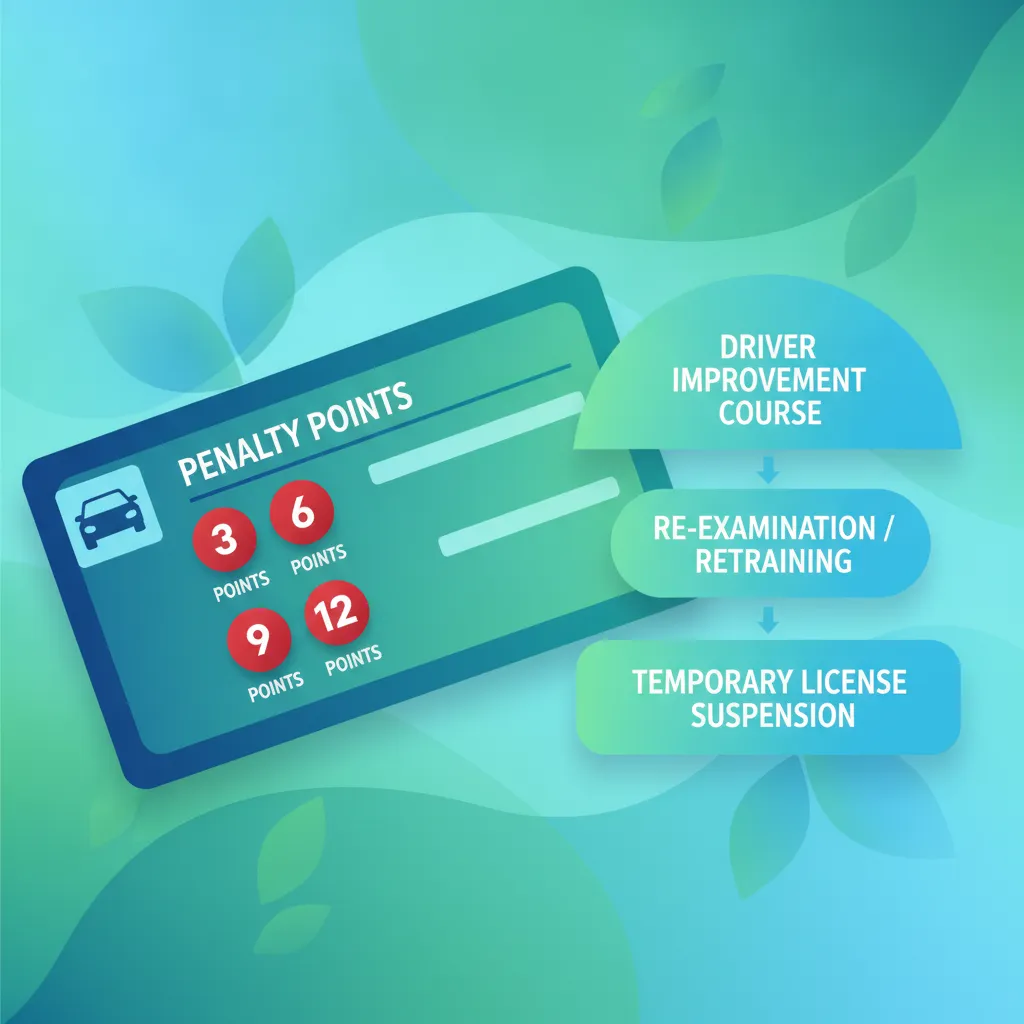
This lesson offers a clear explanation of the Austrian system of penalties for traffic offenses, including the demerit points system (Vormerksystem). It details which violations lead to points, the accumulation process, and the consequences at each stage, such as mandatory driver improvement courses and potential license suspension (Fahrverbot). Understanding this system provides a strong incentive for consistent compliance with all traffic regulations.

This lesson provides a clear overview of the legal penalties for traffic violations in Austria. It details the system of fines, demerit points, and the conditions that can lead to license suspension or revocation. Understanding these consequences reinforces the importance of lawful and responsible riding.

This lesson provides essential knowledge for using Austria's high-speed road network. It covers the correct procedure for entering via acceleration lanes, maintaining strict lane discipline (keeping right, passing left), and understanding the digital or physical Vignette (toll sticker) requirement. The formation of the 'Rettungsgasse' (emergency corridor) during traffic jams is also a key topic.

This lesson explains how fatigue, alcohol, and drugs dangerously impair a rider's judgment, coordination, and reaction time. It specifies the legal blood alcohol concentration (BAC) limit for vehicle operators in Austria and describes the severe penalties for driving under the influence (DUI). The importance of being well-rested and completely sober before every ride is strongly emphasized.

This lesson details the mandatory personal and vehicle documentation required for motorcyclists in Austria. It covers the necessity of carrying a valid licence card, vehicle registration papers, and proof of insurance at all times. Understanding these legal requirements ensures full compliance with Austrian traffic law and facilitates smooth interactions with law enforcement.
This lesson explains the system of penalties and enforcement for heavy vehicle operations in Austria. It covers the fines and penalty points associated with common traffic violations, such as overloading or insecure loads. Learners will understand the role of authorities in conducting roadside checks and inspections to ensure regulatory compliance.

This lesson provides a comprehensive overview of a driver's legal responsibilities and the potential consequences of failing to adhere to traffic laws. Learners will explore the concept of liability in the event of an accident and the structure of the official penalty catalogue. The material covers the impact of fines, demerit points, and potential driving bans (Fahrverbot) on one's license, as well as the effects on insurance premiums.
This lesson provides an overview of the legal framework governing heavy vehicle drivers in Austria. It details the potential penalties for violations, including fines, penalty points, and the risk of licence suspension. A clear understanding of these consequences reinforces the importance of compliant and responsible driving.

This lesson provides a comprehensive explanation of Austria's right-of-way laws, which are fundamental to intersection safety. It covers the meaning of different priority signs and clarifies the 'Rechts vor Links' (priority to the right) rule that applies at unmarked junctions. A clear understanding of these rules is essential to prevent conflicts and collisions in urban and rural settings.

This lesson explains the critical Mehrphasenausbildung (multi-phase training) process that all new drivers in Austria must complete after obtaining their license. It focuses on the obligations during the probationary period, including the demerit points system and the consequences of traffic violations like a Fahrverbot (driving ban). The content details the mandatory driver improvement courses designed to enhance risk awareness and promote responsible driving habits.
Learn about the serious legal ramifications for major traffic violations in Austria, including driving under the influence (DUI), reckless driving, and hit-and-run incidents. This covers fines, licence suspension, and potential criminal liability.
This lesson provides a clear overview of the legal penalties for traffic violations in Austria. It details the system of fines, demerit points, and the conditions that can lead to license suspension or revocation. Understanding these consequences reinforces the importance of lawful and responsible riding.
This lesson explains how fatigue, alcohol, and drugs dangerously impair a rider's judgment, coordination, and reaction time. It specifies the legal blood alcohol concentration (BAC) limit for vehicle operators in Austria and describes the severe penalties for driving under the influence (DUI). The importance of being well-rested and completely sober before every ride is strongly emphasized.
This lesson provides essential knowledge for using Austria's high-speed road network. It covers the correct procedure for entering via acceleration lanes, maintaining strict lane discipline (keeping right, passing left), and understanding the digital or physical Vignette (toll sticker) requirement. The formation of the 'Rettungsgasse' (emergency corridor) during traffic jams is also a key topic.
This lesson details the mandatory personal and vehicle documentation required for motorcyclists in Austria. It covers the necessity of carrying a valid licence card, vehicle registration papers, and proof of insurance at all times. Understanding these legal requirements ensures full compliance with Austrian traffic law and facilitates smooth interactions with law enforcement.
This lesson provides a comprehensive overview of a driver's legal responsibilities and the potential consequences of failing to adhere to traffic laws. Learners will explore the concept of liability in the event of an accident and the structure of the official penalty catalogue. The material covers the impact of fines, demerit points, and potential driving bans (Fahrverbot) on one's license, as well as the effects on insurance premiums.
This lesson provides an overview of the legal framework governing heavy vehicle drivers in Austria. It details the potential penalties for violations, including fines, penalty points, and the risk of licence suspension. A clear understanding of these consequences reinforces the importance of compliant and responsible driving.
This lesson offers a clear explanation of the Austrian system of penalties for traffic offenses, including the demerit points system (Vormerksystem). It details which violations lead to points, the accumulation process, and the consequences at each stage, such as mandatory driver improvement courses and potential license suspension (Fahrverbot). Understanding this system provides a strong incentive for consistent compliance with all traffic regulations.
Find clear answers to common questions learners have about Legal Consequences and Penalties. Learn how the lesson is structured, which driving theory objectives it supports, and how it fits into the overall learning path of units and curriculum progression in Austria. These explanations help you understand key concepts, lesson flow, and exam focused study goals.
Accumulating too many demerit points triggers specific legal actions, which can range from mandatory participation in advanced training courses to the temporary suspension or even revocation of your licence.
While the fundamental traffic laws apply to all road users, new riders—particularly those in the initial probationary phase of their licence—may face stricter scrutiny or faster pathways to mandatory remedial training if they commit serious traffic violations.
Yes, Austrian law mandates specific protective standards. Failure to comply with equipment requirements can lead to fines and may negatively impact your insurance coverage or liability status in the event of an accident.
Repeat offenses in Austria lead to an escalation of penalties. The legal framework is designed to track persistent disregard for traffic rules, meaning subsequent violations often carry significantly higher fines and stricter administrative consequences than first-time offenses.
Refine your study plan by searching for specific Austrian driving theory practice sets. Pinpoint questions related to particular road rules, signs, or challenge levels, and begin practicing immediately to reinforce your knowledge and excel in your official exam with confidence. Get started with focused revision today.