
This lesson details the legal framework for professional heavy goods vehicle drivers operating in Austria. You will explore the consequences of traffic violations, including how fines and penalty points impact your driving privileges and professional standing.
Lesson content overview
Driving a heavy goods vehicle (HGV) in Austria comes with significant responsibilities. Due to their size, mass, and potential impact, commercial vehicles in categories C, C1, C1E, and CE are subject to stringent legal regulations. A thorough understanding of these laws, the potential penalties for violations, and your rights as a driver is not merely advisable – it is essential for safety, career longevity, and compliance within the Austrian legal framework. This lesson details the legal obligations of professional drivers, the system of penalty points and fines, and the conditions under which a driving license may be suspended or revoked.
The foundation of heavy vehicle operation in Austria is built upon a robust legal framework designed to ensure road safety and fair conduct. Professional drivers are held to a high standard, reflecting the increased risks associated with larger vehicles. This framework is primarily codified in the Austrian Road Traffic Act (Straßenverkehrsordnung – StVO) and related ordinances such as the Vehicle Registration Ordinance (FZV).
Several core principles underpin the legal responsibilities of heavy vehicle drivers in Austria:
Drivers are legally bound to follow all traffic regulations and are subject to administrative and criminal sanctions for violations. This principle emphasizes that operating a heavy vehicle is a privilege tied to strict adherence to the law.
This principle ensures compliance and promotes uniform behavior among all road users, particularly acknowledging the enhanced risks posed by heavy vehicles. Non-compliance can lead to fines, penalty points, or even license suspension, directly affecting a driver’s professional standing and employability. Drivers must maintain valid roadworthiness documents, ensure proper load securing, and adhere to all prescribed speed limits.
Penalties are graded based on the severity and nature of the violation, ranging from minor infractions to serious offenses. This ensures that the punishment aligns with the risk posed, the deterrence needed, and the overall social impact of the offense.
For instance, a minor speed violation will result in a lower fine and fewer points compared to a serious overload offense or driving under the influence. This proportionality aims for fairness while maintaining effective deterrence.
Points are accrued for each violation; reaching defined thresholds triggers progressive sanctions, including mandatory training or license suspension. This provides a visible and cumulative record of driver behavior, fostering long-term safe driving habits.
Drivers must continuously monitor their point total, as paying a fine does not automatically erase the associated penalty points. Accumulating too many points can lead to the loss of a driving license, even if individual fines have been paid.
National traffic law in Austria supersedes any regional or company-specific policies; in case of conflict, the stricter regulation always applies. This guarantees uniform application of traffic law across the entire country.
This means that internal company rules or guidelines cannot waive legal obligations, such as mandatory vehicle inspections or restrictions on driving hours. Drivers must always prioritize legal requirements above all else.
Legal accountability for drivers can broadly be divided into two subcategories:
Violations are systematically grouped based on their severity and nature, which directly determines the type and magnitude of the penalty. This categorization helps ensure proportional responses to different levels of risk and harm.
A minor infraction carrying a lower fine and fewer penalty points. These typically involve less dangerous behaviors or minor breaches of regulations.
Examples: Slightly exceeding the speed limit (e.g., by 5-10 km/h) in a non-critical area, failure to use a turn signal, or minor administrative oversights. While seemingly minor, even light violations accumulate points and contribute to a driver's record, signaling a pattern of non-compliance if repeated.
A mid-severity infraction that carries higher fines and more penalty points than a light violation. These violations often involve a significant breach of safety regulations or a notable disregard for traffic rules.
Examples: Significant overload (e.g., exceeding axle load by 200 kg), failure to secure cargo properly but without immediate danger, driving under the influence of alcohol but below the criminal threshold (e.g., a BAC up to 0.5‰), or exceeding speed limits by a more substantial margin (e.g., 15-20 km/h). Moderate violations pose a greater risk to road safety and warrant more serious consequences.
A high-severity infraction that leads to significant penalties, including substantial fines, a high number of penalty points, and potential license suspension or even permanent revocation. These violations typically involve endangerment of life, major safety breaches, or repeated offenses.
Examples: Driving under the influence with a blood alcohol concentration (BAC) significantly above 0.5‰, major load shifts causing accidents, reckless driving, or operating a heavy vehicle without a valid technical inspection (MOT) that results in a severe safety defect. Serious violations can have immediate and severe impacts on a driver's career and legal status.
Believing that minor speeding does not affect professional drivers is a common misunderstanding. Any violation, no matter how small, adds to a driver's record and can contribute to the accumulation of penalty points, which have cumulative consequences.
The Austrian penalty point system serves as a crucial mechanism for monitoring driver behavior over time. It ensures that drivers who repeatedly commit offenses face escalating consequences beyond just monetary fines.
Under § 35 of the StVO, points are assigned to specific violations. These points accumulate on a driver’s record and remain active for a period of two years from the date of the offense. The system operates with defined thresholds that trigger progressive sanctions:
0–3 Points: Points are recorded. There is no immediate impact on the driver's license, but these points contribute to the cumulative total.
4–7 Points: Upon reaching this threshold, the driver receives a warning. They are typically required to attend an obligatory refresher training course. This course is designed to improve safety awareness and refresh knowledge of traffic laws. Failure to attend this training can lead to further penalties.
8–12 Points: Reaching this level often results in a temporary license suspension, for instance, a period of 2 to 4 weeks. The exact duration depends on the severity of the accumulated offenses and the discretion of the authorities. This suspension directly impacts a professional driver's livelihood.
13+ Points: Accumulation of 13 or more points can lead to permanent license revocation. In such cases, the driver would need to reapply for a license and undergo full retesting, including both theoretical and practical exams, to regain driving privileges.
A common misunderstanding is assuming that simply paying the fine erases the associated penalty points. This is incorrect. Fines and points are separate consequences, and points remain on the record for their designated period regardless of fine payment.
Monetary penalties, or fines, are a primary consequence for traffic violations in Austria. The structure of these fines is designed to be proportional to the offense and, in some cases, to the driver's economic standing.
Austrian law, specifically under § 24 of the StVG (Straßenverkehrsgesetz – Road Traffic Act), employs a system where fines are often calculated as a multiple of a base fine (Geldstrafe).
The fundamental monetary unit used to calculate fines for violations, which can vary based on the driver's income and financial circumstances.
This means that heavy vehicle drivers, who typically have higher incomes, may face substantially higher total fines for the same violation compared to a driver with a lower income. The specific fine multiplier is then set according to the nature and severity of the violation (e.g., 15-120 times the base fine).
It is a common misunderstanding to believe that fines are fixed irrespective of income level. For certain serious offenses, the court has discretion to determine the base fine, making it higher for individuals with greater financial means.
For professional drivers, the loss of a driving license is not just an inconvenience; it can mean the loss of their livelihood and career. Understanding the conditions and procedures for license suspension and revocation is therefore paramount.
A temporary withdrawal of driving privileges for a specific period due to accumulated penalty points or serious individual offenses.
Conditions that can lead to license suspension include:
The procedure usually involves a formal notification from the administrative authority, outlining the reason for suspension and its duration. Drivers typically have an opportunity to appeal the decision. During the suspension period, the driver's license is physically withdrawn, and operating any vehicle is illegal.
A permanent removal of driving privileges, often after severe, repeated, or highly dangerous offenses. This is the most severe administrative sanction.
Conditions for permanent revocation include:
If a license is revoked, the driver will usually be required to undergo a full retesting process, including medical and psychological assessments, before they can even apply to regain their driving privileges. This process can be lengthy and expensive.
Thinking that a paid fine automatically reinstates a license after a suspension is incorrect. The license is only reinstated once the suspension period has elapsed and all other conditions (e.g., mandatory training) have been met.
Drivers are afforded legal provisions to contest penalties or point allocations they believe are unjust or incorrect. This principle of due process is fundamental to the Austrian legal system.
Under § 31 of the StPO (Strafprozessordnung – Code of Criminal Procedure) and relevant administrative law, a driver has the right to appeal a fine, penalty point allocation, or license suspension.
Receive Notification: The driver receives a formal notification of the penalty (e.g., a fine notice, penalty point allocation, or suspension order).
Review and Gather Evidence: The driver carefully reviews the details of the alleged violation and gathers any relevant evidence to support their case (e.g., loading documents, tachograph records, witness statements, dashcam footage).
Submit Appeal: An appeal must be submitted within a prescribed period, usually specified on the penalty notification (often 2-4 weeks). This appeal is typically lodged with the administrative authority that issued the penalty.
Administrative Review/Hearing: The authority reviews the appeal, and in some cases, a hearing may be scheduled where the driver can present their case.
Decision: The administrative body makes a decision to uphold, reduce, or revoke the penalty. If the driver is still dissatisfied, they may have further avenues for appeal to higher administrative courts or, in specific cases, judicial bodies.
It is advisable to seek legal counsel, especially for serious violations or license suspensions, as an experienced lawyer can navigate the complexities of administrative and criminal law more effectively.
Professional drivers operating heavy goods vehicles must adhere to specific regulations that go beyond those for private cars. These rules are critical for maintaining safety and preventing accidents involving larger, heavier vehicles.
Heavy vehicles of categories C, C1, C1E, CE must not exceed the posted speed limits, which are often lower than those for light vehicles on motorways, expressways, and rural roads in Austria.
The rationale behind these lower limits is straightforward: heavier mass leads to significantly longer stopping distances, and lower speeds reduce the severity of accidents.
Verify the specific speed limits for heavy vehicles on different road types (motorways, expressways, rural roads) as these can vary or be subject to specific signage.
Correct Behavior Example: Driving a C-category truck at 80 km/h on a motorway where the limit for heavy trucks is explicitly marked at 80 km/h.
Incorrect Behavior Example: Exceeding the 80 km/h motorway limit by 15 km/h; this results in a moderate violation and penalty points.
The driver must ensure that all cargo is secured according to the European Load Securing Regulations (EN 12195) and Austrian technical standards, preventing any movement during transport.
This regulation is crucial because unsecured or improperly secured cargo can shift, destabilizing the vehicle, causing loss of control, and leading to severe accidents. The driver is ultimately responsible for ensuring the load is correctly secured before commencing a journey and performing checks en route if necessary.
Correct Behavior Example: Using appropriate tie-downs, non-slip mats, load distribution calculations, and physically inspecting the security of the cargo before departure and at appropriate intervals during long journeys.
Incorrect Behavior Example: Commencing a journey with unsecured pallets or insufficient strapping, leading to a serious violation if a load shift occurs, especially on a downhill slope or during sudden braking.
The measure of alcohol level in the bloodstream. For professional drivers in Austria, the legal limit for Blood Alcohol Concentration (BAC) is 0.5‰ (per mille), which corresponds to 0.25 mg/ml in breath alcohol.
This limit is significantly stricter than for private drivers in some other countries, reflecting the heightened responsibility of operating heavy vehicles. Alcohol impairs judgment, reaction times, and coordination, which is exceptionally critical for drivers of large vehicles.
Correct Behavior Example: A professional driver abstains completely from alcohol when operating any C-category vehicle, ensuring their BAC is 0.0‰.
Incorrect Behavior Example: A driver operates a heavy vehicle with a BAC of 0.6‰, even if they feel capable of driving. This is a serious violation that will result in substantial fines, penalty points, and an immediate, significant license suspension or revocation.
Heavy vehicles must undergo periodic technical inspections according to the Austrian Vehicle Inspection Ordinance (FZV). This is known colloquially as the "Pickerl" in Austria.
This mandatory inspection ensures the vehicle's roadworthiness, checking critical components like brakes, tires, lights, steering, and suspension. It is designed to detect potential safety hazards before they lead to breakdowns or accidents.
Applicability: Heavy goods vehicles over 3.5 tonnes typically require an inspection every 12 months. The exact interval depends on the vehicle's age and mileage.
Correct Behavior Example: A truck owner ensures their vehicle undergoes its annual inspection well before the current "Pickerl" expires, receiving a valid roadworthiness certificate.
Incorrect Behavior Example: Operating a truck without a valid inspection certificate. This results in a serious violation, significant fines, and immediate penalty points, as undetected technical faults could severely jeopardize safety.
EU Regulation (EC) No 561/2006 dictates maximum daily driving time, weekly rest periods, and mandatory breaks for professional drivers to prevent fatigue.
These regulations are crucial for preventing driver fatigue, a major contributing factor to accidents involving heavy vehicles. Compliance is rigorously enforced via tachograph recordings.
Key Rules Include:
Correct Behavior Example: A driver completes 4 hours of driving, takes a 45-minute break, and then continues for another 4 hours, adhering to the daily driving limit and break requirements.
Incorrect Behavior Example: Continuing to drive beyond 9 hours without taking a break, or failing to record breaks accurately on the tachograph. This leads to a moderate or serious violation depending on the extent of the infringement, resulting in fines and penalty points.
Understanding specific scenarios where violations frequently occur helps in preventing them. Here are common infractions and their typical consequences in Austria.
Minor Speed Exceedance (e.g., 5-10 km/h over limit)
Overloading an Axle (e.g., exceeding axle load by 200 kg)
Improper Load Securing (e.g., unsecured cargo shifting on a downhill)
Driving Without a Valid Vehicle Inspection Sticker (MOT)
Driving Under Influence (BAC 0.6‰)
Exceeding Driving Hours (e.g., driving 10 hours straight without a break)
Failure to Use Hazard Lights During a Breakdown
Incorrect Positioning at an Intersection / Failure to Yield
Using a Hand-held Mobile Phone While Driving
Proceeding on a Red Traffic Light on an Alpine Road
The application and severity of penalties can be influenced by various contextual factors. Drivers must adapt their behavior to these changing conditions.
Every legal responsibility and associated penalty for heavy goods vehicle drivers is rooted in fundamental safety principles. Understanding these principles reinforces the importance of compliance.
This lesson covers the legal framework governing heavy goods vehicle drivers in Austria under the Austrian Road Traffic Act (StVO) and Road Traffic Act (StVG), detailing how violations are categorized into light, moderate, and serious offenses with corresponding penalty point allocations and fine multipliers. The penalty point system operates through defined thresholds: warnings and mandatory refresher training at 4-7 points, temporary license suspension at 8-12 points, and permanent revocation at 13+ points, with all points remaining active for two years. Professional drivers must comply with specific HGV regulations including reduced speed limits (80 km/h motorway, 70 km/h expressways), a strict BAC limit of 0.5‰, mandatory annual vehicle inspections ('Pickerl'), and EU driving hours rules enforced via tachograph. Understanding the distinction between administrative and criminal accountability, the principle that fines and points are separate consequences, and the driver's right to appeal under §31 StPO are essential for both exam preparation and maintaining professional driving privileges.
A short set of high-value points that capture the most important learning from this lesson.
Heavy vehicle drivers in Austria operate under strict legal accountability where penalties are graded proportionally based on violation severity, ranging from light infractions to serious criminal offenses.
The Austrian penalty point system (Vormerksystem) under §35 StVO operates with specific thresholds: warnings at 4-7 points, suspension at 8-12 points, and permanent revocation at 13+ points, with points remaining active for two years.
Fines for traffic violations are calculated using a base fine (Geldstrafe) multiplied by severity factors (15-180 times), and drivers with higher incomes may face substantially higher fines for identical violations.
Professional HGV drivers must adhere to specific regulations including speed limits (80 km/h motorway, 70 km/h expressways), BAC limit of 0.5‰, mandatory vehicle inspections, and EU driving hours rules.
The legal principle of hierarchy means national traffic law supersedes company policies, so internal rules cannot waive legal obligations such as mandatory inspections or driving hour restrictions.
Explore all units and lessons included in this driving theory course.
Penalty points and fines are separate consequences: paying a fine does not erase associated points, which remain on record for two years regardless of payment.
License suspension is not automatically lifted upon payment; reinstatement requires the suspension period to elapse AND all conditions (such as mandatory refresher training) to be met.
For serious violations, courts have discretion to set the base fine according to the driver's financial circumstances, potentially resulting in much higher total fines.
Heavy vehicles require lower speed limits than light vehicles (80 km/h on Autobahn versus 130 km/h) specifically because their greater mass exponentially increases stopping distances.
The 45-minute break requirement applies after 4.5 hours of driving, with breaks being recorded via tachograph as part of EU Regulation 561/2006 compliance.
Assuming that minor speeding violations (5-10 km/h over limit) have negligible consequences; these light violations still add penalty points that accumulate toward thresholds triggering mandatory training or suspension.
Believing that company policies or road transport operator instructions can override legal requirements; in any conflict, the stricter national regulation always applies.
Failing to distinguish between administrative accountability (fines and points for most violations) and criminal accountability (court prosecution for severe offenses like DUI causing injury), which carry fundamentally different consequences.
Not recognizing that overloaded vehicles face higher penalty classifications for other infractions because their compromised state dramatically increases danger and risk.
Neglecting to verify specific speed limits for heavy vehicles on different road types, as alpine roads and urban areas impose additional restrictions beyond standard highway limits.
Lesson content overview
A short set of high-value points that capture the most important learning from this lesson.
Heavy vehicle drivers in Austria operate under strict legal accountability where penalties are graded proportionally based on violation severity, ranging from light infractions to serious criminal offenses.
The Austrian penalty point system (Vormerksystem) under §35 StVO operates with specific thresholds: warnings at 4-7 points, suspension at 8-12 points, and permanent revocation at 13+ points, with points remaining active for two years.
Fines for traffic violations are calculated using a base fine (Geldstrafe) multiplied by severity factors (15-180 times), and drivers with higher incomes may face substantially higher fines for identical violations.
Professional HGV drivers must adhere to specific regulations including speed limits (80 km/h motorway, 70 km/h expressways), BAC limit of 0.5‰, mandatory vehicle inspections, and EU driving hours rules.
The legal principle of hierarchy means national traffic law supersedes company policies, so internal rules cannot waive legal obligations such as mandatory inspections or driving hour restrictions.
Explore all units and lessons included in this driving theory course.
Penalty points and fines are separate consequences: paying a fine does not erase associated points, which remain on record for two years regardless of payment.
License suspension is not automatically lifted upon payment; reinstatement requires the suspension period to elapse AND all conditions (such as mandatory refresher training) to be met.
For serious violations, courts have discretion to set the base fine according to the driver's financial circumstances, potentially resulting in much higher total fines.
Heavy vehicles require lower speed limits than light vehicles (80 km/h on Autobahn versus 130 km/h) specifically because their greater mass exponentially increases stopping distances.
The 45-minute break requirement applies after 4.5 hours of driving, with breaks being recorded via tachograph as part of EU Regulation 561/2006 compliance.
Assuming that minor speeding violations (5-10 km/h over limit) have negligible consequences; these light violations still add penalty points that accumulate toward thresholds triggering mandatory training or suspension.
Believing that company policies or road transport operator instructions can override legal requirements; in any conflict, the stricter national regulation always applies.
Failing to distinguish between administrative accountability (fines and points for most violations) and criminal accountability (court prosecution for severe offenses like DUI causing injury), which carry fundamentally different consequences.
Not recognizing that overloaded vehicles face higher penalty classifications for other infractions because their compromised state dramatically increases danger and risk.
Neglecting to verify specific speed limits for heavy vehicles on different road types, as alpine roads and urban areas impose additional restrictions beyond standard highway limits.
Explore search topics learners often look for when studying Legal Responsibilities and Penalties for Violations. These topics reflect common questions about road rules, driving situations, safety guidance, and lesson level theory preparation for learners in Austria.
Browse additional driving theory lessons that cover connected traffic rules, road signs, and common driving situations related to this topic. Improve your understanding of how different rules interact across everyday traffic scenarios.
Understand the legal framework for C, C1, C1E, CE licence holders in Austria. This lesson details penalties, fines, and the point system for traffic violations, crucial for professional drivers.
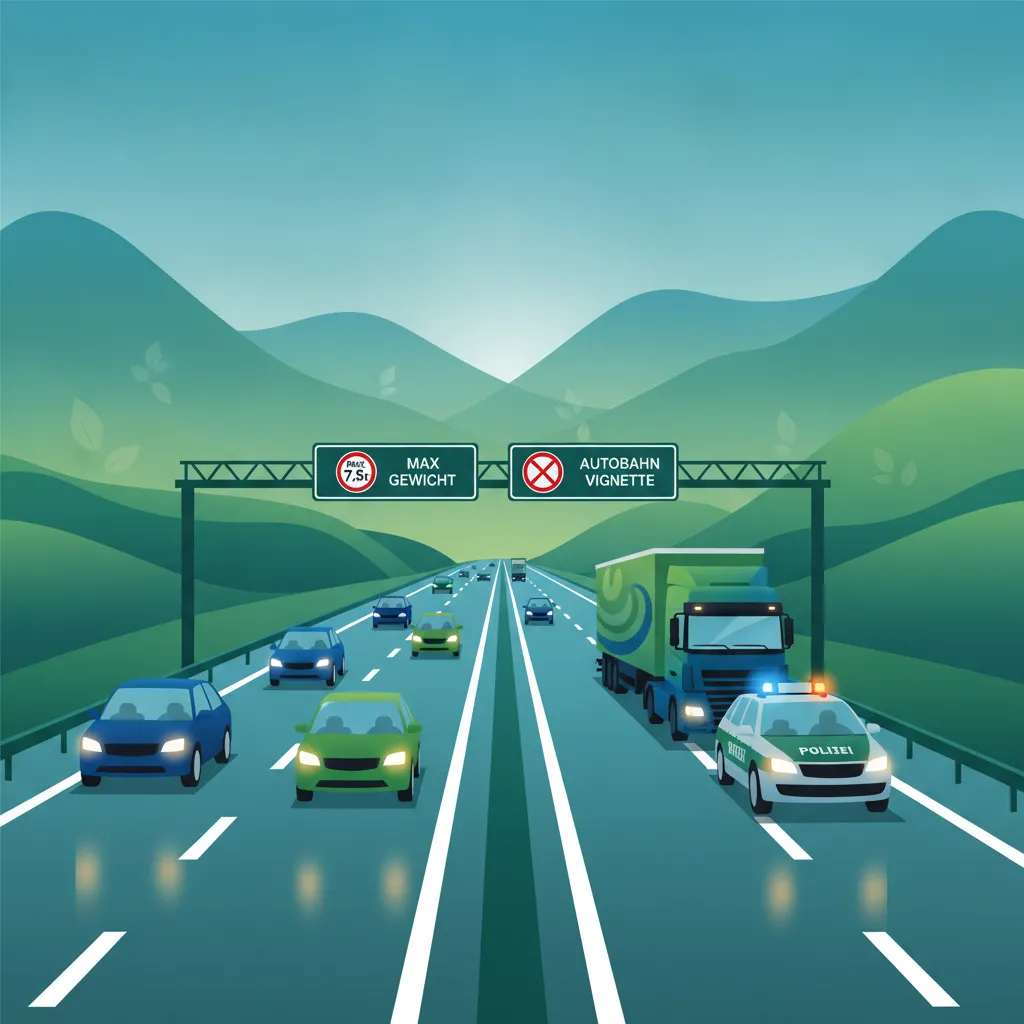
This lesson explains the system of penalties and enforcement for heavy vehicle operations in Austria. It covers the fines and penalty points associated with common traffic violations, such as overloading or insecure loads. Learners will understand the role of authorities in conducting roadside checks and inspections to ensure regulatory compliance.
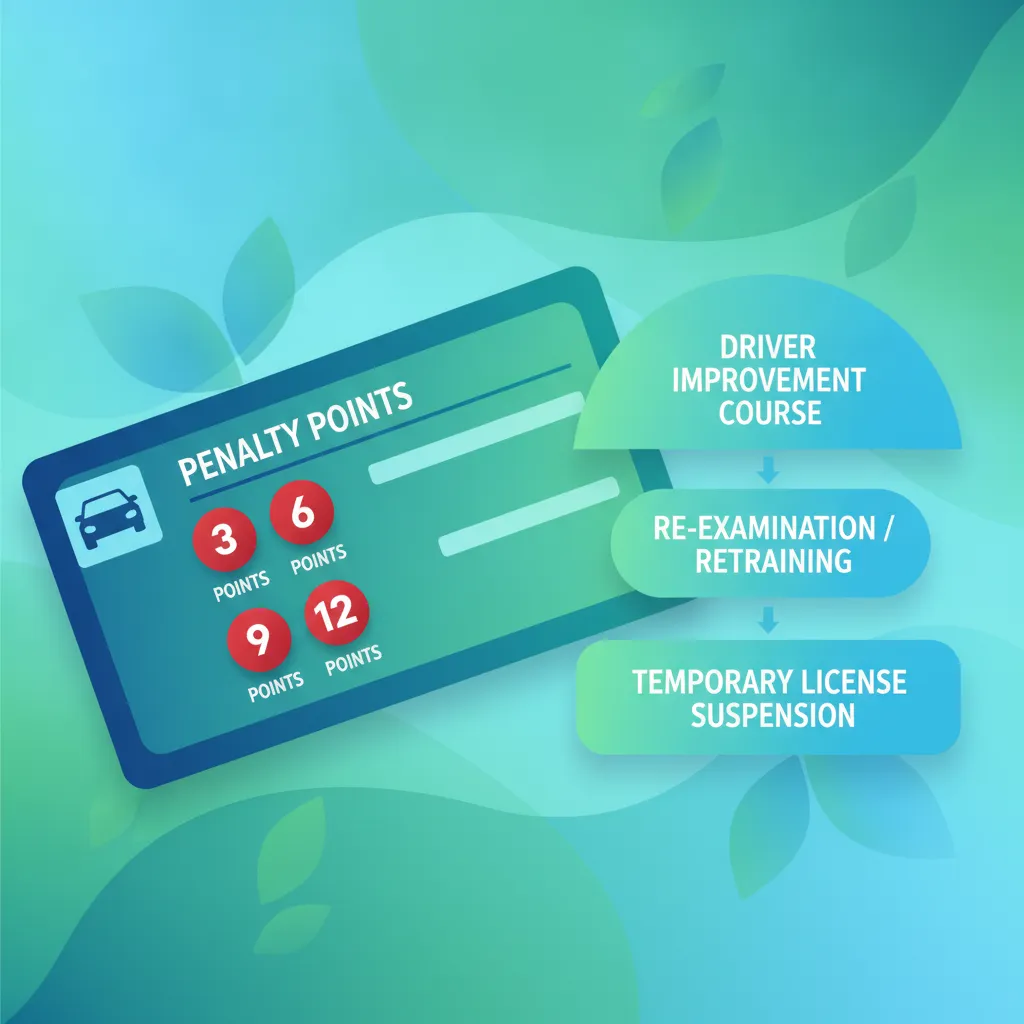
This lesson offers a clear explanation of the Austrian system of penalties for traffic offenses, including the demerit points system (Vormerksystem). It details which violations lead to points, the accumulation process, and the consequences at each stage, such as mandatory driver improvement courses and potential license suspension (Fahrverbot). Understanding this system provides a strong incentive for consistent compliance with all traffic regulations.

This lesson details the legal ramifications of operating an overloaded heavy vehicle in Austria, which include significant fines and penalty points. It also emphasizes the severe safety risks, such as compromised braking performance and increased mechanical stress on the vehicle. Understanding these consequences reinforces the importance of strict adherence to weight limits.

This lesson provides an overview of the legal framework for traffic enforcement in Austria. It explains the structure of fines for common offenses, the demerit point system that can lead to licence suspension, and the more severe consequences for major violations. Understanding these penalties reinforces the importance of consistent adherence to all traffic laws.
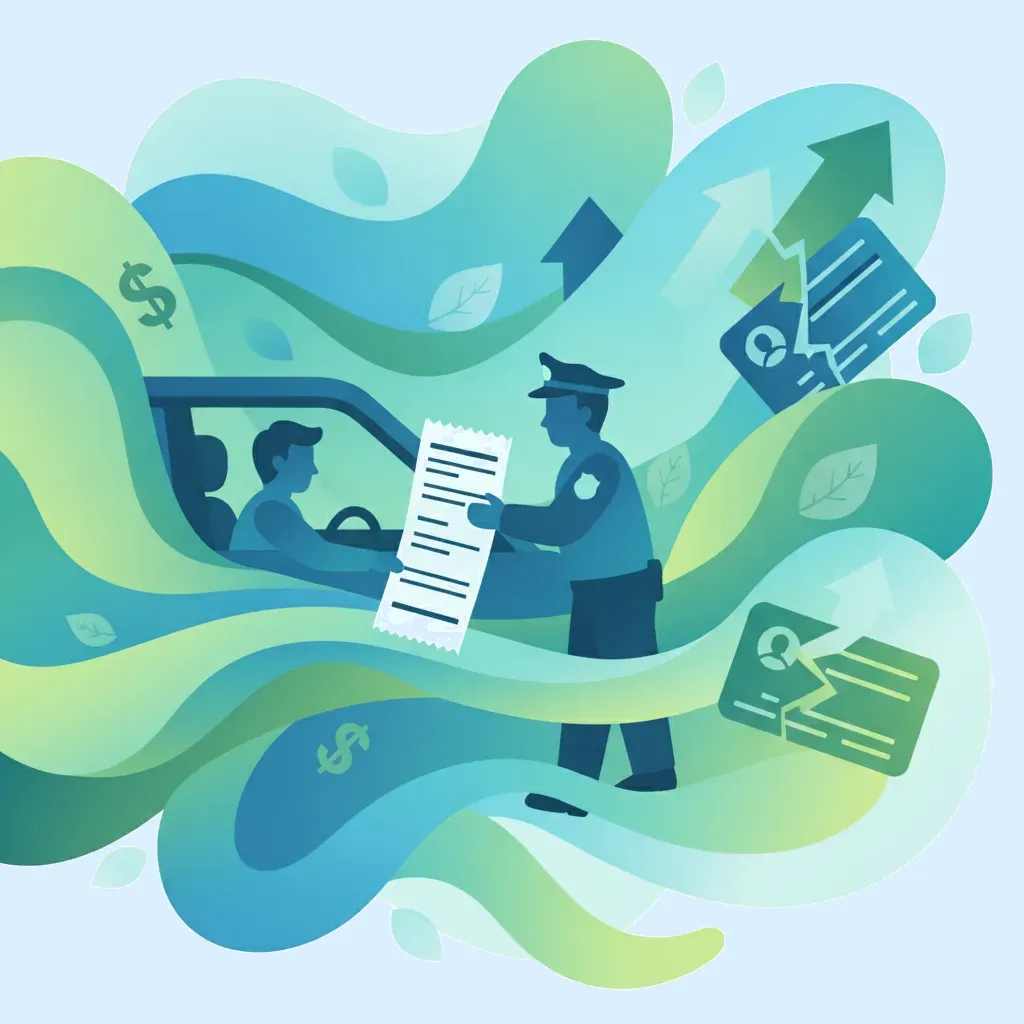
This lesson provides a clear overview of the legal penalties for traffic violations in Austria. It details the system of fines, demerit points, and the conditions that can lead to license suspension or revocation. Understanding these consequences reinforces the importance of lawful and responsible riding.

This lesson details the general traffic rules applicable to heavy goods vehicles on Austrian roads, highlighting differences from passenger car regulations. It covers key topics such as right-of-way at intersections, specific rules for overtaking, maintaining proper lane discipline, and adhering to designated speed limits. Understanding these rules is critical for safe integration into mixed traffic.

This lesson provides a comprehensive overview of a driver's legal responsibilities and the potential consequences of failing to adhere to traffic laws. Learners will explore the concept of liability in the event of an accident and the structure of the official penalty catalogue. The material covers the impact of fines, demerit points, and potential driving bans (Fahrverbot) on one's license, as well as the effects on insurance premiums.
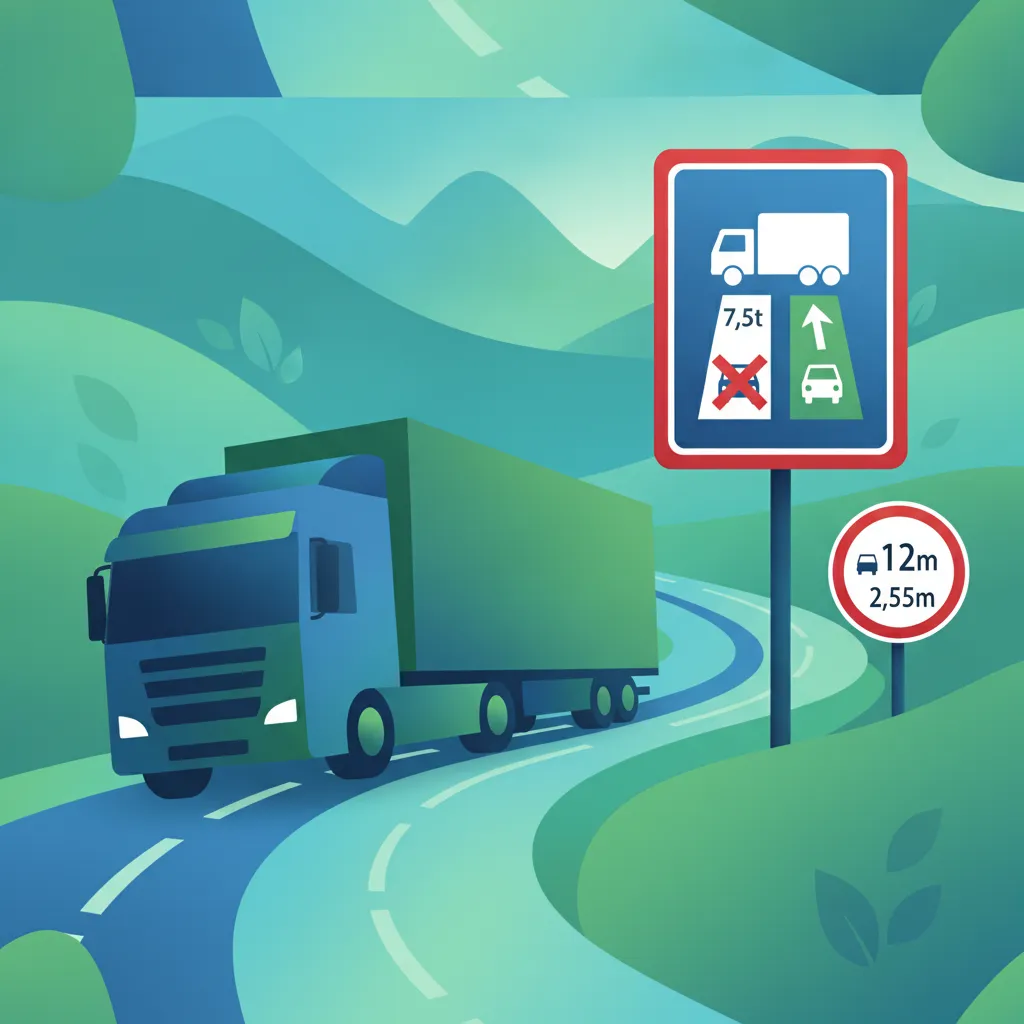
This lesson focuses on the specific Austrian road signs and supplemental plates that apply to heavy goods vehicles. It explains how to interpret signage indicating weight limits, height and width restrictions, lane usage rules, and other critical regulatory information. Correctly understanding these signs is essential for legal compliance and safe navigation on Austria's roads.

This lesson details the regulations for heavy goods vehicles on Austria's high-speed road network. It covers the specific speed limits, rules on lane usage (e.g., when overtaking is permitted), and procedures for entering and exiting the motorway. Adherence to these rules is crucial for safety in a fast-paced environment.

This lesson focuses on the legal restrictions concerning a heavy vehicle's dimensions, including maximum height, width, and length. It teaches drivers how to interpret road signs and supplemental plates that indicate these limits. This knowledge is crucial for route planning, especially when navigating under bridges, through tunnels, and on restricted roads.
Explore the underlying safety principles and physics behind common violations for heavy goods vehicles in Austria, such as load securing, speed limits, and alcohol rules. Understand why these laws are critical for preventing accidents.
This lesson explains the system of penalties and enforcement for heavy vehicle operations in Austria. It covers the fines and penalty points associated with common traffic violations, such as overloading or insecure loads. Learners will understand the role of authorities in conducting roadside checks and inspections to ensure regulatory compliance.
This lesson details the legal ramifications of operating an overloaded heavy vehicle in Austria, which include significant fines and penalty points. It also emphasizes the severe safety risks, such as compromised braking performance and increased mechanical stress on the vehicle. Understanding these consequences reinforces the importance of strict adherence to weight limits.
This lesson details the general traffic rules applicable to heavy goods vehicles on Austrian roads, highlighting differences from passenger car regulations. It covers key topics such as right-of-way at intersections, specific rules for overtaking, maintaining proper lane discipline, and adhering to designated speed limits. Understanding these rules is critical for safe integration into mixed traffic.
This lesson focuses on the legal restrictions concerning a heavy vehicle's dimensions, including maximum height, width, and length. It teaches drivers how to interpret road signs and supplemental plates that indicate these limits. This knowledge is crucial for route planning, especially when navigating under bridges, through tunnels, and on restricted roads.

This lesson consolidates the legal restrictions on the maximum dimensions and weight for different vehicle combinations in Austria. It covers how to read signs indicating these limits and the importance of compliance for route planning. Adhering to these regulations is essential for legal operation and avoiding fines.
This lesson details the regulations for heavy goods vehicles on Austria's high-speed road network. It covers the specific speed limits, rules on lane usage (e.g., when overtaking is permitted), and procedures for entering and exiting the motorway. Adherence to these rules is crucial for safety in a fast-paced environment.
This lesson focuses on the specific Austrian road signs and supplemental plates that apply to heavy goods vehicles. It explains how to interpret signage indicating weight limits, height and width restrictions, lane usage rules, and other critical regulatory information. Correctly understanding these signs is essential for legal compliance and safe navigation on Austria's roads.
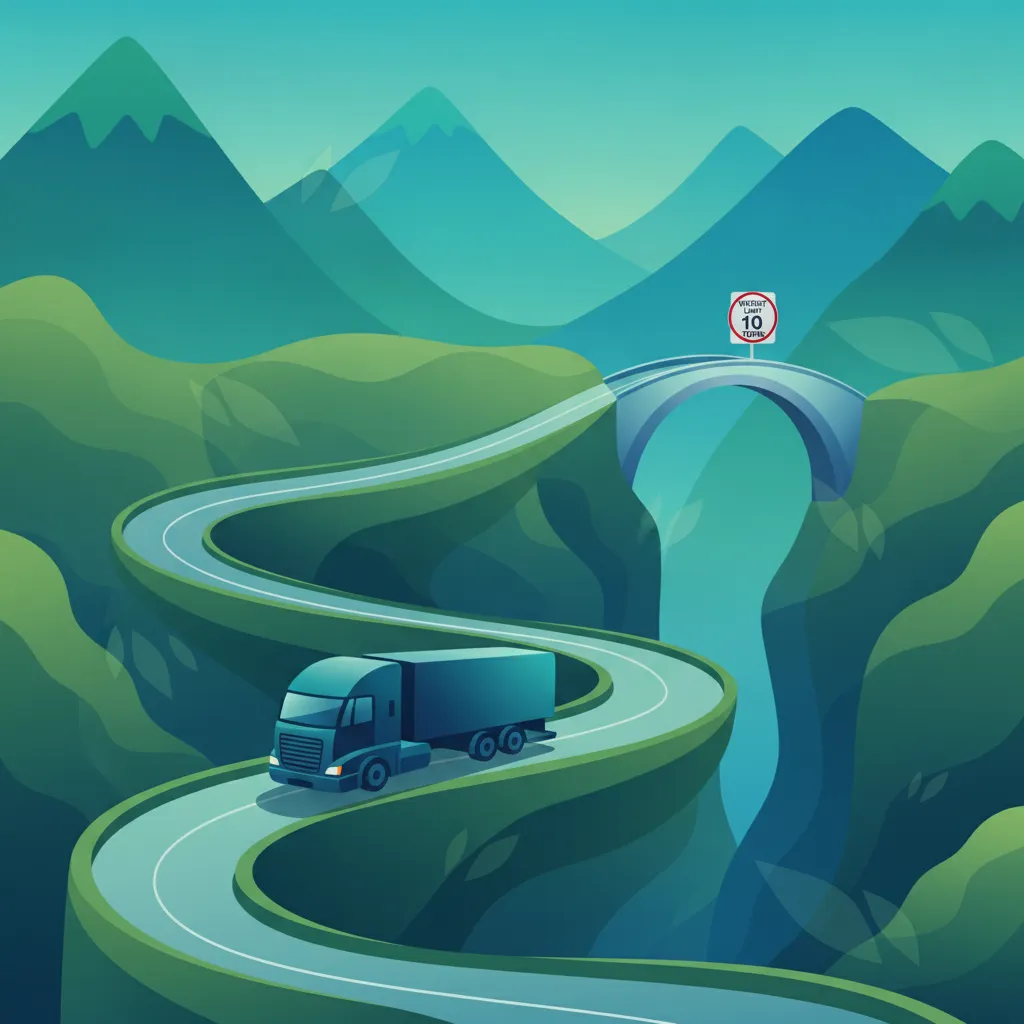
This lesson covers the specific weight restrictions that apply to sensitive infrastructure like Alpine passes and bridges throughout Austria. It explains how to identify these limits through road signage and incorporate them into route planning. Adhering to these restrictions is vital for preventing structural damage and ensuring safety in challenging terrain.

This lesson outlines the significant legal responsibilities placed on heavy-vehicle drivers under Austrian law, emphasizing a strong duty of care and professional conduct. It covers the obligation to perform thorough pre-trip inspections, comply with all load and weight regulations, and uphold safety standards to protect all road users. Adherence to these principles is crucial for professional and safe operation.
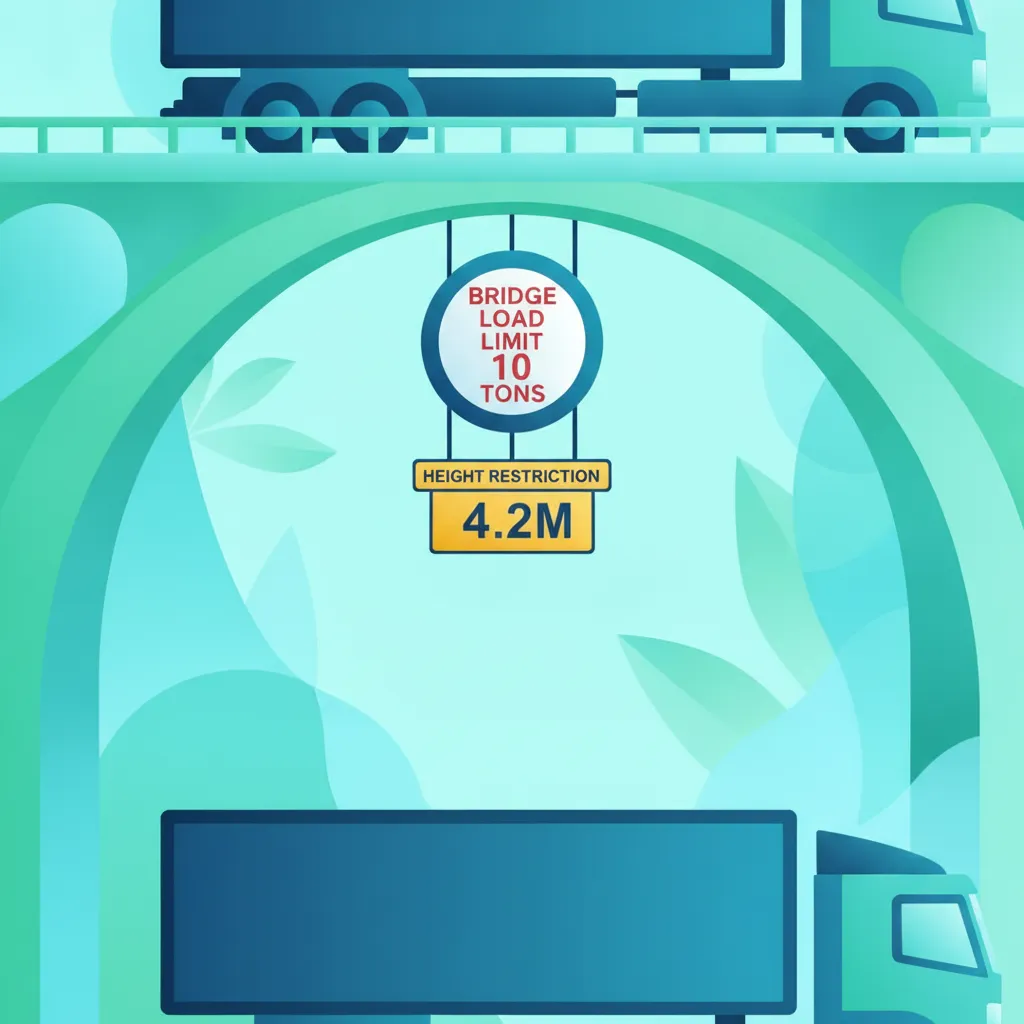
This lesson focuses on the critical importance of observing posted weight and height limits for bridges and other structures. It explains how to read the relevant signage and stresses the driver's responsibility to know their vehicle's exact height and weight. Ignoring these limits can lead to catastrophic structural failure and severe legal consequences.
Find clear answers to common questions learners have about Legal Responsibilities and Penalties for Violations. Learn how the lesson is structured, which driving theory objectives it supports, and how it fits into the overall learning path of units and curriculum progression in Austria. These explanations help you understand key concepts, lesson flow, and exam focused study goals.
The Vormerksystem is an administrative warning system in Austria for repeated traffic offences. If a driver commits specific serious violations, they are recorded in a register; if further offences occur within a set time, mandatory traffic training or licence suspension may follow.
Yes. Certain severe violations, such as extreme speeding, driving under the influence, or causing a serious accident, can lead to immediate temporary or permanent revocation of your licence, depending on the severity and current laws.
While the basic traffic laws apply to everyone, professional HGV drivers are held to higher standards. Violations related to load securing, driving times, and technical roadworthiness often carry heavier fines and more stringent legal scrutiny due to the increased safety risks involved.
Yes. Ignoring specific vehicle-length, weight, or environmental zone restrictions often results in significant fines. These are strictly enforced, especially in sensitive areas like the Tyrol region or through specific mountain passes.
Refine your study plan by searching for specific Austrian driving theory practice sets. Pinpoint questions related to particular road rules, signs, or challenge levels, and begin practicing immediately to reinforce your knowledge and excel in your official exam with confidence. Get started with focused revision today.