
This lesson guides you through the mandatory Mehrphasenausbildung process that all new Category B drivers in Austria must complete. You will learn about the specific obligations, the demerit point system, and how to maintain your license by avoiding common probationary violations.

Lesson content overview
Obtaining your Category B driving license in Austria marks the beginning of an important journey, which includes a mandatory probationary period and a structured training program known as Mehrphasenausbildung (multi-phase training). This system is designed to transform new drivers into experienced, responsible, and safe participants in Austrian road traffic. Understanding these obligations is not just a formality; it is crucial for retaining your driving privilege, preventing legal issues, and enhancing your driving skills beyond the initial test.
This lesson will provide a comprehensive overview of the Mehrphasenausbildung process, detail the obligations during the probationary period, explain the demerit points system for traffic violations, and outline the consequences of serious infractions, including the dreaded Fahrverbot (driving ban). It will also cover the purpose and structure of mandatory driver improvement courses. This knowledge is fundamental for every new driver undertaking the Austrian Driving License B Theory Course: Official Test Preparation.
The probationary period is a legally mandated interval during which new drivers, immediately after receiving their provisional Category B driving license, are subject to specific rules and enhanced scrutiny. In Austria, this period typically lasts for a minimum of two years, but can extend beyond this if all mandatory training requirements are not met or if serious traffic violations occur. Its primary purpose is to provide a structured learning environment that allows new drivers to gain real-world experience under careful monitoring, thereby reducing the high accident risk associated with inexperience.
During this time, drivers must not only comply with general traffic laws but also fulfill additional obligations unique to their probationary status. Failure to adhere to these rules can lead to an extension of the probationary period, mandatory retraining, or even the temporary or permanent loss of the driving license. This period serves as a critical phase for developing responsible driving habits and a deeper understanding of road safety, laying the groundwork for a lifetime of safe driving.
The Mehrphasenausbildung, or multi-phase driver training, is a unique and integral component of the Austrian driving license system for new Category B drivers. It is a structured program designed to build upon the initial driving school education, gradually enhancing a driver's risk awareness, practical skills, and responsible behavior. This comprehensive training is divided into distinct phases, each with specific objectives and mandatory attendance requirements. It is a continuous learning process that must be completed successfully within the probationary period, regardless of whether any traffic violations have occurred. The rationale behind this progressive system is to allow new drivers to mature in their driving abilities and perceptions, addressing common novice driver risks such as overconfidence, poor hazard perception, and limited experience in complex situations.
The initial stage of Mehrphasenausbildung, Phase 1, typically takes place within the first four months of receiving the provisional license. This phase reinforces basic driving rules and introductory practical skills. While the initial driving school training focuses on passing the test, Phase 1 aims to consolidate foundational knowledge and ensure the new driver is comfortable with basic vehicle operation and traffic participation. Although not always a separate practical lesson, it is a conceptual starting point that underpins the subsequent, more intensive phases. It is crucial for drivers to reflect on their initial experiences and identify areas for improvement before progressing.
Phase 2 is a crucial component of the Mehrphasenausbildung, focusing intensely on risk awareness and defensive driving. This phase is usually undertaken between the third and ninth month of the probationary period. It is mandatory for all probationary drivers, irrespective of whether they have committed any traffic violations. The training typically involves both theoretical instruction and practical driving sessions, often utilizing specific training areas or simulators to replicate hazardous situations safely.
The objectives of Phase 2 include:
Successful completion of Phase 2 is recorded and is a prerequisite for moving on to Phase 3. This phase significantly contributes to reducing the likelihood of accidents by equipping drivers with the mental and practical tools to navigate complex and potentially dangerous scenarios safely.
Even if you feel confident and haven't had any incidents, approach Phase 2 with an open mind. Its purpose is to expose you to risks you might not have encountered yet and to refine your ability to react safely.
The final phase of the Mehrphasenausbildung, Phase 3, is typically scheduled between the sixth and twelfth month of the probationary period. This advanced training focuses on refining vehicle handling, mastering complex traffic situations, and fostering critical self-reflection on driving behavior. It often involves practical driving on various road types, including urban, rural, and potentially motorway sections, under diverse conditions.
Key elements of Phase 3 include:
The successful completion of Phase 3, along with Phase 1 and 2, formally concludes the Mehrphasenausbildung requirement, paving the way for the end of the probationary period. It aims to solidify safe and responsible driving practices as ingrained habits.
To encourage safe driving and provide a measurable way to track driver behavior, Austria operates a demerit points system for traffic violations. This system applies to all drivers but has particularly significant implications for those within their probationary period. When a driver commits certain traffic offenses, a predetermined number of points are added to their record. Accumulating a specific threshold of points triggers mandatory intervention, such as driver improvement courses or even a driving ban. The system is designed to identify and correct risky driving patterns early, especially in new drivers who are still developing their skills and judgment.
Demerit points are allocated based on the severity of the traffic violation. More serious offenses naturally result in a higher number of points. These points are recorded by the authorities and contribute to a cumulative total on a driver's record. For probationary drivers, the thresholds for triggering interventions are generally lower than for experienced drivers, reflecting the system's focus on early behavioral correction.
Examples of point allocations can include:
These examples illustrate how seemingly minor infractions can quickly accumulate points, highlighting the importance of strict adherence to traffic laws during the probationary period. Each point accrues and remains active on the driver's record for a specified period, influencing potential future consequences.
While demerit points accumulate, they do not remain on a driver's record indefinitely. Points typically expire after a certain period, often two years, provided no further violations occur. However, this expiration is not automatic, especially during the probationary period, if the point threshold for mandatory courses or bans has been reached. In such cases, points must often be "cleared" through specific actions, primarily by successfully completing a mandatory driver improvement course.
The system is designed to provide a chance for rehabilitation. If a probationary driver accumulates points and completes the required driver improvement course, their points are usually reset or significantly reduced. This mechanism incentivizes participation in remedial training and offers a path for drivers to reset their record and avoid more severe penalties like a driving ban. Misinterpreting how points expire, or assuming they vanish automatically, is a common pitfall that can lead to unexpected and serious consequences.
Driver improvement courses, known as Führerschein-Nachschulung in Austria, are mandatory training sessions for drivers who have accumulated a specific number of demerit points within their probationary period. These courses are not punitive in nature but rather educational, aiming to address the underlying causes of unsafe driving behavior and reduce the likelihood of future infractions. They serve as a crucial intervention point in the demerit points system, offering drivers an opportunity to correct their course before more severe penalties are imposed.
For probationary drivers, a driver improvement course becomes mandatory upon accumulating a certain number of demerit points. The standard threshold is often set at 4 points within the probationary period. Once this threshold is reached, the driver will be notified by the authorities and required to attend a certified driver improvement course within a specified timeframe, typically six months. Failure to enroll in and successfully complete this course within the given period will result in more severe consequences, including a potential Fahrverbot. This proactive approach aims to intervene early, retraining drivers who show patterns of risky behavior before they cause serious accidents.
Notification: You will receive an official notification from the traffic authority detailing your accumulated points and the requirement to attend a driver improvement course.
Enrollment: You must enroll in an approved Führerschein-Nachschulung course at a certified institution within the stipulated timeframe (e.g., 6 months).
Attendance and Completion: Attend all sessions of the course, which typically covers theoretical and practical elements focusing on risk awareness and defensive driving. Successful completion is mandatory.
Point Reduction: Upon successful completion, your accumulated points will usually be reduced or reset, depending on the specific regulations and the number of points accumulated.
Documentation: Ensure all necessary documentation proving course completion is submitted to the relevant authorities to update your driving record.
The content of a Führerschein-Nachschulung course is structured to address common deficiencies in driver behavior and perception. It typically covers:
These courses are usually interactive, combining classroom theory with group discussions and sometimes practical exercises. Upon successful completion, which often involves active participation and a final assessment, the driver's accumulated points are typically reduced. For example, completing the course might reduce the current point total by 2 points, or reset it to zero, depending on the specific regulations at the time of completion. This point reduction is a key incentive, as it helps probationary drivers avoid reaching the threshold for a Fahrverbot.
A Fahrverbot, or driving ban, represents a temporary suspension of driving privileges imposed by either a court or the traffic authority. This is one of the most severe consequences a probationary driver can face, often resulting from serious individual infractions or the accumulation of a high number of demerit points. The primary purpose of a Fahrverbot is to ensure road safety by temporarily removing drivers who have demonstrated a significant disregard for traffic laws or who pose an elevated risk to themselves and other road users.
For probationary drivers, a Fahrverbot can be triggered by several factors:
These measures underscore the seriousness with which Austrian authorities treat road safety, especially for new drivers who are still proving their competence and responsibility.
The implications of a Fahrverbot are significant and far-reaching:
It is crucial for any driver subjected to a Fahrverbot to strictly comply with its terms and to take all necessary steps to legally regain their driving rights, rather than risking further, more severe penalties.
The probationary period and Mehrphasenausbildung system, while beneficial, can be complex. New drivers often fall victim to common misunderstandings or overlook specific requirements, leading to unnecessary complications. Being aware of these pitfalls can help ensure a smooth progression towards becoming a fully experienced driver.
Safe driving is not static; it requires constant adaptation to dynamic road conditions, vehicle states, and environmental factors. The Mehrphasenausbildung implicitly emphasizes this flexibility, preparing probationary drivers for a wide array of scenarios. Understanding how different contexts influence driving requirements is vital for responsible behavior and for fulfilling the more advanced training phases.
To summarise, a set of key rules and regulations govern the probationary period for new Category B drivers in Austria. Adherence to these is non-negotiable for retaining driving privileges and successfully completing the probationary phase.
The Austrian Mehrphasenausbildung and probationary driver obligations are a robust framework designed to foster safe, responsible, and skilled drivers. They represent a commitment to continuous learning and risk mitigation that extends beyond the initial driving test. By understanding and diligently fulfilling these requirements—from attending all phases of the Mehrphasenausbildung to managing demerit points and, if necessary, completing driver improvement courses—new drivers can navigate their probationary period successfully. This not only ensures the retention of their driving license but also builds a strong foundation for a lifetime of confident and accident-free driving on Austria's roads. Embrace these obligations as opportunities to further develop your driving expertise and contribute to overall road safety.
The Austrian Mehrphasenausbildung is a mandatory three-phase training program that all new Category B drivers must complete during their two-year probationary period, with Phase 1 covering foundational skills, Phase 2 focusing on risk awareness and defensive driving, and Phase 3 addressing advanced vehicle handling and behavioral reflection. The demerit points system applies stricter thresholds to probationary drivers, where accumulating 4 points triggers a mandatory driver improvement course and 6 points results in a driving ban with mandatory re-examination. Successful completion of all phases and proper management of demerit points are essential for avoiding penalties and transitioning to full driving privileges.
A short set of high-value points that capture the most important learning from this lesson.
The probationary period for Category B drivers in Austria lasts a minimum of two years and requires completion of all three mandatory training phases.
Mehrphasenausbildung consists of Phase 1 (months 1-4), Phase 2 (months 3-9) focusing on risk awareness, and Phase 3 (months 6-12) covering advanced driving skills.
Accumulating 4 demerit points during probation triggers mandatory enrollment in a Führerschein-Nachschulung driver improvement course within six months.
Reaching 6 demerit points results in a Fahrverbot (driving ban), mandatory re-examination, and extension of the probationary period.
All phases of Mehrphasenausbildung are mandatory regardless of driving record; skipping any phase extends probation and may lead to penalties.
Explore all units and lessons included in this driving theory course.
Demerit points expire after two years only if no further violations occur and all triggered obligations have been completed; they do not reset automatically.
Driving during a Fahrverbot can result in outright license revocation, substantial fines, and criminal prosecution beyond the original offense.
Phase 2 specifically addresses psychological factors like peer pressure, fatigue, and overconfidence that impair new driver judgment.
Completion of mandatory courses must be officially documented and submitted to authorities to be officially recognized.
A provisional license has an expiration date; all Mehrphasenausbildung requirements must be finished before this date to legally convert to a full license.
Assuming Phase 2 or Phase 3 can be skipped if no traffic violations have occurred; all phases are legally mandatory.
Ignoring official notifications about demerit point accumulation or failing to enroll in required improvement courses within the deadline.
Believing that insurance discounts for advanced courses substitute for mandatory Mehrphasenausbildung phases required by Austrian authorities.
Attempting to transfer obligations or points from licenses obtained in other EU countries during the Austrian probationary period.
Failing to submit proof of training completion to authorities, resulting in the training not being officially recognized.
Lesson content overview
A short set of high-value points that capture the most important learning from this lesson.
The probationary period for Category B drivers in Austria lasts a minimum of two years and requires completion of all three mandatory training phases.
Mehrphasenausbildung consists of Phase 1 (months 1-4), Phase 2 (months 3-9) focusing on risk awareness, and Phase 3 (months 6-12) covering advanced driving skills.
Accumulating 4 demerit points during probation triggers mandatory enrollment in a Führerschein-Nachschulung driver improvement course within six months.
Reaching 6 demerit points results in a Fahrverbot (driving ban), mandatory re-examination, and extension of the probationary period.
All phases of Mehrphasenausbildung are mandatory regardless of driving record; skipping any phase extends probation and may lead to penalties.
Explore all units and lessons included in this driving theory course.
Demerit points expire after two years only if no further violations occur and all triggered obligations have been completed; they do not reset automatically.
Driving during a Fahrverbot can result in outright license revocation, substantial fines, and criminal prosecution beyond the original offense.
Phase 2 specifically addresses psychological factors like peer pressure, fatigue, and overconfidence that impair new driver judgment.
Completion of mandatory courses must be officially documented and submitted to authorities to be officially recognized.
A provisional license has an expiration date; all Mehrphasenausbildung requirements must be finished before this date to legally convert to a full license.
Assuming Phase 2 or Phase 3 can be skipped if no traffic violations have occurred; all phases are legally mandatory.
Ignoring official notifications about demerit point accumulation or failing to enroll in required improvement courses within the deadline.
Believing that insurance discounts for advanced courses substitute for mandatory Mehrphasenausbildung phases required by Austrian authorities.
Attempting to transfer obligations or points from licenses obtained in other EU countries during the Austrian probationary period.
Failing to submit proof of training completion to authorities, resulting in the training not being officially recognized.
Explore search topics learners often look for when studying Mehrphasenausbildung and Probationary Driver Obligations. These topics reflect common questions about road rules, driving situations, safety guidance, and lesson level theory preparation for learners in Austria.
Browse additional driving theory lessons that cover connected traffic rules, road signs, and common driving situations related to this topic. Improve your understanding of how different rules interact across everyday traffic scenarios.
Understand the complete Mehrphasenausbildung process for probationary drivers in Austria. This lesson details the content and objectives of each training phase, ensuring you meet all legal obligations for license retention.

This lesson explains the mandatory multi-stage training system in Austria, known as Mehrphasenausbildung. It details the required theoretical and practical training modules that riders must complete after obtaining their initial licence. Understanding this structured pathway helps learners plan their skill development and meet all legal requirements for full licensure.

This lesson provides a detailed breakdown of the Mehrphasenausbildung (multi-phase training) program, a legal requirement for all new license holders in Austria. It explains the structure of the probationary period and the mandatory components, such as a perfection drive and a driver safety training course. Learners will understand the legal implications of failing to complete these stages and their purpose in reinforcing safe driving skills after the initial test.

This lesson introduces the L17 program for accompanied driving, detailing the legal requirements for both the learner and the supervising driver (Begleitperson). It outlines the structured learning stages, mandatory driving hours, and the importance of gaining practical experience in diverse traffic scenarios. Emphasis is placed on risk management protocols, correct documentation, and the necessary insurance coverage during the supervised practice period.

This lesson details the technical specifications for each Austrian motorcycle licence category: A1, A2, and A. It clarifies the legal limits on engine capacity and power output, alongside the minimum age requirements for each stage. By outlining the clear progression path, learners will grasp the necessary steps and training phases to advance their riding qualifications according to Austrian law.

This lesson addresses advanced manoeuvres that require precise timing and judgment, such as merging onto a motorway from an acceleration lane. It explains the importance of matching the speed of the traffic flow and finding a safe gap before moving over. The content also covers procedures for navigating lane drops and the 'zipper merge' (Reißverschlusssystem) principle in congested situations, promoting efficient and cooperative driving.

This lesson explains the importance of maintaining a safe following distance to prevent rear-end collisions. It introduces practical methods for judging a safe gap, such as the widely-used 'two-second rule,' and clarifies how this distance needs to be increased in adverse weather or poor visibility. The content emphasizes that an adequate buffer zone provides the necessary time and space to react and brake safely if the vehicle in front stops suddenly.
This lesson provides an overview of the Austrian Road Traffic Act (StVO) as it applies to AM riders. It introduces the hierarchy of road users and explains the fundamental principles of right-of-way, including the concepts of 'Vorfahrt' and 'Nachrang'. Learners will understand the meaning of basic road markings and priority signs to navigate traffic lawfully and safely.

This lesson provides clear instructions for maneuvering through single and multi-lane roundabouts. It covers the critical rule of giving way to traffic already in the circle, proper lane selection based on the intended exit, and the correct use of indicators when entering and exiting. Mastering roundabouts is key to efficient and safe travel in modern Austrian traffic systems.
Learn about the Austrian demerit points system and the severe consequences for probationary drivers, including mandatory improvement courses and driving bans (Fahrverbot). Understand how to avoid losing your license.
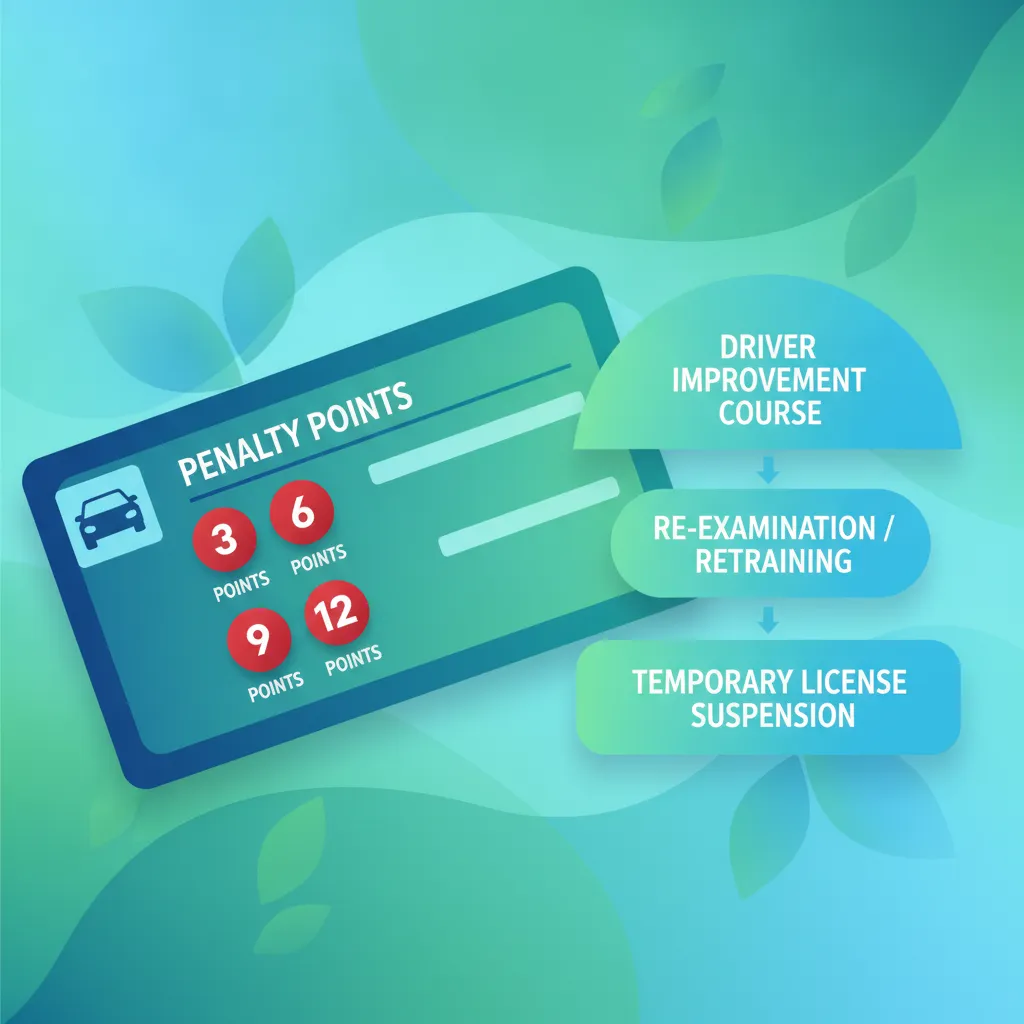
This lesson offers a clear explanation of the Austrian system of penalties for traffic offenses, including the demerit points system (Vormerksystem). It details which violations lead to points, the accumulation process, and the consequences at each stage, such as mandatory driver improvement courses and potential license suspension (Fahrverbot). Understanding this system provides a strong incentive for consistent compliance with all traffic regulations.

This lesson provides a clear overview of the legal penalties for traffic violations in Austria. It details the system of fines, demerit points, and the conditions that can lead to license suspension or revocation. Understanding these consequences reinforces the importance of lawful and responsible riding.

This lesson provides an overview of the legal framework for traffic enforcement in Austria. It explains the structure of fines for common offenses, the demerit point system that can lead to licence suspension, and the more severe consequences for major violations. Understanding these penalties reinforces the importance of consistent adherence to all traffic laws.

This lesson provides a comprehensive overview of a driver's legal responsibilities and the potential consequences of failing to adhere to traffic laws. Learners will explore the concept of liability in the event of an accident and the structure of the official penalty catalogue. The material covers the impact of fines, demerit points, and potential driving bans (Fahrverbot) on one's license, as well as the effects on insurance premiums.
This lesson explains the system of penalties and enforcement for heavy vehicle operations in Austria. It covers the fines and penalty points associated with common traffic violations, such as overloading or insecure loads. Learners will understand the role of authorities in conducting roadside checks and inspections to ensure regulatory compliance.

This lesson provides an overview of the legal framework governing heavy vehicle drivers in Austria. It details the potential penalties for violations, including fines, penalty points, and the risk of licence suspension. A clear understanding of these consequences reinforces the importance of compliant and responsible driving.
Find clear answers to common questions learners have about Mehrphasenausbildung and Probationary Driver Obligations. Learn how the lesson is structured, which driving theory objectives it supports, and how it fits into the overall learning path of units and curriculum progression in Austria. These explanations help you understand key concepts, lesson flow, and exam focused study goals.
The Mehrphasenausbildung is a multi-phase training program in Austria designed to help novice drivers gain experience and risk awareness after passing their initial driving test. It ensures you develop safe habits through mandatory improvement sessions and practical feedback.
In Austria, the probationary period (Probezeit) generally lasts for three years after you receive your probationary driving license, during which time you must adhere to stricter rules regarding alcohol and traffic safety.
Serious violations during the probationary period can lead to an extension of your probationary time, mandatory re-training sessions, or even a temporary driving ban (Fahrverbot), depending on the severity of the offence.
Yes, these improvement courses are a legal requirement for all new drivers. Failure to complete the assigned phases within the specified timeframes can result in the loss of your driving privileges.
Refine your study plan by searching for specific Austrian driving theory practice sets. Pinpoint questions related to particular road rules, signs, or challenge levels, and begin practicing immediately to reinforce your knowledge and excel in your official exam with confidence. Get started with focused revision today.