
This lesson focuses on the critical emergency procedures required when a load shifts or is lost while operating a heavy goods vehicle in Austria. You will learn how to detect instability, safely secure the area, and follow legal reporting requirements to protect yourself and other road users.

Lesson content overview
Driving a heavy goods vehicle (HGV) comes with significant responsibilities, particularly concerning the safe transport of cargo. An emergency involving load loss or an unforeseen cargo shift can dramatically alter vehicle dynamics, posing severe risks to the driver, other road users, and the cargo itself. This lesson, part of the Austrian Driving License Theory Course for Heavy Goods Vehicles (C, C1, C1E, CE), provides essential knowledge and procedures for managing such critical situations safely and effectively.
Understanding how to react swiftly and correctly to a shifting or lost load is crucial for preventing accidents, mitigating hazards, and ensuring compliance with Austrian traffic and transport regulations. This comprehensive guide covers the immediate driver actions required, the safe stopping procedures, how to secure the incident scene, and the mandatory legal reporting obligations.
Cargo shift and load loss refer to the unintended movement or complete detachment of freight from its secured position during transit. This can be caused by inadequate load securing (Ladungssicherung), sudden vehicle maneuvers, or forces encountered on the road, such as potholes or sharp turns. Recognizing the signs and understanding the physical consequences are the first steps in effective emergency management.
The unintended movement of cargo within its secured position on a heavy goods vehicle, altering the vehicle’s dynamic behavior.
The complete detachment of cargo from a heavy goods vehicle during transit, leading to it falling onto the roadway or roadside.
When cargo shifts, it changes the vehicle’s centre of gravity (CG). The CG is the point where the entire weight of the vehicle and its load is considered to act. A sudden change in its position can have profound effects on stability, handling, and braking efficiency.
A longitudinal CG shift, where cargo slides forward or backward, significantly alters the weight distribution over the axles. If cargo shifts forward, more weight presses on the front axle, potentially reducing traction on the drive axles and increasing the risk of understeer. Conversely, a rearward shift can lighten the front axle, leading to oversteer and reduced steering control, while also increasing the stopping distance due to reduced braking effectiveness from the front.
A lateral CG shift, where cargo moves side-to-side, increases the risk of vehicle rollover, especially during turns or on uneven terrain. This shift can also make the vehicle sway unpredictably, requiring constant, often difficult, steering corrections. Even a partial shift, which might seem minor, can dramatically reduce the vehicle’s stability and braking performance, necessitating immediate driver intervention.
Early detection of a cargo shift or load loss is paramount. Drivers must be attuned to their vehicle's behavior and the sounds it makes. Any sudden, unexplained change in handling characteristics or unusual noises should prompt immediate investigation.
Upon detecting a potential cargo shift or load loss, your immediate actions are critical to prevent a loss of control and ensure safety. Panic can lead to abrupt maneuvers that exacerbate the situation.
Remain Calm and Maintain Steering Control: Grip the steering wheel firmly with both hands. Avoid sudden steering inputs, which can worsen instability.
Reduce Speed Gently and Gradually: Ease off the accelerator smoothly. Avoid harsh braking unless absolutely necessary. Gentle deceleration helps to stabilize the vehicle and prevents further load movement.
Assess Vehicle Handling and Surroundings: Evaluate how the vehicle is responding to your actions. Scan mirrors for other traffic and identify a safe place to pull over.
Signal Your Intentions: Use your turn signals to indicate your intention to slow down or change lanes, warning other drivers.
Never attempt sudden braking or sharp steering maneuvers immediately after detecting a load shift. These actions can increase vehicle instability and lead to a rollover or collision.
Once you have controlled the vehicle, the next critical step is to bring it to a safe, stationary position. This involves a systematic approach to minimize further hazards to yourself and other road users, adhering to Austrian traffic regulations.
Select a Safe Pull-Over Location:
Signal Clearly:
Flashing lights on a vehicle used to indicate that it is stationary and poses a danger or obstruction to traffic.
Position the Vehicle Safely:
Secure the Vehicle:
After stopping and activating your hazard lights, you must deploy a reflective warning triangle to alert approaching traffic, as mandated by StVO § 57. This is especially crucial for heavy goods vehicles, which are large and can create significant obstructions.
The placement distance of the warning triangle depends on the type of road:
When deploying the triangle, ensure your own safety. Wear a high-visibility vest, especially at night or in poor visibility, and face oncoming traffic while walking to the placement point.
Once your vehicle is safely stopped and marked, the immediate priority shifts to safeguarding the incident area and assessing the situation with the cargo. This protects you, other road users, and the environment.
Before approaching the cargo, perform a rapid visual assessment from a safe distance if possible.
Re-secure the Cargo (if safe and possible):
Clear Debris (if safe and minimal):
Always prioritize your personal safety over the cargo. If the situation is dangerous, stay in a safe location (e.g., behind a barrier, or inside your vehicle if it is safer) and wait for emergency services.
In Austria, drivers have statutory duties to report load loss or cargo shift incidents. Failure to report can lead to legal penalties, issues with insurance claims, and further safety risks.
Police Notification (StVO § 91): You must notify the police if the load loss or cargo shift:
Employer Reporting: You are typically required to report the incident to your employer within a set timeframe (e.g., 24 hours). This allows the company to initiate internal procedures, arrange for recovery, and handle insurance claims.
Insurance Companies: Depending on your company's policy, you may also need to report directly to the insurance company or ensure your employer does.
Thorough documentation of the incident is crucial for legal and insurance purposes:
Always carry your driver's license, vehicle registration, and relevant transport documents (e.g., consignment note, dangerous goods papers) in your vehicle. These will be required by authorities.
Driving conditions, road types, and vehicle configurations can significantly impact how a load loss or cargo shift emergency unfolds and how you should respond.
When stopping in urban areas, be acutely aware of pedestrians and cyclists. Ensure your warning triangles do not become new hazards for them. Avoid blocking sidewalks or pedestrian crossings. If the load has spilled, cordon off the area if possible, to prevent injury to bystanders.
Effectively handling load loss and cargo shift emergencies is a critical skill for all heavy goods vehicle drivers in Austria. It demands a calm demeanor, immediate corrective action, adherence to precise procedures, and full compliance with legal obligations.
By integrating knowledge of load distribution, vehicle dynamics, braking distances, and emergency procedures, heavy goods vehicle drivers can confidently navigate these challenging situations, minimizing risks and ensuring safety on Austrian roads.
This lesson covers the critical emergency procedures for Austrian heavy goods vehicle drivers when experiencing load loss or cargo shift. Drivers learn to recognize early warning signs such as sudden handling changes and unusual noises, then respond by maintaining calm, gently reducing speed, and avoiding abrupt maneuvers that could cause rollover. Safe stopping requires using the emergency lane or lay-by, activating hazard lights (Gefahrlicht), and deploying reflective warning triangles at legally mandated distances. Drivers must assess whether re-securing is safe, and are legally obligated to report incidents to police under StVO §91 whenever the load creates obstruction, danger, or involves hazardous materials. Response must be adapted for weather conditions, road types, and vehicle configurations, with particular attention to trailer combinations where load shift can cause severe jackknifing.
A short set of high-value points that capture the most important learning from this lesson.
A sudden cargo shift changes the vehicle's centre of gravity, which can cause instability, altered braking performance, and increased rollover risk.
Never use sudden braking or sharp steering after detecting a load shift—ease off the accelerator smoothly to prevent worsening instability.
Hazard warning lights (Gefahrlicht) must only be activated when stationary and posing danger, never while moving.
If the load cannot be re-secured safely, do not attempt it—stay clear and wait for emergency services.
Any load loss causing traffic obstruction, danger, or accident must be reported to police under StVO §91.
Explore all units and lessons included in this driving theory course.
Warning triangle placement distances: 150m on Autobahn, 100m on Freilandstraße, 30m in Ortsgebiet.
Austrian load securing must withstand 0.5 g longitudinal and 0.3 g lateral forces (GüG and StVO §107).
Use hazard lights (Gefahrlicht) immediately after stopping—signalling intention to pull over uses normal turn signals, not hazard lights.
Police notification is mandatory when load loss creates obstruction, danger, accident, or involves hazardous materials.
For trailer sway caused by load shift, maintain steady speed and apply gentle trailer brakes before reducing speed.
Pulling over in traffic lanes, on curves, or immediately after blind rises instead of finding a safe lay-by or emergency lane.
Failing to wear a high-visibility vest before exiting the vehicle to deploy warning equipment.
Deploying hazard warning lights while still moving slowly in traffic, which violates StVO §14.
Assuming a minor partial shift is harmless—any CG change significantly reduces stability and braking efficiency.
Not reporting to the employer within the required timeframe, which complicates insurance claims and internal procedures.
Lesson content overview
A short set of high-value points that capture the most important learning from this lesson.
A sudden cargo shift changes the vehicle's centre of gravity, which can cause instability, altered braking performance, and increased rollover risk.
Never use sudden braking or sharp steering after detecting a load shift—ease off the accelerator smoothly to prevent worsening instability.
Hazard warning lights (Gefahrlicht) must only be activated when stationary and posing danger, never while moving.
If the load cannot be re-secured safely, do not attempt it—stay clear and wait for emergency services.
Any load loss causing traffic obstruction, danger, or accident must be reported to police under StVO §91.
Explore all units and lessons included in this driving theory course.
Warning triangle placement distances: 150m on Autobahn, 100m on Freilandstraße, 30m in Ortsgebiet.
Austrian load securing must withstand 0.5 g longitudinal and 0.3 g lateral forces (GüG and StVO §107).
Use hazard lights (Gefahrlicht) immediately after stopping—signalling intention to pull over uses normal turn signals, not hazard lights.
Police notification is mandatory when load loss creates obstruction, danger, accident, or involves hazardous materials.
For trailer sway caused by load shift, maintain steady speed and apply gentle trailer brakes before reducing speed.
Pulling over in traffic lanes, on curves, or immediately after blind rises instead of finding a safe lay-by or emergency lane.
Failing to wear a high-visibility vest before exiting the vehicle to deploy warning equipment.
Deploying hazard warning lights while still moving slowly in traffic, which violates StVO §14.
Assuming a minor partial shift is harmless—any CG change significantly reduces stability and braking efficiency.
Not reporting to the employer within the required timeframe, which complicates insurance claims and internal procedures.
Explore search topics learners often look for when studying Handling Load Loss and Cargo Shift Emergencies. These topics reflect common questions about road rules, driving situations, safety guidance, and lesson level theory preparation for learners in Austria.
Browse additional driving theory lessons that cover connected traffic rules, road signs, and common driving situations related to this topic. Improve your understanding of how different rules interact across everyday traffic scenarios.
Learn critical procedures for responding to sudden cargo shifts or load loss on Austrian roads. This lesson covers immediate driver actions, safe stopping, securing the scene, and legal reporting requirements for heavy vehicle operators.

This lesson covers the proper techniques for performing an emergency braking manoeuvre in a heavy vehicle. It explains how to apply maximum braking force without losing control, especially in vehicles equipped with an Anti-lock Braking System (ABS). The lesson also discusses how hard braking can affect cargo and the importance of proper load securing.

This lesson outlines the standardized procedure for handling a vehicle breakdown safely. It covers pulling over to a safe location, activating hazard lights, deploying the warning triangle, and wearing a high-visibility vest. It also explains when and how to contact roadside assistance or emergency services.
This final lesson summarizes the core principles of responding to any on-road emergency, from a breakdown to an accident. It reinforces the priorities of personal safety, securing the scene to protect others, and providing clear, concise information when calling the pan-European emergency number, 112. This knowledge is essential for managing any unforeseen incident effectively.

This lesson explains the severe consequences of a load shift while the vehicle is in motion. It details how sudden movement of cargo can drastically alter the vehicle's stability, making it difficult to steer or brake effectively. This can lead to a loss of control or a rollover, highlighting the importance of proper load securing.

This lesson explains the critical relationship between load distribution, the vehicle's centre of gravity, and its stability. It details how incorrect placement of cargo can negatively affect handling, increase the risk of rollovers, and reduce braking efficiency. Achieving a balanced load is a key component of safe heavy vehicle operation.

This lesson provides a step-by-step guide for safely managing a vehicle breakdown on the road. It covers the correct procedure for pulling over to a safe location, activating hazard lights, and wearing a high-visibility vest. Learners will understand the legal requirement and correct placement of the warning triangle to alert oncoming traffic, as well as the necessary information to provide when contacting roadside assistance services.

A breakdown requires a calm, systematic response to keep everyone safe. This lesson details the procedure: move to the safest possible location, activate hazard lights, secure the vehicle, and deploy warning triangles. It emphasizes the importance of moving passengers to a safe place away from the vehicle, especially on a motorway, before contacting your company or the breakdown services.

This lesson covers the practical aspects of planning a route for a heavy goods vehicle. It explains how to use maps and specialized GPS systems to identify and avoid roads with height, weight, or other restrictions. Proactive route planning is essential for ensuring an efficient, legal, and safe journey.

This lesson details the legal ramifications of operating an overloaded heavy vehicle in Austria, which include significant fines and penalty points. It also emphasizes the severe safety risks, such as compromised braking performance and increased mechanical stress on the vehicle. Understanding these consequences reinforces the importance of strict adherence to weight limits.

Properly managed luggage is crucial for safety and passenger flow. This lesson covers procedures for stowing items in underfloor lockers on coaches and managing larger items like prams or winter sports equipment inside the vehicle. It emphasizes the legal requirement to keep gangways and emergency exits clear and provides guidance on assisting passengers with their belongings.
Understand the principles of load distribution, centre of gravity, and their impact on heavy vehicle stability. Covers essential load securing techniques (Ladungssicherung) and legal requirements for safe cargo transport in Austria.
This lesson explains the critical relationship between load distribution, the vehicle's centre of gravity, and its stability. It details how incorrect placement of cargo can negatively affect handling, increase the risk of rollovers, and reduce braking efficiency. Achieving a balanced load is a key component of safe heavy vehicle operation.

This lesson explains the critical importance of properly securing any load, whether inside the vehicle, on a roof rack, or in a trailer. It covers the principles of correct weight distribution to maintain the vehicle's center of gravity and stability. Learners will understand the legal requirements and best practices for using tie-downs and other securing methods to prevent items from shifting or falling, which could create a serious hazard on the road.

This lesson details the importance of managing axle load limits (Achslast) and their relationship to the vehicle's payload (Nutzlast). It explains how uneven load distribution can lead to exceeding individual axle limits, even if the total mass is legal. Proper management of axle loads is essential for vehicle stability, road preservation, and legal compliance.

This lesson explains the physical principles of load distribution and its direct impact on a vehicle's centre of gravity and stability. It details how to arrange cargo to maintain a low centre of gravity and ensure weight is distributed correctly over the axles. Proper load distribution is fundamental to safe handling and preventing rollovers.

This lesson provides guidance on how to strategically distribute a load across both the main vehicle and its trailer. It covers planning the placement of cargo to maintain a stable centre of gravity for the entire combination. This holistic approach to loading is crucial for safe handling and adhering to individual vehicle and axle weight limits.
This lesson covers the proper techniques for performing an emergency braking manoeuvre in a heavy vehicle. It explains how to apply maximum braking force without losing control, especially in vehicles equipped with an Anti-lock Braking System (ABS). The lesson also discusses how hard braking can affect cargo and the importance of proper load securing.
This lesson explains the severe consequences of a load shift while the vehicle is in motion. It details how sudden movement of cargo can drastically alter the vehicle's stability, making it difficult to steer or brake effectively. This can lead to a loss of control or a rollover, highlighting the importance of proper load securing.

This lesson focuses on the management of tongue load (Stützlast), which is the downward force the trailer coupling exerts on the towing vehicle. It explains how too little or too much tongue load can negatively affect the stability and handling of the entire combination. Achieving the correct Stützlast is vital for safe towing.

This lesson covers the specific weight restrictions that apply to sensitive infrastructure like Alpine passes and bridges throughout Austria. It explains how to identify these limits through road signage and incorporate them into route planning. Adhering to these restrictions is vital for preventing structural damage and ensuring safety in challenging terrain.
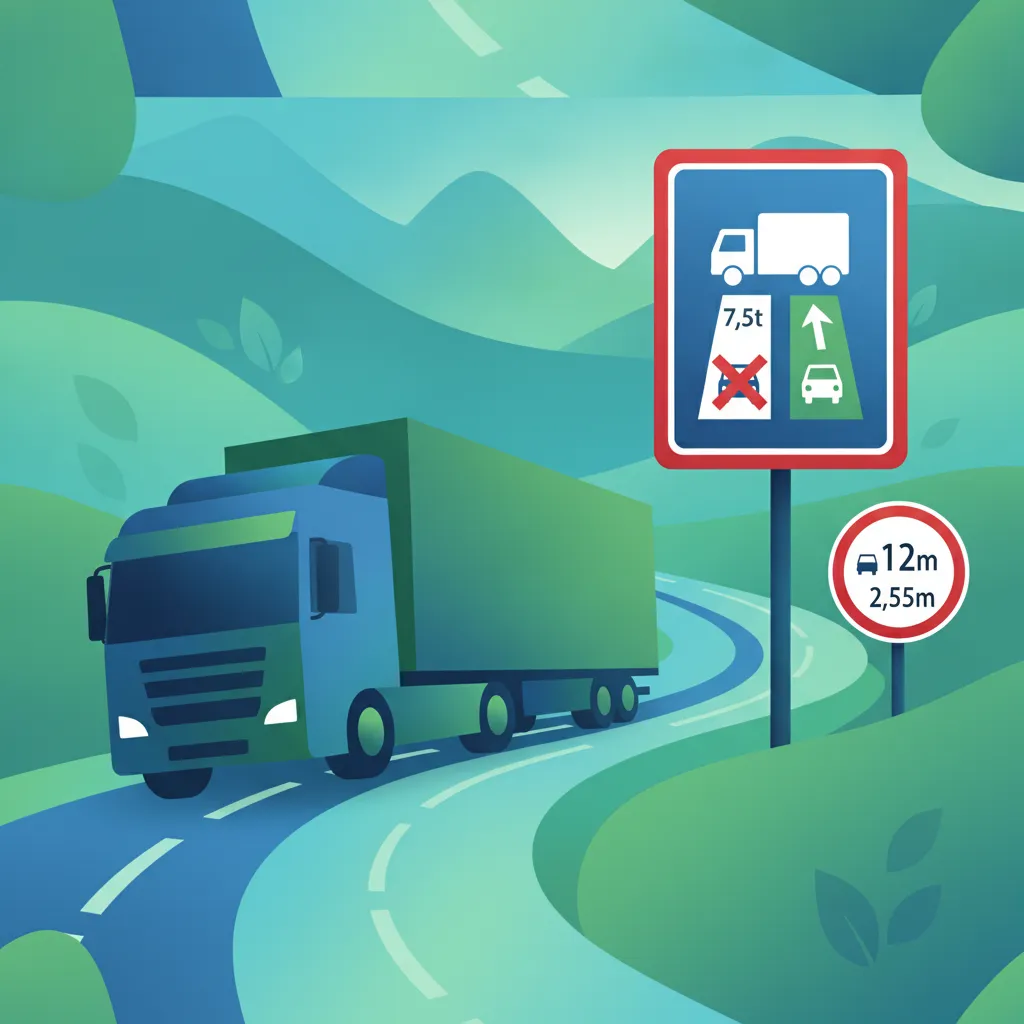
This lesson focuses on the specific Austrian road signs and supplemental plates that apply to heavy goods vehicles. It explains how to interpret signage indicating weight limits, height and width restrictions, lane usage rules, and other critical regulatory information. Correctly understanding these signs is essential for legal compliance and safe navigation on Austria's roads.
Find clear answers to common questions learners have about Handling Load Loss and Cargo Shift Emergencies. Learn how the lesson is structured, which driving theory objectives it supports, and how it fits into the overall learning path of units and curriculum progression in Austria. These explanations help you understand key concepts, lesson flow, and exam focused study goals.
Immediately reduce your speed gently and look for a safe place to pull over, such as a hard shoulder or parking area. Avoid harsh steering or sudden braking, as this could exacerbate the shift and lead to a rollover.
Yes. If your load creates a hazard, you must immediately secure the area using your hazard lights and warning triangle. You are legally required to notify the police or motorway maintenance services, especially if the load obstructs traffic.
The theory exam tests your understanding of preventative measures and immediate emergency reactions. Understanding these protocols is vital for correctly answering hazard perception and vehicle stability questions.
Refine your study plan by searching for specific Austrian driving theory practice sets. Pinpoint questions related to particular road rules, signs, or challenge levels, and begin practicing immediately to reinforce your knowledge and excel in your official exam with confidence. Get started with focused revision today.