
This lesson covers the critical mechanics of tongue load (Stützlast) and its direct impact on the stability of your heavy goods vehicle combination. By mastering these principles, you will ensure your cargo is distributed to meet safety standards, avoiding dangerous handling issues on Austrian roads.

Lesson content overview
Towing a trailer with a heavy goods vehicle (HGV) is a complex operation that demands precise understanding of vehicle dynamics and load management. One of the most critical aspects of safe and stable towing is the correct management of Stützlast, also known as tongue load. This is the downward force that the trailer's coupling exerts on the towing vehicle's rear axle. Achieving the optimal Stützlast is not merely a recommendation; it is a legal requirement and fundamental to preventing accidents, ensuring vehicle control, and preserving the lifespan of your equipment in the Austrian driving license theory course for heavy goods vehicles.
This lesson delves into the physics, safety considerations, and legal obligations surrounding Stützlast, equipping you with the knowledge to maintain stable handling, efficient braking, and compliance with Austrian regulations for Categories C, C1, C1E, and CE.
The stability and handling of any vehicle-trailer combination heavily depend on how the weight is distributed between the towing vehicle and the trailer. Stützlast is a key indicator of this distribution, particularly concerning the connection point.
Stützlast is the vertical force exerted by the trailer’s coupling onto the towing vehicle’s rear axle. It is typically measured in kilograms (kg) and represents a crucial component of the total load on the towing vehicle's rear.
Imagine the trailer coupling as a pivot point. The weight of the trailer itself, combined with its cargo, dictates how much downward force is applied to this pivot. If the trailer's center of gravity is too far back, the coupling might even lift, creating negative Stützlast. Conversely, if too much weight is concentrated at the front of the trailer, the Stützlast becomes excessively high. Both scenarios are dangerous.
Proper Stützlast is not just about avoiding mechanical stress; it directly impacts the dynamic behavior of the entire vehicle-trailer combination. A correctly managed Stützlast ensures:
Every towing vehicle and trailer combination has specific Stützlast requirements and limits. It is vital to distinguish between:
Always consult the vehicle manufacturer's manual and the trailer's specifications for the precise recommended and maximum Stützlast values. These values are crucial and legally binding.
For heavy goods vehicles, particularly in the CE category, legal guidelines often define maximum values. For example, rigid trucks might have a maximum Stützlast of up to 400 kg, while articulated vehicles using a fifth-wheel coupling operate under different principles, where the trailer's weight is directly borne by the tractor unit's fifth wheel plate.
Understanding the underlying physical principles is essential for effective Stützlast management. These principles govern how the vehicle-trailer system behaves as a single dynamic entity.
Load transfer describes the redistribution of weight between the axles of the towing vehicle and the trailer due to dynamic forces such as acceleration, deceleration, and cornering. In simple terms:
Proper Stützlast ensures that these load transfers remain within safe and permissible limits, preventing any single axle from being dangerously overloaded or underloaded, which could compromise traction or braking.
The combined centre of gravity (CoG) of the entire vehicle-trailer system is a virtual point representing the average position of the total weight. Its alignment is paramount for preventing trailer sway and maintaining overall vehicle stability.
The combined centre of gravity (CoG) is the theoretical point where the entire mass of the towing vehicle and its trailer system can be considered concentrated. Its position is critical for dynamic stability.
Incorrect Stützlast directly affects the combined CoG. If the Stützlast is too low (meaning the trailer's CoG is too far back), the combined CoG shifts rearward, making the trailer prone to violent sway and leading to instability. If the Stützlast is too high (trailer CoG too far forward), the combined CoG shifts too far forward, potentially overloading the towing vehicle's rear axle and reducing front axle grip, impairing steering and braking.
Every coupling mechanism, whether a rigid drawbar, a ball coupling, or a fifth-wheel, has a Kopplungsbelastungsgrenze (coupling load limit). This is the maximum permissible load the coupling assembly can safely bear without risk of mechanical failure.
The maximum permissible load that a specific coupling assembly (e.g., hitch, drawbar, fifth-wheel) can safely withstand as defined by the manufacturer and relevant regulations.
Exceeding this limit can lead to catastrophic failure of the coupling, detaching the trailer from the towing vehicle. This principle also applies to the rear axle of the towing vehicle, which also has defined maximum loads. Overloading can compromise structural integrity and overall safety.
The braking system on each axle of the towing vehicle and the trailer must be capable of handling its respective load proportionally. This ensures effective and balanced braking, preventing wheel lock-up or reduced braking efficiency across the combination.
Incorrect Stützlast can severely disrupt this balance. If the rear axle of the towing vehicle is overloaded due to excessive Stützlast, its brakes may fade faster or lock up prematurely. Conversely, if the Stützlast is too low, the trailer's brakes might be underutilized, putting excessive strain on the towing vehicle's braking system and extending stopping distances.
Beyond the core principles, several practical factors directly influence Stützlast and overall trailer stability. Professional drivers must be aware of these to ensure safe operation.
The Stützlast directly adds to the existing load on the towing vehicle's rear axle. The total weight on this axle includes the vehicle's own weight, any cargo it carries, and the Stützlast from the trailer. Overloading the rear axle can lead to several problems:
The type of coupling mechanism used between the towing vehicle and the trailer also dictates how Stützlast is managed:
Each coupling type has different design specifications and maximum allowable loads, which must be strictly observed.
Ladungsverteilung refers to the strategic placement of cargo within a vehicle or trailer to achieve optimal weight balance and ensure that axle loads and tongue load (Stützlast) remain within legal and safe limits.
The placement of cargo inside the trailer is the primary way to control Stützlast.
The goal is to position the trailer's own center of gravity slightly forward of its axle(s) to create the necessary downward force at the coupling point.
Place approximately 60% of the heaviest cargo load forward of the trailer's axle(s).
Distribute the remaining cargo evenly to the sides to prevent sideways instability.
Secure all cargo thoroughly to prevent shifting during transit.
Measure the Stützlast after loading and adjust if necessary, using a Stützlast gauge or a weighbridge.
Trailers above a certain weight threshold (e.g., >750 kg in Austria and many other European countries) are legally required to have their own braking systems. These systems are crucial for maintaining stability and sharing the braking load with the towing vehicle.
Functional trailer brakes help distribute braking forces, reducing the load transferred to the towing vehicle's rear axle during deceleration. This prevents premature wear on the towing vehicle's brakes and maintains better Stützlast stability during critical braking maneuvers.
Ladungssicherung encompasses all measures and methods used to prevent cargo from shifting, tipping, or falling during transport, thereby maintaining the intended load distribution and vehicle stability.
Even with perfect initial load distribution, if cargo is not properly secured (Ladungssicherung), it can shift during transit. A sudden shift of heavy items towards the rear of the trailer can drastically reduce Stützlast, causing immediate instability and severe trailer sway. Conversely, a forward shift during harsh braking can temporarily increase Stützlast beyond safe limits, overloading the towing vehicle's rear axle.
Proper securing using chains, straps, nets, or chocks, as covered in Lesson 5.2, is therefore integral to maintaining consistent Stützlast throughout the journey.
The Stützlast is not static; it changes dynamically with vehicle movement:
Drivers must anticipate these changes by accelerating and decelerating smoothly, avoiding sudden maneuvers that could dangerously alter Stützlast.
Ignoring the principles of Stützlast management carries significant risks, ranging from minor handling issues to catastrophic accidents.
When the Stützlast is too high:
When the Stützlast is too low, or even negative (the trailer lifts the towing vehicle's rear):
Beyond Stützlast, general improper load placement can lead to:
Adherence to specific legal provisions is mandatory for all heavy goods vehicle drivers operating in Austria. These rules are designed to ensure maximum safety on public roads.
Rule Statement: The Stützlast must not exceed the maximum value specified by the towing vehicle manufacturer, the trailer manufacturer, or the statutory limit set by Austrian traffic law, whichever is lowest.
Applicability: This rule applies to all heavy goods vehicles (Categories C, C1, C1E, CE) towing trailers.
Legal Status: Mandatory. Violations can lead to significant fines and potential revocation of driving privileges.
Rationale: This regulation prevents mechanical failure of the coupling, ensures stable handling, and protects the structural integrity of both vehicles.
Rule Statement: The total load on the rear axle of the towing vehicle, which includes the vehicle's own weight, its cargo, and the Stützlast, must not exceed the maximum permissible axle load for that specific axle or the proportion defined for the vehicle class (e.g., a common guideline is that the rear axle load should not exceed 55% of the total permissible vehicle mass for rigid trucks).
Applicability: This rule applies during normal operation, after loading, and critically, before departure.
Legal Status: Mandatory.
Rationale: Compliance ensures that the vehicle remains within its design limits for braking effectiveness, structural integrity, and steering responsiveness.
Rule Statement: Trailers exceeding a specific gross weight (typically 750 kg in Austria) must be equipped with a functional and properly adjusted independent braking system.
Applicability: All trailers used with heavy goods vehicles that meet the weight threshold.
Legal Status: Mandatory.
Rationale: Trailer braking systems are essential for distributing braking forces across the entire combination, preventing the towing vehicle's brakes from being overloaded, and maintaining stability during deceleration.
Rule Statement: Before each journey, all coupling components (e.g., hitch, drawbar, fifth wheel, safety chains/cables, electrical connections) must be thoroughly inspected for any signs of wear, damage, corrosion, or looseness. Any identified defects must be addressed immediately before driving.
Applicability: All towing operations with any type of trailer.
Legal Status: Mandatory (part of the daily safety check).
Rationale: This prevents catastrophic coupling failure during transit, which could lead to severe accidents.
Rule Statement: All cargo carried in the trailer must be secured in such a manner that it cannot shift, slide, fall, tip, or roll under normal driving conditions, including during emergency braking, sudden acceleration, or sharp cornering.
Applicability: All journeys involving cargo transport in trailers.
Legal Status: Mandatory.
Rationale: Proper cargo securing is fundamental to maintaining the initial, correctly established Stützlast and overall vehicle-trailer stability. Shifting cargo can dramatically alter the center of gravity and Stützlast, leading to dangerous situations.
Effective Stützlast management goes beyond theoretical knowledge; it requires adaptation to various real-world driving conditions.
In urban environments with frequent stops, starts, and turns, dynamic Stützlast changes are more common.
When making multiple deliveries, especially when unloading heavy items from the rear of the trailer, the Stützlast can significantly decrease over the course of the day. It is critical to re-check load distribution and Stützlast after each significant change in cargo to prevent instability for subsequent legs of the journey.
When operating heavy goods vehicles with trailers near vulnerable road users (pedestrians, cyclists, motorcyclists), maintaining optimal Stützlast is even more critical. It ensures smoother, more predictable braking and steering responses, reducing the need for abrupt maneuvers that could endanger others. A stable combination also minimizes the risk of trailer sway, which could unexpectedly impact nearby road users.
Effective trailer load and Stützlast management is a cornerstone of safe heavy goods vehicle operation in Austria. It requires a thorough understanding of physics, diligent application of legal regulations, and careful practical execution.
To ensure safety and compliance:
Mastering these aspects ensures not only the safety of the driver and vehicle but also that of other road users, contributing to a responsible and professional approach to heavy goods vehicle operation on Austria's roads.
Stützlast (tongue load) is the downward force the trailer coupling places on the towing vehicle's rear axle and is a legal requirement for safe HGV trailer operation in Austria. Optimal Stützlast keeps the combined centre of gravity correctly positioned, preventing trailer sway and ensuring effective steering and braking across all road conditions. Heavy cargo should be distributed with roughly 60% of the load positioned forward of the trailer's axle(s) to achieve the correct tongue load, and drivers must verify this with a gauge or weighbridge before each journey. Excessive Stützlast overloads the rear axle and impairs braking, while insufficient Stützlast makes the trailer prone to violent oscillating sway that can cause loss of control. Drivers must also account for dynamic load transfers during acceleration, braking, and cornering, and re-check Stützlast after any cargo changes during delivery runs.
A short set of high-value points that capture the most important learning from this lesson.
Stützlast (tongue load) is the vertical downward force the trailer coupling exerts on the towing vehicle's rear axle, and maintaining it within manufacturer and legal limits is essential for stability.
Too little Stützlast causes severe trailer sway (snaking) and loss of steering control, while too much Stützlast overloads the rear axle and impairs braking.
Load distribution inside the trailer directly controls Stützlast; place approximately 60% of the heaviest cargo forward of the trailer's axle(s) to achieve optimal tongue load.
Dynamic forces during acceleration, braking, and cornering continuously shift Stützlast, requiring smooth driving to prevent dangerous fluctuations.
Proper cargo securing (Ladungssicherung) is critical because shifting cargo during transit can suddenly alter Stützlast and trigger instability.
Explore all units and lessons included in this driving theory course.
The Stützlast must never exceed the lowest value specified by the towing vehicle manufacturer, trailer manufacturer, or Austrian traffic law.
After any change in cargo load during multi-stop deliveries, re-check and verify Stützlast before continuing the journey.
Rear axle load (including Stützlast) must not exceed the axle's maximum permissible weight or the 55% ratio guideline for rigid trucks.
Trailers over 750 kg must have their own independent braking system that works in sync with the towing vehicle's brakes.
In fifth-wheel couplings for semi-trailers, the trailer weight distributes directly onto the tractor unit's rear axles rather than as a distinct vertical tongue load.
Assuming Stützlast only needs to be checked once before departure, ignoring that cargo shifts or partial unloading during deliveries changes the load.
Loading heaviest cargo too far back in the trailer to maximise space, which reduces Stützlast and causes dangerous trailer sway at speed.
Overloading the towing vehicle's rear axle by exceeding maximum Stützlast, leading to reduced braking effectiveness and potential axle failure.
Failing to account for dynamic Stützlast changes during steep descents, where the trailer pushes more aggressively and increases rear axle load.
Not securing cargo properly, believing that initial correct load distribution is sufficient to maintain stability throughout the journey.
Lesson content overview
A short set of high-value points that capture the most important learning from this lesson.
Stützlast (tongue load) is the vertical downward force the trailer coupling exerts on the towing vehicle's rear axle, and maintaining it within manufacturer and legal limits is essential for stability.
Too little Stützlast causes severe trailer sway (snaking) and loss of steering control, while too much Stützlast overloads the rear axle and impairs braking.
Load distribution inside the trailer directly controls Stützlast; place approximately 60% of the heaviest cargo forward of the trailer's axle(s) to achieve optimal tongue load.
Dynamic forces during acceleration, braking, and cornering continuously shift Stützlast, requiring smooth driving to prevent dangerous fluctuations.
Proper cargo securing (Ladungssicherung) is critical because shifting cargo during transit can suddenly alter Stützlast and trigger instability.
Explore all units and lessons included in this driving theory course.
The Stützlast must never exceed the lowest value specified by the towing vehicle manufacturer, trailer manufacturer, or Austrian traffic law.
After any change in cargo load during multi-stop deliveries, re-check and verify Stützlast before continuing the journey.
Rear axle load (including Stützlast) must not exceed the axle's maximum permissible weight or the 55% ratio guideline for rigid trucks.
Trailers over 750 kg must have their own independent braking system that works in sync with the towing vehicle's brakes.
In fifth-wheel couplings for semi-trailers, the trailer weight distributes directly onto the tractor unit's rear axles rather than as a distinct vertical tongue load.
Assuming Stützlast only needs to be checked once before departure, ignoring that cargo shifts or partial unloading during deliveries changes the load.
Loading heaviest cargo too far back in the trailer to maximise space, which reduces Stützlast and causes dangerous trailer sway at speed.
Overloading the towing vehicle's rear axle by exceeding maximum Stützlast, leading to reduced braking effectiveness and potential axle failure.
Failing to account for dynamic Stützlast changes during steep descents, where the trailer pushes more aggressively and increases rear axle load.
Not securing cargo properly, believing that initial correct load distribution is sufficient to maintain stability throughout the journey.
Explore search topics learners often look for when studying Trailer Load and Stützlast (Tongue Load) Management. These topics reflect common questions about road rules, driving situations, safety guidance, and lesson level theory preparation for learners in Austria.
Browse additional driving theory lessons that cover connected traffic rules, road signs, and common driving situations related to this topic. Improve your understanding of how different rules interact across everyday traffic scenarios.
Understand the complex dynamics of trailer coupling, including load transfer, centre of gravity, and axle load ratios. Essential theory for safe heavy vehicle operation in Austria.

This lesson provides guidance on how to strategically distribute a load across both the main vehicle and its trailer. It covers planning the placement of cargo to maintain a stable centre of gravity for the entire combination. This holistic approach to loading is crucial for safe handling and adhering to individual vehicle and axle weight limits.

This lesson provides a step-by-step guide to the process of safely coupling a trailer to a tractor unit (Kuppeln). It covers aligning the vehicles, securing the mechanical lock (e.g., fifth wheel), and correctly connecting the air and electrical lines. A thorough safety check after coupling is mandatory to prevent trailer separation.
This lesson provides a foundational overview of towing a trailer with a Category B vehicle. It explains the basics of the coupling process, the importance of safety checks, and the principles of correct load distribution for stability. The content clarifies the legal framework, outlining the weight limits that apply to a standard B license and explaining when the B96 or BE permit extensions are required for heavier combinations.

This lesson explains the critical importance of properly securing any load, whether inside the vehicle, on a roof rack, or in a trailer. It covers the principles of correct weight distribution to maintain the vehicle's center of gravity and stability. Learners will understand the legal requirements and best practices for using tie-downs and other securing methods to prevent items from shifting or falling, which could create a serious hazard on the road.

This lesson focuses on the phenomenon of off-tracking, where the rear wheels of a trailer follow a path inside that of the tractor's wheels during a turn. It explains how to anticipate this effect and allow extra space when cornering to avoid running over curbs, signs, or other roadside objects. Managing off-tracking is a key skill for navigating intersections and roundabouts.

This lesson introduces the different classifications of trailers used in Austria, including drawbar trailers (Anhänger) and semi-trailers (Sattelanhänger/Auflieger). It explains their key structural differences, typical uses, and the types of coupling systems they employ. Understanding these types is the first step in learning to operate combination vehicles.

This lesson explains the critical relationship between load distribution, the vehicle's centre of gravity, and its stability. It details how incorrect placement of cargo can negatively affect handling, increase the risk of rollovers, and reduce braking efficiency. Achieving a balanced load is a key component of safe heavy vehicle operation.

Adding a trailer (Category DE/D1E) changes a vehicle's handling characteristics significantly. This lesson introduces key concepts, such as the increased turning circle, the effect of trailer swing, and the complexities of braking with the extra weight and length. It provides a theoretical foundation for understanding how to safely manage a combination vehicle, particularly during low-speed manoeuvres.
Incorrectly coupling a trailer can lead to catastrophic failure. This lesson provides a detailed, step-by-step guide for safely attaching and detaching a trailer. It covers aligning the vehicle, securing the coupling mechanism, connecting brake and electrical lines, and performing a series of crucial safety checks (like a tug test) before moving off.

This lesson explains the physics of an articulated vehicle and the factors that can lead to a jackknife, where the trailer swings out and folds against the tractor. It discusses common causes, such as improper braking on slippery surfaces or excessive speed in a turn. Learners will understand the crucial preventative measures to avoid this dangerous loss of control.
Master legal requirements for cargo securing (Ladungssicherung) and weight compliance, including Stützlast, for heavy trailers in Austria. Ensure safety and avoid penalties.
This lesson explains the critical importance of properly securing any load, whether inside the vehicle, on a roof rack, or in a trailer. It covers the principles of correct weight distribution to maintain the vehicle's center of gravity and stability. Learners will understand the legal requirements and best practices for using tie-downs and other securing methods to prevent items from shifting or falling, which could create a serious hazard on the road.

This lesson details the legal ramifications of operating an overloaded heavy vehicle in Austria, which include significant fines and penalty points. It also emphasizes the severe safety risks, such as compromised braking performance and increased mechanical stress on the vehicle. Understanding these consequences reinforces the importance of strict adherence to weight limits.

This lesson focuses on the legal restrictions concerning a heavy vehicle's dimensions, including maximum height, width, and length. It teaches drivers how to interpret road signs and supplemental plates that indicate these limits. This knowledge is crucial for route planning, especially when navigating under bridges, through tunnels, and on restricted roads.

This lesson consolidates the legal restrictions on the maximum dimensions and weight for different vehicle combinations in Austria. It covers how to read signs indicating these limits and the importance of compliance for route planning. Adhering to these regulations is essential for legal operation and avoiding fines.

This lesson covers the specific weight restrictions that apply to sensitive infrastructure like Alpine passes and bridges throughout Austria. It explains how to identify these limits through road signage and incorporate them into route planning. Adhering to these restrictions is vital for preventing structural damage and ensuring safety in challenging terrain.

This lesson outlines the significant legal responsibilities placed on heavy-vehicle drivers under Austrian law, emphasizing a strong duty of care and professional conduct. It covers the obligation to perform thorough pre-trip inspections, comply with all load and weight regulations, and uphold safety standards to protect all road users. Adherence to these principles is crucial for professional and safe operation.

This lesson details the general traffic rules applicable to heavy goods vehicles on Austrian roads, highlighting differences from passenger car regulations. It covers key topics such as right-of-way at intersections, specific rules for overtaking, maintaining proper lane discipline, and adhering to designated speed limits. Understanding these rules is critical for safe integration into mixed traffic.
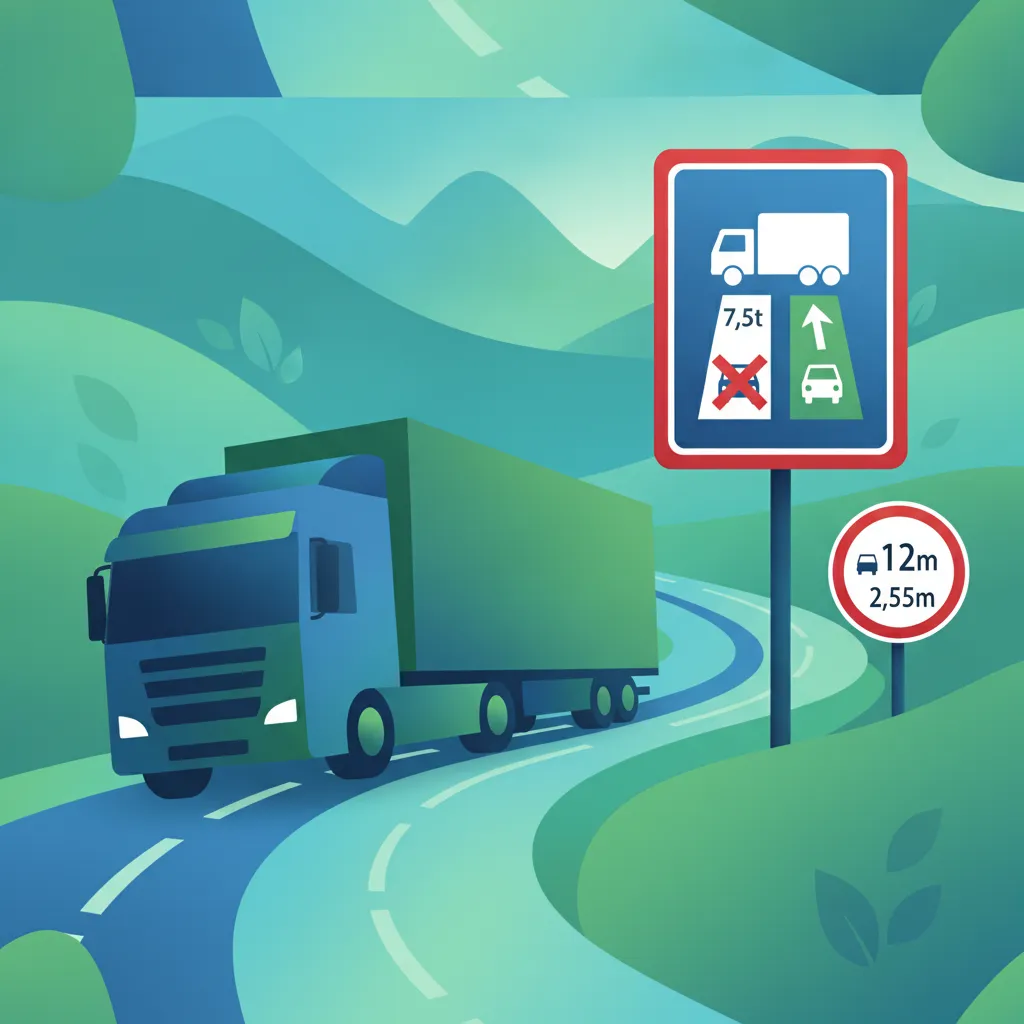
This lesson focuses on the specific Austrian road signs and supplemental plates that apply to heavy goods vehicles. It explains how to interpret signage indicating weight limits, height and width restrictions, lane usage rules, and other critical regulatory information. Correctly understanding these signs is essential for legal compliance and safe navigation on Austria's roads.

This lesson covers the various lighting and reflector systems required on heavy goods vehicles in Austria. It explains the function and legal requirements for headlights, taillights, brake lights, indicators, and reflective markings. Ensuring all lighting systems are operational is essential for visibility and communicating intentions to other road users.
This lesson provides a foundational overview of towing a trailer with a Category B vehicle. It explains the basics of the coupling process, the importance of safety checks, and the principles of correct load distribution for stability. The content clarifies the legal framework, outlining the weight limits that apply to a standard B license and explaining when the B96 or BE permit extensions are required for heavier combinations.
Find clear answers to common questions learners have about Trailer Load and Stützlast (Tongue Load) Management. Learn how the lesson is structured, which driving theory objectives it supports, and how it fits into the overall learning path of units and curriculum progression in Austria. These explanations help you understand key concepts, lesson flow, and exam focused study goals.
Stützlast is essential because it keeps the trailer coupled securely while maintaining proper tire contact on the towing vehicle. Too much load can lift the front steering wheels, while too little can lead to trailer snaking or instability at higher speeds.
If the Stützlast is too low, the trailer tends to lift the rear of the towing vehicle, causing poor steering control, reduced traction on the drive axle, and a higher risk of the trailer oscillating uncontrollably on the Autobahn.
The exam often uses image-based or scenario-based questions where you must identify the correct load distribution in a diagram. You may be asked to predict how a shift in cargo affects the coupling force and the overall stability of the combination.
The permitted Stützlast for your specific vehicle and trailer combination is defined by the technical documentation of both the towing vehicle and the trailer. You must always adhere to the lower of the two limits to ensure legal compliance.
Refine your study plan by searching for specific Austrian driving theory practice sets. Pinpoint questions related to particular road rules, signs, or challenge levels, and begin practicing immediately to reinforce your knowledge and excel in your official exam with confidence. Get started with focused revision today.