Ensuring the safety of minors in a vehicle is a fundamental responsibility of every driver under Danish law. This guide clarifies the specific requirements for using approved child seats for children under 135 cm, the importance of weight and height-based approval standards, and the critical rules regarding airbag safety. Learners will gain the knowledge necessary to answer theory exam questions on passenger safety and understand the legal implications of non-compliance.
Article content overview
Ensuring the safety of minor passengers is one of the most critical responsibilities a driver carries under the Danish Færdselsloven. In the context of the Danish driving license theory exam, understanding how to secure children correctly is not just a matter of road safety, but a fundamental legal obligation. Failure to comply with these regulations can lead to significant penalties, including fines and points on your license, making it essential for every learner to master these requirements before stepping into the driver's seat.
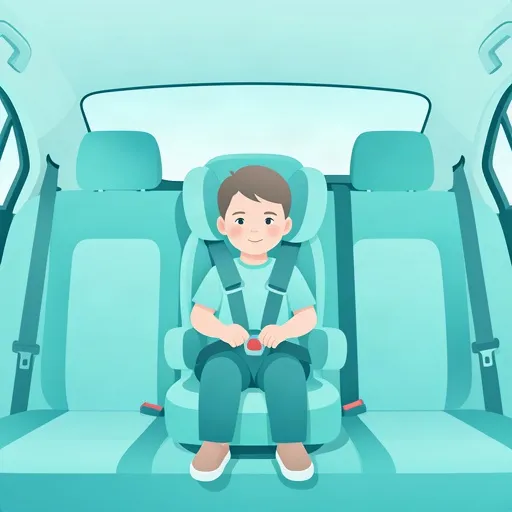
According to §80 of the Danish Færdselsloven, all children with a physical height of less than 135 cm must be secured using approved child restraint systems (such as autostols or child seats) while traveling in a motor vehicle. This requirement applies to almost all passenger vehicles, with very limited exceptions for buses and specific cases involving older vehicles lacking seatbelts. The restraint system must be appropriate for the child's height and weight, ensuring that the car's safety equipment can function effectively in the event of a sudden stop or collision.
It is the driver’s duty to ensure that all passengers under the age of 15 are properly restrained. If you are stopped by the police and a child is not secured in an approved seat, or if the seat is used incorrectly, the driver faces a fine, a penalty point (klip), and a mandatory contribution to the Offerfonden. These consequences highlight the high priority the Danish authorities place on the physical protection of minors.
When selecting a child seat in Denmark, you must look for certification marks that confirm the equipment meets current safety standards. Specifically, seats must be approved according to UN Regulation 44-04 (or the older 44-03) or the newer UN Regulation 129, commonly known as i-Size. While seats approved under the older ECE 44 standards are still legal to use, they are being phased out of retail availability in favor of the i-Size standard, which prioritizes height-based classification over weight.
A modern safety standard for child restraint systems that categorizes seats based on the child's height rather than just weight, and mandates extended rear-facing travel to improve neck and head protection.
The safest position for a child in a car is almost always the rear seat. If you choose to place a child seat in the front passenger seat, you must adhere to strict safety conventions. It is strictly prohibited to place a child in a rear-facing seat in the front if the passenger airbag is active. The force of an airbag deployment is designed for adults and can be fatal to an infant or young child in a rear-facing seat. Always verify that the airbag is deactivated before installing a rear-facing seat in the front, and ideally, keep children in the back to avoid these risks entirely.
Never install a rear-facing child seat on a front passenger seat equipped with an active airbag. The force of the airbag deployment is catastrophic for infants and can cause severe injuries or death.
| Child Height / Age | Recommended System | Positioning |
|---|---|---|
| Under 135 cm | Approved Child Seat | Rear seat is recommended |
| Over 135 cm | Standard seat belt | Front or rear seat |
| Infants (0-15 months) | Rear-facing seat | Always rear-facing |
While the legal minimum requirement is to use a restraint system until the child reaches 135 cm, the Rådet for Sikker Trafik (Danish Road Safety Council) strongly advocates for children to remain in rear-facing seats until they are at least four years old. Rear-facing seats provide superior support for the child's head, neck, and spine in the event of a frontal collision. As a driver, following these expert recommendations is highly encouraged to maximize passenger safety, even if the law allows for forward-facing options once the child is older.
A common trap in the theory exam involves scenarios regarding rental cars. Drivers often mistakenly assume that rental agencies are required to provide child seats. However, in Denmark, while rental companies are regulated, they are not obligated to provide age-appropriate child restraint systems. It remains the responsibility of the parent or the driver to provide and install a compliant, approved seat. If you are traveling in a rental vehicle, you must ensure that you have your own seat that meets the necessary UN standards before starting your journey.
Article content overview
Explore related topics, search based questions, and concepts that learners often look up when studying Danish Child Restraint Laws. These themes reflect real search intent and help you understand how this topic connects to wider driving theory knowledge in Denmark.
Find clear and practical answers to common questions learners often have about Danish Child Restraint Laws. This section helps explain difficult points, remove confusion, and reinforce the key driving theory concepts that matter for learners in Denmark.
According to Færdselsloven, children under 135 cm must be secured in an approved child restraint system appropriate for their height or weight.
Yes, car seats approved under ECE R44-03 or R44-04 remain legal to use, even though they are no longer sold by retailers as of September 2024; newer seats must meet R129 i-Size standards.
You may only place a rear-facing child seat in the front seat if the passenger airbag has been completely deactivated; otherwise, it is prohibited.
No, while rental agencies must inform you of the rules, the driver is legally responsible for providing and correctly installing an approved seat for the child.
Failure to properly secure a child under 15 years old can result in a fine, a penalty fee to the Victim Fund, and a conditional or unconditional driving license strike (klip).
Continue your learning journey by searching for additional articles or browsing our comprehensive topic categories. Deepen your knowledge of Danish road law, vehicle mechanics, and hazard perception to ensure complete preparation for your official theory exam.