Driving at night in Denmark requires a deep understanding of visibility rules and situational awareness to navigate potential hazards on rural roads safely. This guide explains how to properly manage your headlights and adjust your driving speed in accordance with the Færdselsloven to ensure you are fully prepared for the theory test and real-world conditions.
Article content overview
Driving in Denmark after dark presents a distinct set of challenges that every learner must master to pass the theory exam and ensure safety on the road. While the foundational rules of Færdselsloven remain constant regardless of the time of day, the transition from daylight to darkness requires a shift in how you perceive hazards, manage your vehicle’s lighting, and adapt your speed to visibility conditions.
One of the most critical concepts for the Danish theory test is the requirement found in §3 of the Færdselsloven. This section mandates that a driver must always adapt their speed to the visibility conditions and the nature of the road. At night, your visible range is drastically limited compared to daylight hours.
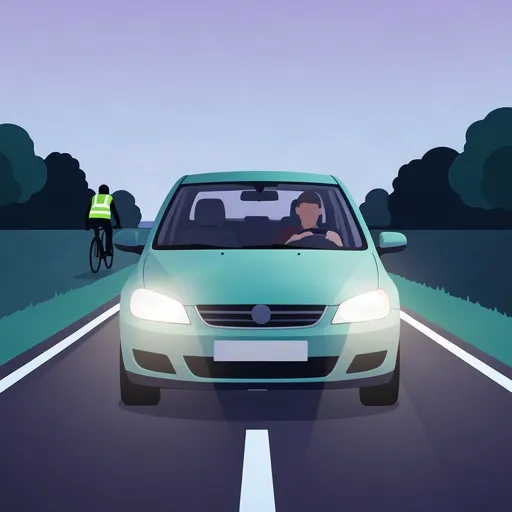
If you are driving on an unlit rural road using only your dipped headlights (nærlys), your ability to spot obstacles—such as unlit cyclists, pedestrians without reflectors, or animals—is significantly reduced. The exam often tests whether you understand that your speed must be low enough to allow you to stop your vehicle within the distance that is currently illuminated by your lights. If you cannot see a potential hazard in time to stop, you are driving too fast for the conditions.
A driver must always adapt their driving speed to the visibility, weather, road conditions, traffic density, and the vehicle's state to ensure they can stop in front of any foreseeable obstacle.
In Denmark, all motor vehicles must have their dipped headlights (nærlys) turned on at all times, even during the day. However, when night falls, the rules regarding the use of full beam (fjernlys) become central to both safety and your performance in the theory test.
On unlit roads, you are expected to use your full beam to maximize your forward visibility, typically extending your view from approximately 100 meters with dipped beams to 150–200 meters with full beams. However, you must immediately switch to dipped headlights when approaching oncoming traffic or when driving closely behind another vehicle. The rule of thumb for the exam is to dip your lights at a distance where you would no longer dazzle the other driver, which is generally considered to be around 200 meters.
Rural roads in Denmark are often unlit, and the presence of vulnerable road users who are not properly equipped with reflectors is a recurring topic in the theory curriculum. Statistically, accidents involving pedestrians and cyclists are higher at night.
Learners should be aware of the "Se og bliv set" (See and be seen) initiative. While this is a safety campaign rather than a formal traffic law, it highlights the responsibility drivers have to scan the road shoulders for movement. If you see a cyclist or pedestrian, you should reduce your speed and increase your lateral distance, as these road users are often unaware of how poorly visible they are to approaching vehicles.
Never assume that because you cannot see a pedestrian or cyclist, the road is clear. In the theory test, always anticipate "hidden" hazards on rural roads at night, especially near intersections or bus stops.
| Condition | Lighting Requirement | Driver Responsibility |
|---|---|---|
| Daytime Driving | Dipped Headlights (or DRL) | Always maintain visibility |
| Unlit Rural Road | Full Beam (Fjernlys) | Switch to dipped when approaching others |
| Following Traffic | Dipped Headlights (Nærlys) | Avoid dazzling the driver ahead |
| Poor Visibility | Dipped Headlights | Adapt speed to stop within visible range |
Article content overview
Explore related topics, search based questions, and concepts that learners often look up when studying Night Driving Rules in Denmark. These themes reflect real search intent and help you understand how this topic connects to wider driving theory knowledge in Denmark.
Find clear and practical answers to common questions learners often have about Night Driving Rules in Denmark. This section helps explain difficult points, remove confusion, and reinforce the key driving theory concepts that matter for learners in Denmark.
According to the Færdselsloven, dipped headlights (nærlys) are mandatory at all times. On unlit rural roads, you should use full beam (fjernlys) to increase your visibility range, switching back to dipped headlights when approaching oncoming traffic or following another vehicle closely.
Under §3 of the Færdselsloven, you must adapt your speed so that your stopping distance is always within the range of your headlight visibility. At night, this often requires reducing your speed, as your ability to see unlit hazards like cyclists or pedestrians is significantly reduced.
Se og bliv set ('See and be seen') is a Danish safety campaign that encourages drivers to be aware of vulnerable road users and promotes the use of reflective gear by pedestrians and cyclists to prevent night-time accidents.
Continue your learning journey by searching for additional articles or browsing our comprehensive topic categories. Deepen your knowledge of Danish road law, vehicle mechanics, and hazard perception to ensure complete preparation for your official theory exam.