Learning how traffic violations affect your legal status is a critical part of the Danish theory syllabus. This guide breaks down the thresholds for penalty points, the financial consequences of fines, and the specific rules that apply to probationary drivers to help you navigate your responsibilities on the road with confidence.
Article content overview
In Denmark, maintaining a valid driving license requires more than just mastering vehicle control; it demands a thorough understanding of the legal consequences associated with traffic violations. For learner drivers and those preparing for their theory exam, grasping how the Danish "klip" (penalty point) system works is essential. Traffic legislation in Denmark is designed to prioritize road safety, and the regulations surrounding speeding and rule breaches are strictly enforced to protect all road users, including cyclists and pedestrians.
The "klip" system, or penalty point system, serves as a mechanism to identify and penalize drivers who commit repeated or serious traffic offenses. If you commit a violation covered by the system, you receive a "klip" in your license, which remains active for three years from the date of the offense. While a single point might not immediately result in the loss of your license, accumulating three points within a three-year period leads to a conditional revocation of your driving rights.
A status where your driving license is suspended, and you are required to pass both a new theory test and a practical driving test within six months to regain your driving privileges.
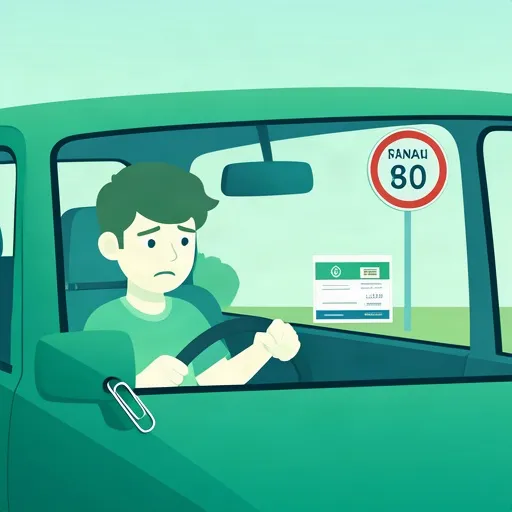
When you receive a penalty point, you also receive a fine. It is crucial for theory students to recognize that these points are applied for behaviors that endanger others, such as driving significantly over the speed limit or disregarding traffic signals.
The Danish Færdselslov (Road Traffic Act) imposes significantly stricter requirements on those who have held their first driving license for less than three years. This probationary period is designed to ensure that new drivers cultivate safe habits from the start. For these "first-time license holders," the threshold for severe consequences is lower; receiving two penalty points within the first three years leads to a kørselsforbud, or a driving ban.
If you are a new driver, a driving ban (kørselsforbud) means you must undergo a special traffic education course and pass both a new theory test and a practical test before you are allowed to drive again.
Penalty points are not issued for every minor infraction, but they are reserved for specific, high-risk behaviors. Being aware of these triggers is a fundamental part of your theory education. Common causes for a "klip" include:
Speeding fines in Denmark are calculated based on the degree to which you have exceeded the legal speed limit. Since 2022, fines have increased by approximately 20% to further deter reckless behavior. When you commit a speeding violation, you are liable for a base fine, which can increase significantly based on your speed, road conditions, and whether you are driving in a designated roadwork zone, where fines are doubled.
Furthermore, every speeding fine includes a mandatory contribution to the Offerfonden, a state fund that supports victims of crime and traffic accidents. It is vital to understand that high-speed violations, often categorized as vanvidskørsel (reckless driving), can lead to the immediate confiscation and sale of your vehicle by the police, regardless of whether you own it or are driving a borrowed car.
In the Danish driving theory exam, you will encounter scenarios that test your judgment regarding speed and traffic safety. The exam authority expects you to recognize that legal speed limits are maximums, not targets, and that situational awareness must always take precedence. By understanding the legal framework behind "klip" and speeding fines, you demonstrate the maturity required to hold a Danish driving license.
Remember that being a safe driver is a continuous process of education. As you prepare for your test, focus on the rationale behind these laws: they exist to ensure that everyone, from cyclists in Copenhagen to commuters on the motorways, can travel safely throughout Denmark.
The Danish penalty point system ('klip') tracks traffic violations for three years, with three points leading to conditional license revocation for experienced drivers. New drivers face stricter rules during their three-year probationary period where only two points trigger a mandatory driving ban. Speeding fines are calculated based on how much you exceed the limit, increased by approximately 20% since 2022, and are doubled in roadwork zones. Serious violations like running red lights, speeding over 30% of the limit, or reckless driving (vanvidskørsel) can result in additional consequences including vehicle confiscation.
A short set of high-value points that capture the most important ideas from this article.
The 'klip' system issues penalty points for serious traffic violations that remain active for three years
Accumulating three penalty points within three years results in conditional license revocation requiring both new theory and practical tests
New drivers face stricter consequences; receiving two points during the three-year probationary period triggers a mandatory driving ban
Speeding fines increase significantly based on how much you exceed the limit and are doubled in roadwork zones
Reckless driving (vanvidskørsel) can result in immediate vehicle confiscation regardless of ownership
Penalty points are issued for exceeding the speed limit by more than 30% or running red lights
The probationary period for new drivers is three years, during which two points lead to kørselsforbud
Every speeding fine includes a mandatory Offerfonden contribution to support traffic accident victims
Conditional revocation (betinget frakendelse) requires passing both theory and practical tests within six months
Vanvidskørsel can lead to permanent license revocation and vehicle confiscation
Assuming minor speeding infractions always result in penalty points when they typically result only in fines
Confusing the three-point threshold for experienced drivers with the two-point threshold that applies to new drivers
Believing that paying a fine resolves the penalty point situation; points remain active for three years
Overlooking that fines are doubled in designated roadwork zones, making violations significantly more expensive
Article content overview
A short set of high-value points that capture the most important ideas from this article.
The 'klip' system issues penalty points for serious traffic violations that remain active for three years
Accumulating three penalty points within three years results in conditional license revocation requiring both new theory and practical tests
New drivers face stricter consequences; receiving two points during the three-year probationary period triggers a mandatory driving ban
Speeding fines increase significantly based on how much you exceed the limit and are doubled in roadwork zones
Reckless driving (vanvidskørsel) can result in immediate vehicle confiscation regardless of ownership
Penalty points are issued for exceeding the speed limit by more than 30% or running red lights
The probationary period for new drivers is three years, during which two points lead to kørselsforbud
Every speeding fine includes a mandatory Offerfonden contribution to support traffic accident victims
Conditional revocation (betinget frakendelse) requires passing both theory and practical tests within six months
Vanvidskørsel can lead to permanent license revocation and vehicle confiscation
Assuming minor speeding infractions always result in penalty points when they typically result only in fines
Confusing the three-point threshold for experienced drivers with the two-point threshold that applies to new drivers
Believing that paying a fine resolves the penalty point situation; points remain active for three years
Overlooking that fines are doubled in designated roadwork zones, making violations significantly more expensive
Explore related topics, search based questions, and concepts that learners often look up when studying Speeding Fines and Penalty Points. These themes reflect real search intent and help you understand how this topic connects to wider driving theory knowledge in Denmark.
Find clear and practical answers to common questions learners often have about Speeding Fines and Penalty Points. This section helps explain difficult points, remove confusion, and reinforce the key driving theory concepts that matter for learners in Denmark.
A 'klip' is a penalty point added to your driving record for specific serious traffic violations, such as speeding over 30% or running a red light. Receiving three points within a three-year period leads to a conditional license revocation.
For first-time license holders within the first three years, the rules are stricter. A 'kørselsforbud' (driving ban) can be triggered after receiving just two penalty points instead of three.
If your license is revoked conditionally, you must pass a new theory test and a practical driving test within six months to keep your right to drive. Failure to do so results in losing your license.
Not always. Penalty points are generally issued for significant violations such as exceeding the speed limit by more than 30%. Minor speeding offenses usually result in a fine but not necessarily a point.
Continue your learning journey by searching for additional articles or browsing our comprehensive topic categories. Deepen your knowledge of Danish road law, vehicle mechanics, and hazard perception to ensure complete preparation for your official theory exam.