Understanding how to safely interact with slow-moving agricultural vehicles is a vital skill for every driver in Denmark, especially when navigating rural landeveje. This guide breaks down the legal speed limits for standard and type-approved tractors, the importance of visibility, and the liability of farmers regarding road hazards like mud. Learning these requirements will prepare you for common hazard perception scenarios found in the Danish theory test.
Article content overview
Driving on rural Danish roads, often referred to as landeveje, presents a unique set of challenges compared to urban environments. One of the most significant hazards for new drivers is encountering heavy, slow-moving agricultural machinery. Mastering the rules for interacting with these vehicles is not only essential for your practical safety but is also a frequent subject of the Danish theory test, where hazard perception and the ability to adapt to varying traffic speeds are strictly examined.
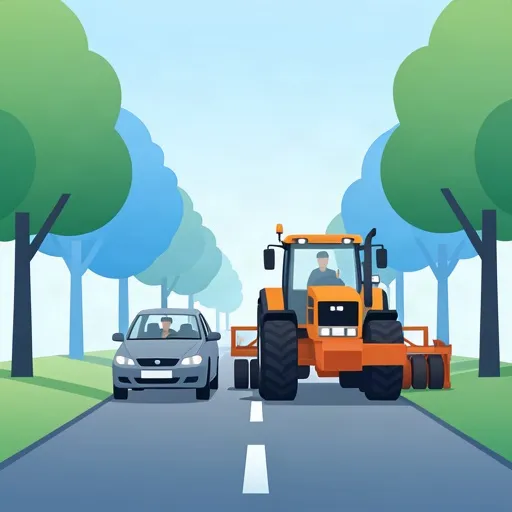
In Denmark, agricultural vehicles such as tractors and harvesters are governed by specific speed restrictions to ensure they do not become an unexpected obstruction on higher-speed roads. While the general speed limit for a passenger car on an open road is 80 km/h, the maximum permitted speed for a standard tractor is 30 km/h.
However, you may occasionally encounter newer, type-approved tractors that are permitted to travel at up to 40 km/h. Because these vehicles are significantly slower than the flow of traffic, they often create "accordion effects" where faster traffic bunches up behind them. Always be prepared to reduce your speed immediately when you see a slow-moving vehicle sign or a large tractor ahead.
| Vehicle Type | Max Speed Limit (km/h) |
|---|---|
| Standard Tractor | 30 km/h |
| Type-Approved Tractor | 40 km/h |
| Tractor towing machinery | 30 km/h |
| Vehicle being towed | 30 km/h |
Never assume a tractor is moving at the standard 30 km/h. Always observe the vehicle's speed relative to your own before deciding to overtake, and remember that failing to anticipate a slow-moving vehicle on a hill or a bend is a common cause of accidents in rural Denmark.
Agricultural activity often leaves the road surface in a dangerous state. It is a legal requirement in Denmark that operators of agricultural machinery must ensure that soil, mud, or crop debris deposited on the road is removed. If a farmer or operator fails to clean the road, they may be liable for accidents caused by the resulting lack of traction.
From a theory test perspective, you must treat mud on the road with the same caution you would apply to ice. If you see signs of agricultural work, assume the road might be slippery, especially in damp conditions. Furthermore, wide loads are common during harvest seasons. If you encounter a machine that is wider than the standard road lane, it may be accompanied by an escort vehicle; you should give them as much space as possible and refrain from overtaking until you are absolutely certain it is safe and legal to do so.
Visibility is a critical factor when driving near agricultural machinery during hours of darkness or poor visibility. By law, any agricultural machine operating on a public road must be equipped with functional front and rear lights. A red light and reflectors must be visible from the rear to warn approaching drivers.
If you find yourself behind an unlit or poorly lit agricultural vehicle at night, maintain a significantly larger following distance than you would for a car. The irregular shape of farm implements often makes it difficult to judge exactly how close you are, and their lack of modern braking lights means they can stop or turn unexpectedly.
Public roads located outside of 'tættere bebygget område' (urban areas), where the general speed limit is 80 km/h, but where hazards like agricultural machinery, wildlife, and narrow lanes are more prevalent.
The Danish theory test often presents scenarios where you must decide whether to overtake a tractor. The key to answering these questions correctly is to look for "hidden" hazards: intersections, hilltops, pedestrian crossings, or oncoming traffic. If you cannot see the road ahead clearly—or if the maneuver would require you to exceed a safe speed—you must remain behind the tractor.
Remember, the goal of the theory test is to prove that you prioritize safety over speed. Always ask yourself: "Can I complete the entire overtaking maneuver without endangering myself or others?" If the answer is no, stay behind and wait for a clear, straight section of the road.
Article content overview
Explore related topics, search based questions, and concepts that learners often look up when studying Agricultural Machinery Road Rules. These themes reflect real search intent and help you understand how this topic connects to wider driving theory knowledge in Denmark.
Find clear and practical answers to common questions learners often have about Agricultural Machinery Road Rules. This section helps explain difficult points, remove confusion, and reinforce the key driving theory concepts that matter for learners in Denmark.
Generally, the maximum speed for a tractor is 30 km/h, though newer, type-approved tractors with enhanced braking and suspension systems may be permitted to travel at up to 40 km/h.
Yes, under Danish traffic law, the operator of the agricultural vehicle is responsible for ensuring that mud, soil, or crop debris is removed from the road, as it poses a significant slipping hazard to other road users.
When used on public roads during darkness or poor visibility, agricultural machinery must be equipped with functioning lights, including at least one red light at the rear and appropriate reflectors.
Agricultural machinery wider than 3 meters typically requires an escort vehicle to safely navigate public roads, and in cases of extreme dimensions, specific police approval may be mandatory.
Continue your learning journey by searching for additional articles or browsing our comprehensive topic categories. Deepen your knowledge of Danish road law, vehicle mechanics, and hazard perception to ensure complete preparation for your official theory exam.