
Braking distance, known in Danish as 'bremselængde', is the distance your vehicle travels from the instant you activate the brakes until it comes to a complete halt. It's a critical component of overall stopping distance and is heavily influenced by factors such as your speed, the road surface, and your vehicle's condition. Understanding these relationships is essential for passing your Danish driving theory test and ensuring safety in real-world traffic.
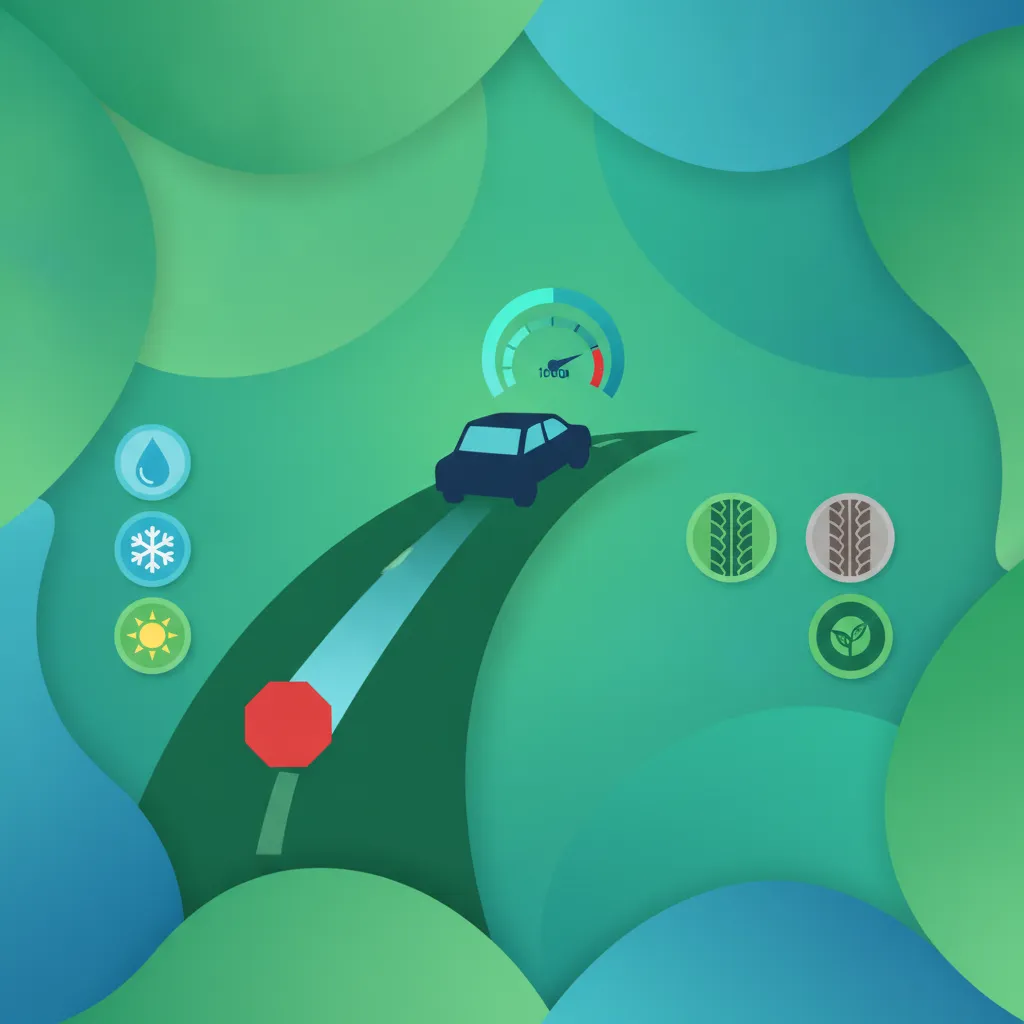
Theory topic content overview
Read the full theory topic guide for Braking Distance with structured, easy-to-scan content built for learners in Denmark. This detailed section explains the exact rule, meaning, traffic context, comparison points, and exam logic behind this Danish driving theory topic so you can study faster, understand the concept more clearly, and avoid common interpretation mistakes on the theory test.
Braking distance, known in Danish as bremselængde, is the physical distance your vehicle travels from the precise moment you begin to apply the brakes until it comes to a complete standstill. It is a critical component of standselseslængden (total stopping distance) and represents the segment of your journey where your vehicle is actively decelerating due to the braking system.
This concept is fundamental in Danish driving theory because it directly relates to your ability to stop safely and avoid collisions, especially when reacting to hazards on Denmark's diverse roads, from busy city streets to exposed landeveje (country roads).
For anyone preparing for the Danish driving licence theory test or driving on Danish roads, mastering bremselængde is non-negotiable. Its significance stems from several key areas:
bremselængde. Questions often focus on the relationship between these elements rather than specific numbers.sikkerhedsafstand).bremselængde empowers you to maintain your vehicle properly and drive defensively.Braking distance is not a fixed value; it's a dynamic measurement influenced by a complex interplay of physics and environmental factors. Here's a breakdown:
The most significant factor affecting bremselængde is your vehicle's speed. The kinetic energy of a moving vehicle increases with the square of its speed. This means:
bremselængde between even small speed increases can be dramatic. As taught in the Danish Undervisningsplan kategori B, if one car brakes at 50 km/h and another at 60 km/h simultaneously, the car at 60 km/h will still be travelling at around 44 km/h at the point where the car at 50 km/h has already stopped. This highlights the severe consequences of even slightly excessive speed.Vejgreb (road grip or traction) is the friction between your tires and the road surface, and it directly dictates how effectively your brakes can slow down your vehicle. Poor vejgreb drastically extends bremselængde.
Factors that reduce vejgreb include:
vejgreb, making braking distances extremely long and requiring much slower speeds.akvaplaning): When tires lose contact with the road surface due to a layer of water, vejgreb is lost entirely, rendering braking ineffective. This can happen even at relatively low speeds with new tires in heavy rain or deep puddles.dækmønster) significantly reduces vejgreb, especially in wet conditions.dæktryk) reduces contact between the tire and the road, impairing vejgreb and handling.bremselængde.bremselængde.vejens hældning): Braking downhill will generally require a longer distance than braking uphill due to gravity.kraftig blæst): Strong headwinds can slightly reduce braking distance, while tailwinds can slightly increase it, especially for larger vehicles.This is a common point of confusion for Danish driving theory learners.
bremselængde): The distance travelled after you apply the brakes until the vehicle stops.reaktionstid): The distance travelled from the moment you perceive a hazard until you actually start to apply the brakes. This depends on driver alertness, speed, and reaction time.standselseslængde): The total distance required to stop your vehicle. It is the sum of Reaction Distance + Braking Distance.In the Danish theory test, ensure you understand that standselseslængden always includes reaktionstid, which is often overlooked in simple calculations but is crucial for real-world safety.
Consider how bremselængde plays out in typical Danish driving situations:
rundkørsel (roundabout) on a rainy day: The wet road reduces vejgreb, meaning your bremselængde will be significantly longer than in dry conditions. You must reduce your speed earlier and more gradually to safely enter the roundabout.landevej (country road) at 80 km/h: If an unexpected hazard (e.g., a deer, a sudden stop in traffic) appears, your bremselængde will be substantial. At 80 km/h, even with good brakes, you will cover many metres before stopping. If the road is wet, this distance increases even further.katastrofebremsning) on ice: Even with modern ABS brakes, bremselængde on ice is exceptionally long. You must press the brake pedal fully and maintain steering control. If your car lacks ABS, you'd need to pump the brakes gently to avoid skidding (blokerede hjul) and losing steering.bremselængde will be longer, requiring you to anticipate stops well in advance and potentially downshift to use engine braking.Learners frequently make these errors regarding bremselængde:
bremselængde. Many assume a linear increase.bremselængde will be the same as on a dry, ideal road. This is especially dangerous given Denmark's varied weather.Bremselængde and Standselseslængde: Forgetting that total stopping distance includes reaction time can lead to overconfidence in stopping capabilities.bremselængde.Sikkerhedsafstand (Safe Following Distance): Failing to maintain an adequate sikkerhedsafstand based on the increased bremselængde required at higher speeds or in poor weather.To drive safely and pass your Danish driving theory test, always remember:
bremselængde will be.vejgreb conditions. Assume reduced vejgreb in rain, fog, ice, or snow.sikkerhedsafstand to allow for your reaktionstid and bremselængde.By internalizing these principles, you'll be well-prepared for any traffic situation and demonstrate a strong understanding of bremselængde in the Danish driving theory exam.
Braking distance is the distance a vehicle travels from brake application to a complete stop, and it is primarily determined by speed, road grip, and vehicle condition. The relationship between speed and braking distance is quadratic, so even modest speed increases dramatically extend stopping requirements. Understanding how braking distance differs from total stopping distance—where reaction distance must be added—is essential for both safe driving and theory test success. Danish drivers must account for factors like wet roads, ice, tire condition, and vehicle load when judging how much space they need to stop safely.
A short set of high-value points that capture the most important ideas from this theory explanation.
Braking distance increases with the square of speed, meaning doubling speed roughly quadruples the distance needed to stop
Road grip (vejgreb) is the critical factor determining how effectively your brakes can slow the vehicle
Stopping distance is the sum of reaction distance plus braking distance, not just braking distance alone
Wet roads, ice, snow, and aquaplaning dramatically reduce road grip and extend braking distance
Vehicle condition, including tire tread depth, tire pressure, and brake efficiency, directly affects braking performance
Speed is the dominant factor in braking distance—small speed increases cause disproportionately large braking distance increases
Poor road conditions (rain, ice, loose surfaces) reduce road grip and can double or triple braking distance compared to dry conditions
Braking distance is only the distance after brakes are applied; reaction distance must be added for total stopping distance
Worn tires, incorrect tire pressure, or inappropriate seasonal tires significantly impair braking capability
Downhill gradients and heavy vehicle loads increase braking distance due to additional forces
Assuming braking distance doubles linearly with speed rather than understanding the quadratic relationship
Confusing braking distance with total stopping distance and forgetting that reaction time is a separate component
Not adjusting speed sufficiently for wet, icy, or otherwise compromised road surfaces
Assuming brakes and tires are always in optimal condition without checking them regularly
Failing to maintain adequate safe following distance (sikkerhedsafstand) based on current speed and conditions
Start with a short, direct summary of Braking Distance before reading the full explanation below.
Braking distance is the path covered by a vehicle from the moment the brakes are engaged until it stops. It increases significantly with speed, often quadrupling when speed doubles, and is also heavily affected by road grip, tire quality, and braking system efficiency. In Danish driving theory, it's crucial to understand these factors to predict stopping needs and drive safely.
Review the most important terms, rule signals, and traffic concepts linked to Braking Distance.
Explore related theory topic pages connected to Braking Distance and continue with the next useful rule explanation.
See the common search queries learners use when trying to understand Braking Distance in Denmark.

Dive into detailed explanations of Danish traffic legislation, road signs, and driving conventions. Solidify your understanding of key theory topics and prepare confidently for all sections of your official Danish driving license theory exam.
Explore Driving Theory TopicsTheory topic content overview
A short set of high-value points that capture the most important ideas from this theory explanation.
Braking distance increases with the square of speed, meaning doubling speed roughly quadruples the distance needed to stop
Road grip (vejgreb) is the critical factor determining how effectively your brakes can slow the vehicle
Stopping distance is the sum of reaction distance plus braking distance, not just braking distance alone
Wet roads, ice, snow, and aquaplaning dramatically reduce road grip and extend braking distance
Vehicle condition, including tire tread depth, tire pressure, and brake efficiency, directly affects braking performance
Speed is the dominant factor in braking distance—small speed increases cause disproportionately large braking distance increases
Poor road conditions (rain, ice, loose surfaces) reduce road grip and can double or triple braking distance compared to dry conditions
Braking distance is only the distance after brakes are applied; reaction distance must be added for total stopping distance
Worn tires, incorrect tire pressure, or inappropriate seasonal tires significantly impair braking capability
Downhill gradients and heavy vehicle loads increase braking distance due to additional forces
Assuming braking distance doubles linearly with speed rather than understanding the quadratic relationship
Confusing braking distance with total stopping distance and forgetting that reaction time is a separate component
Not adjusting speed sufficiently for wet, icy, or otherwise compromised road surfaces
Assuming brakes and tires are always in optimal condition without checking them regularly
Failing to maintain adequate safe following distance (sikkerhedsafstand) based on current speed and conditions
Start with a short, direct summary of Braking Distance before reading the full explanation below.
Braking distance is the path covered by a vehicle from the moment the brakes are engaged until it stops. It increases significantly with speed, often quadrupling when speed doubles, and is also heavily affected by road grip, tire quality, and braking system efficiency. In Danish driving theory, it's crucial to understand these factors to predict stopping needs and drive safely.
Review the most important terms, rule signals, and traffic concepts linked to Braking Distance.
Explore related theory topic pages connected to Braking Distance and continue with the next useful rule explanation.
See the common search queries learners use when trying to understand Braking Distance in Denmark.
Dive into detailed explanations of Danish traffic legislation, road signs, and driving conventions. Solidify your understanding of key theory topics and prepare confidently for all sections of your official Danish driving license theory exam.
Explore Driving Theory TopicsUse this exam-focused revision tip to understand how Braking Distance is likely to appear in theory questions for learners in Denmark. This section helps you identify the most testable part of the rule, avoid common traps, and remember the concept more effectively during Danish driving theory exam preparation.
A common mistake in the Danish theory test is confusing braking distance with total stopping distance. Remember: stopping distance = reaction distance + braking distance. Always consider how speed and poor road conditions (like aquaplaning or ice) dramatically increase the braking component, as this is a frequent trap.
Read direct answers to the most common learner questions about Braking Distance in Denmark. This FAQ focuses on rule confusion, practical meaning, comparison with similar concepts, and the exact uncertainties that appear most often in Danish driving theory revision and exam preparation.
Braking distance (bremselængde) is only the distance covered after you apply the brakes. Stopping distance (standselængden) is the total distance, combining your reaction distance (the distance traveled before you react and apply brakes) and the braking distance.
Braking distance increases disproportionately with speed. According to Danish theory, if you double your speed, your braking distance increases by approximately four times, making higher speeds much more dangerous.
Wet, icy, or snowy roads significantly reduce tire grip, leading to much longer braking distances. Gravel, loose debris, or oil on the road surface also have the same effect.
Yes, significantly. Worn tire tread, incorrect tire pressure, or choosing the wrong tire type for conditions (e.g., summer tires in winter) all reduce road grip and extend braking distance.
In an emergency, apply maximum braking pressure firmly and quickly. For cars with ABS, maintain consistent pressure. Without ABS on slippery roads, apply light, pulsating pressure to prevent wheel lock-up, as taught in Danish driving lessons.
While understanding the *relationships* between speed, grip, and braking distance is most important, you might encounter practical examples. For instance, at 60 km/h, a very hard brake might stop a car in about 20 meters, while a soft brake could take 50 meters.
Yes, a heavier vehicle typically requires a longer distance to stop compared to a lighter one under the same conditions, as it has more kinetic energy to dissipate during braking.
Use our powerful search tool to pinpoint specific Danish driving theory topics, road signs, or traffic situations you need to review. Start exploring relevant practice sets now to reinforce your knowledge and build confidence for your upcoming driving licence exam.