Navigating French urban environments requires a precise understanding of reserved lanes and public transport prioritization. This article explains the legal requirements for sharing the road with buses, taxis, and cyclists, including how to handle intersection maneuvers and turn crossings. These concepts are essential for both real-world driving safety and successfully passing the ETG theory test.
Article content overview
Mastering the rules of the road in French cities is a fundamental step toward earning your permis de conduire. Among the most common areas where learners face confusion—and potential fines—are the lanes designated specifically for public transport, such as buses and trams. Understanding the distinction between these reserved ways and standard traffic lanes is critical for both the ETG (Épreuve Théorique Générale) theory exam and your eventual real-world driving experience.
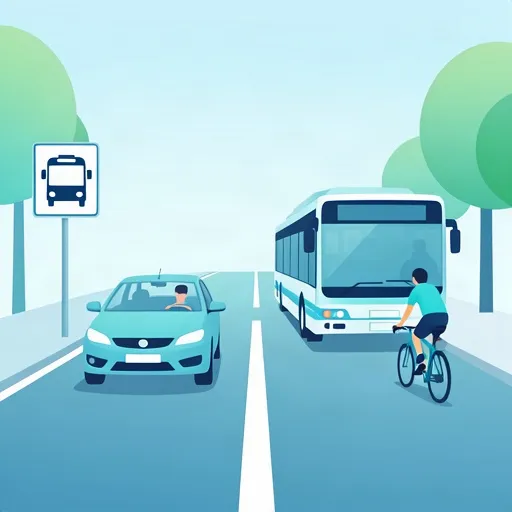
In France, the Code de la route is very precise regarding road markings. A bus lane, often referred to as a voie de bus or couloir de bus, is typically delineated by a continuous or broken white line, frequently accompanied by the word "BUS" painted on the road surface. When the line is continuous, the lane is strictly prohibited for standard vehicles.
However, not all markings are equal. A broken line indicates that the lane is reserved but allows for specific maneuvers, such as entering or exiting a driveway, or preparing for a turn. It is important to remember that these lanes may also be open to taxis, bicycles, and in some cities, vehicles with a specific number of occupants or car-pooling stickers.
One of the most frequent traps in the French theory exam involves scenarios where a driver must cross a bus lane to make a right-hand turn. If the lane is marked with a broken line near an intersection, you are legally permitted to cross it to complete your turn, but you must do so with extreme caution. You must ensure that no public transport vehicles are approaching and that you do not impede their progress.
If the line is continuous, you are strictly forbidden from entering the lane under any circumstances. If your intended turn requires crossing a continuous line, you must continue until the line becomes broken or the reserved lane ends.
Public transport vehicles, especially trams, operate under specific priority rules that differ from those of standard motorists. Trams are considered heavy rail vehicles and, in almost all urban contexts, they have absolute priority over other road users, regardless of the intersection's markings.
When driving near a tramway, you must be hyper-aware of the track placement. Trams are often integrated into the road surface and can move in directions that might surprise a novice driver. Always check your mirrors and blind spots for cyclists and scooters, which are increasingly allowed to share designated public transport corridors in specific municipalities.
| Vehicle Type | Priority Level | Notes |
|---|---|---|
| Tramway | Absolute | Always yields priority regardless of signage. |
| Bus | Conditional | Yields to others unless exiting a stop. |
| Bicycle | Protected | Must be given distance when in a shared lane. |
| Private Car | Secondary | Must not obstruct reserved lanes. |
The ETG exam often presents images of urban streets where a driver is positioned in a lane adjacent to a bus lane. You may be asked if you can overtake, if you can turn, or if you are permitted to stop. The key to answering these questions correctly is to observe the road markings and signs carefully before making a decision.
Always look for the sign indicating the type of vehicle permitted. Some lanes are restricted only to buses, while others allow taxis. If you see a cyclist symbol, it implies that you must maintain a safe lateral distance when the lane is shared, particularly when entering or exiting.
This guide explains the French Code de la route rules for bus lanes and reserved traffic ways, emphasizing that continuous white lines absolutely prohibit entry while broken lines allow crossing for specific maneuvers like turning. Trams hold absolute priority over all other vehicles, while buses have conditional priority only when exiting stops. The ETG exam tests your ability to read road markings and signage to determine permitted actions, so always identify the line type and any vehicle symbols before deciding. The four-step procedure for turning across a bus lane—check markings, signal early, mirror check, execute safely—covers the practical sequence you need to master for both the exam and real driving.
A short set of high-value points that capture the most important ideas from this article.
A continuous white line separating a bus lane means absolute prohibition—no entry for private vehicles under any circumstances
A broken white line permits crossing a bus lane only for specific maneuvers like entering a driveway or preparing to turn
Trams have absolute priority over all other road users at all times, regardless of traffic signs or signals
Buses have conditional priority but must yield to other traffic when exiting stops
Never use a bus lane to bypass traffic congestion, even if the dividing line is broken—this is a common exam trap and traffic violation
Continuous line (ligne continue) = prohibited entry; Broken line (ligne discontinue) = limited permission for crossing
Trams always have absolute priority; buses only have priority when exiting stops; bicycles must be given lateral distance
The four-step turning procedure: check markings, signal early, mirror check, then execute safely
Some bus lanes also permit taxis, carpooling vehicles with stickers, or cyclists depending on local signage
Road markings and signs must be observed together before making any lane decision on the ETG exam
Assuming that broken white lines allow you to drive in the bus lane—they only permit crossing for specific purposes
Confusing tram priority rules with bus lane rules; trams always have absolute priority regardless of markings
Forgetting to check mirrors for cyclists and scooters that may share the reserved lane
Believing that traffic congestion justifies entering a bus lane with a broken line—it does not
Not distinguishing between the various permitted users (taxis, cyclists, carpooling vehicles) when answering exam questions about the same lane
Article content overview
A short set of high-value points that capture the most important ideas from this article.
A continuous white line separating a bus lane means absolute prohibition—no entry for private vehicles under any circumstances
A broken white line permits crossing a bus lane only for specific maneuvers like entering a driveway or preparing to turn
Trams have absolute priority over all other road users at all times, regardless of traffic signs or signals
Buses have conditional priority but must yield to other traffic when exiting stops
Never use a bus lane to bypass traffic congestion, even if the dividing line is broken—this is a common exam trap and traffic violation
Continuous line (ligne continue) = prohibited entry; Broken line (ligne discontinue) = limited permission for crossing
Trams always have absolute priority; buses only have priority when exiting stops; bicycles must be given lateral distance
The four-step turning procedure: check markings, signal early, mirror check, then execute safely
Some bus lanes also permit taxis, carpooling vehicles with stickers, or cyclists depending on local signage
Road markings and signs must be observed together before making any lane decision on the ETG exam
Assuming that broken white lines allow you to drive in the bus lane—they only permit crossing for specific purposes
Confusing tram priority rules with bus lane rules; trams always have absolute priority regardless of markings
Forgetting to check mirrors for cyclists and scooters that may share the reserved lane
Believing that traffic congestion justifies entering a bus lane with a broken line—it does not
Not distinguishing between the various permitted users (taxis, cyclists, carpooling vehicles) when answering exam questions about the same lane
Explore related topics, search based questions, and concepts that learners often look up when studying French Bus and Reserved Lane Rules. These themes reflect real search intent and help you understand how this topic connects to wider driving theory knowledge in France.
Find clear and practical answers to common questions learners often have about French Bus and Reserved Lane Rules. This section helps explain difficult points, remove confusion, and reinforce the key driving theory concepts that matter for learners in France.
You are only permitted to enter or cross a bus lane to reach a junction or access a private entrance, provided that lane markings allow it, typically indicated by a broken line.
Look for specific road markings (the word BUS painted on the ground) and vertical signage. Some lanes may also be open to taxis, bicycles, or emergency vehicles, which will be explicitly indicated on the sign.
Yes, stopping or parking in a bus lane is considered an obstruction of public transport and is strictly prohibited in France, often resulting in immediate fines.
Tramway tracks and lanes are highly restricted; unauthorized driving on tram platforms or tracks is prohibited and dangerous, as these are reserved exclusively for public transit vehicles.
Continue your preparation for the French permis de conduire exam. Dive deeper into specific Code de la route sections, practice scenarios, or review official procedures. Use our comprehensive article collection to master every aspect of driving theory.