
Drivers in France must be aware of specific winter equipment regulations enforced in mountainous areas to ensure road safety during the colder months. This guide clarifies the legal status of snow tires and chains, helping you identify the official road signage and avoid penalties like fines or vehicle immobilization. Mastering these regulations is a vital component of your preparation for the French Code de la route.
Article content overview
Driving in France during the winter months requires more than just careful handling of your vehicle; it requires strict adherence to seasonal equipment regulations. To ensure the safety of all road users and to prevent traffic congestion in sensitive areas, the French government enforces mandatory winter equipment rules for specific mountainous zones. Understanding these regulations is not only a matter of legal compliance but also a core requirement for passing your theory driving exam (ETG).
Between November 1st and March 31st of each year, the "Loi Montagne" (Mountain Law) applies to designated municipalities across various French mountain massifs, including the Alps, Pyrenees, Massif Central, Jura, and Vosges. In these regions, you are legally required to ensure your vehicle is equipped with either approved winter tires or removable anti-skid devices such as snow chains or snow socks.
Failure to comply with these rules can lead to significant consequences. If you are caught driving in these zones without the required equipment, you face a fine of 135 euros, and in some cases, authorities may order the immediate immobilization of your vehicle. It is essential to verify if your travel route passes through these restricted areas by checking local official signage before embarking on your journey.
Even if the road appears clear, the legal requirement remains in effect throughout the designated period. Always carry your snow chains or ensure your tires meet the official criteria to avoid potential fines and safety hazards.
The French Code de la route utilizes specific signs to notify drivers when they are entering or exiting a mandatory equipment zone. These signs are placed at the entry and exit points of the affected areas, serving as a clear instruction for drivers to verify their vehicle's status.
Not every tire marketed as a "winter tire" qualifies under the official regulations. For a tire to be legally recognized in these mountainous zones, it must meet specific technical markings. The safest and most compliant choice is a tire displaying the "Alpine" symbol—a snowflake inside a mountain pictogram.
In addition to the Alpine symbol, tires must be marked with "M+S," "M.S," or "M&S." While tires marked only with "M+S" without the Alpine symbol are temporarily accepted for compliance, the authorities strongly recommend the Alpine-certified tires for superior performance in snow and ice conditions.
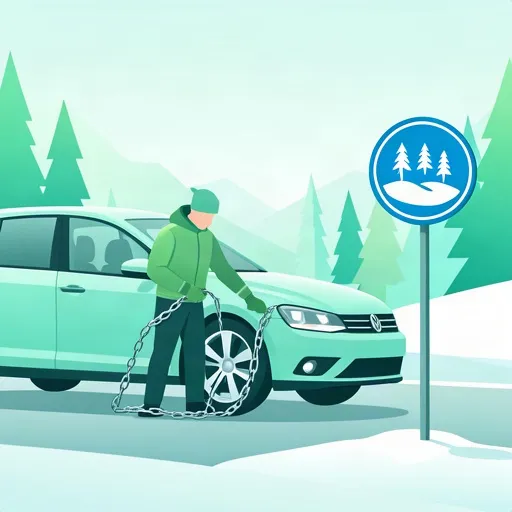
Metallic devices that wrap around the tires to provide traction on packed snow or ice. They must be fitted to at least two driving wheels to be effective.
In the context of the Code de la route exam, you may encounter questions regarding vehicle safety and preparation for extreme weather. Examiners often test your knowledge of how to identify these zones and what the specific equipment requirements are for different types of vehicles. Remember that the rules are designed to prevent the blocking of traffic by ill-equipped vehicles, which is a frequent cause of accidents and delays in mountain regions.
French mountain driving requires specific winter equipment under the Loi Montagne between November 1st and March 31st. Drivers must equip their vehicles with either approved winter tires bearing the Alpine symbol and M+S marking, or carry removable anti-skid devices like snow chains or snow socks. The B58 sign marks zone entry and B59 marks zone exit, and failure to comply carries a 135 euro fine with possible vehicle immobilization. The five regulated massifs are the Alps, Pyrenees, Massif Central, Jura, and Vosges, and these regulations are testable items in the French driving theory exam (ETG).
A short set of high-value points that capture the most important ideas from this article.
The Loi Montagne requires vehicles to have winter tires OR snow chains in designated mountain zones between November 1st and March 31st.
The B58 road sign marks the entry point where winter equipment becomes mandatory, while B59 marks the exit from these regulated zones.
A tire displaying the Alpine symbol (snowflake inside a mountain) is the official standard for compliant winter tires in France.
Driving without required equipment in these zones can result in a 135 euro fine and potential vehicle immobilization.
The five French mountain massifs covered by these regulations are the Alps, Pyrenees, Massif Central, Jura, and Vosges.
Remember the exact dates: November 1st to March 31st are when winter equipment is legally required in mountain zones.
The Alpine symbol is the snowflake-inside-mountain pictogram and is the strongest indicator of a compliant winter tire.
B58 means ENTER the zone (equipment required), B59 means EXIT the zone (requirement ends).
Tires marked only with M+S without the Alpine symbol are temporarily accepted but not recommended as the preferred option.
Snow chains must be fitted to at least two driving wheels to be legally effective.
Assuming that having chains alone is enough without knowing they must actually be fitted to the tires when required.
Confusing B58 and B59 signs and not recognizing when the mandatory equipment requirement begins or ends.
Believing that any tire with M+S marking automatically qualifies, when the Alpine symbol is the official preferred standard.
Thinking the requirement only applies when roads are snowy or icy, when in fact it applies throughout the entire designated period regardless of conditions.
Not checking whether your planned route crosses any of the five regulated mountain massifs before traveling.
Article content overview
A short set of high-value points that capture the most important ideas from this article.
The Loi Montagne requires vehicles to have winter tires OR snow chains in designated mountain zones between November 1st and March 31st.
The B58 road sign marks the entry point where winter equipment becomes mandatory, while B59 marks the exit from these regulated zones.
A tire displaying the Alpine symbol (snowflake inside a mountain) is the official standard for compliant winter tires in France.
Driving without required equipment in these zones can result in a 135 euro fine and potential vehicle immobilization.
The five French mountain massifs covered by these regulations are the Alps, Pyrenees, Massif Central, Jura, and Vosges.
Remember the exact dates: November 1st to March 31st are when winter equipment is legally required in mountain zones.
The Alpine symbol is the snowflake-inside-mountain pictogram and is the strongest indicator of a compliant winter tire.
B58 means ENTER the zone (equipment required), B59 means EXIT the zone (requirement ends).
Tires marked only with M+S without the Alpine symbol are temporarily accepted but not recommended as the preferred option.
Snow chains must be fitted to at least two driving wheels to be legally effective.
Assuming that having chains alone is enough without knowing they must actually be fitted to the tires when required.
Confusing B58 and B59 signs and not recognizing when the mandatory equipment requirement begins or ends.
Believing that any tire with M+S marking automatically qualifies, when the Alpine symbol is the official preferred standard.
Thinking the requirement only applies when roads are snowy or icy, when in fact it applies throughout the entire designated period regardless of conditions.
Not checking whether your planned route crosses any of the five regulated mountain massifs before traveling.
Explore related topics, search based questions, and concepts that learners often look up when studying French Mountain Winter Regulations. These themes reflect real search intent and help you understand how this topic connects to wider driving theory knowledge in France.
Find clear and practical answers to common questions learners often have about French Mountain Winter Regulations. This section helps explain difficult points, remove confusion, and reinforce the key driving theory concepts that matter for learners in France.
The requirement to have winter equipment in designated mountain regions applies annually from November 1st to March 31st.
Drivers must either have winter tires marked with the Alpine symbol and M+S ratings or carry snow chains (metallic) or compatible anti-skid textile devices in their vehicle.
Failure to comply can result in a fixed fine of 135 euros, and in certain conditions, law enforcement may order the immobilization of your vehicle.
Continue your preparation for the French permis de conduire exam. Dive deeper into specific Code de la route sections, practice scenarios, or review official procedures. Use our comprehensive article collection to master every aspect of driving theory.