Navigating intersections and crosswalks in France requires a clear understanding of when to grant priority to pedestrians and cyclists. This guide breaks down the legal requirements from the Code de la route, helping you distinguish between pedestrians who are merely waiting and those who have the right of way. By mastering these rules, you will be prepared to handle real-world traffic scenarios and successfully answer related questions on the ETG theory test.
Article content overview
In the context of the French Code de la route, the safety of vulnerable road users is a non-negotiable priority for every driver. Whether you are preparing for your ETG theory exam or practicing for real-world driving, understanding exactly when you must yield to pedestrians and cyclists is a fundamental skill. French traffic law is designed to protect those outside of a vehicle, and failing to adhere to these rules is one of the most common reasons for errors during the theory test.
A frequent scenario in the theory exam involves approaching a pedestrian crossing without traffic lights. As a driver, you must be prepared to stop for any pedestrian who is already engaged on the crossing or who clearly manifests the intention to cross. This is not merely a suggestion; it is a legal requirement aimed at reducing accidents in urban and rural settings.
Common Exam Trap: You are never allowed to signal, honk, or maintain your speed to intimidate a pedestrian who is waiting at a crosswalk. If you are asked what to do, the correct answer is always to be ready to yield, even if the pedestrian has not yet stepped onto the road but is clearly waiting to do so.
When you see a pedestrian waiting near a crosswalk, you must anticipate their movement. If they are looking toward the road or positioning themselves at the edge of the curb, you must treat their presence as an intention to cross. Slowing down early shows the examiner that you are observing the environment and prioritizing human life over your own convenience.
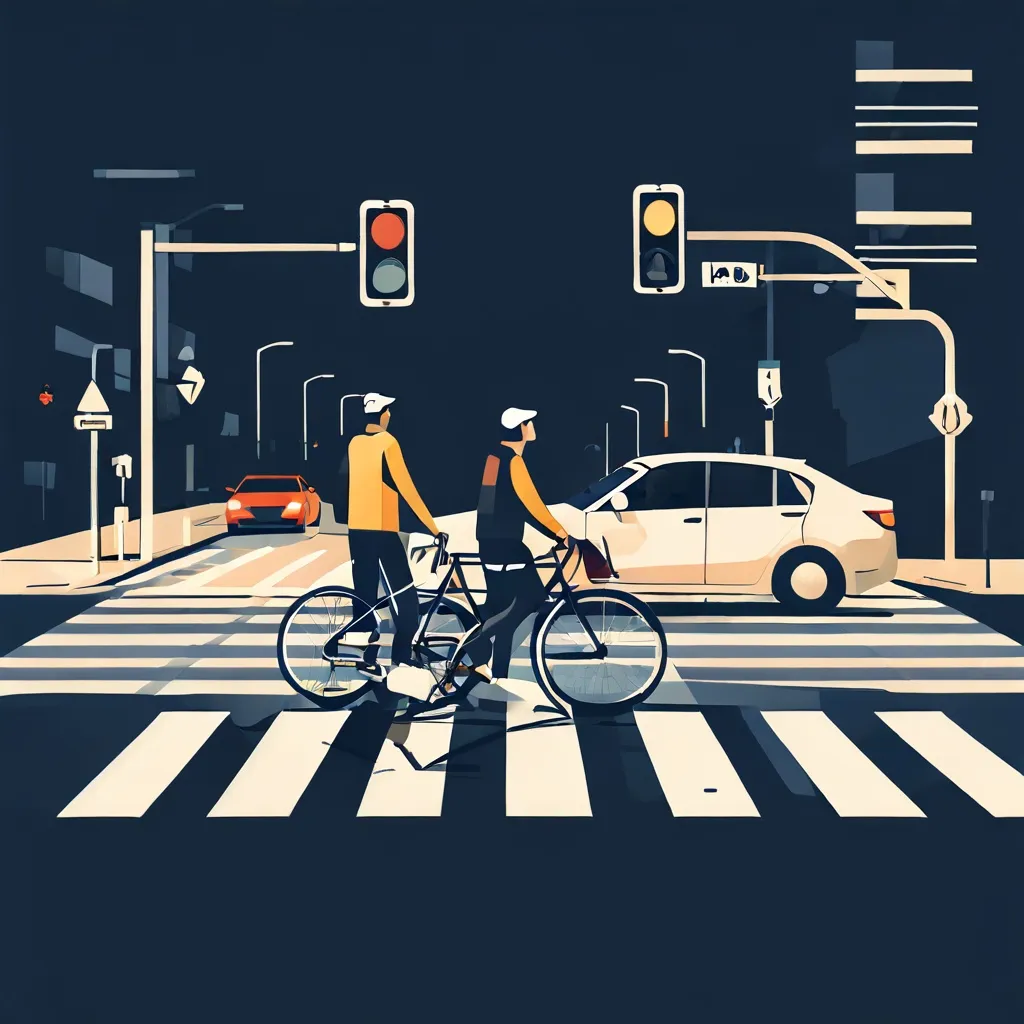
While many learners focus on crosswalks, the rules for turning at intersections where a cycle path or pedestrian lane crosses your path are equally critical. When you turn right or left at an intersection, you must verify that you are not cutting off a cyclist who is traveling straight or a pedestrian who is crossing the road you are entering.
Cyclists in France are increasingly protected by "sas vélo" (bike boxes) at intersections. These areas allow cyclists to position themselves in front of vehicles when the light is red, ensuring they are visible to drivers when the light turns green. As a driver, you must never encroach on these zones while waiting for the signal.
The Code de la route emphasizes a proactive approach. In the ETG theory exam, you will encounter questions that test your ability to perceive hazards before they become dangerous. If you see a cyclist or a pedestrian, you should always assume they might behave unpredictably.
| Road User | Condition | Driver Requirement |
|---|---|---|
| Pedestrian | At an unmarked crossing | Yield if intending to cross |
| Cyclist | In a dedicated cycle lane | Do not cut off while turning |
| Pedestrian | Crossing on a green light | Yield to those currently in the road |
| Cyclist | In a bike box | Wait for them to clear the junction |
This content explains the legal obligations drivers face under the French Code de la route when sharing the road with vulnerable users. Pedestrians at marked or unmarked crossings who show intent to cross have automatic priority, meaning drivers must be ready to yield even before the pedestrian physically steps onto the road. Cyclists benefit from special protections including dedicated lanes and sas vélo (bike boxes) at intersections, requiring drivers to check blind spots carefully before turning. The ETG theory exam tests hazard perception and anticipatory behavior rather than rote memorization, making it essential to understand how these priority rules apply in practice. Mastering these concepts helps avoid the most common exam traps and develops safe driving habits for real-world French roads.
A short set of high-value points that capture the most important ideas from this article.
Pedestrians who are already on a crossing or clearly manifesting intent to cross have legal priority under the Code de la route
Drivers must never use horn, signals, or maintain speed to pressure a pedestrian waiting at a crosswalk
Cyclists in designated cycle lanes have protected status and cannot be cut off when drivers turn
Bike boxes (sas vélo) position cyclists ahead of vehicles at red lights; drivers must not encroach on these zones
Drivers should always anticipate unpredictable behavior from pedestrians and cyclists as a proactive safety approach
A pedestrian does not need to step onto the road to have priority; visible waiting and intent to cross are sufficient triggers for yielding
Sas vélo (bike boxes) give cyclists an advanced position at signalized intersections and must remain clear of vehicles
When turning at any intersection, always check blind spots for cyclists traveling straight in adjacent lanes
Green light does not override pedestrian priority if they are already in the process of crossing
Céder le passage is the legal obligation to yield to vulnerable road users, not an optional courtesy
Assuming pedestrians without yet stepping onto the crossing have no priority and passing them without slowing
Failing to check blind spots when turning right or left, thereby cutting off cyclists in adjacent lanes
Encroaching on sas vélo (bike boxes) while waiting at red lights, which is prohibited by the Code de la route
Misinterpreting a pedestrian's body language and assuming they do not intend to cross when they clearly do
Believing that horn signals or speed maintenance are acceptable ways to manage waiting pedestrians at crossings
Article content overview
A short set of high-value points that capture the most important ideas from this article.
Pedestrians who are already on a crossing or clearly manifesting intent to cross have legal priority under the Code de la route
Drivers must never use horn, signals, or maintain speed to pressure a pedestrian waiting at a crosswalk
Cyclists in designated cycle lanes have protected status and cannot be cut off when drivers turn
Bike boxes (sas vélo) position cyclists ahead of vehicles at red lights; drivers must not encroach on these zones
Drivers should always anticipate unpredictable behavior from pedestrians and cyclists as a proactive safety approach
A pedestrian does not need to step onto the road to have priority; visible waiting and intent to cross are sufficient triggers for yielding
Sas vélo (bike boxes) give cyclists an advanced position at signalized intersections and must remain clear of vehicles
When turning at any intersection, always check blind spots for cyclists traveling straight in adjacent lanes
Green light does not override pedestrian priority if they are already in the process of crossing
Céder le passage is the legal obligation to yield to vulnerable road users, not an optional courtesy
Assuming pedestrians without yet stepping onto the crossing have no priority and passing them without slowing
Failing to check blind spots when turning right or left, thereby cutting off cyclists in adjacent lanes
Encroaching on sas vélo (bike boxes) while waiting at red lights, which is prohibited by the Code de la route
Misinterpreting a pedestrian's body language and assuming they do not intend to cross when they clearly do
Believing that horn signals or speed maintenance are acceptable ways to manage waiting pedestrians at crossings
Explore related topics, search based questions, and concepts that learners often look up when studying Pedestrian and Cyclist Priority. These themes reflect real search intent and help you understand how this topic connects to wider driving theory knowledge in France.
Find clear and practical answers to common questions learners often have about Pedestrian and Cyclist Priority. This section helps explain difficult points, remove confusion, and reinforce the key driving theory concepts that matter for learners in France.
You must be prepared to yield to any pedestrian who is already on the crossing or who has clearly manifested the intention to cross.
Yes, if the pedestrian has clearly manifested an intention to cross, you are legally required to grant them priority, even if they have not yet stepped onto the road.
The exam often uses images of pedestrians near crossings to test your awareness; you must select the option that indicates readiness to slow down or stop to ensure their safety.
Continue your preparation for the French permis de conduire exam. Dive deeper into specific Code de la route sections, practice scenarios, or review official procedures. Use our comprehensive article collection to master every aspect of driving theory.