
Navigating French city streets requires a precise understanding of how trams and buses interact with private vehicles. This guide clarifies the absolute priority usually held by trams and the specific lane restrictions that apply to buses, ensuring you are prepared for both the ETG theory exam and real-world urban driving conditions.
Article content overview
Navigating French urban environments requires a sophisticated understanding of how the Code de la route governs the interaction between private vehicles and public transport. In the dense, often complex street layouts of French cities, trams and buses operate under specific rules that prioritize the efficiency of mass transit. For candidates preparing for the Code de la route theory exam (ETG), recognizing these priority hierarchies is not just a safety requirement—it is essential for identifying the correct answer in tricky junction scenarios.
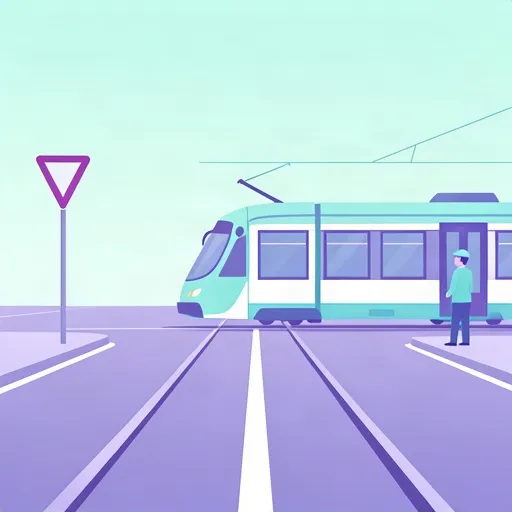
In France, the rule of thumb regarding trams is simple but strict: they generally possess absolute priority over all other road users, including cars, cyclists, and pedestrians. Because of their significant braking distances and fixed tracks, trams cannot deviate from their path to avoid a collision. In the eyes of the French traffic law, a tram is considered a "privileged" road user, and failing to yield to a tram is a frequent cause of test failure during the theory exam.
Whenever you encounter a tramway, you must observe the specific signaling associated with it. Unlike standard road traffic lights, tram signals use a unique system of white lights arranged in horizontal, vertical, or circular patterns. If these signals are present, they dictate the tram's movement, and your own light status does not grant you the right to proceed if it puts you in the tram's path.
Bus lanes, often marked by continuous solid lines and the word "BUS" painted on the road surface, are strictly reserved for public transport, taxis, and sometimes cyclists, depending on local municipal decrees. Navigating these requires a clear understanding of when you may enter these lanes and when you are strictly prohibited from doing so.
You are permitted to enter a bus lane only to execute a turn at an upcoming intersection or to access a property, provided the road marking is a dashed line in that specific section. If the line is continuous, you are forbidden from crossing or driving in the lane, even if you are simply trying to turn.
One of the most critical aspects of the French driving theory exam is understanding the hierarchy of signals. Even when you believe you have the right of way, a tram or a priority vehicle with its sirens and lights activated overrides standard traffic control devices. In urban areas, you must be hyper-aware of your surroundings, as public transport often utilizes dedicated corridors that intersect with standard traffic lanes.
| Situation | Priority Holder | Action Required |
|---|---|---|
| Tram approaching junction | Tram | Stop and allow the tram to clear the intersection |
| Bus leaving a marked stop | Bus | Yield if the bus signals its intention to pull out |
| Emergency vehicle with lights | Emergency | Pull over and yield regardless of signals |
| Standard roundabout | Current user | Follow priority rules for roundabouts |
The ETG exam often presents scenarios where a car has a green light, but a tram is crossing the intersection. Candidates often mistakenly rely on the green light as an absolute "go" signal. Remember that the tram's right-of-way is independent of standard signal colors in many French urban designs. Always scan for tracks when approaching any intersection in a city like Paris, Lyon, or Bordeaux.
This article covers the critical priority rules governing trams and buses in French urban driving, essential for the Code de la route theory exam (ETG). Trams possess absolute priority due to their fixed tracks and extended braking distances, overriding standard traffic signals. Bus lanes are strictly regulated: private vehicles may only enter at dashed-line sections for turning or property access. The hierarchy places trams, emergency vehicles, and then standard traffic signals in descending priority order. Learners must recognize that a green light never permits proceeding when a tram is approaching, and that violating tram priority is a common cause of immediate exam failure.
A short set of high-value points that capture the most important ideas from this article.
Trams in France hold absolute priority over all other road users, including private vehicles with a green light
Trams cannot deviate from their fixed tracks and have long braking distances, making their priority non-negotiable
Bus lanes with continuous solid lines are strictly forbidden for private vehicle entry except for authorized turning maneuvers
Tram-specific white signal lights override standard traffic signals in determining right-of-way
Emergency vehicles and priority vehicles with active lights and sirens always supersede standard traffic control devices
Tramway priority is absolute unless a specific tram signal clearly directs otherwise
Enter bus lanes only at dashed-line sections when turning or accessing property; never when lines are continuous
A green traffic light does not grant the right to proceed if a tram is in or approaching the intersection
Check mirrors and blind spots for cyclists before executing any maneuver near bus lanes
Bus lanes are reserved for public transport, taxis, and sometimes cyclists depending on local municipal decree
Assuming a green traffic light automatically grants right-of-way when a tram is present at an intersection
Attempting to 'beat' a tram through an intersection, which is both dangerous and results in immediate exam failure
Crossing a continuous bus lane marking to turn, even when the driver intends only a brief crossing
Linger or stop within a bus lane after completing a turn maneuver, violating lane usage rules
Failing to scan for tram tracks when approaching any urban intersection in cities like Paris, Lyon, or Bordeaux
Article content overview
A short set of high-value points that capture the most important ideas from this article.
Trams in France hold absolute priority over all other road users, including private vehicles with a green light
Trams cannot deviate from their fixed tracks and have long braking distances, making their priority non-negotiable
Bus lanes with continuous solid lines are strictly forbidden for private vehicle entry except for authorized turning maneuvers
Tram-specific white signal lights override standard traffic signals in determining right-of-way
Emergency vehicles and priority vehicles with active lights and sirens always supersede standard traffic control devices
Tramway priority is absolute unless a specific tram signal clearly directs otherwise
Enter bus lanes only at dashed-line sections when turning or accessing property; never when lines are continuous
A green traffic light does not grant the right to proceed if a tram is in or approaching the intersection
Check mirrors and blind spots for cyclists before executing any maneuver near bus lanes
Bus lanes are reserved for public transport, taxis, and sometimes cyclists depending on local municipal decree
Assuming a green traffic light automatically grants right-of-way when a tram is present at an intersection
Attempting to 'beat' a tram through an intersection, which is both dangerous and results in immediate exam failure
Crossing a continuous bus lane marking to turn, even when the driver intends only a brief crossing
Linger or stop within a bus lane after completing a turn maneuver, violating lane usage rules
Failing to scan for tram tracks when approaching any urban intersection in cities like Paris, Lyon, or Bordeaux
Explore related topics, search based questions, and concepts that learners often look up when studying French Tram and Bus Rules. These themes reflect real search intent and help you understand how this topic connects to wider driving theory knowledge in France.
Find clear and practical answers to common questions learners often have about French Tram and Bus Rules. This section helps explain difficult points, remove confusion, and reinforce the key driving theory concepts that matter for learners in France.
Yes, in almost all urban scenarios, trams have absolute priority, even when they are approaching from the left or right, unless traffic lights dictate otherwise.
You are strictly forbidden from driving in a bus lane ('couloir de bus'), even if you are just passing through, unless road markings explicitly allow it for specific maneuvers.
In built-up areas, you must facilitate the bus's departure by slowing down or changing lanes if safe to do so, as public transport vehicles have priority when signaling to rejoin traffic.
The ETG exam often features images of intersections where you must identify if a tram is present and acknowledge that it retains priority, regardless of the typical right-hand rule.
Continue your preparation for the French permis de conduire exam. Dive deeper into specific Code de la route sections, practice scenarios, or review official procedures. Use our comprehensive article collection to master every aspect of driving theory.