Urban driving in France demands constant vigilance and strict adherence to the Code de la route, even under pressure. This guide explores how emotional states like impatience affect your ability to process traffic signs, respect right-of-way, and anticipate the movements of cyclists and pedestrians. Learn how to maintain the cognitive clarity required to pass your theory exam and navigate city centers safely.
Article content overview
Driving in a dense French city requires more than just mechanical skill; it demands high-level cognitive engagement with the Code de la route. In the high-pressure environment of urban traffic, human factors like impatience and stress act as significant cognitive filters that can distort your perception of road hazards. When you are behind the wheel, your emotional state directly influences your ability to process information from road signs, react to vulnerable road users, and correctly interpret priority rules at intersections. For candidates preparing for the Épreuve Théorique Générale (ETG), recognizing how these psychological states manifest is essential for avoiding common exam pitfalls and developing the defensive driving mindset required in France.
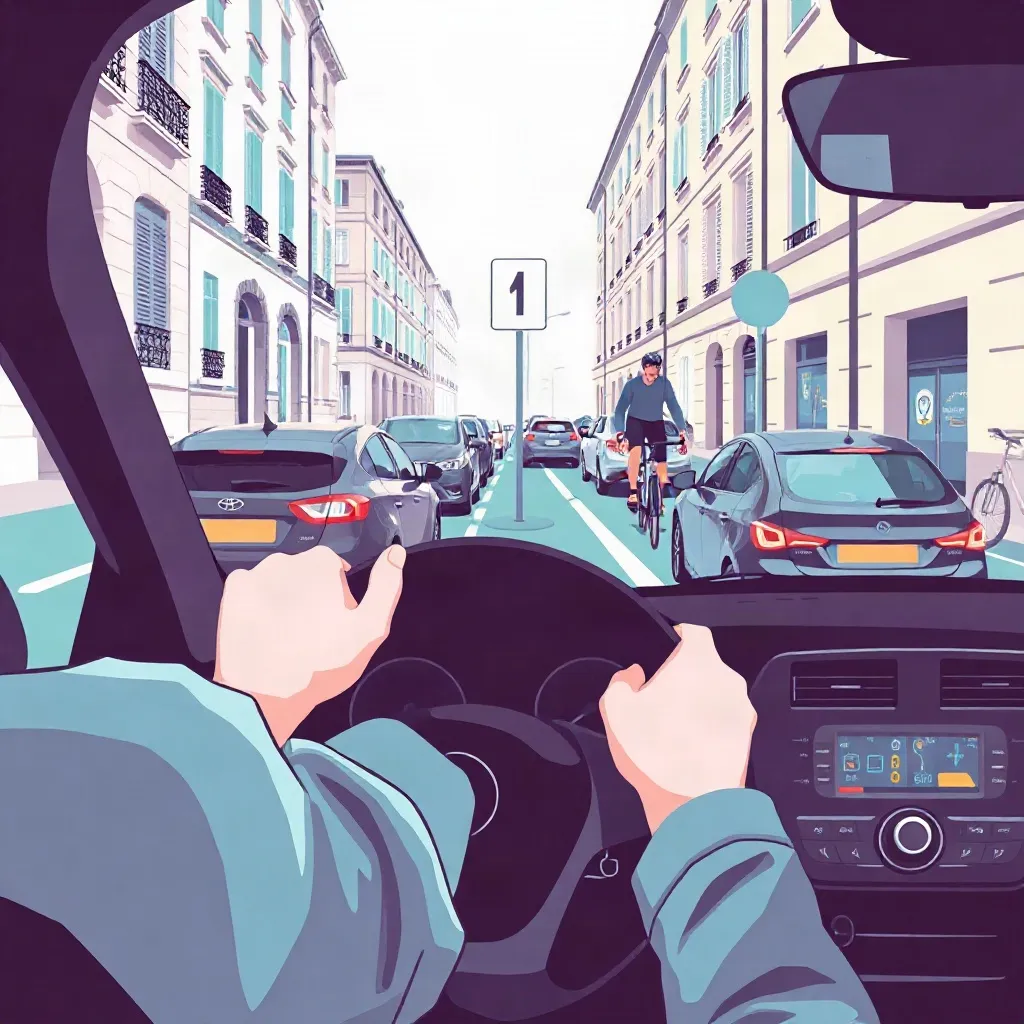
Impatience is one of the most common reasons for preventable errors during the ETG theory exam. When a driver is hurried, their "field of vision" effectively narrows, causing them to focus intensely on their immediate path while ignoring peripheral hazards like cyclists in blind spots or pedestrians waiting at crosswalks. In the context of French cities, where road space is shared among cars, trams, bicycles, and scooters, this tunnel vision is dangerous.
Impatience often leads to the "rushing reflex," where a candidate assumes they have priority simply because they are moving faster, directly contradicting the fundamental right-hand priority rules (priorité à droite) codified in the French system.
When you feel the urge to speed up or force a passage, you are likely failing to account for the Code de la route etiquette that prioritizes safety over traffic flow. Exam questions often present scenarios where a driver is tempted to overtake a bus or ignore a cyclist, testing your ability to suppress the instinct for speed in favor of defensive vigilance.
A major part of the ETG exam involves identifying who has the right-of-way in complex urban scenarios. Stress often clouds a driver's ability to identify specific road signs, leading to incorrect assumptions about intersection priority. Even when a sign clearly mandates yielding, an impatient driver may subconsciously seek to justify a shortcut.
Maintaining cognitive clarity means consistently scanning for these signs regardless of how "urgent" your journey feels. Remember that in urban environments, vulnerable road users such as pedestrians are often protected by specific markings, and your impatience cannot override their right to safety.
Hazard perception is the cornerstone of the French driving theory exam. To master this, you must learn to detach your emotional state from the traffic environment. Stress causes a delay in reaction time, making it harder to spot subtle clues—such as a door opening on a parked car or a cyclist signaling a turn.
Continuously scan for signage rather than focusing only on the vehicle in front.
Anticipate that other drivers may act impatiently, and prepare to yield even when you technically possess the right-of-way.
Maintain a consistent following distance, resisting the urge to tailgate even in heavy stop-and-go traffic.
Monitor your breathing to lower physical tension, which helps in maintaining a wider field of visual awareness.
| Behavior | Potential Consequence | Theory Exam Impact |
|---|---|---|
| Tailgating | Inability to react to sudden braking | Failure in "Hazard Perception" section |
| Ignoring Priority | Collision at intersection | Automatic major fault |
| Rushing Intersections | Missing traffic light changes | Error in "Traffic Regulations" section |
A proactive approach to driving where the operator anticipates potential hazards and acts to mitigate risks before they occur, rather than reacting only when a situation becomes critical.
The French theory exam is designed to filter out drivers who cannot manage the psychological demands of the road. Questions often place you in situations where a "stressful" choice is the intuitive one, while the "safe" choice requires patience and adherence to the Code de la route. If you find yourself consistently missing questions during practice, evaluate whether you are trying to "solve" the problem too quickly. Often, the correct answer is the one that prioritizes the safety of others over the convenience of the driver.
This article explains how stress and impatience impair driving judgment in French cities, particularly affecting hazard perception and priority rule compliance. Impatience causes tunnel vision that narrows awareness of cyclists, pedestrians, and vulnerable road users sharing urban space, while stress delays reaction time and clouds recognition of road signs. The ETG exam specifically tests whether candidates can suppress emotional impulses in favor of defensive driving practices. Key strategies include continuous environmental scanning, maintaining safe following distances, and using breathing techniques to preserve cognitive clarity. Understanding these psychological factors is essential for both passing the theory exam and developing the mindset required for safe urban driving in France.
A short set of high-value points that capture the most important ideas from this article.
Impatience creates tunnel vision, causing drivers to miss peripheral hazards like cyclists and pedestrians in French urban zones
The 'rushing reflex' leads drivers to incorrectly assume priority based on speed, violating the fondamentaux Code de la route
Stress directly delays reaction time, making it harder to spot subtle hazard cues such as opening car doors or cyclist signals
Defensive driving in France means anticipating that other drivers may act impatiently and preparing to yield even with right-of-way
The ETG exam deliberately tests whether candidates can prioritize safety over convenience when under pressure
Continuously scan for road signs rather than focusing only on the vehicle ahead, regardless of urgency
Vulnerable road users (pedestrians, cyclists, motorcyclists) have protected rights that cannot be overridden by driver impatience
Maintain consistent following distance to preserve reaction time; tailgating eliminates escape options
Breathing control directly affects physical tension and field of visual awareness while driving
The correct ETG answer typically prioritizes the safety of others over the convenience or speed of the driver
Assuming you have priority because you are moving faster, directly contradicting priorité à droite rules
Failing to check blind spots when impatient, missing cyclists that share French urban road space
Rushing through exam scenarios instead of applying defensive driving principles
Ignoring pedestrians waiting at crosswalks when focused on navigating through an intersection quickly
Tailgating in heavy stop-and-go traffic, reducing ability to react to sudden braking situations
Article content overview
A short set of high-value points that capture the most important ideas from this article.
Impatience creates tunnel vision, causing drivers to miss peripheral hazards like cyclists and pedestrians in French urban zones
The 'rushing reflex' leads drivers to incorrectly assume priority based on speed, violating the fondamentaux Code de la route
Stress directly delays reaction time, making it harder to spot subtle hazard cues such as opening car doors or cyclist signals
Defensive driving in France means anticipating that other drivers may act impatiently and preparing to yield even with right-of-way
The ETG exam deliberately tests whether candidates can prioritize safety over convenience when under pressure
Continuously scan for road signs rather than focusing only on the vehicle ahead, regardless of urgency
Vulnerable road users (pedestrians, cyclists, motorcyclists) have protected rights that cannot be overridden by driver impatience
Maintain consistent following distance to preserve reaction time; tailgating eliminates escape options
Breathing control directly affects physical tension and field of visual awareness while driving
The correct ETG answer typically prioritizes the safety of others over the convenience or speed of the driver
Assuming you have priority because you are moving faster, directly contradicting priorité à droite rules
Failing to check blind spots when impatient, missing cyclists that share French urban road space
Rushing through exam scenarios instead of applying defensive driving principles
Ignoring pedestrians waiting at crosswalks when focused on navigating through an intersection quickly
Tailgating in heavy stop-and-go traffic, reducing ability to react to sudden braking situations
Explore related topics, search based questions, and concepts that learners often look up when studying Stress and Impatience in Urban Driving. These themes reflect real search intent and help you understand how this topic connects to wider driving theory knowledge in France.
Find clear and practical answers to common questions learners often have about Stress and Impatience in Urban Driving. This section helps explain difficult points, remove confusion, and reinforce the key driving theory concepts that matter for learners in France.
The ETG exam tests your ability to make safe decisions in complex scenarios; stress can cloud your judgment, leading to errors in priority and hazard detection.
Impatience often causes drivers to ignore road signs, perform risky overtakes, or fail to yield to pedestrians, all of which are critical violations.
Maintain a calm demeanor, increase your following distance to allow for reaction time, and remain strictly observant of priority markers at every intersection.
Continue your preparation for the French permis de conduire exam. Dive deeper into specific Code de la route sections, practice scenarios, or review official procedures. Use our comprehensive article collection to master every aspect of driving theory.