Learn the correct maneuvers required by the French Code de la route when emergency services approach with priority signals. This guide clarifies how to act responsibly, ensuring you provide clear passage without performing illegal or hazardous actions. You will gain the knowledge needed to answer situational questions on the ETG exam with confidence and precision.
Article content overview
Encountering an emergency vehicle while driving in France requires a clear understanding of the Code de la route. As a candidate preparing for the ETG theory exam, you must recognize that facilitating the passage of vehicles with priority sirens and blue lights is not just a courtesy—it is a legal obligation that requires calm, decisive, and safe behavior. Failure to react correctly can lead to dangerous situations, potential accidents, and negative outcomes on your exam.
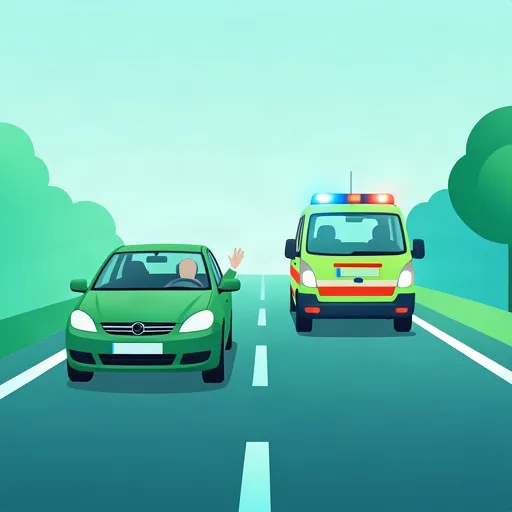
Under the French Code de la route, drivers are mandated to facilitate the passage of emergency vehicles—such as police, gendarmerie, SAMU (medical services), or firefighters—when these vehicles are utilizing their official audible warning devices (sirens) and visual warning lights (rotating or flashing blue lights). When you hear a siren or notice blue lights in your mirrors, your primary objective is to create a path for the vehicle to pass safely without compromising your own safety or that of other road users.
It is important to emphasize that while you have a duty to yield, you are not authorized to break traffic laws to do so. For example, if you are stopped at a red light, you must not cross the stop line or enter the intersection if doing so would create a hazard or put you in the path of cross-traffic. The only exception to this rule occurs when an official, such as a police officer on the ground, specifically directs you to move forward or perform a maneuver that would otherwise be prohibited.
Never attempt to cross a red light or enter a pedestrian crossing to clear a path for an emergency vehicle unless you have received clear, direct instructions from a uniformed officer directing traffic. Your safety and the legality of your actions remain your responsibility.
Your behavior should be adapted to the specific road environment. On narrow urban streets, you may need to pull over to the right as far as safely possible, signaling your intention to move. If you are on a multi-lane road or a dual carriageway, you should move toward the shoulder or the edge of your lane to allow the emergency vehicle to pass through the center or in the clearest available lane.
On motorways, which are high-speed environments, the requirement to yield is even more critical. You must monitor your rearview mirrors constantly. If an emergency vehicle approaches from behind, signal your move to the right lane—if safe to do so—and maintain a steady speed or gently slow down to allow the emergency vehicle to maneuver efficiently. Never slam on the brakes, as this can cause a chain-reaction collision, especially at motorway speeds.
The ETG exam often tests your ability to anticipate these scenarios through video-based or image-based questions. You will likely be presented with a situation where a siren is audible or lights are visible, and you must choose the safest course of action. Common pitfalls involve candidates panicking and braking abruptly or moving into an intersection prematurely.
Remember that the examiners look for:
Understanding the specific terminology used in the Code de la route helps you navigate theory questions with greater confidence. Here are the key terms you need to know for your exam regarding emergency services and priority.
If you encounter a sign indicating a dedicated lane or specific emergency access, always prioritize the instructions provided by that signage while maintaining your awareness of emergency vehicles in the vicinity.
Mastering the rules of the road is a continuous process. As you continue your training through the permis de conduire journey, ensure that you are consistently practicing situational questions that focus on priority and emergency procedures.
This article explains the mandatory legal duty to facilitate passage for emergency vehicles in France under the Code de la route, covering sirens, blue lights, and vehicles like SAMU, police, and firefighters. It details specific safe maneuvers adapted to different road types—urban streets, multi-lane roads, and motorways—emphasizing smooth, predictable actions without breaking traffic laws unless directed by an officer. The ETG exam tests candidates on awareness, predictability, and vehicle control through video-based scenarios, with common errors including abrupt braking and premature intersection entry. Key terminology such as priorité, clignotant, and autoroute is provided to reinforce exam readiness.
A short set of high-value points that capture the most important ideas from this article.
Facilitating passage for emergency vehicles using sirens and blue lights is a legal obligation under the French Code de la route, not merely a courtesy.
You must never cross a red light or enter an intersection to clear a path unless explicitly directed by a uniformed officer.
On motorways, maintain steady speed or slow smoothly when yielding; sudden braking can cause chain-reaction collisions at high speeds.
Your response should prioritize awareness (mirrors and sound), predictability (signaling), and control (smooth maneuvers).
Dedicated emergency lanes or signage take priority over general yielding rules when present.
Emergency vehicles with active sirens and blue lights hold priorité and must be given passage by all drivers.
On narrow urban streets, pull over to the right as far as safely possible; on multi-lane roads, move toward the shoulder or edge.
Always use your clignotant (turn signal) to inform other road users of your intended maneuver.
Stay calm and remain in position until the emergency vehicle has fully passed before resuming normal driving.
The only legal exception to traffic law violations during emergency yielding is direct instruction from an on-ground officer.
Panicking and braking abruptly, which is especially dangerous on motorways and can cause rear-end collisions.
Crossing a red light or entering a pedestrian crossing without officer instruction to clear a path.
Moving prematurely into an intersection when an emergency vehicle approaches, creating cross-traffic hazards.
Failing to use turn signals when pulling over or changing lanes, reducing predictability for other drivers.
Only checking mirrors without scanning the full environment for the source and direction of the emergency vehicle.
Article content overview
A short set of high-value points that capture the most important ideas from this article.
Facilitating passage for emergency vehicles using sirens and blue lights is a legal obligation under the French Code de la route, not merely a courtesy.
You must never cross a red light or enter an intersection to clear a path unless explicitly directed by a uniformed officer.
On motorways, maintain steady speed or slow smoothly when yielding; sudden braking can cause chain-reaction collisions at high speeds.
Your response should prioritize awareness (mirrors and sound), predictability (signaling), and control (smooth maneuvers).
Dedicated emergency lanes or signage take priority over general yielding rules when present.
Emergency vehicles with active sirens and blue lights hold priorité and must be given passage by all drivers.
On narrow urban streets, pull over to the right as far as safely possible; on multi-lane roads, move toward the shoulder or edge.
Always use your clignotant (turn signal) to inform other road users of your intended maneuver.
Stay calm and remain in position until the emergency vehicle has fully passed before resuming normal driving.
The only legal exception to traffic law violations during emergency yielding is direct instruction from an on-ground officer.
Panicking and braking abruptly, which is especially dangerous on motorways and can cause rear-end collisions.
Crossing a red light or entering a pedestrian crossing without officer instruction to clear a path.
Moving prematurely into an intersection when an emergency vehicle approaches, creating cross-traffic hazards.
Failing to use turn signals when pulling over or changing lanes, reducing predictability for other drivers.
Only checking mirrors without scanning the full environment for the source and direction of the emergency vehicle.
Explore related topics, search based questions, and concepts that learners often look up when studying Yielding to French Emergency Vehicles. These themes reflect real search intent and help you understand how this topic connects to wider driving theory knowledge in France.
Find clear and practical answers to common questions learners often have about Yielding to French Emergency Vehicles. This section helps explain difficult points, remove confusion, and reinforce the key driving theory concepts that matter for learners in France.
No. You must facilitate the passage of emergency vehicles, but you must not commit a traffic offense, such as crossing a red light or driving on a sidewalk, unless explicitly directed to do so by a police officer.
In France, priority emergency vehicles use blue flashing lights and, if necessary, a two-tone siren. When these are both active, you are legally required to yield.
You should maintain your speed while checking your mirrors, signal your intent, and move to the right lane if it is safe to do so. Never make sudden, dangerous braking maneuvers in the travel lane.
Only when the vehicle is using both its visual (blue lights) and audible (siren) warning devices does it have official priority over other road users.
Continue your preparation for the French permis de conduire exam. Dive deeper into specific Code de la route sections, practice scenarios, or review official procedures. Use our comprehensive article collection to master every aspect of driving theory.