
Understanding the hierarchy of traffic control in France is a fundamental pillar of the Code de la route. This article breaks down the authoritative order of signals, ensuring you know exactly when a traffic light, a sign, or a police agent takes precedence, and how to navigate safely when lights are blinking or disabled.
Article content overview
For any candidate preparing for the French Code de la route, mastering the hierarchy of traffic control is one of the most critical steps toward exam success. In France, the traffic management system is built upon a rigid, logical structure that determines exactly which signal or rule takes precedence in any given situation. Understanding this order—from the authority of a human agent down to the default rules of the road—is essential for interpreting complex intersection scenarios correctly during your theory exam.
The most important rule to memorize is that signals are not equal; they follow a strict hierarchy. If you encounter contradictory signals, you must prioritize them in a specific order. Failing to recognize this ranking is a common cause of errors in the ETG (Épreuve Théorique Générale).
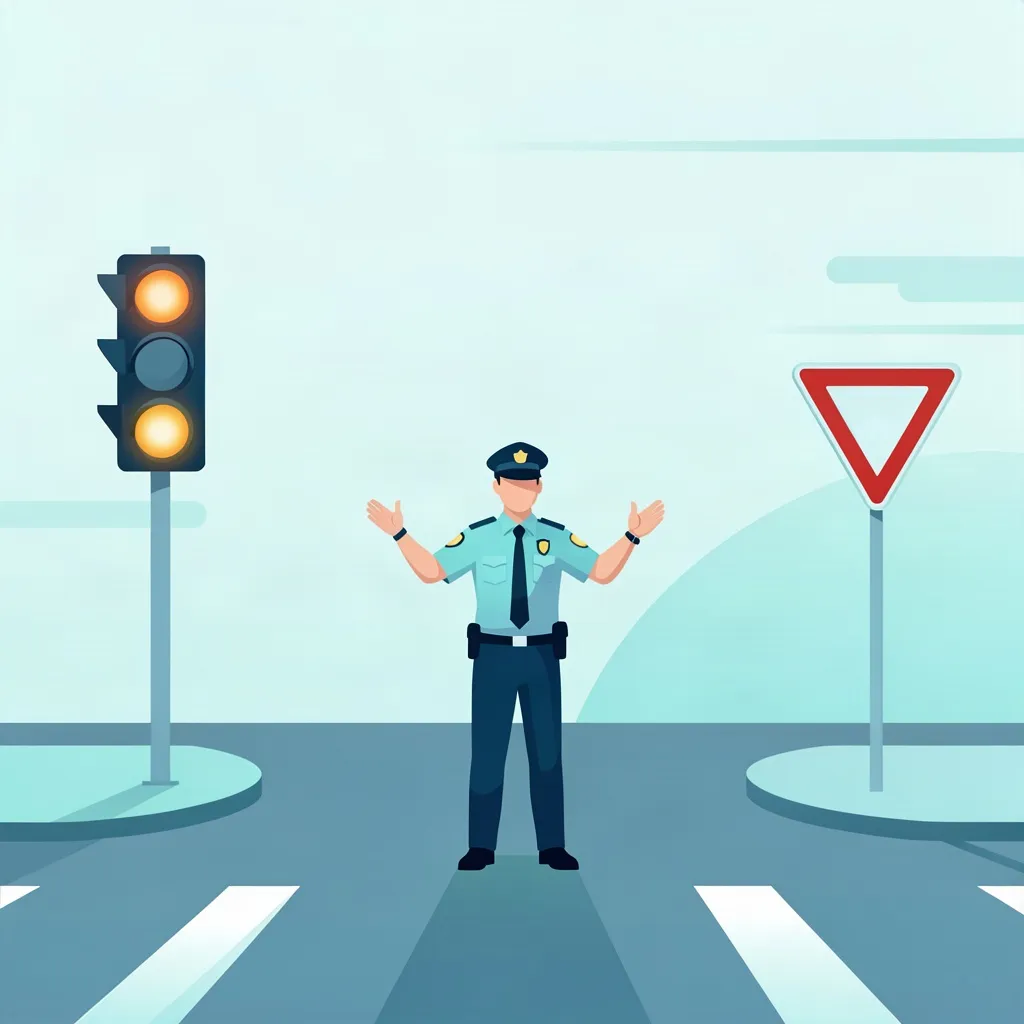
If a police agent is directing traffic at an intersection, their gestures completely nullify the status of any traffic lights or signs present. Similarly, when a traffic light is functioning normally, you must follow the light’s indication rather than the yield sign posted on the same pole.
One of the most frequently tested concepts in the French theory exam involves the "feu orange fixe." Many learners mistakenly believe they should treat a fixed orange light as an opportunity to speed up or clear the intersection quickly; however, the legal requirement is to stop unless you cannot do so safely.
The fixed amber light (feu orange fixe) is not a "get ready" signal like in some other countries; it is an order to stop. You are only permitted to cross if you are already so close to the intersection that stopping would create a significant risk of a rear-end collision or endanger other road users.
Beyond the fixed amber light, you may encounter flashing yellow or amber signals. These often indicate that the traffic light system is malfunctioning or operating in a "night mode." When a light is flashing amber, it is a warning that you are approaching a dangerous point, and the traffic lights are no longer regulating priority. In this specific scenario, you must look for road signs (such as a "Priority to the Right" sign or "Stop" sign) to determine who has the right of way. If no signs are present, the default rule of "priority to the right" (priorité à droite) is reinstated immediately.
The following table summarizes how to interpret different light states during your driving theory assessments.
| Signal State | Meaning | Correct Action |
|---|---|---|
| Steady Green | Clear to proceed | Proceed with caution |
| Steady Amber | Mandatory stop | Stop unless unsafe to do so |
| Steady Red | Stop | Stop completely behind the line |
| Flashing Amber | System alert/malfunction | Check for signs; use default priority |
When you are presented with a scenario in the exam, always scan for the highest level of authority first. Ask yourself: Is there a police officer present? If no, is there a light? If the light is malfunctioning or simply not there, look for vertical signs. Only when all of these are absent should you rely on ground markings or the default rules of priority. Many "trap" questions will show a green light while a pedestrian is crossing or a flashing amber light to see if you can correctly identify that the traffic lights are not the final word in that specific context.
The French traffic signal system follows a strict hierarchy where police officers override all other signals, functioning traffic lights override signs, signs override road markings, and default priority rules apply only when nothing else is present. The fixed amber light (feu orange fixe) requires you to stop unless stopping would itself create a safety hazard, while flashing amber signals indicate the light system is no longer regulating priority and you must follow posted signs or the default priority-to-the-right rule. When answering ETG exam questions, always identify the highest level of authority present before determining your action.
A short set of high-value points that capture the most important ideas from this article.
The hierarchy of authority is strict: police officers override all, then traffic lights override signs, then signs override markings, and finally default rules apply
A fixed amber light (feu orange fixe) is a mandatory stop order, not a 'clear to accelerate' signal
Flashing amber indicates the traffic light system is not regulating priority and you must rely on road signs or default rules
When all signals are absent, the default priority to the right (priorité à droite) immediately applies
Always scan for the highest authority level first (police, then lights, then signs) before relying on lower-level controls
Police officers and authorized traffic agents always have the final word over any traffic light or sign
Steady amber means stop unless you are already too close to stop safely
If traffic lights are flashing amber, look for vertical signs to determine priority
Road signs take precedence over road markings when both are present
The four-level hierarchy: Agent > Traffic Light > Sign > Marking > Default Rule
Treating the fixed amber light as permission to speed through the intersection instead of as a stop signal
Assuming traffic lights always take priority when a police officer is present directing traffic differently
Forgetting that flashing amber reinstates default priority rules, including priority to the right
Confusing the hierarchy order and following a road sign when a traffic light is actively functioning
Not checking for road signs after encountering a flashing amber light, directly jumping to assumptions about right of way
Article content overview
A short set of high-value points that capture the most important ideas from this article.
The hierarchy of authority is strict: police officers override all, then traffic lights override signs, then signs override markings, and finally default rules apply
A fixed amber light (feu orange fixe) is a mandatory stop order, not a 'clear to accelerate' signal
Flashing amber indicates the traffic light system is not regulating priority and you must rely on road signs or default rules
When all signals are absent, the default priority to the right (priorité à droite) immediately applies
Always scan for the highest authority level first (police, then lights, then signs) before relying on lower-level controls
Police officers and authorized traffic agents always have the final word over any traffic light or sign
Steady amber means stop unless you are already too close to stop safely
If traffic lights are flashing amber, look for vertical signs to determine priority
Road signs take precedence over road markings when both are present
The four-level hierarchy: Agent > Traffic Light > Sign > Marking > Default Rule
Treating the fixed amber light as permission to speed through the intersection instead of as a stop signal
Assuming traffic lights always take priority when a police officer is present directing traffic differently
Forgetting that flashing amber reinstates default priority rules, including priority to the right
Confusing the hierarchy order and following a road sign when a traffic light is actively functioning
Not checking for road signs after encountering a flashing amber light, directly jumping to assumptions about right of way
Explore related topics, search based questions, and concepts that learners often look up when studying Traffic Signal Hierarchy and Flashing Lights. These themes reflect real search intent and help you understand how this topic connects to wider driving theory knowledge in France.
Find clear and practical answers to common questions learners often have about Traffic Signal Hierarchy and Flashing Lights. This section helps explain difficult points, remove confusion, and reinforce the key driving theory concepts that matter for learners in France.
The hierarchy is as follows: instructions given by a traffic police agent override all other signals, followed by traffic lights, then road signs (including markings), and finally the standard rules of the road (such as priority to the right).
A flashing amber light indicates that the signal system is malfunctioning or deactivated. You must proceed with caution and follow the priority indicated by existing road signs or, in their absence, apply the standard rule of priority to the right.
A steady amber light means you must stop unless you are already too close to the intersection to stop safely without creating a hazard for yourself or others.
At a pedestrian crossing, a flashing amber signal acts as a warning to be extra vigilant for pedestrians who may be crossing. At an intersection, it signals that the traffic light system is currently inactive, requiring you to revert to traffic signs or priority rules.
Continue your preparation for the French permis de conduire exam. Dive deeper into specific Code de la route sections, practice scenarios, or review official procedures. Use our comprehensive article collection to master every aspect of driving theory.