
Using a mobile phone while driving is a major cause of accidents and is strictly regulated under French traffic law. This guide provides an essential overview of prohibited behaviors, the legal status of hands-free devices, and the severe penalties, including points loss on your permit, that result from non-compliance. Ensuring you understand these restrictions is vital for both your personal safety on the road and success in the ETG exam.
Article content overview
In the eyes of the French Code de la route, driving is a task that requires your full and undivided attention. With the rise of in-car technology, modern drivers are often tempted to glance at notifications, change navigation routes, or take calls while behind the wheel. However, French traffic legislation is exceptionally strict regarding the use of mobile phones, viewing any interaction with a screen or handheld device as a major source of cognitive distraction that significantly increases the risk of road accidents.
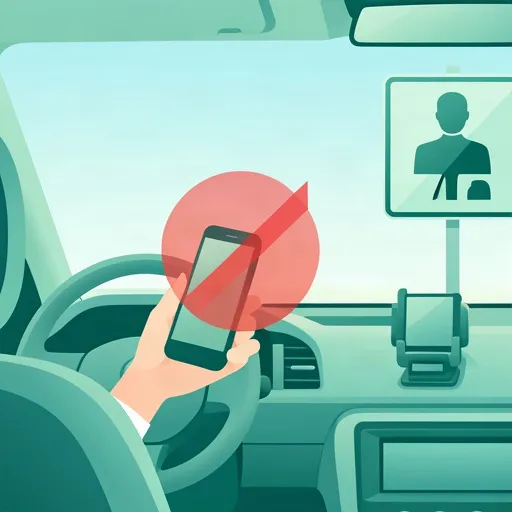
Under French law, the prohibition is clear and comprehensive. It is strictly forbidden to hold a mobile phone in your hand while driving. This rule applies regardless of whether you are moving, stopped at a red light, or waiting in a traffic jam. The law is designed to prevent "driver distraction," which the Code de la route categorizes into visual, manual, and cognitive distractions. By interacting with a phone, you remove one or both hands from the steering wheel, take your eyes off the road, and shift your mental focus away from critical traffic hazards.
Using a mobile phone while driving is punishable by a fixed fine and a deduction of three points from your driving license. Furthermore, if you commit another traffic offense while using your phone, such as failing to signal or speeding, the judge or authorities can order the suspension of your license.
A common point of confusion for learners is the status of hands-free technology. While built-in car Bluetooth systems that allow you to take calls through the vehicle’s speakers are technically permitted, they are not without risk. However, you must note a crucial distinction regarding personal audio devices. It is strictly prohibited to wear any device in or on your ears—such as headsets, headphones, or earphones—that could block your ability to hear external road sounds like sirens or horns. This applies to all road users, including cyclists, motorcyclists, and car drivers.
Even when using an authorized hands-free system, the risk of "cognitive distraction" remains high. This occurs when your brain is occupied by a conversation rather than the road environment. In the French theory exam, you will likely encounter questions that test your understanding of this phenomenon. Even if your eyes are on the road, if your mind is engaged in a complex phone call, your reaction time to sudden events—such as a pedestrian stepping onto a crossing—is significantly delayed.
To keep your driving record clean and stay safe, it is vital to master these key concepts. The Code de la route emphasizes that any device that could divert a driver’s attention is a potential danger.
When you sit for your Épreuve Théorique Générale (ETG), you will face questions that test not just your knowledge of the law, but your behavior. You might see a photograph of a driver looking at a GPS screen or a phone mounted on the dashboard. The goal is to determine if the driver is acting safely. The correct answer will almost always favor keeping your attention on the road and only adjusting devices before you begin your journey.
Always remember: if you need to adjust your GPS or input an address into your phone, you must pull over safely into a designated parking area or a safe zone where the engine is turned off. Never attempt to use your phone while the vehicle is in traffic, even if you are moving very slowly.
Mastering the rules of the road is the first step toward becoming a responsible driver in France. By understanding that mobile phone use is more than just a legal violation—it is a dangerous distraction—you are already ahead in your preparation. Ensure you understand that the law is non-negotiable and that your safety depends on your ability to remain fully present behind the wheel.
French traffic law under the Code de la route strictly prohibits holding a mobile phone while driving, including while stationary in traffic. The key distinction is between permitted car-integrated hands-free systems and prohibited ear-piece or headphone devices. Even authorized hands-free use carries the risk of cognitive distraction, which delays reaction time to hazards. Violations result in a fixed fine, 3 points deducted from your permis à points, and potential license suspension for additional offenses. For the ETG exam, focus on understanding that only pre-journey device setup or safe roadside stops are acceptable.
A short set of high-value points that capture the most important ideas from this article.
Holding a mobile phone in your hand while driving is strictly prohibited under the Code de la route, regardless of whether the vehicle is moving or stationary
Built-in Bluetooth hands-free systems are authorized, but cognitive distraction remains a risk even when your eyes are on the road
Wearing earphones, headsets, or any audio device in or on the ears is prohibited for all road users including drivers, cyclists, and motorcyclists
Penalties include a fixed fine and 3 points deducted from your permis à points, with possible license suspension for combined offenses
You must pull over safely and stop the engine before adjusting GPS or entering an address on your phone
The prohibition applies at red lights, in traffic jams, and whenever the vehicle is in traffic—not just while driving
Hands-free (main libre) via car speakers is permitted; ear-piece or headphone devices are not
Distraction under the Code de la route includes visual, manual, and cognitive forms
Cognitive distraction can occur even with hands-free calls if the conversation occupies your mental focus
Only adjust phones and navigation devices before starting your journey or when safely parked with the engine off
Believing it is acceptable to hold a phone while stopped at a red light or in a traffic jam—it is not
Confusing authorized hands-free Bluetooth systems with prohibited ear-piece or headphone devices
Assuming hands-free calling eliminates all distraction risk; cognitive distraction remains a factor
Attempting to quickly glance at a phone screen or GPS mounted on the dashboard while approaching hazards like roundabouts
Thinking the 3-point deduction is the only consequence; license suspension can be ordered if combined with other offenses
Article content overview
A short set of high-value points that capture the most important ideas from this article.
Holding a mobile phone in your hand while driving is strictly prohibited under the Code de la route, regardless of whether the vehicle is moving or stationary
Built-in Bluetooth hands-free systems are authorized, but cognitive distraction remains a risk even when your eyes are on the road
Wearing earphones, headsets, or any audio device in or on the ears is prohibited for all road users including drivers, cyclists, and motorcyclists
Penalties include a fixed fine and 3 points deducted from your permis à points, with possible license suspension for combined offenses
You must pull over safely and stop the engine before adjusting GPS or entering an address on your phone
The prohibition applies at red lights, in traffic jams, and whenever the vehicle is in traffic—not just while driving
Hands-free (main libre) via car speakers is permitted; ear-piece or headphone devices are not
Distraction under the Code de la route includes visual, manual, and cognitive forms
Cognitive distraction can occur even with hands-free calls if the conversation occupies your mental focus
Only adjust phones and navigation devices before starting your journey or when safely parked with the engine off
Believing it is acceptable to hold a phone while stopped at a red light or in a traffic jam—it is not
Confusing authorized hands-free Bluetooth systems with prohibited ear-piece or headphone devices
Assuming hands-free calling eliminates all distraction risk; cognitive distraction remains a factor
Attempting to quickly glance at a phone screen or GPS mounted on the dashboard while approaching hazards like roundabouts
Thinking the 3-point deduction is the only consequence; license suspension can be ordered if combined with other offenses
Explore related topics, search based questions, and concepts that learners often look up when studying Mobile Phone Rules in France. These themes reflect real search intent and help you understand how this topic connects to wider driving theory knowledge in France.
Find clear and practical answers to common questions learners often have about Mobile Phone Rules in France. This section helps explain difficult points, remove confusion, and reinforce the key driving theory concepts that matter for learners in France.
It is illegal to hold a mobile phone in your hand while driving. You must not look at or interact with a screen unless it is a fixed, integrated navigation system, and even then, your primary focus must always remain on the road.
Yes, built-in or integrated hands-free systems that do not require you to hold the device or wear an object in your ear are generally allowed, provided they do not distract you from driving.
No, the use of any device worn in or on the ear, such as headphones, earphones, or headsets, is strictly prohibited for all road users, including drivers, motorcyclists, and cyclists, as these block essential external sounds.
You risk a fixed fine and a deduction of points from your driving license (permis à points). In more severe cases involving accidents, the penalties can be much stricter.
Continue your preparation for the French permis de conduire exam. Dive deeper into specific Code de la route sections, practice scenarios, or review official procedures. Use our comprehensive article collection to master every aspect of driving theory.