
Navigating French urban environments requires a precise understanding of specialized traffic zones where speed limits and priority rules deviate from the standard 50 km/h norm. This article details the legal requirements for Zone 30 and zone de rencontre areas, helping you identify proper signage and master the duties of a driver toward pedestrians and cyclists. Success in the ETG exam depends on your ability to apply these regulations in practical, text-based scenarios.
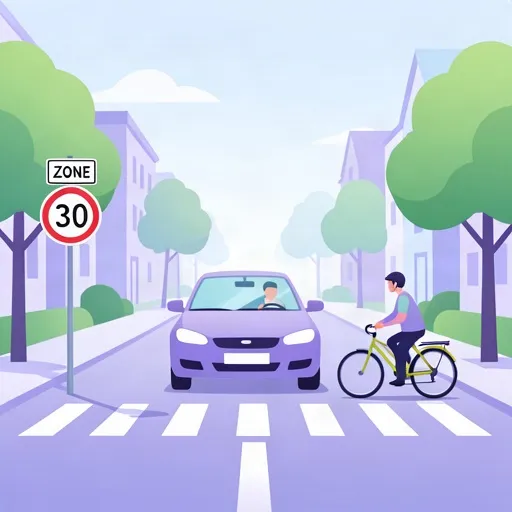
Article content overview
Navigating French urban environments requires a precise understanding of specialized traffic zones where speed limits and priority rules deviate from the standard 50 km/h norm. For candidates preparing for the Épreuve Théorique Générale (ETG), recognizing these zones is not merely a matter of safety but a core requirement for passing the exam. These zones are designed to protect vulnerable road users, such as pedestrians and cyclists, by forcing drivers to adopt a more cautious and slower pace.
A "Zone 30" is a regulatory urban area where the speed limit is restricted to 30 km/h for all vehicles. Unlike a standard urban road, which defaults to 50 km/h, a Zone 30 is marked by specific signage at its entry and exit points. It is crucial to remember that this speed limit is a legal obligation, not a recommendation. Driving at speeds higher than this limit within such a zone can lead to severe penalties, including fines and the loss of points on your permis de conduire.
The exit of these zones is clearly marked to inform drivers that the local 30 km/h restriction no longer applies, though the general urban speed limit of 50 km/h will typically resume unless otherwise posted. Always stay alert for these signs, as they represent the boundaries of different driving contexts that the ETG exam will test frequently.
One of the most common pitfalls for students in the ETG exam involves priority rules in shared urban spaces. In many Zone 30 areas, the priorité à droite (priority to the right) rule is the standard default unless a different sign indicates otherwise. Students often mistakenly assume that they have priority because they are on a wider road or following the main flow of traffic, but in the absence of signs such as "Cédez le passage" or "Stop," the right-hand vehicle always has the right of way.
Always be prepared to yield to vehicles coming from the right at every intersection within a Zone 30, unless explicit signage grants you priority. Assuming you have the right of way is a frequent cause of failure in theory test scenarios.
In a zone de rencontre, the rules become even stricter. These are shared spaces where pedestrians are legally authorized to walk anywhere on the carriageway, and they have absolute priority over vehicles. The speed limit here is further reduced to 20 km/h.
The French Code de la route places a high emphasis on the protection of vulnerable road users. When you encounter a pedestrian at a crossing—or even one who is simply waiting to cross—you must demonstrate your willingness to yield. In the context of an exam question, you must choose the answer that shows you are slowing down and observing the pedestrian's intentions. Never attempt to "force" your way through by maintaining speed.
To help you distinguish between standard urban driving and special zones, refer to the following comparison of regulatory limits and priorities.
| Zone Type | Speed Limit | Pedestrian Status |
|---|---|---|
| Standard Urban Road | 50 km/h | Crossing must be respected |
| Zone 30 | 30 km/h | High priority, caution required |
| Zone de rencontre | 20 km/h | Absolute priority, walk anywhere |
While speed is the primary focus of Zone 30 and zones de rencontre, modern urban driving in France also involves Zones à Faibles Émissions (ZFE). These are low-emission zones where access may be restricted based on your vehicle's Crit'Air sticker. While the ETG exam focuses primarily on your physical interaction with the road, understanding that urban areas are increasingly managed through a combination of speed limits and environmental restrictions is key to a holistic view of the Code de la route.
French urban driving distinguishes between standard roads (50 km/h), Zone 30 areas (30 km/h), and zone de rencontre spaces (20 km/h with absolute pedestrian priority). The priorité à droite rule applies by default in Zone 30 unless overridden by signs, making it critical to always check for traffic from the right at unsignalized intersections. Pedestrians in zones de rencontre have legal authority to walk anywhere on the carriageway, requiring drivers to maintain very low speeds. Understanding the specific signage (B30 for Zone 30 entry/exit), the step-by-step approach to intersections, and the graduated priority system is essential for both passing the ETG exam and driving safely in French cities.
A short set of high-value points that capture the most important ideas from this article.
French urban areas have three distinct speed zones: standard 50 km/h, Zone 30 at 30 km/h, and zone de rencontre at 20 km/h
Zone 30 and zone de rencontre are mandatory speed limits with legal penalties for violations, not mere recommendations
In Zone 30, pedestrians and cyclists receive heightened legal protection requiring drivers to exercise increased caution
Zone de rencontre grants pedestrians absolute priority—they may walk anywhere on the carriageway
The Zone 30 entry and exit are marked by specific B30 signage that defines the boundary of the restricted speed area
Without explicit signage granting priority, priorité à droite applies at every intersection within Zone 30
Zone de rencontre pedestrians have absolute priority and can walk anywhere on the road at 20 km/h maximum
Exiting a Zone 30 typically returns you to the standard 50 km/h urban limit unless otherwise posted
Always scan for Stop, Cédez le passage, or other priority signs before assuming right of way
Reducing speed proactively in Zone 30 ensures you can stop safely for pedestrians and right-turning vehicles
Assuming priority on a wider or main road when no signs are present—priorité à droite means the right-hand vehicle has priority
Failing to recognize the zone de rencontre's stricter 20 km/h limit versus Zone 30's 30 km/h limit
Attempting to maintain speed through pedestrian crossings instead of slowing and observing the pedestrian's intentions
Not scanning for exit signs when leaving Zone 30, potentially continuing to drive at restricted speeds unnecessarily
Confusing the three zone types when answering ETG questions about speed limits and pedestrian rights
Article content overview
A short set of high-value points that capture the most important ideas from this article.
French urban areas have three distinct speed zones: standard 50 km/h, Zone 30 at 30 km/h, and zone de rencontre at 20 km/h
Zone 30 and zone de rencontre are mandatory speed limits with legal penalties for violations, not mere recommendations
In Zone 30, pedestrians and cyclists receive heightened legal protection requiring drivers to exercise increased caution
Zone de rencontre grants pedestrians absolute priority—they may walk anywhere on the carriageway
The Zone 30 entry and exit are marked by specific B30 signage that defines the boundary of the restricted speed area
Without explicit signage granting priority, priorité à droite applies at every intersection within Zone 30
Zone de rencontre pedestrians have absolute priority and can walk anywhere on the road at 20 km/h maximum
Exiting a Zone 30 typically returns you to the standard 50 km/h urban limit unless otherwise posted
Always scan for Stop, Cédez le passage, or other priority signs before assuming right of way
Reducing speed proactively in Zone 30 ensures you can stop safely for pedestrians and right-turning vehicles
Assuming priority on a wider or main road when no signs are present—priorité à droite means the right-hand vehicle has priority
Failing to recognize the zone de rencontre's stricter 20 km/h limit versus Zone 30's 30 km/h limit
Attempting to maintain speed through pedestrian crossings instead of slowing and observing the pedestrian's intentions
Not scanning for exit signs when leaving Zone 30, potentially continuing to drive at restricted speeds unnecessarily
Confusing the three zone types when answering ETG questions about speed limits and pedestrian rights
Explore related topics, search based questions, and concepts that learners often look up when studying French Zone 30 and Urban Rules. These themes reflect real search intent and help you understand how this topic connects to wider driving theory knowledge in France.
Find clear and practical answers to common questions learners often have about French Zone 30 and Urban Rules. This section helps explain difficult points, remove confusion, and reinforce the key driving theory concepts that matter for learners in France.
The legal speed limit in a Zone 30 is 30 km/h. It is a mandatory regulatory limit, not a recommendation, and failing to comply is a traffic violation.
In a Zone 30, the speed limit is 30 km/h, while in a zone de rencontre, the limit is strictly 20 km/h. In a zone de rencontre, pedestrians are legally allowed to walk anywhere on the road and have priority over vehicles.
You have exited a Zone 30 when you pass the sign indicating the 'End of Zone 30' (Fin de Zone 30), which typically shows the Zone 30 sign with a grey diagonal bar across it.
Drivers must remain highly vigilant. While general priority rules like 'priorité à droite' often still apply at intersections, the presence of vulnerable road users means you must yield to pedestrians who are engaged in crossing or signify their intent to cross.
Continue your preparation for the French permis de conduire exam. Dive deeper into specific Code de la route sections, practice scenarios, or review official procedures. Use our comprehensive article collection to master every aspect of driving theory.